


Launching a SaaS product is not the hard part. We’ve worked with enough SaaS founders to know the real challenge and helped them to build a proper SaaS marketing plan.
Most teams are already running ads, publishing blogs, sending emails, and posting on LinkedIn. Yet growth still slows because they’re executing isolated tactics instead of operating a connected system.
This article is built around what we’ve implemented with clients: a connected framework we call the Compounding SaaS marketing strategies.
We’re not listing tactics for the sake of it. Every strategy here has been tested, and we’ll share what worked, what surprised us, and the kind of results you should expect when executed properly.
What Makes SaaS Marketing Fundamentally Different?
SaaS marketing requires a different mental model than traditional marketing, even though it’s necessary to build a go-to-market strategy or complete it.
In traditional marketing, success happens at the point of purchase. In SaaS, the purchase is only the beginning. A customer who churns after 60 days may cost more to acquire than they ever paid you.
Sustainable growth depends on customers staying long enough, expanding enough, and referring enough to eventually exceed acquisition costs.
That changes the role of marketing entirely. SaaS marketing has three responsibilities: acquire, activate, and retain. Most teams overinvest in acquisition, underinvest in activation, and ignore retention until churn becomes a crisis.
The most efficient SaaS companies we’ve helped grow all shared one trait: they treated acquisition, activation, and retention as one connected system rather than separate team functions.
How to Build an Effective SaaS Marketing Strategy?
After implementing marketing strategies across multiple SaaS clients in different verticals, from early-stage B2B tools to mid-market platforms, we noticed a consistent pattern.
Companies that grew predictably weren’t necessarily running more tactics than those that stalled. They were running connected ones.
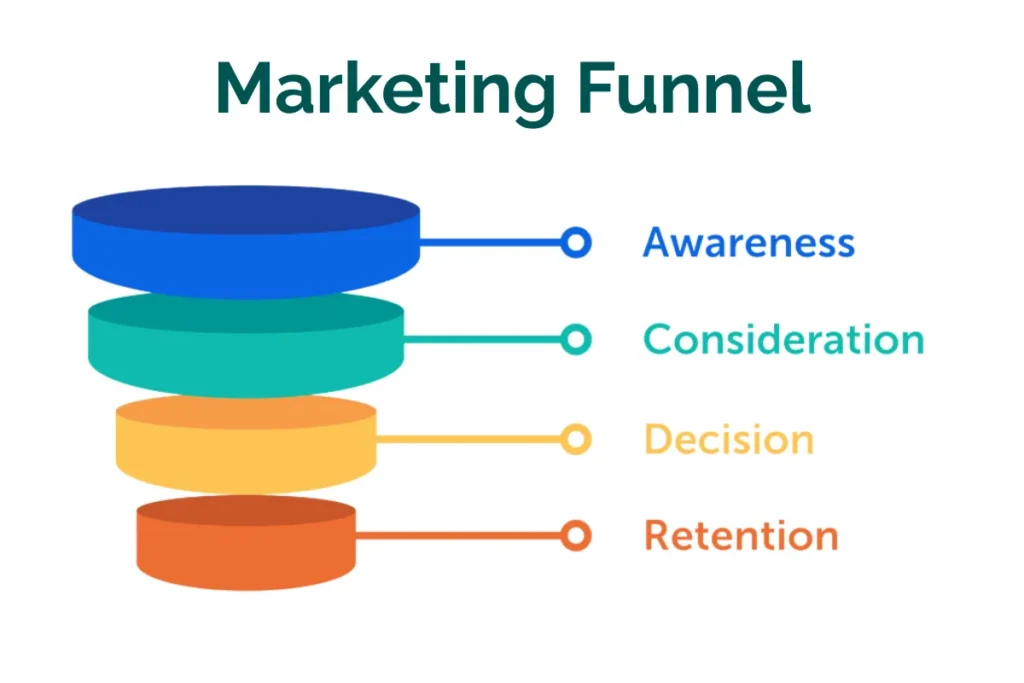
We mapped this into four marketing funnel layers:
Layer 1: Demand Capture: Intercepting buyers who are already searching for a solution (SEO, PPC, review platforms).
Layer 2: Demand Generation: Creating awareness and intent among buyers who don’t know you yet (content, social, partnerships, events).
Layer 3: Conversion Engine: Turning interest into activated, paying users (free trials, onboarding, email automation, CRO).
Layer 4: Retention & Expansion: Turning paying users into long-term customers and advocates (churn prevention, referral programs, upsell motions).
Here is what each layer looks like in practice.
Layer 1: Demand Capture SaaS Marketing Strategies
These are high-intent channels: places where buyers are already searching for a solution and you need to appear. They represent some of the highest-converting B2B SaaS marketing channels available to growing SaaS companies.
1. SEO to Target High-Intent Traffic
One of the biggest SEO mistakes SaaS companies make is optimizing for the highest-volume keywords in their niche.
High volume does not equal high intent, and confusing the two wastes both time and budget.
When auditing a SaaS client’s organic strategy, the first step is separating keywords by buyer stage:
| Buyer Stage | Keyword Type | Example | Intent |
|---|---|---|---|
| Problem-aware | Educational | “why is my trial conversion rate low” | Low, learning |
| Solution-aware | Category | “best SaaS onboarding tools” | Medium, evaluating |
| Product-aware | Commercial | “Intercom vs Pendo for SaaS” | High, deciding |
| Ready to buy | Transactional | “Pendo pricing” / “[tool] alternative” | Very high, acting |
Most SaaS companies over-invest in middle-stage educational content while under-investing in commercial and transactional pages that convert significantly better.
Comparison pages and alternative pages are especially effective. We’ve seen clients triple organic-attributed trial signups simply by adding:
- “[Competitor] vs [Competitor]” pages
- “[Competitor] alternatives” pages
Build a pillar page around your core product category, such as “project management software,” then create supporting cluster pages targeting:
- Features pages
- Products pages
- Use cases pages
- Industry pages
- Free micro saas tools
One client increased organic demo requests by 67% in five months after shifting 40% of their content budget toward bottom-of-funnel pages.
2. PPC to Get Initial Boost Without Burn
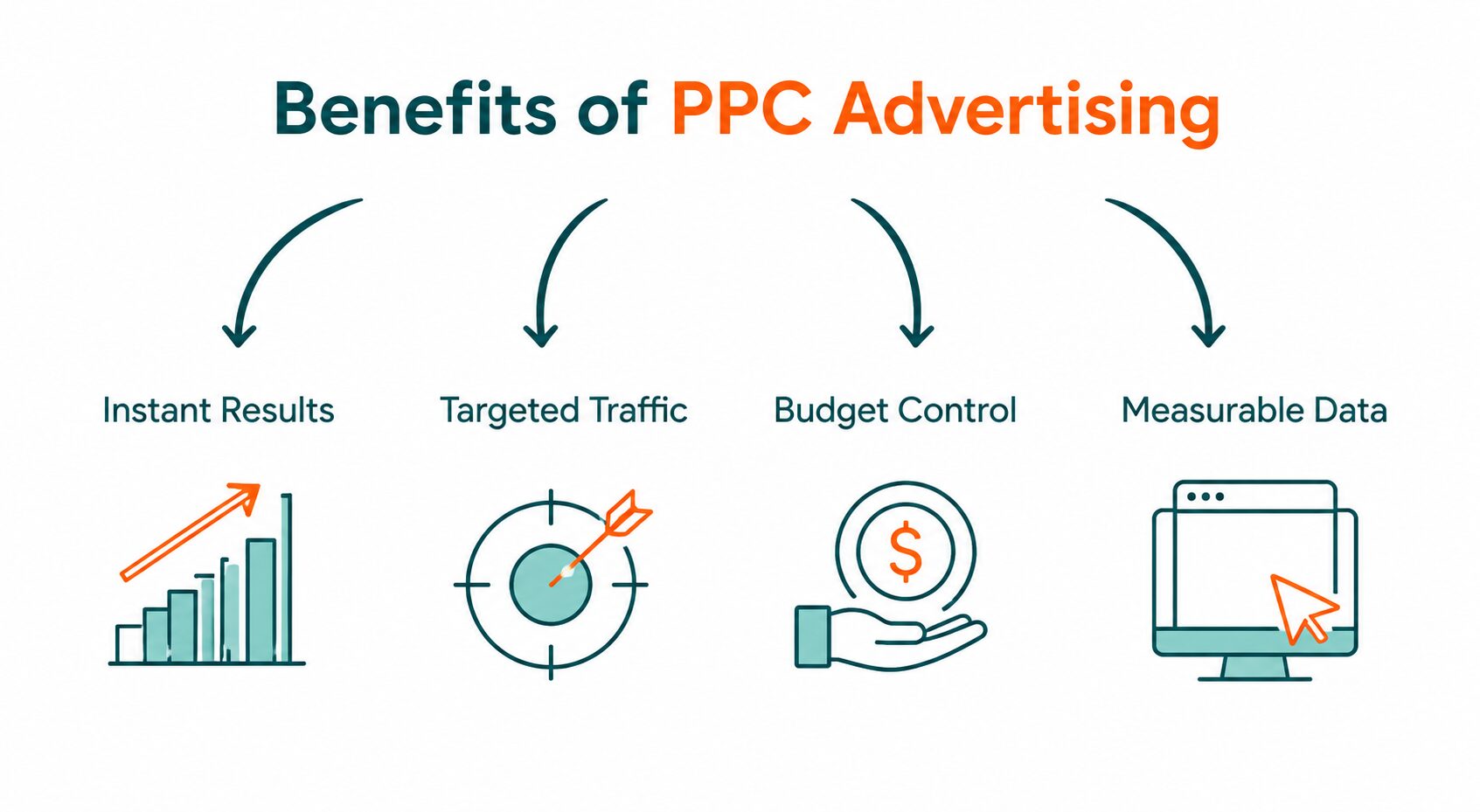
PPC is one of the most consistently misused SaaS marketing channels. Founders run broad-match campaigns, waste budget on irrelevant clicks, conclude that PPC “doesn’t work,” and abandon it.
The problem is rarely the channel itself. It’s usually weak targeting and a poor post-click experience.
PPC works best for SaaS in three situations:
- You need an immediate pipeline while SEO compounds.
- You want to test messaging and offers before investing heavily in content.
- You already have a proven funnel and need to scale it.
Outside those conditions, content investment is often the better long-term play.
The biggest PPC mistakes are broad targeting and weak post-click alignment.
Best practices:
- Target job-to-be-done searches instead of broad software terms
- Match landing page messaging tightly with ad copy
- Retarget users based on engagement depth
Someone who viewed pricing and comparison pages is far more valuable than someone who bounced from the homepage.
3. Review Platform Dominance
For B2B SaaS, platforms like G2 and Capterra are high-intent acquisition channels because buyers there are already evaluating tools.
High-impact actions:
- Fully optimize profiles with screenshots and feature details
- Request reviews immediately after activation
- Respond to every review, especially negative ones
Embedding strong G2 testimonials directly on pricing and signup pages consistently improves conversion because social proof works best at decision points.
Layer 2: Demand Generation SaaS Marketing Strategies
These channels don’t intercept existing demand they create it. They build awareness and trust among buyers who aren’t actively searching yet but will be.
4. Content That Builds a Pipeline
Most SaaS content fails because it targets traffic instead of pipeline. Traffic-focused content drives sessions. Pipeline-focused content educates a defined buyer, addresses objections, and moves them toward conversion.
Effective content maps directly to buyer stages and conversion goals:
| Content Type | Buyer Stage | Conversion Goal | Example |
|---|---|---|---|
| Educational guides | Awareness | Email capture via lead magnet | “The SaaS Onboarding Playbook” |
| Comparison posts | Consideration | Trial signup or demo request | “HubSpot vs Salesforce for SaaS” |
| Case studies | Decision | Sales conversation | “How [Client] reduced churn by 34% in 90 days” |
| ROI calculators | Decision | Demo request | “Calculate your CAC payback period” |
| Product tutorials | Activation | Feature adoption | “How to set up automated onboarding in [Product]” |
When every asset has a defined conversion objective, content becomes measurable pipeline generation instead of passive publishing.
One mid-market SaaS client shifted from purely educational TOFU content to a mix including comparison pages and case studies.
Without increasing publishing frequency, organic MQLs grew 88% in six months. The difference was not volume. It was intent alignment.
5. LinkedIn for Demand Creation
In B2B SaaS, deals often begin weeks before a form fill. Prospects consume a founder’s LinkedIn content, build trust, then later search for the product directly and convert with minimal friction.
This is demand creation. It is also one of the most efficient acquisition channels because CAC is largely the founder’s time investment.
The highest-performing LinkedIn content is not product promotion. It is perspective:
- Observations about why common approaches fail
- Lessons from real implementations
- Clear opinions on industry trends
This builds trust in the people behind the product.
What underperforms: feature launches, awards, and company updates. These engage existing customers more than prospective buyers.
The objective is to make your ICP think: “They deeply understand this problem.”
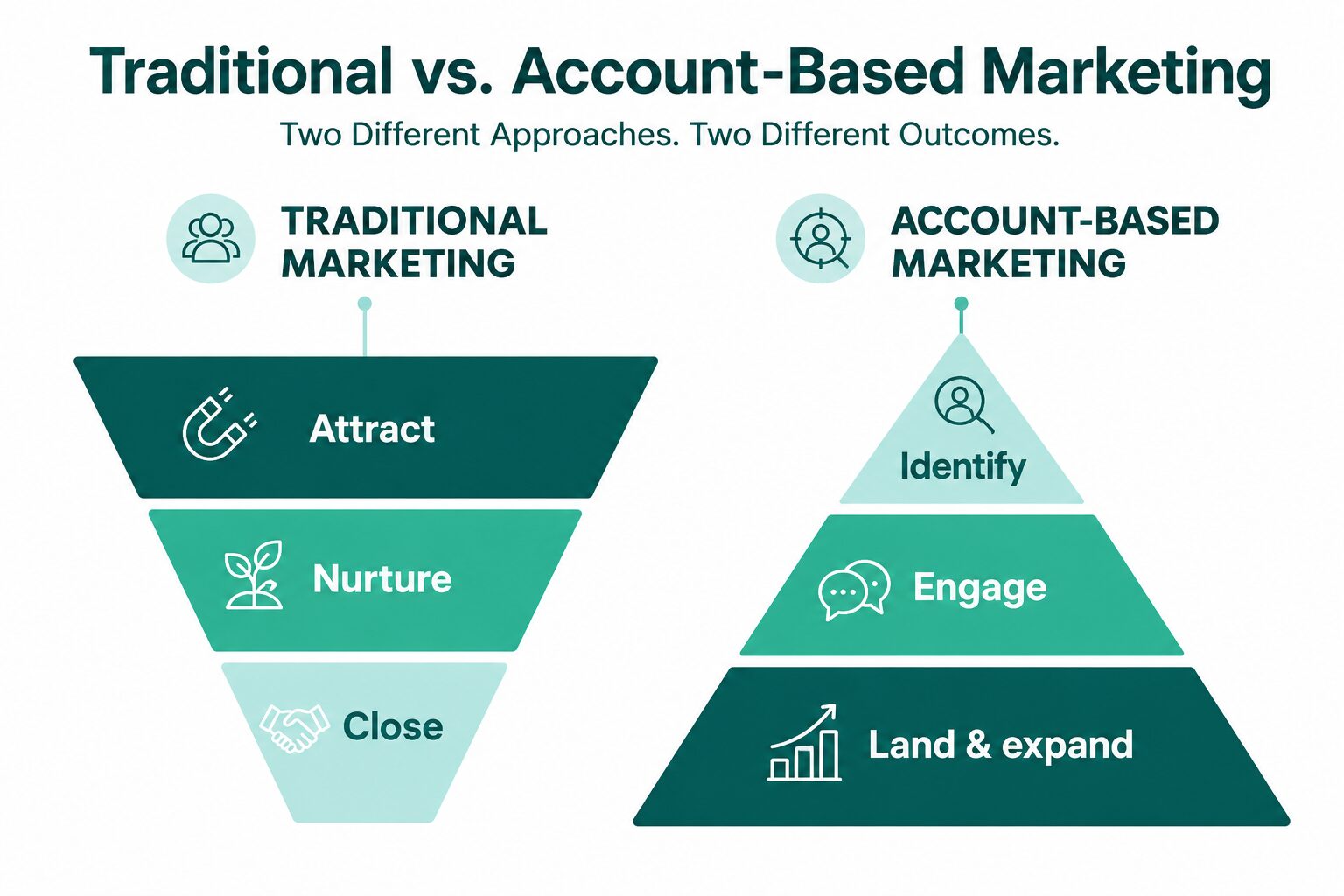
6. Account-Based Marketing (ABM)
ABM for SaaS is one of the most effective yet underused B2B SaaS growth strategies.
Instead of generating broad lead volume, ABM identifies ideal target companies and creates highly relevant outreach around their specific context.
Modern ABM is not mass-personalized cold email. It is coordinated targeting powered by account intelligence.
Here’s the framework that you can follow:
- Define the firmographic and technographic traits your best customers share: industry, company size, growth stage, and tech stack. Every marketing dollar should target only these accounts.
- Use intent data to identify accounts actively researching your category, competitors, or visiting your site. These become immediate-priority opportunities.
- Customize website messaging, ads, and content based on the account profile. A $50M logistics SaaS company should not see the same messaging as a 15-person fintech startup.
- Combine LinkedIn ads, SDR outreach, and personalized content into a sequenced experience. This coordinated visibility is what differentiates ABM from traditional outbound.
Well-executed ABM programs can reduce sales cycles by 30 to 40% because prospects are already familiar with the company before direct outreach begins.
7. Webinars and Events for High-Intent Pipeline
Webinar attendees are self-qualifying prospects. Someone registering for a 45-minute session on a specific SaaS challenge is signaling active interest in solving that problem.
The strongest webinar strategy focuses on a narrow ICP pain point, not the product itself.
Example:
- Effective: “How to Reduce SaaS Churn in the First 90 Days”
- Weak: “See [Product] in Action”
Post-webinar follow-up should vary by engagement:
- Live attendees who asked questions should move toward demos or sales conversations
- Registrants who did not attend should receive recordings and related resources
Done consistently, webinars become an ongoing pipeline engine instead of isolated content events.
Layer 3: The Conversion Marketing Strategies for SaaS
Demand generation brings prospects in. The conversion engine determines whether they become activated, paying customers.
This is where most SaaS companies lose the most revenue.
8. Free Trial Optimisation
Across most SaaS products, trial outcomes are largely decided within the first 72 hours. If users do not experience clear value quickly, conversion probability drops sharply.
That makes onboarding one of the highest-ROI investments in SaaS growth.
The key is identifying the activation milestone, the early action strongly correlated with paid conversion:
- Project management tool: creating a board and inviting teammates
- Analytics platform: running the first report
Your onboarding should drive users to this milestone as fast as possible.
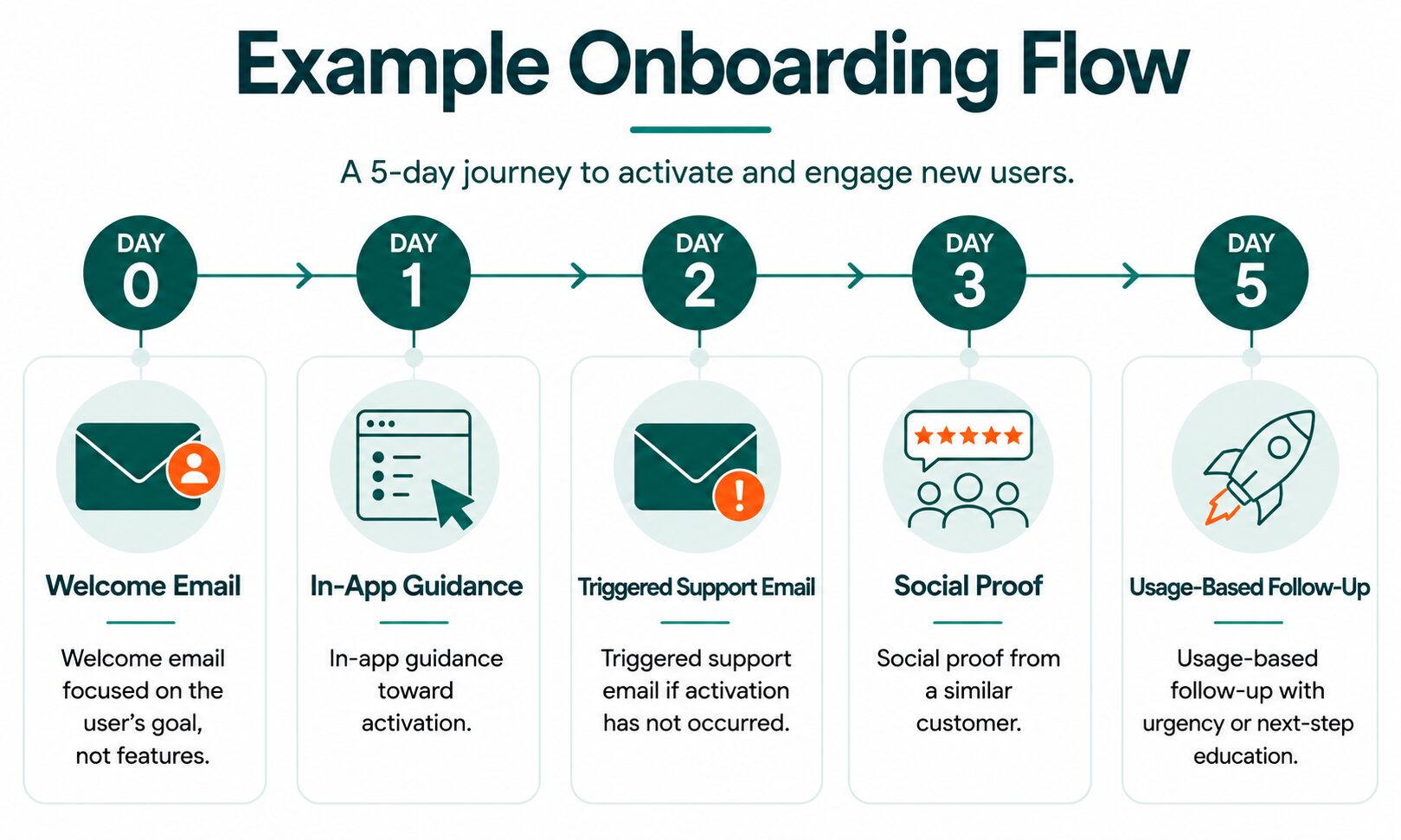
Example Onboarding Flow
- Day 0: Welcome email focused on the user’s goal, not features
- Day 1: In-app guidance toward activation
- Day 2: Triggered support email if activation has not occurred
- Day 3: Social proof from a similar customer
- Day 5: Usage-based follow-up with urgency or next-step education
One B2B analytics client improved trial-to-paid conversion from 9% to 21% in three months simply by redesigning onboarding around activation behavior. The product stayed the same. The path to value changed.
9. Email Automation as a Lifecycle System
SaaS email marketing should function as a behavioral lifecycle system, not a campaign calendar.
Scheduled campaigns are time-based. Lifecycle systems are trigger-based, and trigger-based emails outperform because they arrive when the message is contextually relevant.
Here’s the core SaaS Email Workflows you can follow:
- Onboarding Sequences” Guide new users to activation during Days 0 to 14. Every email should have one purpose and one CTA.
- Product Education” Introduce features progressively based on actual product usage.
- Expansion Sequences: Trigger upgrade prompts based on plan limits or high-value feature usage.
- Re-engagement and Churn Prevention: Detect inactivity early and trigger personalized outreach before churn occurs.
The goal is not more email. It is timely, behavior-driven communication.
10. Conversion Rate Optimization (CRO): The Multiplier
CRO improves the performance of every acquisition channel simultaneously. A 20% lift in signup conversion improves returns from SEO, paid ads, and social traffic without increasing spend.
Highest-Leverage CRO Areas
On pricing page test:
- Outcome-focused vs feature-focused plan positioning
- CTA variations
- Placement of social proof
- ROI calculators for mid-market buyers
Every additional required field lowers conversion. Collect only email and password upfront. Gather enrichment data later during onboarding.
Your homepage should have a solid value proposition. You can test:
- Outcome-focused messaging
- Feature-focused messaging
- Problem-focused messaging
In crowded SaaS categories, problem-focused headlines often perform best because buyers already feel the pain and want immediate relevance.
Layer 4: Retention & Expansion Marketing Strategies for SaaS
This is the layer that makes everything else compound. Strong retention means your acquisition investment has a longer runway to pay back. Expansion revenue means you can grow revenue without growing your customer count proportionally.
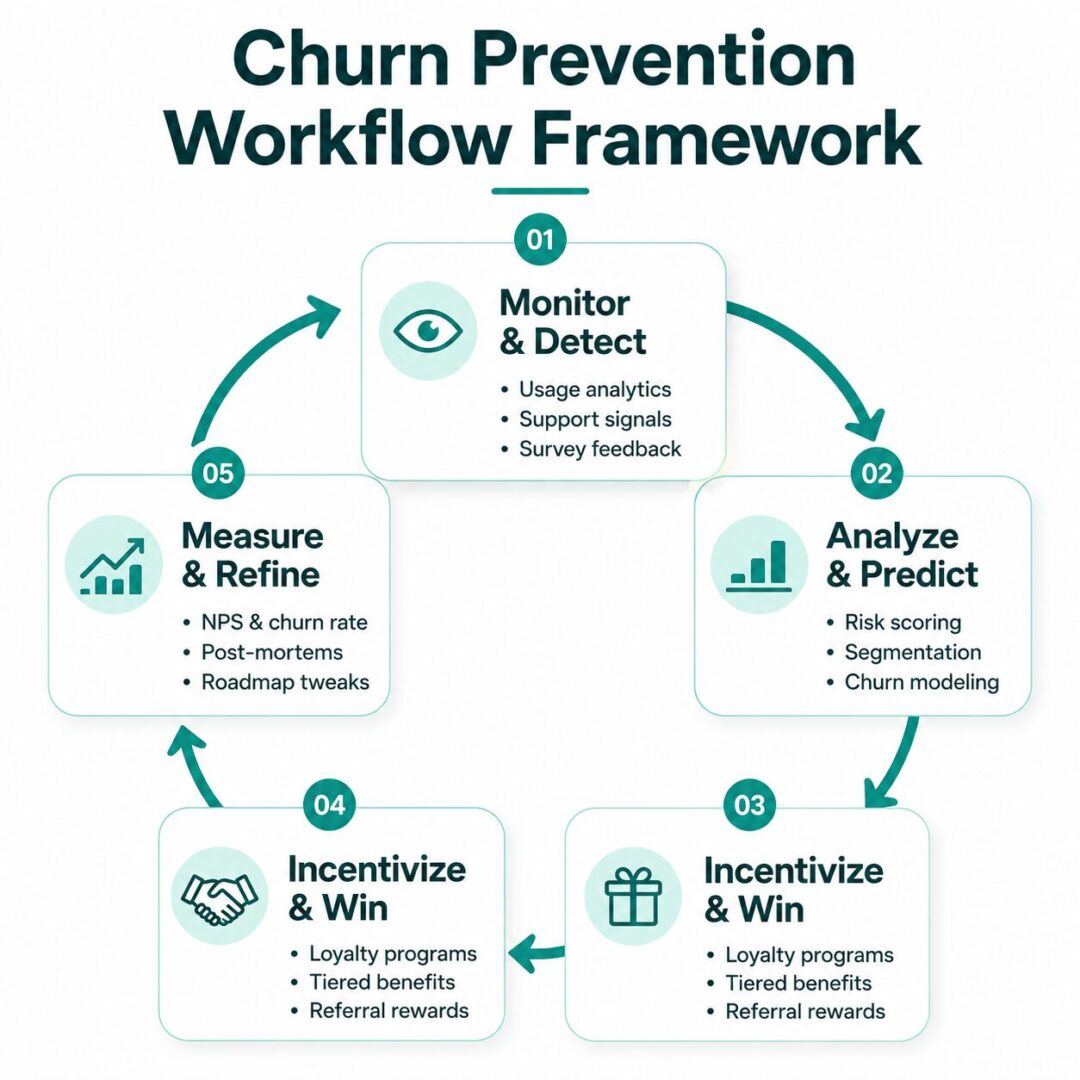
11. Proactive Churn Prevention
The most expensive churn is the churn you never saw coming. By the time a customer cancels, the decision was often made weeks earlier. Effective churn prevention identifies risk before that point.
The foundation is customer health scoring. Every SaaS product has behavioral indicators that predict churn:
- Declining login frequency
- Reduced feature usage
- Repeated support issues
- Sudden inactivity after consistent engagement
Combining these into a health score creates an early-warning system that allows customer success teams to intervene before the account is lost.
The intervention itself is often simple. A personal message from an account manager saying, “I noticed usage dropped this month. Is there anything we can help with?” can re-engage an at-risk customer because it signals active attention and support.
One consistent pattern: the strongest churn predictor is not product dissatisfaction. It is failure to adopt the product’s core value driver. Users who never fully integrate the product into their workflow churn far more often than dissatisfied power users.
That means churn prevention starts during onboarding, not at renewal.
12. Referral Programs Built Into the Product
Referral programs perform best when embedded directly into the product experience, not isolated in email campaigns.
In-product referrals work because they reach users when engagement and satisfaction are highest.
The mechanics that consistently improve referral performance:
- Two-sided incentives where both users benefit
- Frictionless sharing with instant referral links and pre-written copy
- Referral visibility so users can track clicks and signups
The best referral moment is immediately after a success milestone:
- Publishing a successful campaign
- Completing onboarding
- Reaching a tracked KPI
That moment of achievement creates the highest willingness to recommend the product.
Referral prompts inside weekly emails rarely achieve the same result because they miss the emotional timing tied to product success.
13. Technology Partnerships and Marketplace Presence
Partnerships create leverage by placing your product inside ecosystems your ICP already trusts and uses.
For early-to-mid-stage SaaS companies, the highest-value partnership is often a native integration with a widely adopted platform in the customer workflow.
Example: If your ICP relies heavily on Slack, a Slack integration creates distribution through:
- Slack’s app marketplace
- Slack’s ecosystem marketing
- Organic discovery through shared workflows
Marketplace presence is another major acquisition channel. Platforms like:
- HubSpot App Marketplace
- Salesforce AppExchange
- Google Workspace Marketplace
Already contain high-intent buyers actively searching for solutions.
A well-optimised listing with strong reviews can generate recurring signups without additional acquisition spend.
14. Influencer and Affiliate Partnerships
In B2B SaaS, influencer marketing is less about audience size and more about credibility.
A niche creator with 5,000 highly relevant subscribers will usually outperform a broad creator with 500,000 disengaged followers if the audience strongly matches your ICP.
The key evaluation criteria:
- Audience alignment with your target buyers
- Authenticity and real product usage
- Engagement quality from practitioners, not passive viewers
Affiliate programs also perform better when incentives reward retention, not just acquisition.
Paying affiliates only for first-month signups encourages low-quality lead generation. Paying recurring commissions over 6 to 12 months aligns affiliate incentives with long-term customer value.
The SaaS Marketing Metrics That Actually Matter
Most SaaS marketers track CAC and LTV. But the SaaS metrics that truly reveal whether your growth system is healthy go much deeper.
| Metric | Formula | What It Tells You | Healthy Benchmark |
|---|---|---|---|
| CAC | Total Sales & Marketing Spend / New Customers | Acquisition efficiency | < ⅓ of LTV |
| LTV | Avg. Revenue per Customer × Avg. Customer Lifespan | Revenue value per customer | > 3× CAC |
| LTV:CAC Ratio | LTV ÷ CAC | Overall unit economics health | 3:1 or higher |
| MRR | Sum of all monthly recurring subscription revenue | Revenue health and growth | Month-over-month growth |
| Churn Rate | Customers Lost ÷ Customers at Period Start | Retention effectiveness | < 5% monthly for SMB |
| Trial Activation Rate | Users who hit activation milestone ÷ Total trial signups | Onboarding effectiveness | 40%+ |
| Time to Value (TTV) | Days from signup to first activation milestone | Onboarding speed | Under 72 hours |
| Net Revenue Retention (NRR) | (Starting MRR + Expansion − Churn − Contraction) ÷ Starting MRR × 100 | Retention + expansion combined | 100%+ (top-quartile: 110–120%) |
| CAC Payback Period | CAC ÷ Monthly Gross Margin per Customer | How long before a customer pays for themselves | Under 12 months |
How to Approach Each Layer in Your SaaS Marketing Strategy?
If you’re early-stage, don’t try to build all four layers at once. Here is the sequence we recommend:
Stage 1 (0–$1M ARR): Focus on Demand Capture (SEO foundation + review platform presence) and the Conversion Engine (onboarding sequence + activation milestone identification). These have the highest direct revenue impact on a small user base.
Stage 2 ($1M–$5M ARR): Layer in Demand Generation (content marketing + LinkedIn + first ABM list). Use the case studies you’ve built from Stage 1 customer success stories as your content foundation.
Stage 3 ($5M+ ARR): Scale what works, add the Retention & Expansion layer systematically (health scoring, expansion email sequences, referral program), and start diversifying into partnerships, affiliates, and events.
The mistake to avoid at every stage: adding a new acquisition channel before fixing conversion. More traffic into a broken funnel is more wasted spend.
Conclusion
Building a compounding SaaS marketing system is not about finding a single winning channel. It is about connecting the right channels in the right sequence, supported by strong conversion and retention infrastructure.
At SERP Forge, the focus is not on isolated tactics. The approach combines demand capture, content, conversion optimization, and retention into a unified growth system where each layer strengthens the others over time.
When a SaaS company is growing slower than its fundamentals suggest, the issue is usually not the strategy itself. It is the system surrounding it.
Book a free strategy audit to identify where your current growth system is leaking and where the biggest compounding opportunities exist.
Frequently Asked Questions
1. What makes SaaS marketing different from traditional marketing?
SaaS marketing focuses on recurring subscriptions, long-term customer relationships, and product adoption. Unlike traditional marketing, it prioritizes user onboarding, retention, and continuous engagement to increase lifetime value.
2. What is the most effective SaaS marketing strategy for early-stage startups?
For early-stage startups, strategies such as SEO, content marketing, and product-led growth are often effective. These approaches help attract qualified leads, educate users, and encourage product adoption with lower acquisition costs.
3. How long does it take for SaaS marketing strategies to show results?
The timeline depends on the marketing channel. Paid campaigns may generate results quickly, while strategies like SEO and content marketing usually take several months to show consistent traffic and lead generation.
4. Which marketing channels work best for B2B SaaS companies?
Commonly effective channels for B2B SaaS include SEO, content marketing, LinkedIn marketing, webinars, email marketing, and account-based marketing. These channels help reach decision-makers and generate qualified leads.
5. How can SaaS companies reduce churn and improve customer retention?
SaaS companies can reduce churn by improving onboarding experiences, offering helpful product education, maintaining regular communication with users, and continuously improving product value based on customer feedback.