


SaaS marketing teams are usually chasing volume. More leads, MQLs, pipeline activity. And they hit the same wall around quarter three.
Volume-based marketing treats every company the same. ABM for SaaS picks the accounts worth winning and aligns sales and marketing to work them together.
The urgency is real. According to Forrester’s 2025 B2B Marketing and Sales Predictions, more than half of large B2B transactions above $1 million will process through digital self-serve channels.
The accounts you want are comparing vendors right now. ABM for SaaS puts your brand in front of them before they shortlist someone else.
This guide gives you the framework, channels, tools and real examples to build an ABM program that generates pipeline from important accounts.
What is SaaS Account-Based Marketing?
ABM for SaaS is a B2B growth strategy that flips traditional marketing. Instead of chasing volume, you pick the accounts worth winning and align your entire sales and marketing effort around them.
Unlike traditional marketing that starts wide and narrows down, ABM for SaaS starts with a defined list and goes deep. For SaaS companies, this is important for one precise reason: the right account pays, stays and grows. Getting the wrong account can cost more than losing the deal.
The practical difference shows up in how the program runs:
- Sales and marketing work from one shared target account list
- Content and messaging get built around specific account pain points
- Channels get chosen based on where target accounts pay attention
- Pipeline gets measured at the account level, with lead volume replaced by account engagement scores
That shift in operating model is what separates b2b account based marketing from traditional demand generation. For SaaS companies selling to mid-market or enterprise buyers, it is the more efficient path to revenue.
But here is where most teams get confused:
How Does ABM Compare to Demand Generation, Inbound and Outbound?
ABM for SaaS borrows from all three but operates on a different logic.
Where demand generation chases volume, ABM chases fit. Where inbound waits for buyers to arrive, ABM goes to them with account-specific relevance.
Where outbound sends messages broadly, ABM coordinates personalized outreach around a curated account list.
Here’s a comparison of ABM with demand generation, inbound and outbound for SaaS:
| Dimension | Demand Generation | Inbound | Outbound | ABM for SaaS |
|---|---|---|---|---|
| Starting Point | Wide audience targeting | Search intent and content discovery | Prospect list outreach | Target account list |
| Goal | Generate lead volume and awareness | Increase organic traffic and inbound leads | Book meetings and create pipeline | Build high-value account pipeline |
| Personalization | Low | Medium | Low to medium | High |
| Sales-Marketing Alignment | Loose collaboration | Loose collaboration | Moderate alignment | Tight alignment |
| Best For | Brand building and market awareness | Long-term SEO and content growth | Fast pipeline generation | High-value enterprise accounts |
| Measurement | MQLs, CPL, and campaign reach | Rankings, traffic, and conversions | Reply rate, meetings booked, and opportunities | Account engagement, pipeline value, and revenue influence |
For ABM for SaaS startups, the decision comes down to deal size and sales cycle length. If your average contract value sits above $20,000 ARR and your sales cycle runs longer than 60 days, ABM produces a stronger return than demand generation alone.
So where do you start?
What Are the Core Elements of ABM for SaaS?
The seven core elements of your ABM program are:
1. ICP Definition
Your ICP answers one question: which type of company is built for what you sell? The ones that get the most value, pay the most, stay the longest and grow inside your product.
A sharp ICP covers firmographic filters: industry, company size, geography and technology stack. It also covers readiness signals: recent funding rounds, open job postings in relevant departments and competitor usage.
The fastest way to build it is to study your closed-won data and find the pattern.
2. Buying Committee Mapping
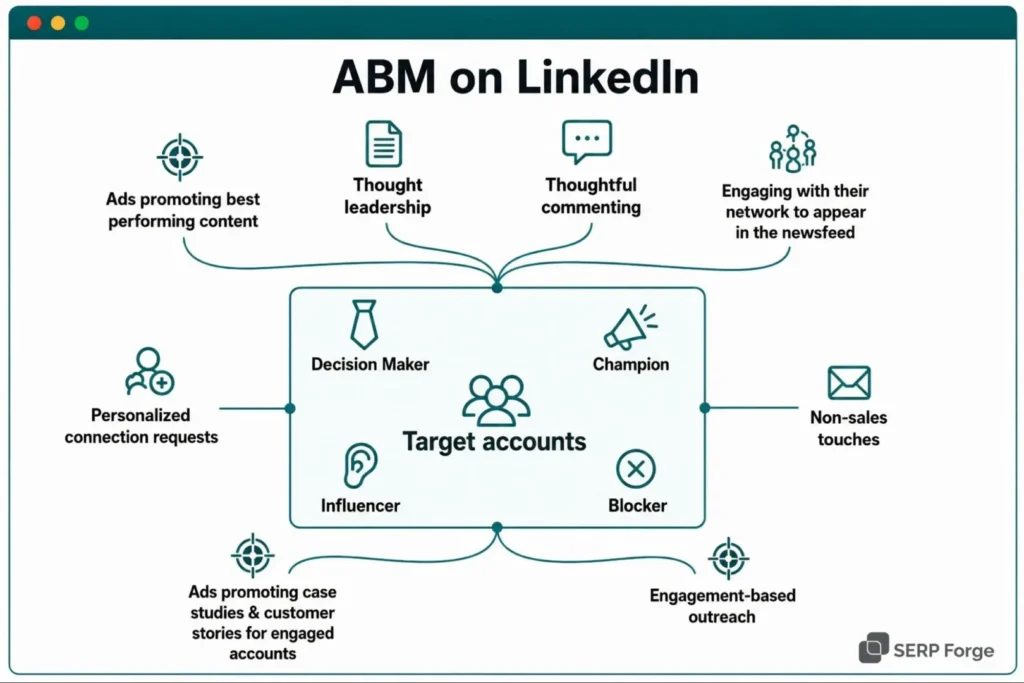
In SaaS, the person who signs the contract rarely found the problem or championed the solution internally. The average enterprise B2B purchase involves six to ten stakeholders.
Map every person whose opinion or authority influences the deal. One controls the marketing budget, the second vets technical fit and third champions your solution internally before you get a second meeting.
The stakeholder controlling budget will often benchmark your proposal against acquisition cost norms for their industry. Knowing your SaaS CAC benchmarks helps your sales team frame pricing in a way that justifies the investment
Each role gets a distinct messaging track. Generic outreach sent to the entire committee is the fastest way to lose a deal at the wrong contact.
3. Account Segmentation
Tier 1 gets the full treatment: content built around their specific situation, outreach that goes straight to the executive level and campaigns that reference their business by name.
Tier 2 accounts get semi-personalized programs: industry-specific messaging and coordinated outreach sequences across 100 to 300 accounts.
Tier 3 accounts get lightly personalized programs using automation: segment-level content within a defined ICP. This is where you test messaging before scaling to Tier 1.
4. Value Proposition Personalization
Different accounts face different problems. A healthcare buyer cares about HIPAA compliance, a fintech buyer about regulatory reporting and a logistics buyer about ERP integration. Your value proposition must connect to that specific challenge, in their language, with proof from a company that looks like them.
If your message could have been sent to any company, it will resonate with none of them.
5. Sales–Marketing Alignment
ABM for SaaS works when sales and marketing operate from the same target account list, the same account status data and the same definition of what a good account looks like.
In mature SaaS organizations, RevOps owns the shared data infrastructure that keeps alignment running without manual coordination. When alignment breaks down, the account receives conflicting messages from the same company and disengages from both.
6. ABM Data Infrastructure
Effective b2b account based marketing runs on four data layers:
- The first tells you who fits.
- The second tells you who is ready to buy right now.
- The third shows you what tools they already use.
- The fourth shows you how much they already know about you.
Bombora surfaces intent signals by tracking content consumption across thousands of B2B sites. 6sense uses predictive AI to identify accounts in an active buying cycle before they engage with you directly.
Together, they cover the second and third data layers in your ABM infrastructure.
Use those four layers to score each account before assigning tiers:
| Dimension | What to Measure | Weight |
|---|---|---|
| ICP Fit | Evaluate industry, company size, geography, and technology stack alignment. | 30% |
| Intent Signal Strength | Track category content consumption, competitor research activity, and buying intent signals. | 30% |
| Engagement Depth | Measure website visits, email opens, ad interactions, and repeat engagement behavior. | 25% |
| Relationship Presence | Identify CRM contacts, warm introductions, partnerships, and prior signups or interactions. | 15% |
Review scores monthly. A weak intent signal in month one can shift to a buy signal in month three. That shift is your entry signal.
7. Account-Level Measurement
The metrics that matter in account-level measurement are engagement scores, pipeline velocity and account penetration.
Engagement scores capture total interaction across all channels. Pipeline velocity tracks how fast accounts move from first touch to opportunity. Account penetration shows how many contacts within a target account you have reached.
Net revenue retention (NRR) from ABM-sourced accounts is the metric that tells you whether the accounts you won are staying and growing.
How to Implement a Winning ABM Program for Your SaaS?
Follow the sequence given below and your pilot will produce data worth scaling:
Step 1: Choose High-Value Target Accounts
Start with your ten best customers. Study them.
What industry are they in? What size? What triggered them to evaluate your product in the first place?
That answer becomes your selection criteria. Run your SaaS TAM against it using LinkedIn Sales Navigator, ZoomInfo, or Apollo and filter down to your SAM before building account tiers.
Prioritize by intent signal strength. Accounts actively researching your category move to the top of your Tier 1 list.
Step 2: Find Key Decision-Makers in Each Account
For each account on your list, map at least four contacts: the economic buyer, the technical evaluator, the likely internal champion and one end user. Use LinkedIn to identify titles, seniority levels and recent activity.
Cross-reference with your CRM to find existing contacts, warm relationships, or previous trial signups from the same company. Every connection inside a target account reduces the friction of getting to the right conversation.
Step 3: Create Personalized Messages for Each Account
Write account-specific messaging before launching any outreach sequence.
For Tier 1 accounts, research the company’s recent news, funding activity, leadership changes and publicly stated strategic priorities. Then build messaging that connects your solution directly to those priorities.
For Tier 2 accounts, segment by industry or company size and write messaging that addresses the shared challenges of that segment. Your SaaS content strategy gives you the asset library to do this at scale without rebuilding from scratch for every account.
Quick test: could this message have been sent to any company? If yes, it will resonate with none of them.
Step 4: Run Campaigns Across Email, LinkedIn and Ads
Coordinate your channels so a target account sees your brand across multiple touchpoints in the same period.
A sequence might run like this. LinkedIn ads targeting decision-makers at the account build familiarity over two weeks.
A personalized email from a sales rep arrives in week two referencing a specific challenge relevant to their industry. A LinkedIn connection request from the same rep follows in week three.
This coordinated approach creates market presence without requiring a large budget. For ABM for SaaS startups with lean teams, three channels run in coordination outperform six channels run independently.
Step 5: Align Sales and Marketing Outreach
Every account on your target list should have one named owner in sales and one in marketing. Sales owns the direct relationship. Marketing owns the surrounding programs: ads, content, events and email sequences.
Before any outreach begins, both teams agree on the account’s current status, what has already been tried and what the next move is. This step prevents the account from receiving conflicting messages from the same company in the same week.
Step 6: Reach Out Based on Buyer Activity Signals
Timing outreach to buyer activity is one of the highest-leverage moves in b2b account based marketing. An account that visited your pricing page three times in a week deserves a same-day follow-up. An account that downloaded a competitor comparison guide is ready for a direct message referencing that specific topic.
Intent data tools like Bombora and 6sense surface these signals before they appear in your CRM. Connecting your outreach cadence to those signals improves reply rates and meeting conversion without increasing message volume.
Step 7: Start with a Small ABM Test Campaign
Before scaling to your full target account list, run a 30-day pilot with 20 to 30 Tier 1 accounts. Use one coordinated sequence: LinkedIn ads, two personalized emails and one direct sales outreach per account. Measure account engagement scores, reply rates and meetings booked.
According to HubSpot’s ABM setup guide, starting with a defined segment and a feedback loop produces better long-term results than launching a broad program without validation data.
Step 8: Scale What Works to More Accounts
Once the pilot produces consistent results, expand to your full Tier 1 list. Apply the winning message and channel combination to Tier 2 accounts with lighter personalization at scale.
Use marketing automation to handle the repeatable parts of the sequence. This keeps direct sales outreach focused on the highest-priority accounts.
Which Channels Work Best for SaaS Account-Based Marketing?
The right channel depends on where your target account is in their buying journey:
LinkedIn Ads
LinkedIn works best in the awareness phase, before direct outreach begins, when target accounts don’t know you exist yet.
Upload your account list using LinkedIn’s Company Targeting and serve ads exclusively to decision-makers at those companies. Every rupee goes to someone already on your list.
Run LinkedIn ads four to six weeks before your sales team makes first contact. This gives decision-makers multiple brand touchpoints before a rep’s name lands in their inbox.
Salesforce research shows ABM programs with coordinated sales and marketing touchpoints produce 38% higher win rates and 91% larger deal sizes. LinkedIn is where that coordination starts.
Targeted Email
Email converts once an account has shown early intent: a website visit, a content download, ad engagement. Cold email to purchased lists produces low open rates and rarely moves accounts forward.
For buying committee outreach, sequence emails across roles so multiple stakeholders hear from you in the same week. Reference a public challenge their company faces and tie it to a measurable outcome you deliver.
For enterprise accounts with six to ten stakeholders in the buying committee, a rep-led email sequenced with marketing automation keeps the message consistent without overlap.
HubSpot data shows teams with strong sales and marketing alignment close up to 38% more deals through a more effective saas sales funnel. Email is where that alignment shows up first.
Website Personalization
Website personalization works in the mid and late stages, when target accounts are actively evaluating you and returning to your site.
IP-based tools identify the visiting company and serve industry-specific content, relevant case studies and stage-appropriate CTAs. A Tier 1 account visiting your pricing page a second time should see a case study from their sector and a direct demo invitation.
Without personalization, that return visit goes unacknowledged and the account compares you against a competitor who did respond.
Retargeting Ads
Retargeting is for accounts that have shown intent without engaging directly. Use it to maintain brand presence during the research phase.
Match creative to what the account viewed. An account that read your integration docs needs different messaging than one that visited your pricing page three times.
ABA campaigns increase customer engagement by 72%. This makes retargeting one of the highest-ROI ways to stay present between direct touchpoints.
Direct Sales Outreach
Sales outreach in ABM for SaaS lands best after multiple brand touchpoints. A rep calling after an account has seen LinkedIn ads, opened emails and attended a webinar is entering a warm conversation
Before outreach, brief the rep on the account’s recent activity and the angle most likely to resonate by role and company priority.
Gartner research confirms modern B2B buying decisions involve a committee of six to ten people, so outreach needs to map to the full committee.
Webinars
Webinars convert mid-funnel accounts that are evaluating but haven’t committed to a demo. They work best when the session is built around a specific challenge relevant to your target segment.
Keep the post-event follow-up tight. Send the recording, relevant case studies and a direct booking link within 48 hours. Track who opens, clicks and returns. Those signals tell you which accounts sales should contact first. Every day after that, intent cools.
Events
Events accelerate relationships that have stalled in digital channels. Request meetings before the event through LinkedIn or email and prepare account-specific talking points for each conversation.
Forrester finds that B2B marketers are prioritising smaller hosted in-person events. This makes them the fastest-growing event format for pipeline generation.
For ABM for SaaS startups with limited budgets, pre-scheduled meetings at events deliver comparable results to sponsoring at a fraction of the cost.
Direct Mail
Direct mail is for Tier 1 accounts that are high-value but unresponsive to digital outreach. It works when it arrives with a specific, relevant message rather than branded merchandise.
A custom report with the account’s own data or a handwritten executive note ahead of a scheduled call all outperform generic gifts.
ABM programs that combine coordinated sales and marketing touchpoints report an 11% to 50% increase in average deal size. Direct mail is the final push that makes that coordination visible in a physical form.
Which ABM Tools and Technology Should You Use for Your SaaS?
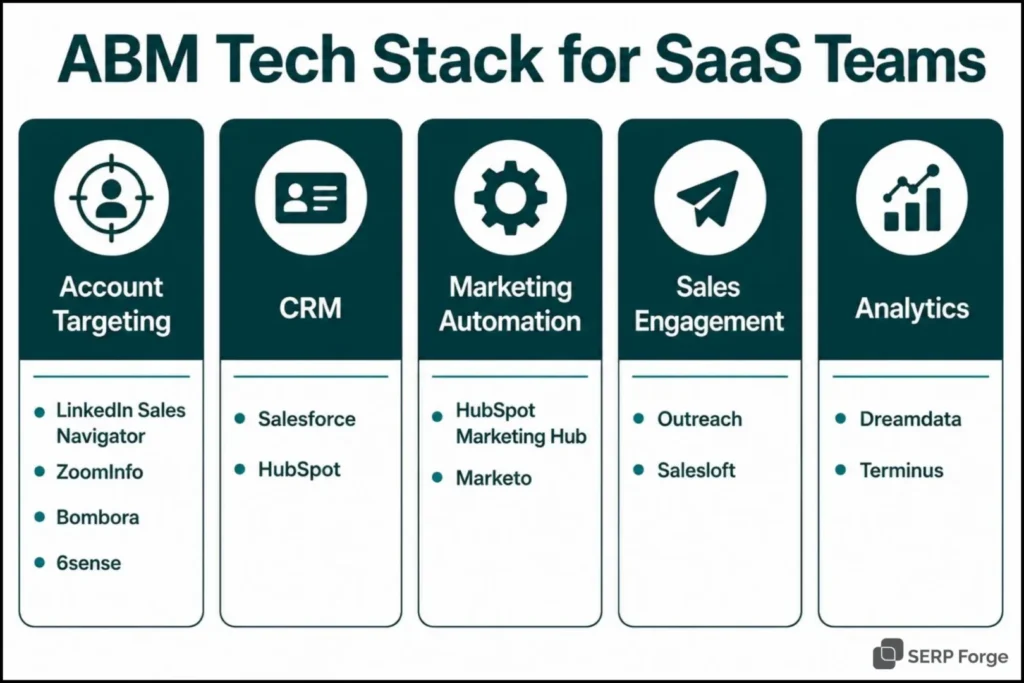
Start with one tool per category, connect everything to a shared CRM and expand as the program scales:
Account Targeting and Data Tools
LinkedIn Sales Navigator is the starting point for account identification and buying committee mapping.
ZoomInfo adds firmographic depth and technographic data to validate account fit.
6sense combines intent signals with predictive analytics to identify accounts in an active buying cycle before they engage for ABM for SaaS programs.
This cuts wasted outreach significantly.
CRM and Customer Data Platforms
Salesforce and HubSpot both offer native ABM features. The critical configuration: standard CRM setups track individual contacts. ABM for SaaS requires an account view that aggregates all contact activity and deal progression under one company record.
Marketing Automation and Campaign Tools
HubSpot Marketing Hub covers email sequences, landing page personalization and campaign reporting for ABM for SaaS startups running smaller account lists. For larger programs across hundreds of accounts simultaneously, Marketo handles more complex multi-touch orchestration.
For platform comparisons, see our SaaS marketing automation tools breakdown covering HubSpot, Marketo, ActiveCampaign and 12 others.
Sales Engagement and Outreach Tools
Outreach and Salesloft coordinate personalized sequences across buying committee contacts, ensuring every stakeholder receives appropriately timed, non-overlapping outreach.
Analytics and Reporting Tools
Dreamdata and Terminus connect marketing touchpoints to pipeline and revenue at the account level. They answer the question every SaaS board asks: which accounts did we influence and what did that produce?
What Do Real ABM Examples Look Like in SaaS?
Here is how one team did it with three people and $3,000:
How Iridium Mobile Built Five $100K+ Customers on a $3,000 Budget
Iridium Mobile needed to reach net-new enterprise accounts with a team of three and no budget for paid ads or an ABM platform.
They built a virtual summit and designed the guest list as the strategy: existing customers for credibility, Tier 1 target accounts as the primary pipeline source, thought leaders for new audiences, partners for reach and industry media for amplification. Pre-summit prep calls with Tier 1 accounts doubled as qualification conversations.
The summit drew 2,320 attendees, 39% net-new. Post-event, the team ran targeted webinars for highest-priority accounts only, then sent a content hub with the recording, case studies, FAQs and a booking link.
The hub was the intent filter. The team tracked who visited and what they consumed. Sales followed up only with accounts showing active evaluation signals. Five customers with LTV above $100,000 closed. Total spend: $3,000.
The lesson: Your guest list is part of the strategy. Post-event follow-up should separate buyers from attendees before a rep touches anyone.
What Challenges Do SaaS Companies Face in ABM?
Every team running ABM for the first time hits at least two of these challenges:
Account selection takes longer than expected. The ICP process requires input from sales, customer success and product and surfaces real disagreements. Budget time for this before campaign planning begins.
Buying committee mapping is almost always incomplete at launch. Most teams start with one or two contacts per account. Mapping five to eight requires weeks of coordinated research. Gaps lead to deals stalling at the wrong contact.
Sales and marketing alignment breaks down under pressure. When pipeline is thin and targets approach, both teams revert to old habits. Shared account targets and shared pipeline goals built into the program from day one prevent this.
Measurement takes longer than expected. ABM programs need 90 to 180 days before producing measurable pipeline impact. Early engagement data can look like failure before it becomes pipeline.
Personalization hits a production bottleneck without structure. Segment-level personalization scales. Individual account personalization is for Tier 1 only. Applying Tier 1 standards to Tier 3 accounts is how ABM for SaaS startups stall before seeing results.
Ready to Build Your ABM Program?
ABM is a multiplier and it makes good marketing better. Before building an ABM program, make sure the foundations are in place. Your SaaS marketing strategy sets the direction for every account and channel decision that follows.
Once those foundations are in place, ABM turns your best accounts into a predictable revenue engine. The SERP Forge team builds custom ABM programs for SaaS companies based on stage, ICP and growth goals. A program your team executes from day one, with the accounts, messaging and measurement already built in.
Conclusion
A quarter from now, your pipeline will reflect the targeting decisions you make this week.
The SaaS companies outperforming their category made one decision early. They stopped chasing volume and started owning a list. Everything else followed from that.
ABM for SaaS is built on that shift. It aligns every revenue-generating function in your company around the accounts most likely to produce long-term, compounding recurring revenue.
The accounts are in your market right now. The only variable left is whether execution follows.
Frequently Asked Questions
1. When should a SaaS company start using ABM?
When your ACV exceeds $15,000 to $20,000 ARR and your sales cycle runs longer than 45 days.
2. How many accounts should a SaaS ABM program target first?
Start with 20 to 30 Tier 1 accounts on a fully coordinated sequence, like LinkedIn ads, personalized emails and direct sales outreach running together.
Once results are consistent, expand to a full Tier 1 list of 50 accounts. Then introduce a Tier 2 program of 100 to 200 accounts on semi-personalized sequences using automation.
3. Does ABM for SaaS work for companies with long sales cycles only?
It produces the strongest results at higher ACVs and longer cycles. Product-led marketing companies can also use ABM for B2B SaaS to convert high-potential trial accounts to paid.
The logic applies at any ACV above $5,000 ARR.
4. Who should own ABM in a SaaS company?
Both teams. Marketing owns account selection, campaigns, content and measurement. Sales owns direct outreach and deal progression.
Every Tier 1 account needs a named owner from each team. In mature organizations, RevOps owns the shared data infrastructure that keeps b2b account based marketing aligned without constant manual coordination.
5. How long does it take to see results from ABM for SaaS?
Expect 90 to 180 days before ABM for SaaS produces measurable pipeline impact. Most teams see early engagement signals like reply rates, meeting bookings, account score increases within the first 60 days.
The first 90 days cover ICP building, pilot launch and first meetings booked. This phase feels slow because you are building infrastructure.
Pipeline and ROI data become reliable between months four and six.