


SaaS products require explanation, and content handles much of this education before a sales conversation begins.
That is why SaaS content marketing requires more than articles built around high-volume keywords. Each page should close a specific information gap and help the reader take the next logical step. That step could involve reading a comparison, reviewing pricing, starting a trial or learning how to use a feature.
AI has made basic information easier to produce, but it has also made average content easier to ignore. SaaS companies therefore need content shaped by customer questions and real product knowledge.
What Is Content Marketing for SaaS?
SaaS content marketing is the process of creating and distributing useful information that helps software buyers and users make informed decisions.
It supports the complete customer journey by explaining the problem and helping buyers evaluate solutions before purchase. After signup, it shortens the path to product value and helps customers use the platform effectively.
For SaaS companies, content performs five core jobs:
- Create demand around a painful problem
- Convert interest into demos or trials
- Explain product value in practical terms
- Support onboarding and adoption
- Help customers renew or expand
For example, a blog article introduces a problem, a comparison page helps a buyer shortlist vendors and an onboarding guide helps a new customer complete the first important workflow.
The format changes according to the reader’s question, but the purpose remains the same: reduce the uncertainty standing between the reader and the next decision.
Why Should SaaS Companies Invest in Content Marketing in 2026?
SaaS buyers now build their shortlist before speaking with sales. Gartner found that 67% of B2B buyers prefer a rep-free experience. Yet 69% still consult sales representatives to validate AI-generated insights.
That creates a new job for content. It must help buyers research alone, then prepare them for a better sales conversation.
A SaaS content system can support this process through:
- SEO guides that capture problem-aware searches
- Comparison pages that help buyers narrow their options
- Product videos that show workflows before a demo
- Case studies that support internal approval
- Calculators and templates that let buyers test the value
- Tutorials that help new users reach value after signup
Content marketing for SaaS companies now extends far beyond blogs. Video, interactive tools, product screenshots and visual explainers can answer questions that text handles poorly. In 2026, 91% of businesses use video, and 93% of video marketers consider it central to their strategy.
The commercial advantage comes from building reusable assets. One benchmark report can become an article, infographic, webinar, sales deck and email series. Each format reaches the buyer in a different research environment.
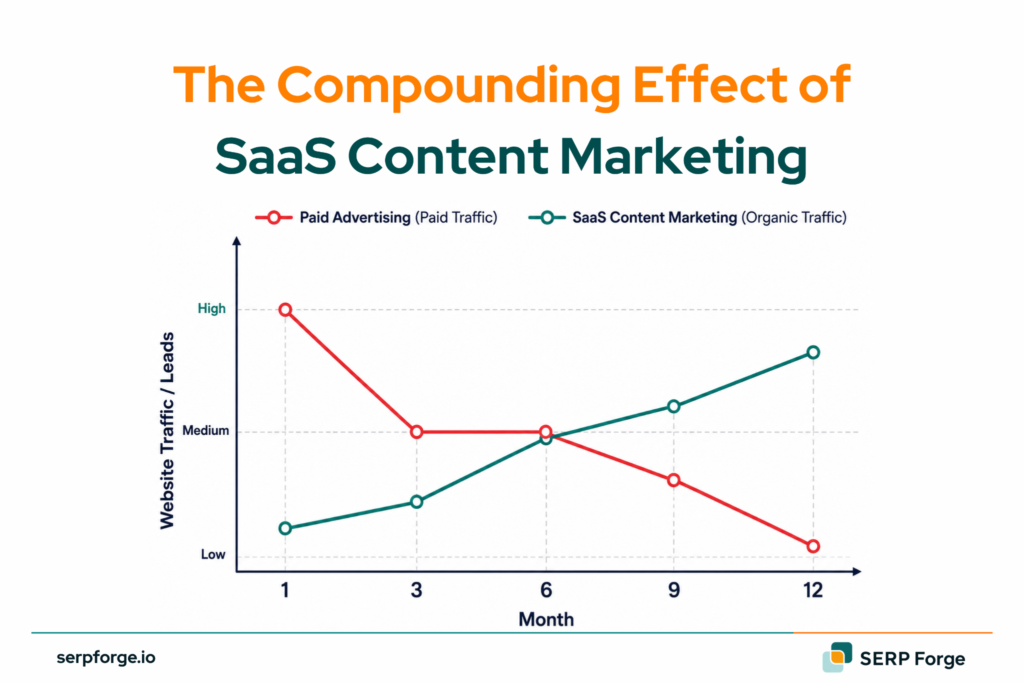
This reduces dependence on rented attention from paid campaigns. A useful comparison page, template or tutorial can keep attracting buyers and supporting customers.
However, volume alone creates little advantage. AI can already produce basic definitions and category summaries. SaaS companies need content around product evidence, real workflows, buyer objections and original data.
The better question is no longer, “How much content did we publish?”
It is, “Which buyer decision became easier because this content existed?”
How Should SaaS Companies Adapt Their Content for AI Search?
SaaS content must be easy for AI systems to interpret and useful enough for readers to trust.
Direct answers and descriptive headings help AI systems identify the topic and extract relevant information. Yet structure alone does not create authority.
The page also needs evidence that reflects direct experience with the product, customer and market.
Useful additions include:
- Product screenshots
- Attributed customer quotes
- Original data
- Implementation lessons
- Expert commentary
- Workflow examples
- Honest limitations
- Named tools and integrations
Entity-focused content also helps AI systems understand the page and connect it with relevant queries.
Focus on:
- Consistent entity signals: Keep product descriptions, company details and positioning consistent across the website and external profiles.
- Direct question coverage: Answer one user question per section while naming the product, category, audience and use case.
- Complete topic coverage: Explain setup, activation, integrations, use cases, limitations and measurement instead of targeting isolated keywords.
- Topical authority: Build connected content around related questions, workflows and buyer needs.
- Structured data: Use relevant FAQ, Article, Product and Organization schema.
- Evidence-based claims: Replace broad statements with the workflow, affected user and measurable outcome.
- Original expertise: Add insights, examples and lessons that a generic AI summary cannot reproduce.
A useful quality check: does the page demonstrate expertise and explain something the reader could not get from a generic summary?
What Should a Content Marketing Strategy for a SaaS Company Include?
A B2B SaaS content marketing strategy should define who the content serves, which problem it addresses and how it contributes to the buying journey.
A content calendar only shows what the team plans to publish, whereas a strategy explains why each asset deserves investment.
The core planning sequence is:
ICP → problem → funnel stage → content type → page format → distribution → metric
Each step answers a different question:
| Strategy Step | What It Decides |
|---|---|
| ICP | Which buyers are worth targeting |
| Problem | Which pain creates urgency |
| Funnel stage | What question the buyer has now |
| Content type | Which format answers that question best |
| Page format | Where the content belongs |
| Distribution | How the target audience will find it |
| Metric | How performance gets measured |
A SaaS company should also decide which topics it will avoid.
Publishing every loosely related topic creates an unfocused content library, so effective strategies define clear boundaries around audience, product relevance and search intent.
Keywords can help identify demand, but they do not explain why the buyer is searching. The buyer’s problem should shape the page first, while keywords refine how that problem is expressed.
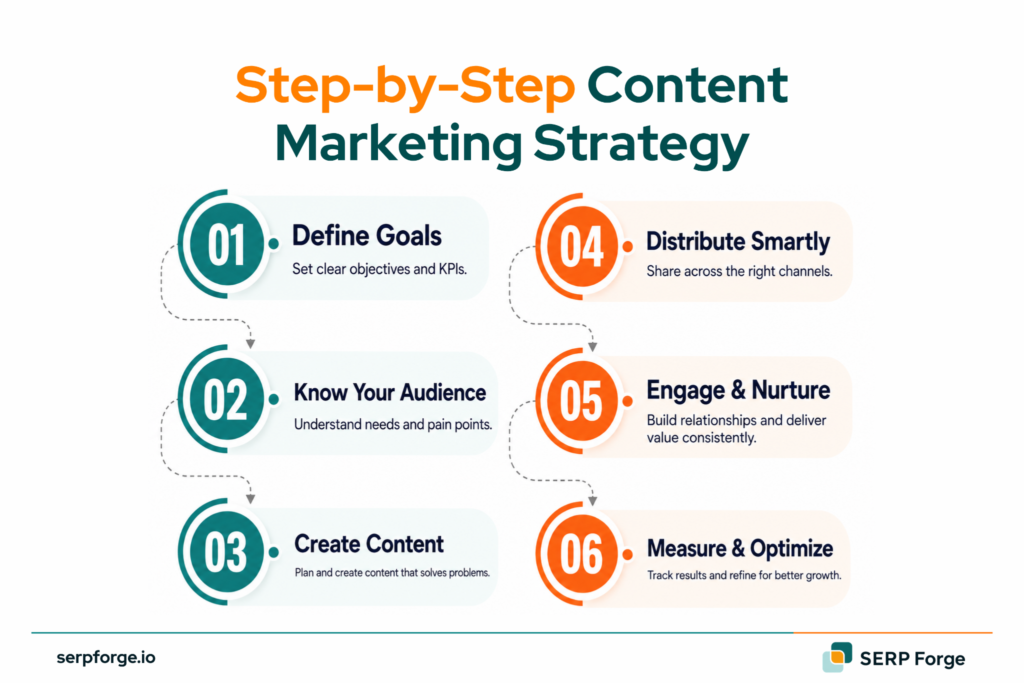
How Should a SaaS Company Build Its Content Marketing Plan?
A SaaS content marketing plan should connect each format with a buyer question and business goal.
Content can include articles, landing pages, videos, webinars, templates, calculators, infographics and product demos.
Use this process:
1. Define the ICP
Choose the customer segment most likely to buy, activate and retain. Use CRM data, customer interviews, product analytics and churn feedback.
2. Map Buyer Questions
List the questions buyers ask across awareness, consideration, decision, onboarding and renewal. These questions decide which content formats the company needs.
3. Match Questions With Content Formats
Choose formats based on how the audience needs to learn:
- Articles for detailed explanations
- Videos for product workflows
- Calculators for value estimates
- Infographics for visual data
- Templates for practical tasks
- Webinars for deeper education
4. Build Connected Content Clusters
Group articles, videos, tools and visual assets around the same problem or use case. Avoid creating separate assets for topics with the same intent.
5. Prioritise Revenue-Focused Content
Build comparison pages, product demos, case studies, pricing support and onboarding content early. These assets support trials, demos, activation and sales conversations.
6. Add Original Proof
Use screenshots, customer examples, expert insights, internal data and benchmarks. This makes the content harder to copy and easier to trust.
7. Distribute and Review
Turn major assets into emails, social posts, videos, sales material and webinars. HubSpot uses this approach across blogs, templates, tools, courses and product education.
Review performance quarterly and update assets with falling traffic, weak conversion or outdated information.
What Does the SaaS Content Funnel Look Like?
The SaaS content funnel maps content to awareness, consideration, decision, activation and retention.
Use this funnel map:
| Stage | Buyer or User Question | Best Content Types |
|---|---|---|
| Awareness | What is this problem costing us? | Guides, reports, LinkedIn posts, videos |
| Consideration | Which approach fits our workflow? | Templates, webinars, ROI calculators, use-case pages |
| Decision | Which product fits best? | Case studies, SaaS comparison pages, pricing pages |
| Activation | How do we get value fast? | Tutorials, onboarding emails, checklists |
| Retention | How do we get more value? | Help content, playbooks, product education |
The funnel is useful for planning, although buyers rarely follow it in a fixed order.
An end user can discover the product through a template. A finance leader can start with pricing. An IT stakeholder can enter through an integration page after a demo.
Internal links should therefore follow the next question the reader is likely to ask.
A problem guide should lead to a relevant use case. A use-case page should connect with proof or comparison content. A pricing page should link to implementation details when setup affects the total cost.
The B2B SaaS content path should support the buyer’s decision process rather than mirror a rigid funnel.
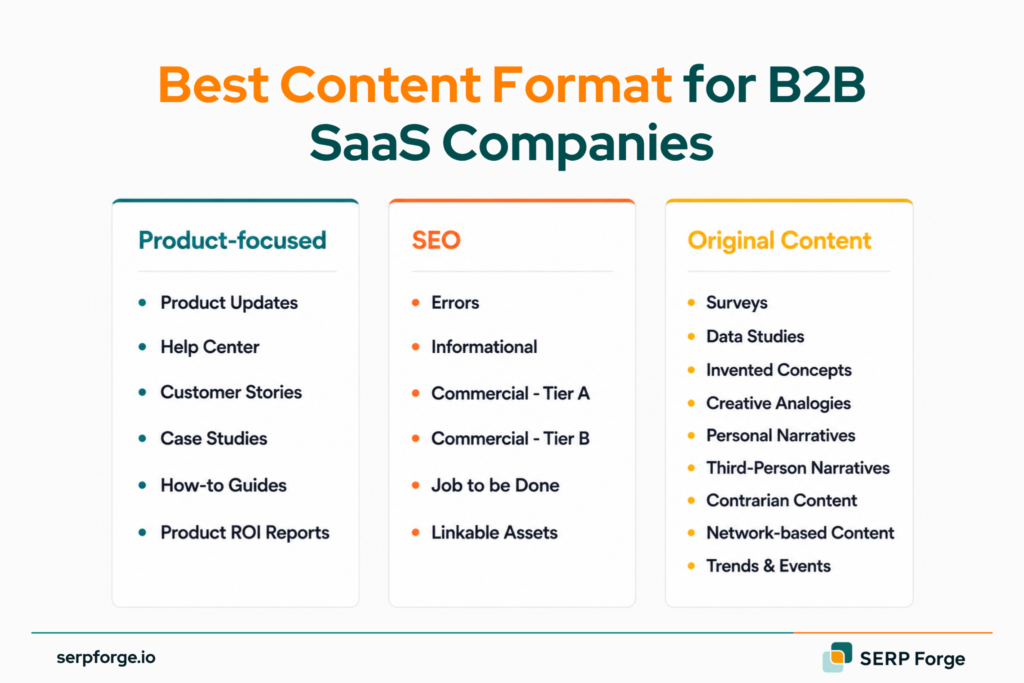
Which Content Formats Should SaaS Companies Use?
The right format depends on what the reader needs to understand:
| Reader Need | Suitable Format |
|---|---|
| Understand a concept | Educational guide |
| Complete a task | Tutorial or template |
| Compare approaches | Listicle |
| Evaluate named vendors | Comparison page |
| Validate a claim | Case study |
| Estimate cost | Pricing explainer |
| See the product workflow | Interactive demo |
| Reach value after signup | Onboarding guide |
A format should be chosen because it answers the question well, not simply because competitors have published something similar.
Listicle Ideas That Help Readers Make Decisions
Listicle ideas work when they help readers compare options, avoid errors or choose a path.
A useful listicle organises a decision and connects each point with a next step. That format works well for SaaS because buyers often compare tools, workflows, templates and mistakes before they speak to sales.
Use these SaaS listicle formats:
- Best tools for a specific workflow
- Common mistakes in a SaaS process
- Examples of high-converting SaaS pages
- Alternatives to a known competitor
- Templates for a specific team
- Trends with practical actions
- Checklists for product onboarding
The intent decides the angle. “10 SaaS content ideas” helps early planning, while “best onboarding software for customer success teams” serves buyers evaluating vendors.
SaaS Landing Page
A SaaS landing page has to explain the product fast. However, speed alone will not create conversions. The page also has to reduce doubt before the visitor clicks a trial or demo CTA.
SaaS landing page best practices focus on product clarity, proof and one next action.
Use this structure:
| Page Section | Purpose |
|---|---|
| Hero | Explain the outcome and target user |
| Product visual | Show the software interface or workflow |
| Pain section | Name the business problem |
| Feature blocks | Connect capabilities to outcomes |
| Social proof | Add logos, reviews or customer results |
| CTA | Drive one action |
| FAQ | Answer final objections |
The hero has to answer three questions:
- What does the product do?
- Who is it for?
- What happens after the click?
Avoid vague lines like “automate finance operations.” Use a more specific message like “close revenue reports faster across Stripe, HubSpot and NetSuite.”
Comparison Pages for SaaS
SaaS comparison pages serve buyers who are already evaluating options.
They cover several types of intent:
Product A vs Product B
The buyer has identified two products and needs a direct comparison.
Product A Alternatives
The buyer is looking for a replacement or closer fit.
Best Tools for a Use Case
The buyer understands the task and needs help building a shortlist.
Category Comparisons
The buyer is deciding between different approaches.
A useful comparison page should address:
- Best-fit customer
- Primary use case
- Setup requirements
- Integration support
- Pricing model
- Support expectations
- Product limitations
A credible comparison does not force the publishing brand to win every category.
Instead, it explains fit with precision, which builds trust by helping the buyer evaluate the decision rather than pushing a favourable conclusion.
Product-Led Content Marketing
Product led marketing uses content to help users experience product value earlier.
The content gives the buyer a sample of the outcome before they speak to sales or start a paid plan. That is why templates, free tools and interactive demos work well in product-led SaaS.
Useful product-led formats include:
- Interactive demos
- Free tools
- Templates
- Product walkthroughs
- Use-case guides
- Onboarding checklists
- Help center articles
- In-app education
A finance SaaS can offer a burn-rate calculator. A project management SaaS can offer a sprint planning template. The content becomes useful before the buyer pays.
Examples of SaaS Blog
The best SaaS blog examples match content with the company’s product and growth model.
A developer tool needs technical depth. A CRM platform needs workflow and revenue education. A finance SaaS needs accuracy, proof and compliance context. So the goal is to understand why each blog works for its audience.
Study these blog models:
| Blog Type | Content Style | Why It Works |
|---|---|---|
| Product-led blog | Tutorials and workflows | Shows the product in real tasks |
| Developer blog | Technical guides and changelogs | Builds trust with technical users |
| Inbound blog | Educational guides and templates | Captures broad search demand |
| Industry blog | Research and expert views | Builds category authority |
| Comparison blog | Alternatives and competitor pages | Captures purchase-stage demand |
A data platform can publish engineering tutorials. A project management tool can publish sprint templates. A finance SaaS can publish reporting benchmarks.
The blog needs to reflect the product, buyer and sales process.
Examples of SaaS Pricing Page
SaaS pricing page examples show how top software brands reduce decision anxiety.
A pricing page helps visitors choose a plan, understand limits and prepare for internal approval. That is why the best pricing pages combine plan details with proof, FAQs and buying guidance.
Use these pricing elements:
| Pricing Element | Why It Helps |
|---|---|
| Plan names | Helps users self-select |
| Feature limits | Shows what changes between plans |
| Annual billing toggle | Makes savings easy to compare |
| Usage calculator | Reduces billing uncertainty |
| “Most popular” plan | Guides plan selection |
| FAQ | Answers cancellation, security and billing concerns |
| Sales CTA | Routes complex buyers to a conversation |
For usage-based SaaS, show real pricing examples. For enterprise SaaS, explain what affects the quote. Hidden pricing can slow serious buyers when they need budget approval.
How Should a SaaS Company Write B2B Content?
B2B SaaS content should help the reader understand the product without relying on internal jargon.
Product teams work with the same terminology every day. Buyers do not.
A useful section should explain:
- What is happening
- Why it matters
- How the workflow works today
- How the product changes it
- What evidence supports the claim
- What the reader should do next
This structure keeps the content educational and gives each paragraph a clear purpose.
The reader should not have to decode the product before understanding its value.
SaaS Copywriting for B2B
B2B SaaS copywriting is the process of changing product features into business meaning.
The buyer needs to see how a feature affects cost, time, risk or workflow. That is why SaaS copy works best when it connects the problem, outcome, mechanism and proof.
Use this copy flow:
Problem → outcome → mechanism → proof → action
Here is how feature copy becomes SaaS copy:
| Weak Copy | Better SaaS Copy |
|---|---|
| Real-time analytics dashboard | Spot revenue changes before the monthly review |
| AI workflow automation | Route approvals without manual follow-ups |
| Seamless integrations | Connect HubSpot, Stripe and NetSuite in one reporting view |
Feature-first copy explains what exists. Outcome-led copy explains why buyers care.
PAS Copywriting Framework
The PAS copywriting framework stands for Problem, Agitate and Solution.
It works for landing pages, ads, emails and website sections. In SaaS, the framework needs control because exaggerated pain can reduce trust.
Use a practical SaaS version:
| PAS Step | SaaS Example |
|---|---|
| Problem | Sales data lives across five tools |
| Agitate | Forecast reviews take longer and still miss deal risk |
| Solution | A shared revenue dashboard shows pipeline changes daily |
The ideal PAS copy names a real workflow problem. Then it shows the product as the practical fix. Keep the tension believable because SaaS buyers respond to specific operational cost.
Writing Like a Journalist
If you’re confused about how to write like a journalist, lead with the main answer and support it with facts.
This style works well for SaaS because buyers scan fast. They need the core point before the full explanation. So every section needs a direct answer, then the proof or example that makes it useful.
Use these rules:
- Put the answer first
- Add context after the answer
- Use short sentences
- Remove soft claims
- Check every statistic
- Use expert input where useful
- Add examples that prove the point
Journalistic SaaS writing sounds specific, fast and useful. A simple test works here: can the reader understand the main point in five seconds?
How Do You Run a Content Audit for SaaS?
A SaaS content audit reviews existing content to decide what to keep, update, merge, redirect or remove.
The goal is to make every page earn its place. Some pages earn through traffic, while others earn through conversions, backlinks, sales enablement or customer support. That is why the audit needs both SEO data and business context.
Use this audit process:
| Audit Step | What to Review |
|---|---|
| Inventory | Export blogs, landing pages, case studies and help pages |
| Categorise | Tag each URL by topic, funnel stage and intent |
| Measure | Review clicks, impressions, rankings and conversions |
| Diagnose | Find decay, duplication, cannibalisation and weak intent |
| Decide | Keep, update, merge, redirect or remove |
| Prioritise | Start with pages closest to revenue impact |
Look for pages with traffic but no conversions. These may need improved CTAs, better internal links or intent matching. Also review pages with backlinks but outdated information, because these often regain value through a focused rewrite. Pages that need more authority can also benefit from link building for SaaS.
How Should a SaaS Company Manage Its Content?
SaaS content management is the process of planning, creating, approving, publishing, updating and measuring SaaS content.
It includes the CMS, editorial calendar, workflow, ownership and performance review process. Without it, pages become outdated and teams publish overlapping topics. So content management becomes more important as the library grows.
A practical content management system covers:
| Function | What It Includes |
|---|---|
| Planning | Topic roadmap, calendar and keyword mapping |
| Production | Briefs, SME input, writing and editing |
| Publishing | CMS upload, visuals, links and SEO checks |
| Governance | Ownership, updates and approvals |
| Measurement | Search, conversion and pipeline reporting |
A 30-page blog may survive without governance. A 300-page SaaS library needs owners, update cycles and content rules.
When Should a SaaS Company Hire Content Creation Agencies?
Content creation agencies help SaaS teams produce strategy, blogs, landing pages, comparison pages, case studies and sales assets.
They add value when internal teams lack specialist skill or production capacity. They can also help connect SEO, AI visibility and conversion copy, especially when the team needs expert execution faster. For the AI visibility piece, a specialist AI SEO agency is often the better fit.
Choose agencies that understand SaaS economics:
- CAC
- MRR
- ARR
- Activation
- Churn
- NRR
- Pipeline
- Payback period
Ask for proof before hiring:
- SaaS portfolio
- Published samples
- Strategy process
- SME interview method
- Search performance examples
- Conversion examples
- Reporting format
Article volume is a weak measure of capability.
A trusted SaaS marketing agency should understand how content supports the buying process and how the SaaS company earns revenue.
The company should retain ownership of positioning, product accuracy and final approval.
An external team can shape the content, but it cannot replace internal knowledge that has never been captured.
Which Metrics Show SaaS Content Performance?
SaaS content performance can’t solely be judged on pageviews.
Traffic shows reach, while revenue metrics show whether the content attracts the ideal audience and supports action. So each content type needs to be measured by its job.
Track these metrics:
| Metric | What It Shows |
|---|---|
| Organic clicks | Search demand captured |
| Qualified traffic | Audience fit |
| Demo requests | Sales intent from content |
| Trial signups | Product-led conversion |
| Assisted pipeline | Content’s role in deal creation |
| Activation rate | Product value reached after signup |
| CAC payback | Acquisition cost recovery |
| Expansion influence | Content support across account growth |
Define the job of the page before choosing its metric.
Attribution will not capture every interaction. Buyers read several pages and share content internally before converting.
Analytics should therefore be reviewed alongside CRM data and sales feedback.
Build SaaS Content Around Buyer Decisions
SaaS content works when it helps the right buyer move from search result to next action.
A blog may start the journey, but the real value comes from what happens after the click. The buyer needs a reason to keep reading, compare the product, trust the offer and move toward a demo, trial or signup.
If impressions are growing but qualified clicks or conversions are weak, review the content path. The issue may sit in the title, search intent, internal links, CTA placement or how clearly the page connects the problem to product value.
Find the Gaps in Your SaaS Content System
SERP Forge can review your blogs, landing pages, comparison pages and content funnel.
Frequently Asked Questions
How do SaaS companies use content marketing?
SaaS companies use content marketing to attract buyers, explain product value and support users after signup. Blogs create discovery. Comparison pages, landing pages and onboarding content help convert and retain customers.
What content works best for B2B SaaS?
Use-case pages, comparison pages, pricing pages, case studies and product-led guides usually work best for B2B SaaS. These pages answer buying questions close to demos, trials and sales conversations.
How do you create a B2B SaaS content marketing strategy?
Start with the ICP, buying problem and revenue gap. Then map content to awareness, consideration, decision, onboarding and retention. This shows which blogs, landing pages, case studies and customer education assets to build.
How often should SaaS content be updated?
Review SaaS content every quarter. Update priority pages faster when rankings drop, pricing changes, product features launch or competitors shift.
Are SaaS blogs still worth it in 2026?
Yes, SaaS blogs still work when they include product examples, original data and customer proof. Basic articles are easier to ignore because AI tools can already summarise simple topics.
What is the difference between SaaS content marketing and SaaS SEO?
SaaS SEO focuses on rankings, organic traffic and search visibility. SaaS content marketing covers SEO, landing pages, comparison pages, case studies, onboarding, email and customer education. A SaaS SEO company usually handles the first, while content marketing spans the whole customer journey.
When should a SaaS company hire a content creation agency?
Hire a content creation agency when the internal team needs strategy, speed or specialist execution. Check whether the agency understands ICPs, positioning, demos, trials, CAC, pipeline and revenue impact.