


Most B2B SaaS copy fails before it even gets read. The headline is vague, the value proposition is buried, and the call-to-action asks for commitment before building trust. The result? Qualified buyers bounce, pipelines stall, and marketing spend goes to waste.
Good B2B SaaS copywriting is not about clever wordplay. It is about understanding exactly who you are writing for, what they are afraid of, what outcome they need, and writing words that make the decision feel obvious.
This guide gives you the frameworks, core elements, actionable tips, and real examples to do exactly that.
[blog_summary]
Is your SaaS copy losing you customers? Get a free messaging audit →
What Is B2B SaaS Copywriting?
B2B SaaS copywriting is about translating complex software into clear, benefit-driven messaging that convinces businesses to take action.
Instead of just explaining features, it focuses on showing how your product solves a specific problem, improves outcomes, and makes work easier for teams.
B2B SaaS copywriting works by clearly communicating how the software solves real business challenges, building trust through proof, and guiding decision-makers toward meaningful actions like booking a demo or starting a free trial.
The stat “45% of marketers say copy quality is the biggest factor in conversion rates” points to a fundamental truth most SaaS teams underestimate.
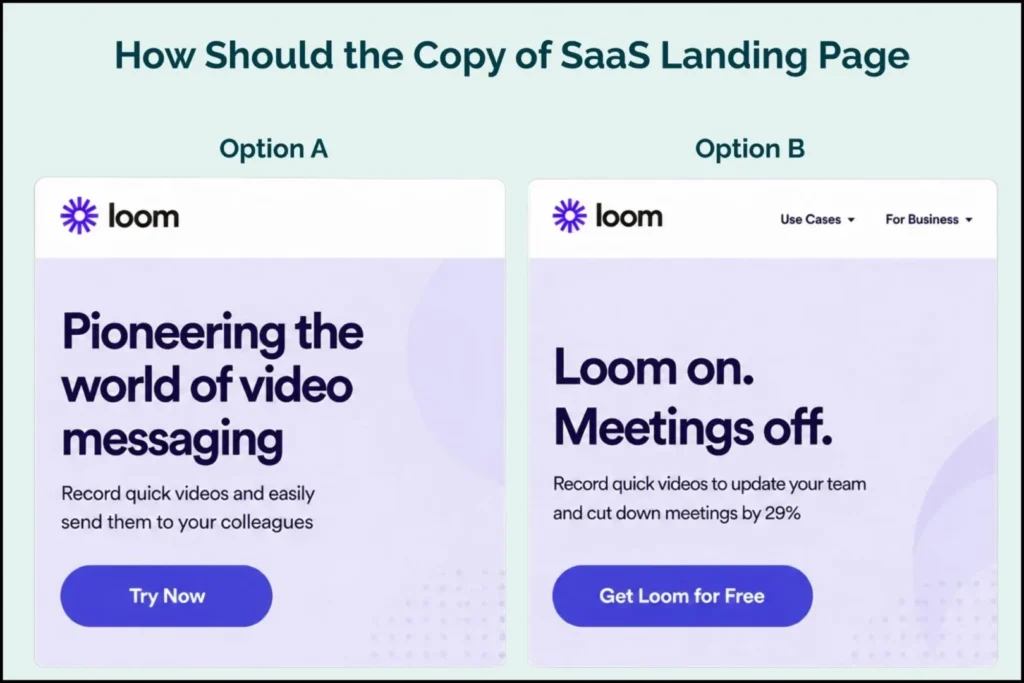
Why Is B2B SaaS Copywriting Important?
Traffic without conversion is just an expense. You can run flawless SEO, paid ads, and an email nurture campaign, but if the copy on your landing page fails to convert, none of it matters.
B2B SaaS copywriting is the multiplier on every other marketing investment you make.
Here is what strong copy actually does for a SaaS business:
- Reduces the sales cycle. When visitors arrive at a page that immediately articulates their problem and shows a clear path to solving it, they move faster. Fewer “I need to think about it” responses. Strong copy compresses every stage of the B2B SaaS sales process, from first touch to closed-won
- Improves lead quality. Copy that is specific to a target persona naturally filters out poor-fit prospects. Vague copy attracts everyone and converts no one.
- Lowers customer acquisition cost. Higher conversion rates mean the same ad spend generates more customers.
- Supports product-led growth. In-app copy, onboarding emails, and tooltips guide users to the “aha moment” faster, improving activation and retention.
- Builds a competitive moat. Positioning and messaging are harder to copy than features. A company with a sharper voice and clearer value proposition maintains an advantage even when competitors release similar functionality.
Traffic without conversion is just an expense…
According to research, 57% of B2B decision makers start their research using search engines.
Strong copy doesn’t just improve conversions, it strengthens your entire SaaS funnel, from first click to final signup, while also supporting better SaaS CRO across landing pages and product experiences.
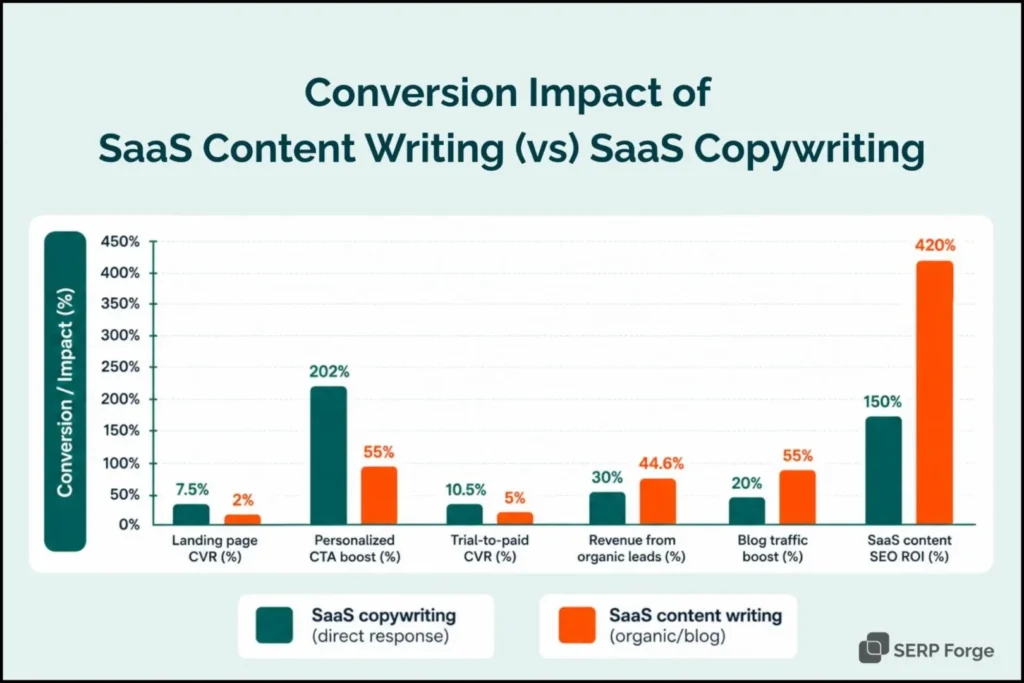
B2B SaaS Copywriting vs Content Writing
These terms are often used interchangeably, but treating them as the same is one of the most expensive mistakes in SaaS marketing.
While copywriting drives conversion, B2B SaaS content writing builds the awareness, trust, and SEO foundation that feeds those conversions in the first place.
Understanding the difference helps you allocate budget, measure success, and avoid the wrong KPIs:
| Factor | B2B SaaS Copywriting | Content Writing |
|---|---|---|
| Goal | Drive conversions such as signups, demos, and sales | Build awareness and educate the audience |
| Focus | Persuasive messaging and decision-making | Informational and value-driven content |
| Format | Landing pages, product pages, ads, and emails | Blogs, guides, articles, and case studies |
| Tone | Direct, clear, and action-oriented | Informative, engaging, and explanatory |
| Audience Intent | Ready to evaluate or take action | Researching or learning about a topic |
| Key Elements | Value proposition, benefits, CTAs, and proof | Insights, explanations, examples, and SEO |
| Metrics | Conversion rate, CTR, and signups | Traffic, time on page, and engagement |
| Approach | Short, precise, and outcome-focused | Detailed, structured, and topic-focused |
Understanding where content writing ends and copywriting begins helps you build both effectively. For the content side of this equation, our B2B SaaS Content Writing Guide covers every format, type, and best practice you need.
What are B2B SaaS Copywriting Frameworks?
B2B SaaS copywriting frameworks are structured methods that help you turn complex product messaging into clear, persuasive content.
Instead of guessing what to write, these frameworks guide how you present problems, highlight value, and lead readers toward action.
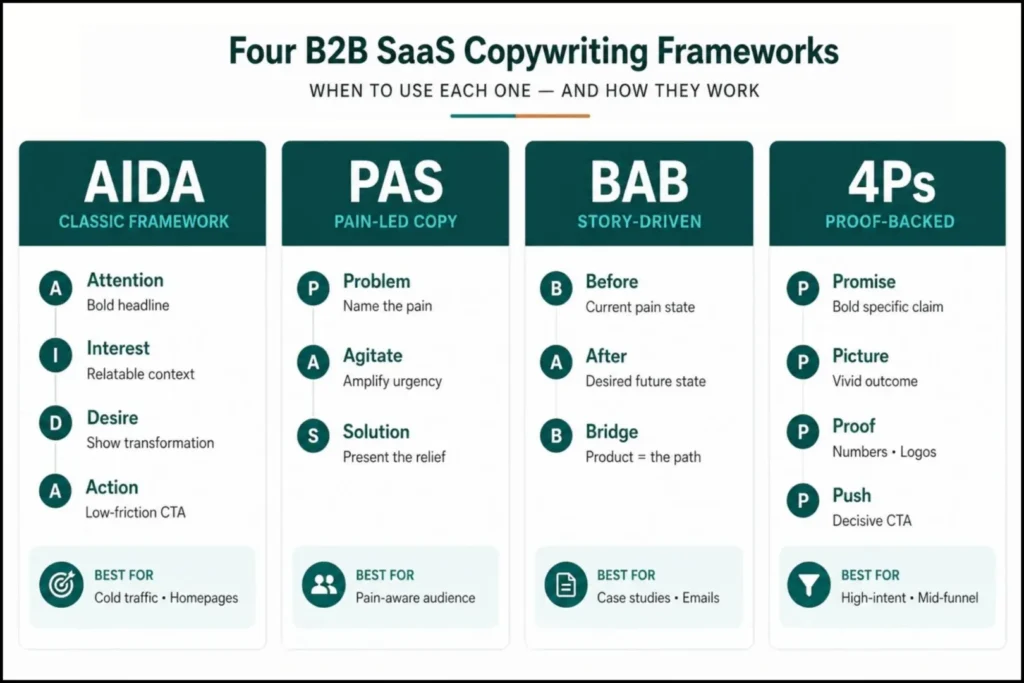
Let’s look at the most effective frameworks used in B2B SaaS copywriting:
AIDA (Attention, Interest, Desire, Action)
AIDA is one of the most widely used copywriting frameworks and for good reason. It follows a natural flow that mirrors how people make decisions.
Attention: Your headline should immediately show the reader they’re in the right place.
Example: Call out their problem or situation clearly so they feel understood.
Interest: Your next lines should explain the problem in a way that feels real and relevant.
Example: Highlight what’s going wrong and why it matters to their work or results.
Desire: Show how your product solves that problem and what changes after using it.
Example: Focus on outcomes, not features, what improves, what becomes easier.
Action: Tell the reader exactly what to do next with a clear and low-friction CTA.
Example: “Start free trial,” “Book a demo,” or “See how it works.”
Example (SaaS landing page):
- Attention: “Still managing customer data in spreadsheets?”
- Interest: “Manual tracking leads to missed follow-ups and lost deals.”
- Desire: “Our CRM helps you track, manage, and close deals faster.”
- Action: “Start your free trial today.”
This framework works best for landing pages, ads, and email campaigns where you need a clear and direct conversion path.
Your “Attention” line should speak to a real problem, not just sound catchy.
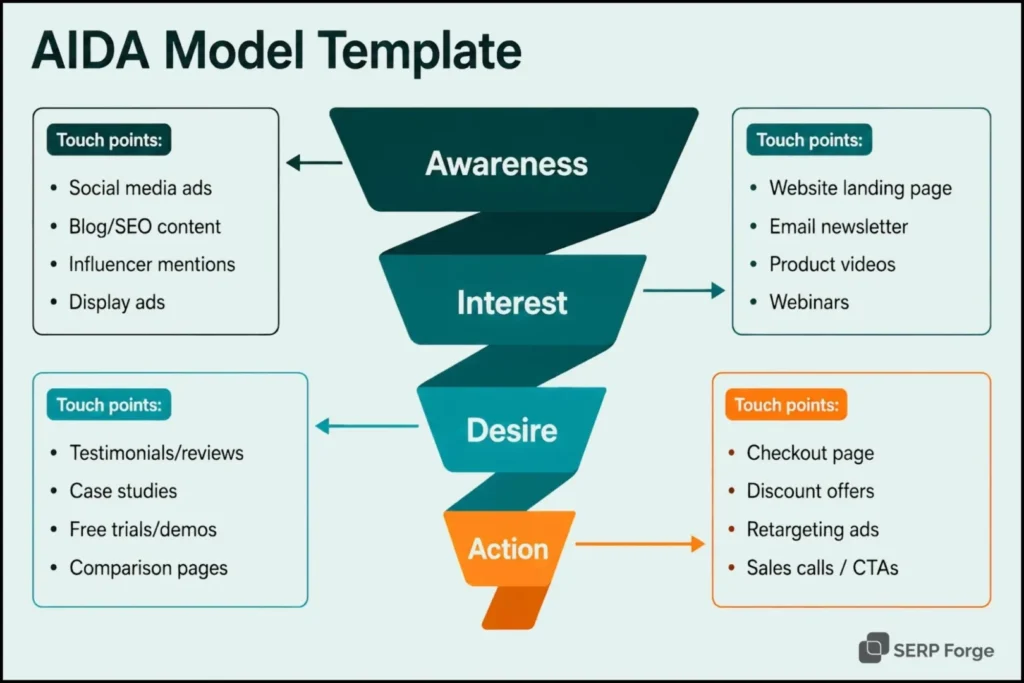
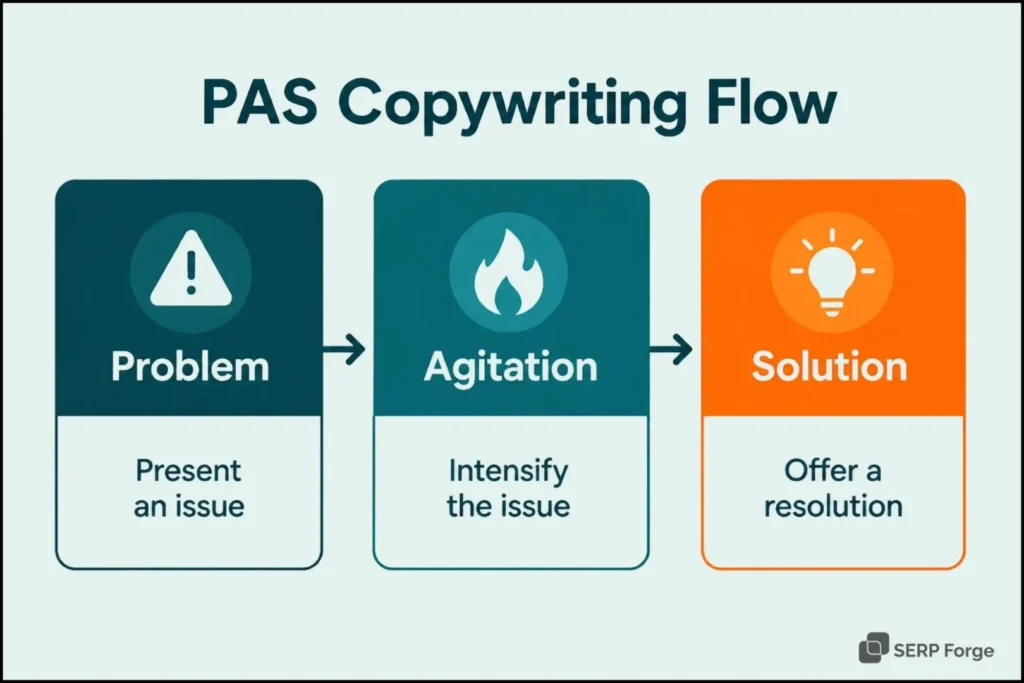
PAS (Problem, Agitate, Solution)
PAS focuses on pain-driven messaging, making it highly effective for SaaS products that solve clear business challenges.
- Problem: Identify the issue your audience is facing
- Agitate: Highlight the impact or consequences of that problem
- Solution: Present your product as the answer
This framework works well because it builds emotional urgency before offering a solution.
Read the guide to applying the PAS copywriting framework across landing pages, emails, and sales copy.
Example:
- Problem: “Your team struggles to manage multiple tools.”
- Agitate: “This leads to delays, confusion, and missed deadlines.”
- Solution: “Our platform brings everything into one dashboard for better control.”
PAS is especially useful for sales pages, onboarding flows, and product-led growth funnels.
BAB (Before, After, Bridge)
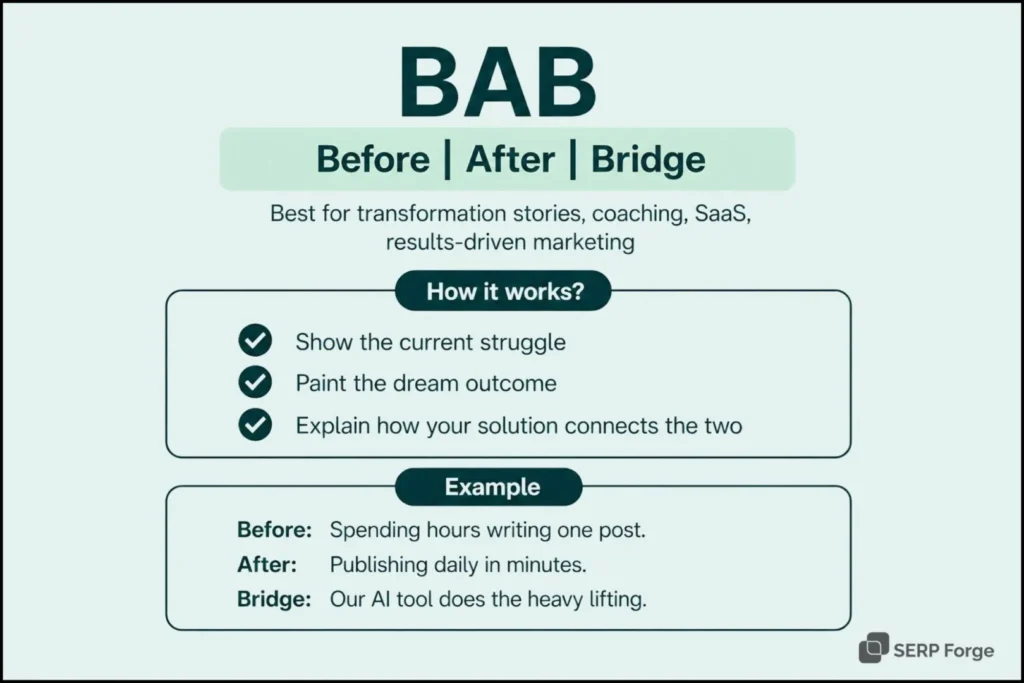
BAB is a storytelling-driven framework that shows transformation. It helps readers clearly visualize the difference your product can make.
- Before: Describe the current situation (pain or limitation)
- After: Show the improved outcome
- Bridge: Explain how your product helps them get there
Example:
- Before: “You spend hours manually onboarding new users.”
- After: “Imagine a seamless onboarding process that runs automatically.”
- Bridge: “Our automation tool handles onboarding so your team can focus on growth.”
This framework works well for case studies, landing pages, and feature explanations.
4Ps (Promise, Picture, Proof, Push)
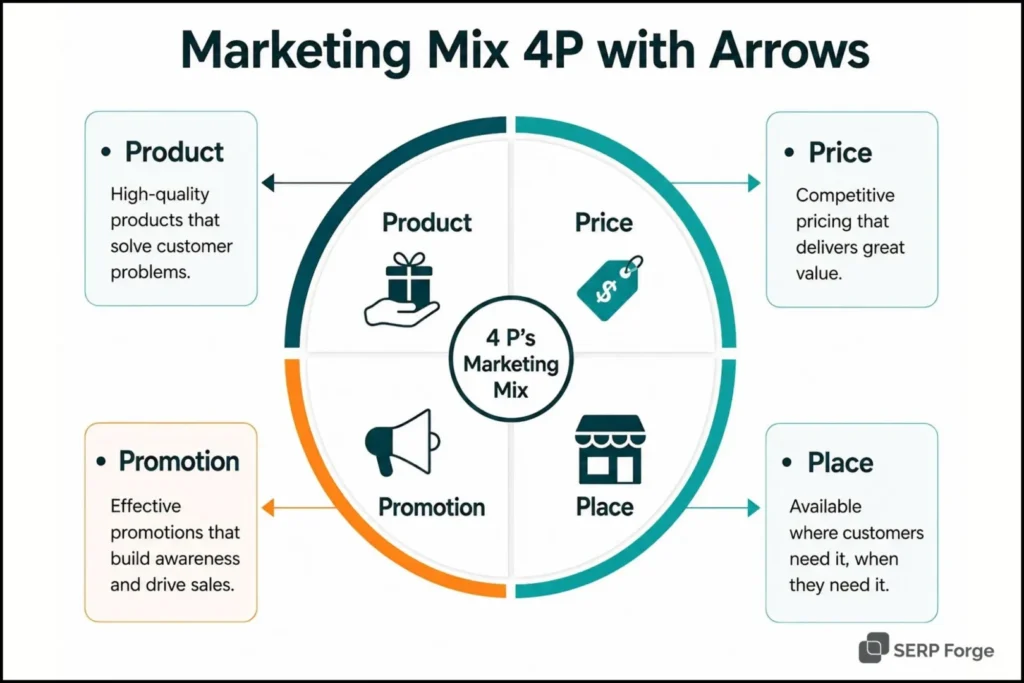
The 4Ps framework is designed to create a strong, persuasive message that builds trust and drives action.
- Promise: State the main benefit clearly
- Picture: Help the reader visualize the outcome
- Proof: Add credibility (testimonials, data, results)
- Push: Encourage action with a clear CTA
Example:
- Promise: “Reduce your customer churn by 30%.”
- Picture: “Keep more customers engaged without increasing your team’s workload.”
- Proof: “Trusted by 500+ SaaS companies worldwide.”
- Push: “Book a demo to see how it works.”
This framework is ideal for homepage copy, product pages, and conversion-focused sections.
Which Framework to Use When:
Use AIDA for cold traffic. Use PAS when your audience is pain-aware. Use BAB for testimonials and case study pages.
Use 4Ps for product comparison or high-intent landing pages where buyers need reassurance before committing.
What Are the Core Elements of B2B SaaS Copywriting?
Good SaaS copy is not about clever wording; it’s about clarity, relevance, and impact. When someone lands on your page, they should quickly understand what your product does, why it matters, and what they gain from it.
These core elements help you build copy that connects with decision-makers and drives action:
A clear value proposition
Your value proposition answers one question in the reader’s mind: “Why should I care about this product over every other option, including doing nothing?”
Modern SaaS messaging goes deeper. It uses POV-led messaging, where you take a strong stance instead of being generic. It also uses problem reframing, helping users see their challenges differently, making your solution feel more relevant and urgent.
A strong SaaS value proposition is specific, outcome-oriented, and differentiated. It is not a mission statement. It is not “the leading platform for X.” It is a concrete promise of transformation for a specific type of buyer.
A weak value proposition: “The all-in-one platform for your business.”
A strong value proposition: “Close 40% more demos without adding a single rep by automating follow-up at exactly the right moment.”
According to data, 45% of marketers say copy quality is the biggest factor in conversion rates, and 60% of B2B buyers say clear messaging influences their decision more than brand reputation.
Real and specific pain points
Generic problems don’t convert. Your audience already knows their challenges; you need to show that you understand them deeply.
Instead of saying:
“Improve your workflow efficiency.”
Say something more real:
“Switching between tools slows your team down and leads to missed follow-ups.”
The more specific your pain points, the more relatable your copy becomes. This builds trust and makes your solution feel relevant.
To find these pain points:
Read customer reviews
Listen to sales calls
Analyze support tickets
Use the exact words your customers use; it makes your copy feel natural and believable.
Strong emotional triggers
Even in B2B, decisions are not purely logical. Emotions like urgency, fear of loss, and desire for growth play a big role.
Modern SaaS copy also applies SaaS onboarding psychology, where messaging reduces friction during signup and early usage. This helps users reach value faster and improves retention.
Strong SaaS copy taps into these triggers:
- Fear: Losing leads, wasting time, falling behind competitors
- Frustration: Complex tools, inefficient processes
- Relief: Simpler workflows, better control
- Confidence: Making smarter decisions with clear data
For example:
“Stop losing deals because your follow-ups fall through the cracks.”
This speaks directly to a real fear and creates urgency.
Balance emotion with logic, pair emotional triggers with clear benefits and proof.
Tangible outcomes and results
SaaS buyers care about results, not features. They want to know what changes after using your product.
Instead of:
“Advanced analytics dashboard”
Focus on outcomes:
“Track campaign performance in real time and improve ROI within weeks.”
Strong SaaS copy uses proof-driven storytelling, where every claim is backed by data, results, or real examples. This makes your message more believable and effective.
Whenever possible, make your results measurable:
- Time saved
- Revenue increased
- Errors reduced
- Efficiency improved
Adding numbers, timelines, or real examples makes your copy more convincing and easier to trust.
If you don’t have exact numbers, use realistic outcomes instead of vague promises.
Tips to Write Copywriting Content for B2B SaaS Websites
Writing high-converting B2B SaaS copy isn’t about adding more words; it’s about making every line work harder. Your copy should guide the reader from confusion to clarity, from interest to action.
Here are practical tips to help you write copy that actually converts.
Turn customer research into a sharp messaging angle
The most common mistake in SaaS copywriting is starting with the product instead of the customer.
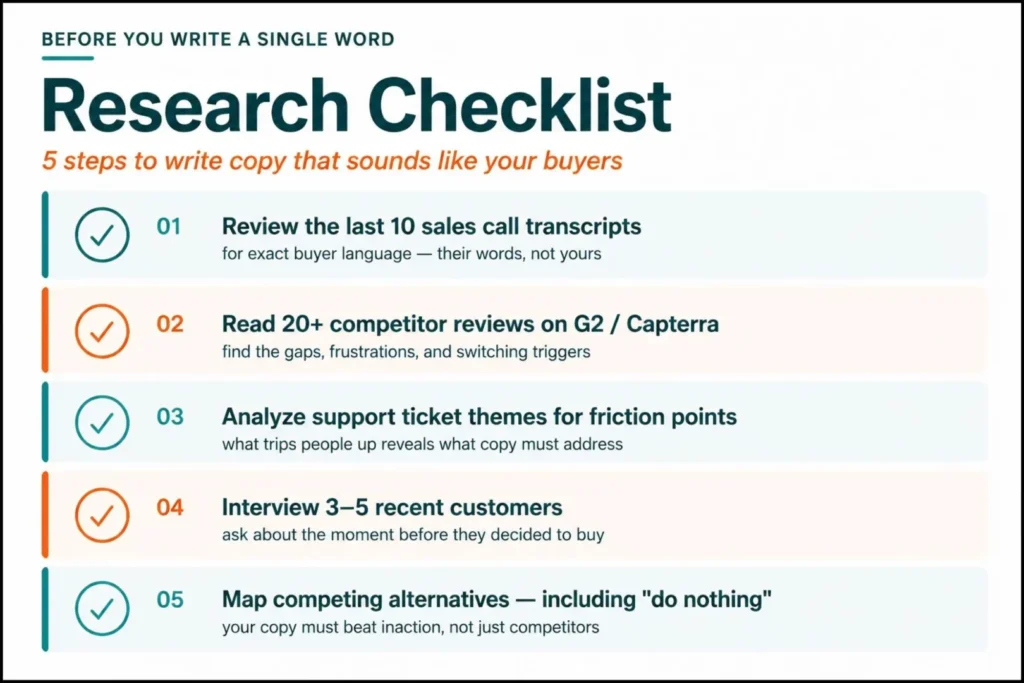
Before writing a single word, conduct genuine research: review sales call recordings, analyze support tickets, read G2 and Capterra reviews (especially the ones comparing you to competitors), and run customer interviews focused on the moment before they decided to buy.
Look for patterns in language. When three different customers use the same phrase to describe their problem, that phrase belongs in your headline, not your interpretation of their problem. Your job is to reflect reality, not rewrite it.
Research Checklist Before Writing:
Position the product around a specific use case, not features
Feature-led copy tells buyers what your product does. Use-case-led copy tells them what they will be able to accomplish. The former requires the buyer to connect the dots. The latter does that work for them.
Image ref text:
Instead of writing “Our platform includes AI-powered forecasting, territory management, and deal scoring,” write for the specific person with the specific problem: “Built for RevOps teams running a distributed sales force across three or more regions without the spreadsheet chaos every quarter-end.”
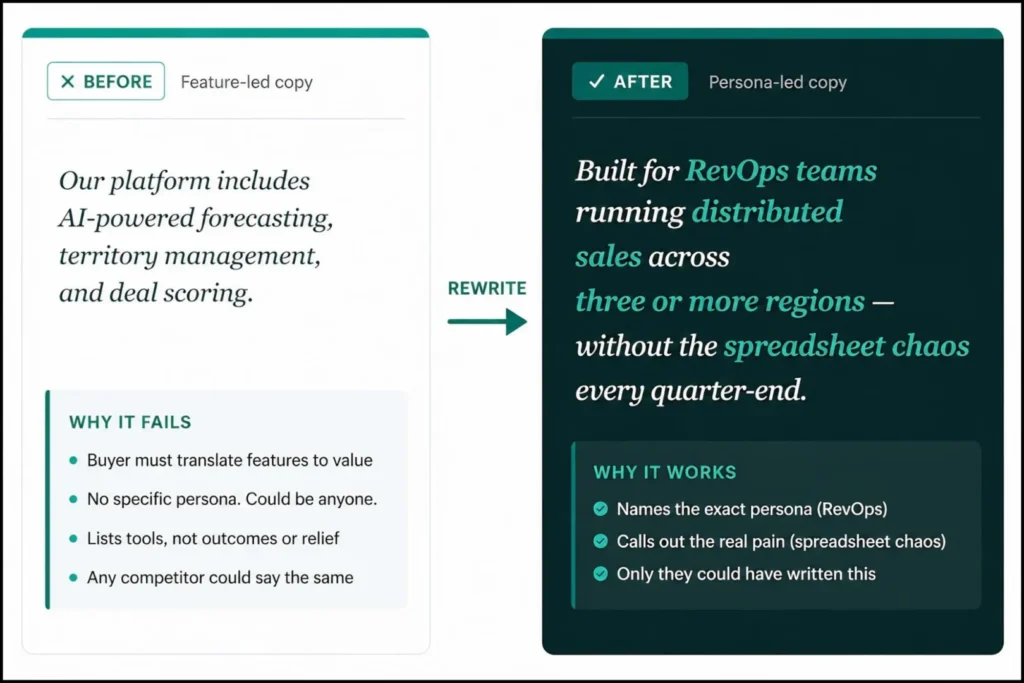
See how SaaS landing pages that focus on a single use case consistently outperform generic feature-list pages in conversion rate testing.
Write copy that reduces friction at every stage
Even if your product is great, friction can stop users from converting. Your copy should address that friction is any moment where a buyer hesitates.
In copy, friction comes from: unclear CTAs, unexplained commitments (“Start Free Trial” raises the question do I need a credit card?), missing social proof at decision moments, and jargon that requires translation.
Every sentence should move the reader forward or remove a reason not to move forward.
Audit your copy for friction points: Where do readers drop off? What questions are unaddressed?
A study of enterprise SaaS landing pages consistently shows that adding specific friction-reducers near CTAs, “No credit card required,” “Cancel anytime,” “Setup in under 10 minutes,” lifts conversion rates meaningfully without changing a single other word.
Refine the copy until the message feels precise
First drafts of SaaS copy are almost always too long, too vague, and too safe. The real work is editing: cutting every word that does not earn its place, sharpening every claim until it is specific, and testing headline variations until one clearly outperforms the others.
The fastest path to precision is reading your copy aloud. Sentences that sound awkward when spoken are sentences that will lose readers.
Ask yourself after every paragraph: “Could a competitor put their logo on this and have it still be true?” If yes, it is not specific enough. Keep refining until only you could have written it.
If you’re refining copy across an entire site or blog library, start with a structured SaaS content audit to identify which pages are underperforming before rewriting them.
High-performing SaaS brands create sales enablement content, which helps sales teams explain value, handle objections, and close deals faster with consistent messaging.
For a deeper dive into building the strategic foundation behind your copy, see SaaS content strategy: good copy without strategic alignment is just well-written noise.
What are Mistakes to Avoid in B2B SaaS Copywriting?
Even well-written SaaS copy can fail if it misses the basics. Many brands focus on sounding impressive instead of being clear and useful. The result? Low engagement, poor conversions, and confused readers.
Avoiding these common mistakes can significantly improve your b2b saas copywriting, strengthen your saas messaging strategy, and help you create high-converting website copy:
Writing Without Understanding the Audience
Copying the product perspective rather than the buyer’s perspective is the most common and most costly mistake in SaaS marketing.
Without genuine research into your ICP’s language, fears, goals, and decision criteria, every subsequent copywriting decision is built on assumptions. Start with research, not a blank page.
Overusing Jargon and Buzzwords
Terms like “synergistic,” “best-in-class,” “end-to-end,” and “disruptive” have been stripped of meaning through overuse. They signal that you are not confident enough in your actual differentiators to name them specifically.
Replace every buzzword with either a concrete claim or a real customer outcome. If you cannot do that, you have a positioning problem, not a copywriting problem.
Focusing Only on Features
Features describe what your product does. Benefits describe what the buyer gets. Outcomes describe what their business becomes.
Most SaaS copy stops at features. The most effective SaaS copy skips features almost entirely and speaks directly to outcomes. Features live in documentation. Outcomes live in copy.
Weak or Generic Value Propositions
A value proposition that could belong to any SaaS product in your category is not a value proposition; it is a placeholder.
Generic VP statements (“the smarter way to manage your business”) tell buyers nothing about who you are, what specifically you do better, and why that matters now.
Test your VP by asking: Could a direct competitor use this exact sentence? If yes, rewrite it until the answer is no.
Ignoring Proof and Credibility
Bold claims without evidence are just marketing noise. B2B buyers are trained to discount any claim that is not substantiated.
Embed proof throughout your copy, not as a separate section, but as reinforcement of every claim you make.
When you say “faster onboarding,” follow it immediately with “customers go live in an average of 4 days, not 4 weeks.” Specificity is credibility.
Avoiding these mistakes helps your b2b saas copywriting become clearer, more relevant, and more persuasive.
5 Best B2B SaaS Copywriting Examples
Now that you know the best practices for B2B SaaS copywriting and the mistakes to avoid, here are three pure B2B SaaS companies with exceptional copy and a breakdown of exactly what makes each one work.
Salesforce
Salesforce is one of the most recognized B2B SaaS platforms, offering CRM solutions for sales, marketing, and customer management.
Key Takeaways:
- Clear headline focused on business growth and customer relationships
- Strong value proposition that highlights outcomes, not just features
- Use of trust signals like customer logos and case studies
Enterprise SaaS copy works best when it focuses on measurable business outcomes.
HubSpot
HubSpot is known for its clean, conversion-focused messaging across its website and landing pages.
Key Takeaways:
- Simple and clear headline with strong positioning
- Use of “free tools” to attract and convert users
- Clear CTAs that guide users toward signup
Combining value + low entry barrier (like free tools) improves conversion rates.
Slack
Slack focuses on simplicity and clarity in its messaging, making workplace communication feel easy and efficient.
Key Takeaways:
- Benefit-driven headline focused on productivity
- Clean and minimal copy that’s easy to scan
- Strong focus on team collaboration outcomes
Simpler copy often performs better, especially for widely-used tools.
Zendesk
Zendesk uses clear, structured messaging to explain complex customer support solutions.
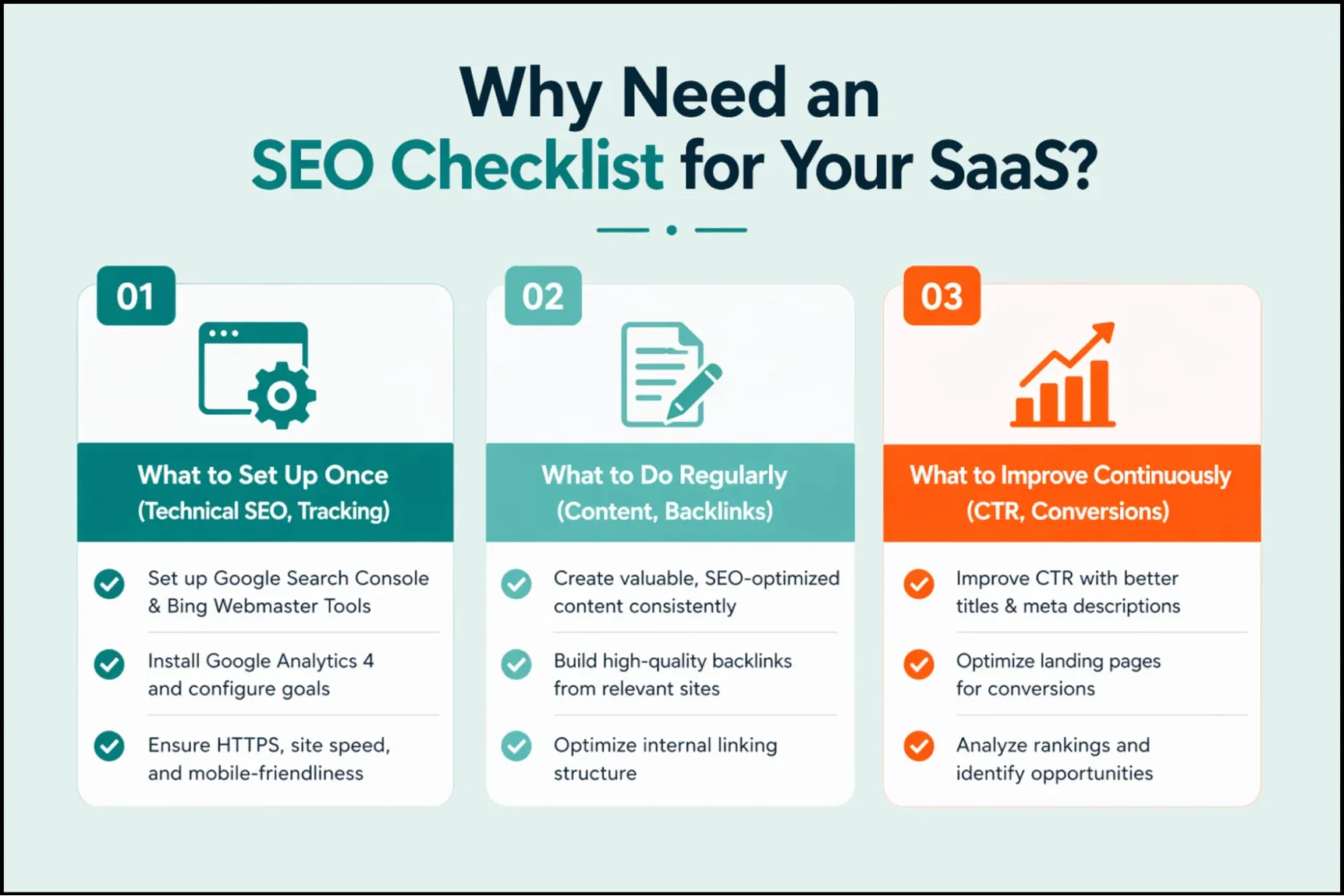
Key Takeaways:
- Focus on solving customer support challenges
- Strong use of structured sections for clarity
- Emphasis on customer experience and outcomes
Break complex products into simple sections to improve understanding.
Atlassian
Atlassian offers tools like Jira and Confluence, widely used by development and product teams.
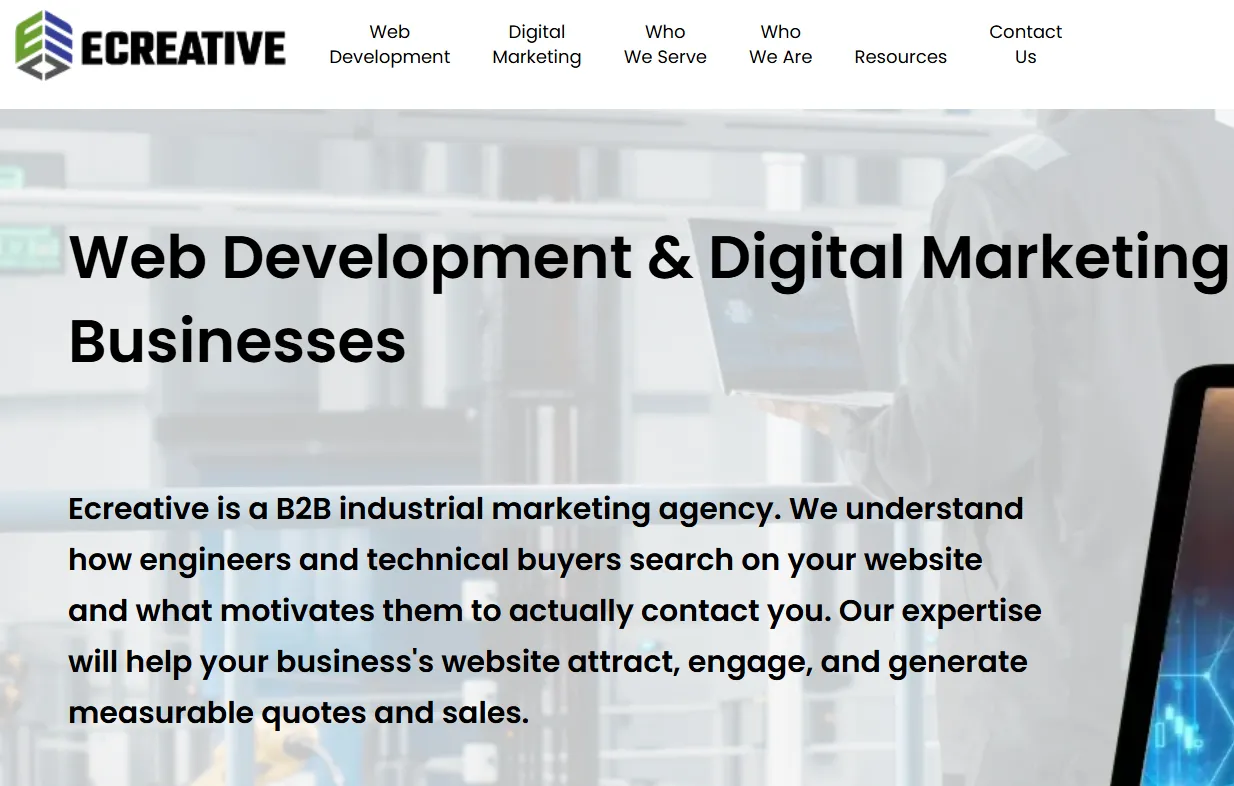
Key Takeaways:
- Clear product-focused messaging for specific teams (developers, product managers)
- Strong positioning around workflows and productivity
- Use of use cases instead of generic features
Tailor your messaging to specific roles or teams for better relevance.
Conclusion
B2B SaaS copywriting is not a talent; it is a discipline. Winning SaaS companies don’t rely on creativity alone; they follow a repeatable process to research buyers, apply frameworks, and refine copy until it drives action.
Start with one page. Apply one framework. Run one test. Better copy across your funnel compounds over time, and every word either drives conversions or loses them. The SERP Forge marketing team helps B2B SaaS companies turn that copy into a tested conversion system.
Frequently Asked Questions
What makes B2B SaaS copywriting different?
B2B SaaS copywriting focuses on logic, clarity, and business outcomes. Unlike general copy, it needs to address multiple decision-makers, longer sales cycles, and more complex products. It combines clear messaging with strong value communication to drive conversions.
How long should B2B SaaS copy be?
There’s no fixed length. The ideal length depends on your product complexity and audience awareness. Simple tools may need shorter copy, while complex SaaS products often require detailed explanations, use cases, and proof to convert effectively.
What type of copy converts best in SaaS?
Copy that focuses on real problems, clear outcomes, and specific use cases tends to perform best. Conversion-focused content that combines emotional triggers with logical proof (like data, testimonials, or case studies) usually drives higher conversions.
How do you improve SaaS copywriting performance?
Improve SaaS copy by testing headlines and CTAs, using customer insights, adding proof, and keeping language clear.
Regular testing and iteration are key to better saas conversion rate optimization.
Do you need technical knowledge for SaaS copywriting?
Basic understanding helps, but you don’t need deep technical expertise. What matters more is your ability to understand the product, ask the right questions, and translate complex features into simple, benefit-driven messaging.