


I’ve worked with enough SaaS teams to know the real problem is rarely traffic or lead generation. It is what happens after the signup.
Most teams focus heavily on increasing trial numbers. They optimize ads, celebrate signups, and assume growth is happening. Then they check MRR a few months later and realize it has barely moved.
What I see repeatedly is that SaaS funnels usually break after signup. Trial users drop off because activation was never clearly defined. Customers churn because retention and expansion were never prioritized. Meanwhile, acquisition costs keep rising while revenue leaks downstream.
A strong SaaS marketing funnel fixes this by making every stage intentional, from discovery to advocacy.
This guide breaks down the full funnel, including frameworks, metrics, tools, common mistakes, and saas marketing strategies that consistently drive sustainable SaaS growth.
What is a SaaS marketing funnel?
A SaaS marketing funnel is the complete customer journey a user takes from the first time they hear about your product to becoming a long-term customer who refers others.
What makes it different from a traditional funnel is simple: the sale is not the finish line.
In a traditional funnel, conversion is the goal. The customer buys once and the funnel ends. In SaaS, conversion is just the beginning.
The real goal is recurring revenue, and that depends on retention, expansion, and advocacy long after the first payment clears.
If your average customer stays for 4 months but your customer acquisition cost (CAC) takes 6 months to recover, you’re losing money on every new customer you bring in.
I’ve seen teams double their traffic while watching revenue stay flat for exactly this reason. Increasing retention by 10% will almost always be more profitable than doubling your traffic.
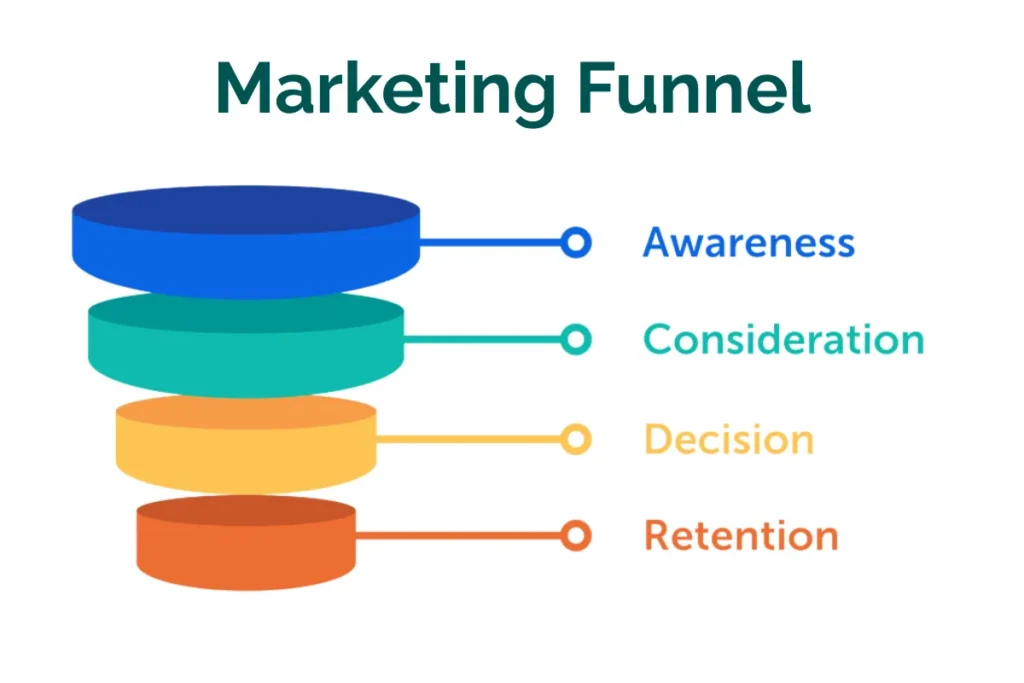
The Two SaaS Marketing Funnel Frameworks You Need to Know
Before getting into the stages, I want to establish two frameworks that work together. Most teams use one and ignore the other, which is why they have blind spots.
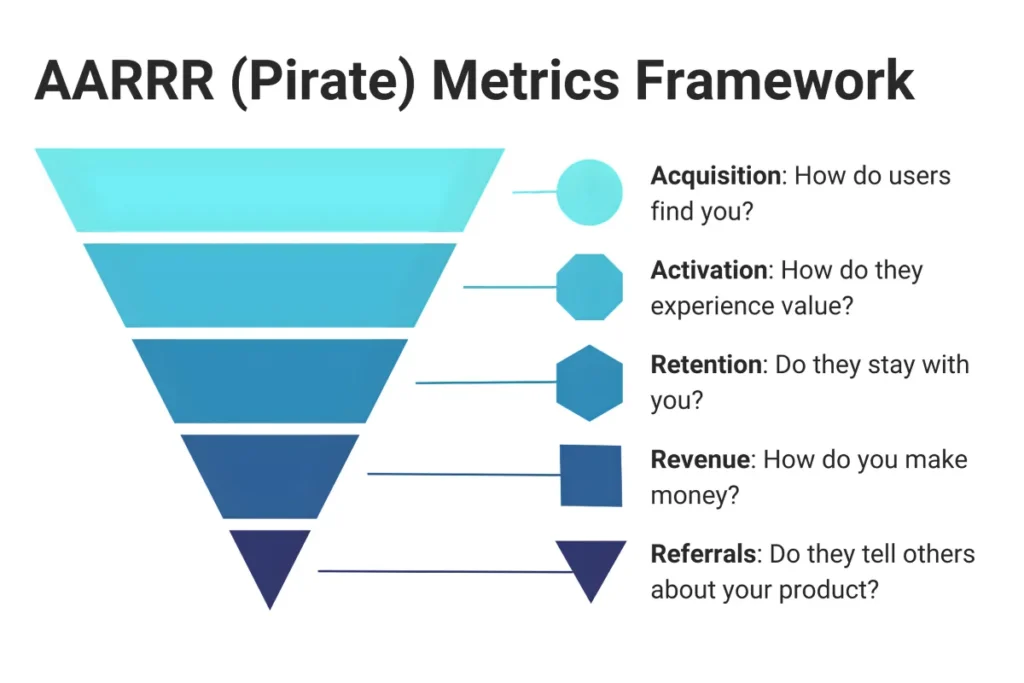
AARRR (Pirate Metrics)
AARRR is a product-focused framework that covers the full customer lifecycle. The five components are:
- Acquisition: How users find you
- Activation: First meaningful product experience
- Retention: Consistent, ongoing usage
- Referral: Word-of-mouth growth
- Revenue: Monetization and expansion
Use AARRR to measure what happens inside the product after signup. It’s your post-conversion operating framework.
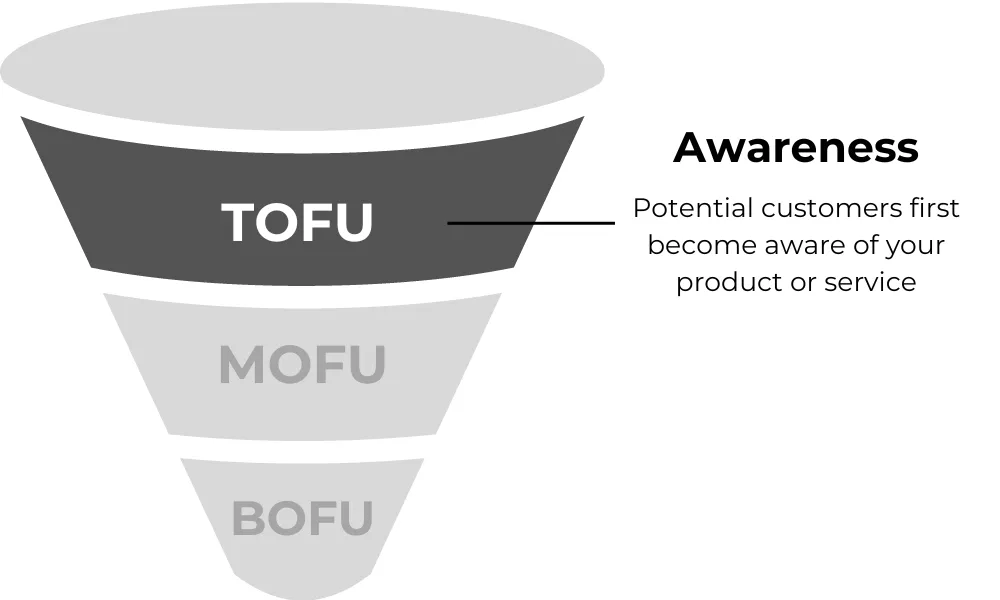
TOFU, MOFU, BOFU
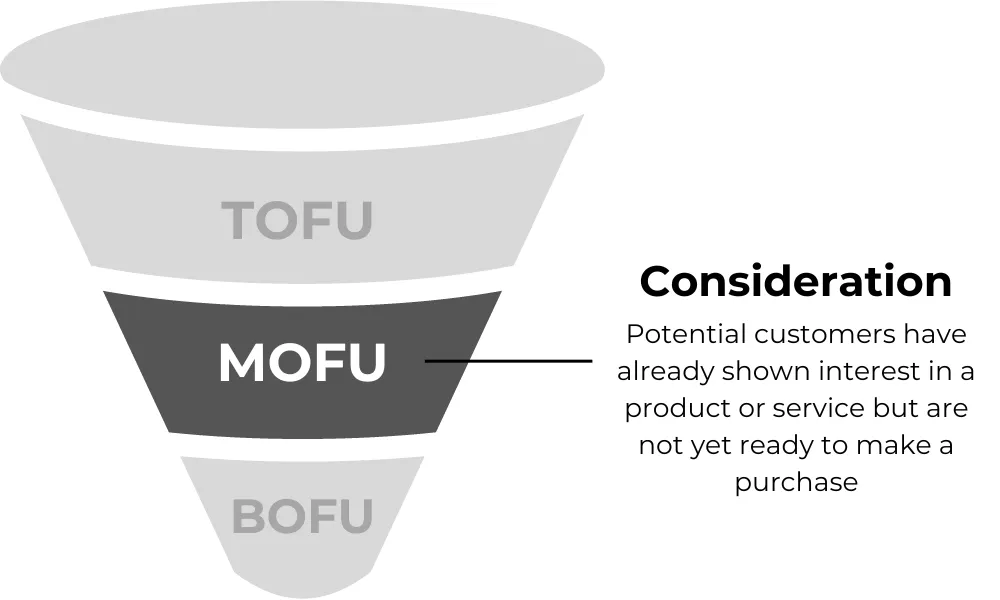
This content marketing framework maps to the pre-signup stages:
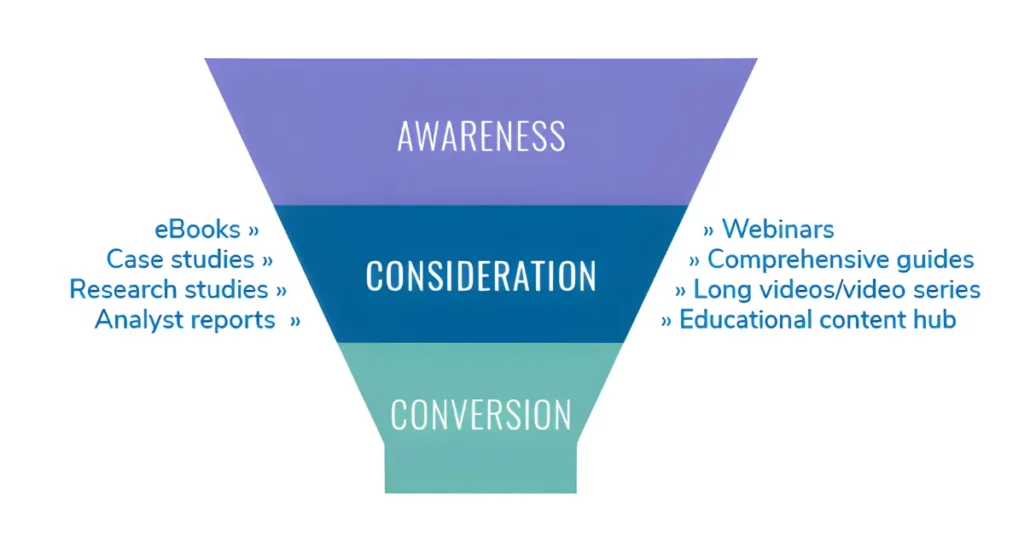
- TOFU (Top of Funnel): Awareness content for cold audiences who don’t know you yet
- MOFU (Middle of Funnel): Consideration content for warm leads who are evaluating options
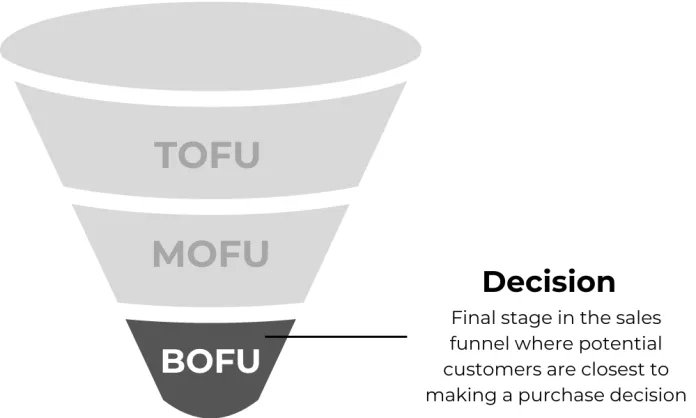
- BOFU (Bottom of Funnel): Conversion content for decision-ready prospects
Use TOFU, MOFU, and BOFU to attract and convert leads through content and campaigns.
How I use both frameworks together in practice within a saas marketing plan:
A TOFU blog post captures organic traffic. A MOFU webinar or template captures the email. A BOFU free trial page triggers activation.
Then AARRR metrics track everything that happens inside the product from that point forward.
Neither framework alone gives you the full picture. You need both.
What are the 7 Stages of a SaaS Marketing Funnel?
I’ve included it as a dedicated stage here because it deserves that attention.
Stage 1: Awareness
Awareness begins when potential customers first encounter your brand. They are not searching for your product directly.
Understanding the latest SaaS marketing trends can help teams identify where customer attention is shifting and which channels deserve the most investment.
They are searching for solutions to a problem your product solves, and many do not yet realize a tool like yours exists.
What I consistently see SaaS companies doing wrong is chasing high-volume keywords for vanity traffic. That usually attracts low-intent visitors.
A smaller audience with strong buying intent almost always outperforms larger traffic numbers with weak conversion rates.
Metrics to track at this stage:
- Organic traffic segmented by keyword intent
- Click-through rate (CTR) from search results
- Impressions and ranking positions for target keywords
- Social media engagement rate
- Referral traffic from communities and partner sites
Tools I recommend: Google Search Console, Ahrefs, Semrush, SparkToro, and LinkedIn Campaign Manager.
Did you know?
According to HubSpot’s 2025 marketing statistics, 74 % of marketers say content marketing helped them generate demand and leads, reinforcing how valuable top-of-funnel content is for reaching new audiences.
Stage 2: Engagement
Engagement is where interest turns into trust. The goal is to convert anonymous visitors into qualified leads who want an ongoing relationship with your brand.
What I see most often is SaaS teams generating decent traffic but relying on a generic newsletter signup as the primary conversion point. Broad offers rarely convert because they lack immediate value.
The best-performing MOFU assets I have built or seen are highly specific and instantly useful: churn calculators, SaaS dashboard templates, competitor teardowns, or practical frameworks that solve a focused problem quickly. These assets typically outperform generic ebooks by a wide margin.
Webinars work especially well in B2B because they humanize the brand. A prospect who joins live, asks questions, or actively engages during the session is significantly warmer than someone who passively downloads a PDF.
At this stage, I pay closer attention to behavioral signals than raw lead counts. Users who read multiple articles, interact with lead magnets, and spend meaningful time on pricing or saas landing pages show far stronger intent than passive subscribers.
Metrics to track at this stage:
- Email list growth rate
- Lead magnet download conversion rate
- Time on page and pages per session
- Webinar registration and live attendance rate
- Newsletter open rate and click rate
Tools I recommend: ConvertKit, Mailchimp, HubSpot, Hotjar, Microsoft Clarity, and Typeform.
Stage 3: Desire and Consideration
This is the stage where prospects experience product value before committing financially. It is also where many SaaS funnels quietly break down.
One of the biggest mistakes I see is treating free trials and freemium models as interchangeable. They solve different problems.
Free trials work best when users can experience value quickly. Giving full access for a limited period creates urgency and encourages faster decision-making.
Freemium models work better for product-led growth, where the product itself drives acquisition. Tools like Slack, Notion, and Figma use free access to drive adoption, while limits on features or seats create natural upgrade pressure over time.
The wrong model creates friction by design. I once worked with a team offering a 14-day trial for a product that required several days of setup before delivering value. Extending the trial to 30 days increased conversions by 40% without any other changes.
The most important concept at this stage is the activation moment. This is the specific action proving your product’s value to the user.
Everything in onboarding should push users toward this milestone. Teams that clearly define and optimize around activation often see dramatic increases in activation rates without changing the product itself.
Until users reach that moment, they remain at high churn risk.
Metrics to track at this stage:
- Free trial sign-up rate
- Trial activation rate (percentage of trial users who reach the activation moment)
- Demo request rate
- Time-to-activation (hours or days until users hit the activation moment)
- Feature engagement rate during trial
Tools I recommend: Mixpanel or Amplitude for product analytics, Intercom for in-app messaging and onboarding sequences, Appcues for in-product walkthroughs, Calendly for demo booking.
Good to know:
According to Userpilot’s SaaS benchmarks, the average SaaS activation rate is around 37.5%, meaning nearly two-thirds of users never reach their first meaningful product experience without proper onboarding and guidance.
Stage 4: Conversion
Once users are activated, the goal becomes removing friction from the buying process.
What I consistently find is that most conversion problems are not motivational. Users already want the product. The friction comes from confusing pricing models, unclear upgrade paths, complicated checkout flows, or poorly timed sales processes.
Pricing clarity is critical. Hidden fees, overlapping plan tiers, or forcing sales calls for standard purchases create unnecessary resistance.
I have seen companies improve conversion rates simply by simplifying pricing pages, reducing plan options, and making upgrade paths more obvious.
For higher-ticket B2B deals, the process becomes more relationship-driven. Security reviews, procurement approvals, legal discussions, and stakeholder buy-in all become part of the funnel.
At this level, sales support matters because trust becomes just as important as product value.
Tactics that consistently improve conversion:
- Trigger emails based on user behavior, not just trial expiry
- Show upgrade prompts when users hit feature limits
- Use exit-intent offers before trials expire
- Add strong social proof near pricing and checkout pages
Metrics to track at this stage:
- Trial-to-paid conversion rate (B2B SaaS benchmark is 15 to 25%)
- Demo-to-close rate
- Customer acquisition cost (CAC)
- Sales cycle length
- Pricing page conversion rate
Tools I recommend: ChartMogul or Baremetrics for subscription analytics, ProfitWell for revenue data.
Stage 5: Retention
Retention is where SaaS growth compounds or breaks down. If you are not tracking NRR (Net Revenue Retention), you do not fully understand business growth.
Strong SaaS companies typically maintain:
- 3% to 8% monthly churn
- NRR above 100%
- Top performers often exceed 120% NRR
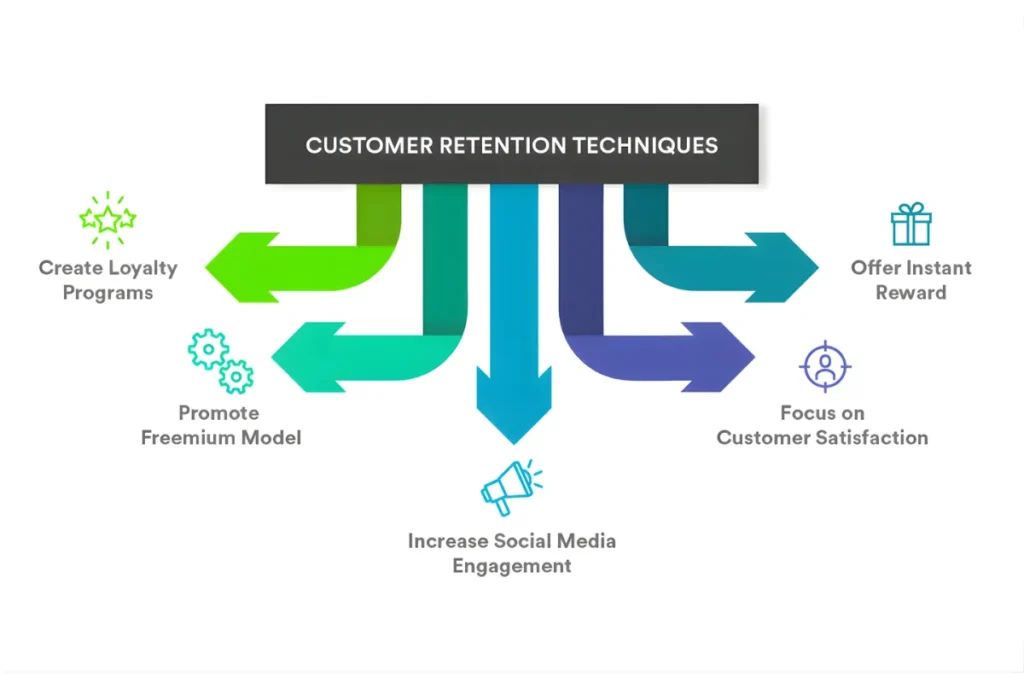
One mistake I made early was focusing too much on reactive support. Fast responses do not save customers who quietly stop using the product. Most churn decisions happen long before cancellation.
The biggest retention lever is proactive customer success powered by product usage data.
Common churn signals:
- Lower login frequency
- Reduced feature usage
- Rising support tickets
- Declining engagement in core workflows
These signals usually appear weeks before churn, creating time to intervene.
Retention tactics that work:
- Usage-based re-engagement instead of generic reminder emails
- Ongoing education through feature tips and webinars
- Community-driven engagement via Slack groups or forums
- Strategic QBRs for high-value accounts
Users adopting more features generally retain longer because the product becomes harder to replace.
SaaS metrics to track at this stage:
- Monthly churn rate
- Net Revenue Retention (NRR)
- Daily and weekly active users (DAU and WAU)
- Feature adoption rate across the product
- Customer satisfaction score (CSAT)
- Support ticket volume and average resolution time
Tools I recommend: Gainsight or ChurnZero for customer success management, Zendesk for support operations, Delighted or Typeform for NPS and CSAT surveys.
Quick insight:
According to a study, top SaaS companies focus heavily on retention, with net revenue retention (NRR) benchmarks around 106 % and top performers exceeding 120 %, meaning they grow revenue from existing customers even after accounting for churn.
Stage 6: Upsell and Expansion
Expansion revenue is one of the most profitable SaaS growth channels because trust already exists.
There are two distinct motions inside this stage, and treating them the same way is a mistake:
Upsell
- Moving customers to higher tiers
- Best triggered by usage patterns like seat, storage, or API limits
Cross-sell
- Introducing complementary products or add-ons
- Works best after strong adoption of the core product
What I’ve learned about doing this well: use product data, not gut feel or arbitrary check-in schedules.
If a customer’s team has grown from 3 users to 9 users on a 5-seat plan, that’s a data-backed signal to reach out about a team plan.
If a customer exports reports manually every single week because they’re on a plan without automated reports, that’s a signal they’d immediately see value in the next tier up.
Metrics to track at this stage:
- Upsell conversion rate
- Average Revenue Per User (ARPU)
- Expansion MRR (monthly recurring revenue generated from upgrades and cross-sells)
- Net Revenue Retention (NRR) as the combined outcome of retention and expansion
Tools I recommend: Baremetrics for expansion MRR tracking, HubSpot or Salesforce for upsell pipeline managemen
Stage 7: Advocacy
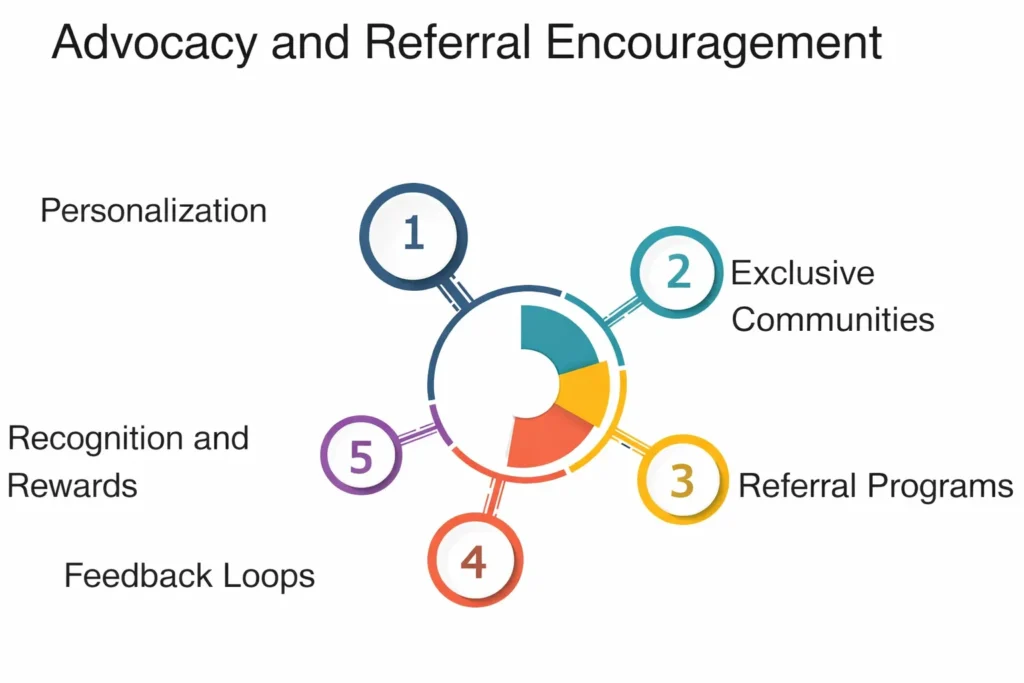
Advocacy makes the SaaS funnel self-sustaining. Referred customers usually convert faster, trust the product sooner, and reduce CAC over time.
What I have consistently seen is that referral programs alone do not create advocacy. Customers promote products that genuinely improve outcomes.
Strong advocacy drivers:
- Product-aligned referral rewards
- Review requests timed after positive outcomes
- Customer case studies and success stories
- Community participation and visibility
Case studies are especially powerful because they strengthen customer relationships while creating high-converting BOFU content.
Metrics to track at this stage:
- Net Promoter Score (NPS)
- Referral conversion rate
- Number of reviews and average rating on G2, Capterra, and Trustpilot
- Referral-driven revenue as a percentage of total new MRR
- Brand mentions and share of voice across social channels
Tools I recommend: ReferralCandy or Rewardful for referral program management, Mention for social listening, G2 and Capterra for review management and monitoring.
How to create saas marketing funnel(with example)
Creating a SaaS marketing funnel starts with understanding that growth doesn’t come from sign-ups alone.
A strong funnel is built to guide users from discovery to long-term usage, ensuring they experience value early and stay engaged over time.
Step 1: Start with data, not assumptions
Before building anything new, pull your last 12 months of conversion data. Where do users drop off? What’s the average time from first visit to free trial? What’s your trial-to-paid rate broken down by acquisition channel?
Build your funnel around what’s actually happening, not what you think should be happening. Every team I’ve worked with has been surprised by at least one finding when they do this exercise properly.
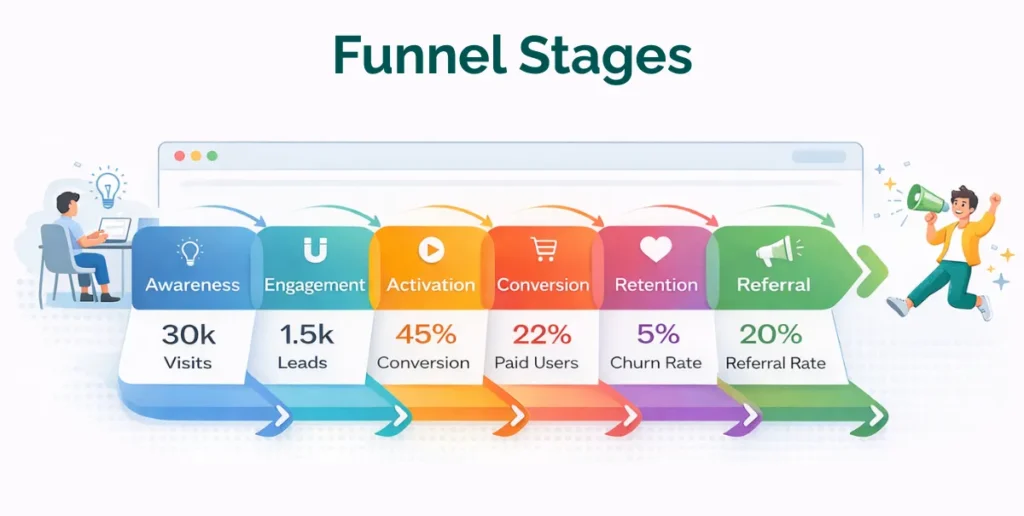
Step 2: Define your activation moment
This is the single most important decision in funnel design. Talk to your 10 best customers and ask them one question: “What was the moment you knew this product was going to work for you?” The answer will be strikingly consistent across the group.
That consistency is your activation moment. Build your entire onboarding sequence around driving new users to that exact point.
Step 3: Map every stage to a goal, a tactic, and a metric
Every stage of the funnel needs three things clearly defined before you build anything:
- A clear goal (what should the user do or feel at this stage)
- A specific tactic (what content, product experience, or outreach drives that behavior)
- A measurable metric (how you know whether the stage is working)
If a stage exists in your documentation but not in your analytics dashboard, it doesn’t exist in practice.
Step 4: Choose your funnel model
Your model determines your entire activation motion:
- Free trial works best for products with fast time-to-value. Your entire focus should be the Day 1 experience.
- Freemium works best for PLG products where the product’s basic value is self-evident and viral. Your focus should be converting power users who hit the free tier’s natural limits.
- Demo-led works best for complex, high-ACV B2B products. Your focus is on discovery calls, consultative selling, and reducing perceived risk.
Mixing signals here creates a confused funnel. Pick the model that matches your product’s actual value delivery timeline.
Step 5: Build your re-engagement sequences
Not every user follows the path you designed, and that’s fine. What’s not fine is having no plan for when they stray.
Set up behavior-based re-engagement for users who:
- Sign up but don’t hit the activation moment within 48 hours
- Go inactive for 7 or more days after activating
- Reach their plan limits without upgrading
- Approach their renewal date without any recent product activity
Step 6: Track, measure, and iterate monthly
Funnel optimization is not a one-time project. Review your stage-by-stage metrics every month.
Identify the single stage where improving conversion would have the biggest downstream impact and focus there before touching anything else.
Trying to optimize every stage simultaneously is how you optimize nothing.
How HubSpot Runs Its SaaS Marketing Funnel?
HubSpot is worth studying because its entire growth engine reflects the same funnel principles its product helps customers manage.
At the awareness stage, HubSpot uses several B2B SaaS marketing channels, including SEO-focused blog content, free tools, and educational resources to drive traffic and demand.
Free tools like website graders, templates, and generators attract top-of-funnel users with almost no friction.
For engagement, HubSpot uses gated ebooks, templates, and courses to capture leads and segment them by intent. Follow-up nurturing is personalized based on user behavior and content interests instead of generic email sequences.
Its consideration stage is powered by a strong PLG model. The free CRM delivers immediate value, while product limitations naturally reveal the benefits of upgrading to paid hubs and advanced features.
Conversion is heavily behavior-driven. Upgrade prompts appear when users hit usage limits, and sales teams focus on accounts showing strong activation signals instead of contacting every trial user.
Retention and expansion are strengthened through HubSpot Academy certifications, which create deeper product adoption and internal champions inside customer organizations. Users who invest time learning the platform are far less likely to churn and more likely to support upsells internally.
For advocacy, HubSpot actively encourages customer reviews on platforms like G2 and Capterra while consistently publishing customer case studies that simultaneously improve retention and strengthen conversion through social proof.
The result is consistently strong NRR above 110%, allowing revenue from existing customers to grow even without relying entirely on new customer acquisition.
Conclusion
In our saas marketing agency, we built and optimized SaaS marketing funnels long enough to know that the teams who get this right are not necessarily the ones with the biggest acquisition budgets.
They’re the ones who obsess over their activation rates, know their CLTV-to-CAC ratio by heart, and treat retention as a product problem, not just a marketing responsibility.
The funnel I’ve laid out in this guide is not theoretical. Every stage, every metric, every tactic here comes from real implementation, including the failures.
Start with the stage where you’re leaking the most. For most SaaS products, that’s activation or early retention.
Fix that before scaling anything else. The compounding effect of strong retention makes every other part of the funnel more efficient.
Build the funnel right, and growth becomes predictable. Keep patching it reactively, and you will keep refilling a leaking bucket.
FAQs about Marketing Funnel
What is the biggest mistake SaaS companies make in their marketing funnel?
The most common mistake is focusing too much on acquisition while ignoring activation and retention. Many SaaS teams drive traffic and sign-ups but fail to help users experience value early, which leads to low conversions and high churn.
How long does it take to see results from a SaaS marketing funnel?
Results vary by stage. Awareness and engagement efforts like SEO and content usually take a few months to show impact, while improvements in activation, conversion, and retention can deliver faster results once onboarding and follow-ups are optimized.
Which stage of the SaaS marketing funnel should teams optimize first?
For most SaaS businesses, Activation and Retention should come first. Improving onboarding, time to first value, and ongoing engagement often increases revenue faster than simply driving more traffic.
How is a SaaS marketing funnel different from a SaaS sales funnel?
A SaaS sales funnel mainly focuses on converting leads into paying customers. A SaaS marketing funnel goes further by supporting the entire lifecycle, including onboarding, product usage, renewals, upgrades, and referrals.
Do early-stage SaaS startups need a full funnel?
Yes, but it doesn’t need to be complex. Early-stage SaaS teams should focus on a simple funnel that clearly covers Awareness, Activation, and Retention first, then expand to referrals and upgrades as the product and user base grow.