


SaaS founders who skip the marketing plan usually discover the cost around month four, when the budget is half gone and the pipeline unchanged from day one.
The channel mix made sense on paper and content went out on schedule. But when the quarter ended, revenue looked identical to day one because nothing connected to a stage-specific plan.
A saas marketing plan template gives your team one document to execute from. It identifies which channels belong at your current stage, how to allocate budget without guessing, and which metrics predict revenue.
And that last part matters more than anything else in this guide.
This guide gives you a stage-specific saas marketing plan template for 2026, with a practical template for each phase, real benchmarks, and the mistakes worth catching before they compound.
What is a SaaS Marketing Plan Template?
A saas marketing plan template is a framework that defines your target customer, marketing goals, B2B SaaS marketing channels, budget allocation, and saas marketing strategy, all tied to your current growth stage.
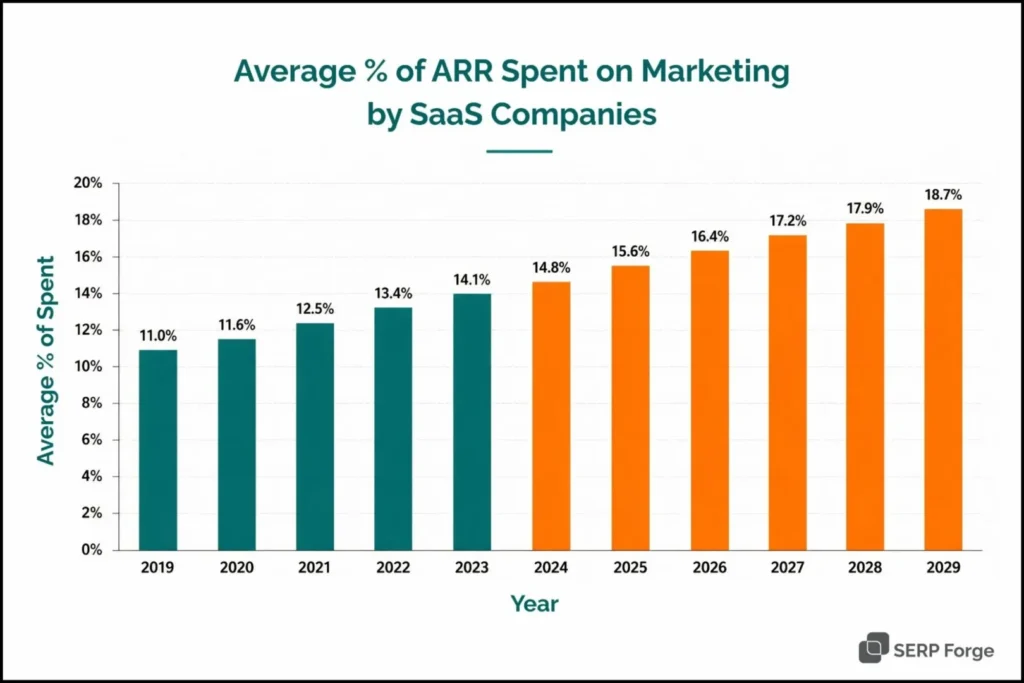
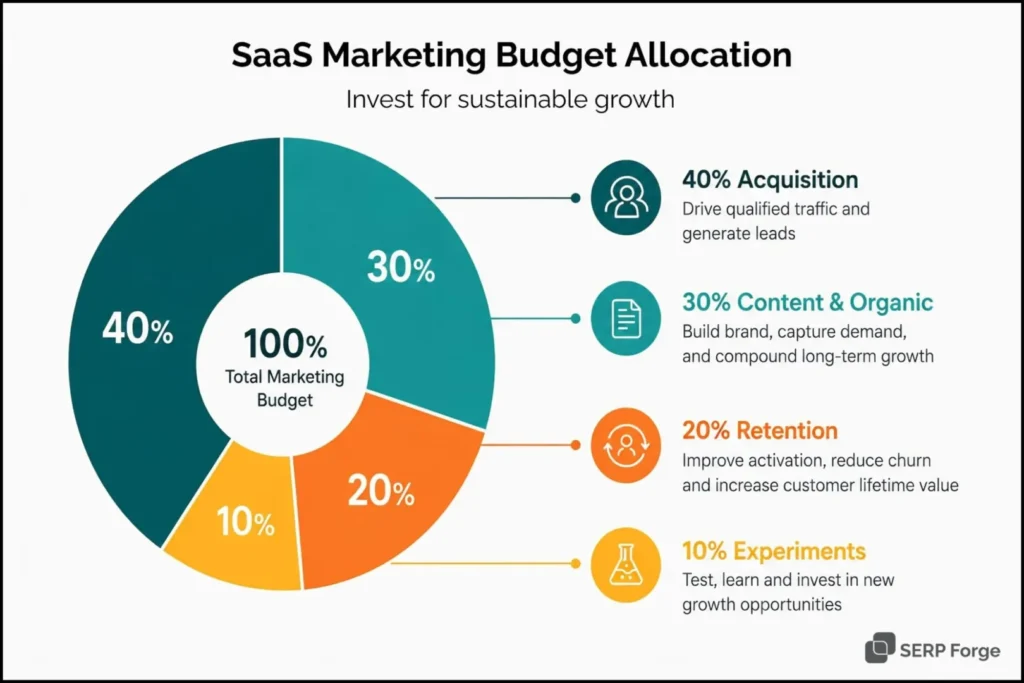
No SaaS marketing plan is complete without a well-defined SaaS marketing budget.
Option 4:
Unlike a generic business plan, it accounts for recurring revenue, which makes churn and expansion marketing problems just as much as acquisition is.
A well built saas marketing strategy template covers:
- Ideal Customer Profile and buyer personas
- Quarterly goals tied to specific KPIs
- Channel priority and execution sequence
- Budget allocation by growth stage
- Messaging and positioning framework
- Named owners for every deliverable
- Quarterly review cadence
Why SaaS Companies Need a Marketing Plan Template?
A documented plan is the difference between a team that compounds results and a team that restarts from zero every quarter.
Without a structured b2b saas marketing plan, four expensive patterns repeat themselves. Budget spreads thin across channels nobody committed to. Teams optimize for signups that churn in week one. Marketing and product operate without alignment, so launches land flat. Competitors drive strategic decisions instead of ICP research.
According to McKinsey, B2B SaaS companies with good NRR consistently outperform on revenue growth. This makes retention and acquisition planning equally critical in any marketing plan. At current SaaS acquisition costs, a plan built on assumptions is a structural drain on growth capital.
How to Use This SaaS Marketing Template?
Three rules apply before you read the stage sections. Follow all three or the template will not hold under operational pressure:
- Identify your stage first: The wrong plan for your stage sets you back further than having no plan. Read all four stages, identify where your company stands today, and start from that section only.
- Replace every placeholder with real data: A template with generic fields is a document. A template filled with your actual ICP, budget, and goals is a plan your team executes without asking for clarification.
- Schedule the review before execution starts: Write the 90-day review date into the document before the first campaign launches. A plan without a review cadence becomes irrelevant by month four.
The SaaS Marketing Plan Template For Each Stage of Your SaaS
Every stage of SaaS growth demands a different plan, channel priorities, success metrics, and saas marketing funnel. The templates below are built from SERP Forge’s research across SaaS companies at each phase. Use the section that matches where your company stands today.
Stage 1: Pre-Launch
You have no customers yet. Your job is to validate your positioning, build an early audience, and create demand before the product goes live.
Want to know what separates the launches that get traction from the ones that go quiet?
The teams that win at pre-launch treat this stage as research and relationship work. The ones that lose treat it as a product problem and assume marketing starts on launch day, when it is already too late to build an audience from scratch.
The trap at this stage: Months go into product development with no audience built alongside it. The product goes live, nobody is waiting, and there is no runway left to fix that.
Use this SaaS product launch plan to align product, marketing, and distribution before launch.
Pre-Launch Template:
| Area | Do This |
|---|---|
| ICP | Define one primary persona with a clear job title, industry, core pain point, and trigger event. |
| Positioning | “We help [ICP] achieve [outcome] without [friction they currently face].” |
| Primary Goal | Generate 300–500 waitlist signups before the launch date. |
| Channel 1: SEO | Create two to three blog posts targeting problem-aware keywords your ICP already searches for. |
| Channel 2: Outreach | Use founder-led LinkedIn outreach and community engagement with at least 20 ICP conversations per week. |
| Channel 3: Landing Page | Create one focused landing page with a single CTA and test two headline variations. |
| Build a three-email welcome sequence over 14 days focused on the core problem your product solves. | |
| Budget Split | Allocate 60% to content and SEO, 30% to paid social testing, and 10% to tools. |
| KPIs | Track waitlist conversion rate, email open rate, and community engagement volume. |
| Owner | Founder or first marketing hire. |
| Review Date | Review performance and strategy 30 days before the planned launch. |
Paid ads to an unoptimized saas landing page produce spend data with no learning attached to it. Content written without keyword research attracts the wrong audience at real acquisition cost, and you will not know it until the budget is gone.
Stage 2: Early Traction
You have launched and you have some customers. Your job now is to find one repeatable acquisition channel before you scale anything else.
Here is what most teams miss at this stage:
One channel that converts your ICP consistently is worth more than five channels with occasional results. The teams that scale all five simultaneously end up with diluted data, exhausted budgets, and no defensible answer about what worked.
The trap at this stage: Founders scale spend before messaging converts organically. The team grows before the model proves itself. Activation gets ignored while acquisition absorbs all the attention and budget.
Early Traction Template:
| Area | Do This |
|---|---|
| ICP (Refined) | Update your ICP using insights from the first 20–50 customers. Document who stayed, who churned, and the reasons behind each outcome. |
| Primary Goal | Reach the first $10K MRR or 100 active users. Clearly define what traction means for your product. |
| Channel 1: SEO | Create four to six bottom-of-funnel blog posts and publish at least one competitor comparison page. |
| Channel 2: Paid | Focus on one paid acquisition channel with a defined spend cap and 30-day success criteria before scaling. |
| Channel 3: Outbound | Conduct ten qualified ICP conversations per week for ongoing market validation. |
| Build an activation email sequence for trial users based on in-product behavior and engagement. | |
| Messaging | Test two value propositions through landing page variants and lead with outcomes instead of features. |
| Budget Split | Allocate 50% to organic content, 30% to paid testing, and 20% to email and onboarding optimization. |
| KPIs | Track free trial-to-paid conversion rate, activation rate, MQL volume, and monthly churn. |
| Owner | The marketing lead should manage execution with founder involvement in sales conversations. |
| Review Date | Review performance, messaging, and acquisition channels every six weeks. |
Stop Here: A full marketing team hire before the model proves itself adds overhead with no corresponding clarity. Poor onboarding at this stage kills more revenue than weak acquisition ever does, because users who do not activate never become the customers your acquisition cost assumed they would.
This is also when getting your value based pricing saas model right matters most if your price doesn’t reflect the outcome you deliver, activation and conversion both suffer.
Stage 3: Growth
You have a repeatable channel. The goal now is to scale it without destroying your unit economics, and that line is easier to cross than most growth-stage teams expect.
Pipeline velocity, CAC payback period, and net revenue retention drive every resource decision at this stage. According to ChartMogul’s SaaS Benchmarks, mid-market SaaS companies run monthly churn between 1.5% and 2.5%. Keeping churn inside that range while growing the pipeline is the dual mandate your plan must address directly.
The trap at this stage: New channels get added before existing ones get maximized. Content volume targets override quality. Expansion revenue from existing customers goes untracked while acquisition spend climbs quarter over quarter.
Growth Stage Template:
| Area | Do This |
|---|---|
| ICP (Locked) | Document primary and secondary personas and align them across the sales and marketing teams. |
| Primary Goal | Achieve 3× pipeline growth quarter-over-quarter while maintaining NRR above 100%. |
| Channel 1: SEO | Publish eight to twelve mid- and bottom-funnel posts per month, including category comparison pages and customer case studies. |
| Channel 2: LinkedIn | Post organic LinkedIn content four times per week and run retargeting plus competitor keyword campaigns. |
| Channel 3: Email | Create segmented nurture sequences based on persona type and funnel stage. |
| Channel 4: Partnerships | Build relationships with two to three channel partners that share the same ICP and support co-marketing initiatives. |
| Paid Strategy | Focus paid campaigns on retargeting, branded search, and competitor keyword targeting. |
| Budget Split | Allocate 40% to organic and SEO, 35% to paid acquisition, 15% to events and partnerships, and 10% to tools. |
| KPIs | Track CAC, CAC payback period, MQL velocity, pipeline value, NRR, and churn by cohort. |
| Team | Build a team that includes a content lead, demand generation specialist, SEO specialist, and marketing operations support. |
| Review Date | Review performance monthly with a deeper strategic analysis every quarter. |
Expansion revenue from existing customers costs less than new acquisition at every growth stage. A plan that only measures new pipeline leaves compounding revenue untracked, and that gap widens every quarter you ignore it.
Stage 4: Scale
The model is proven. The focus now shifts to efficiency, market share, and systems that sustain as the team grows around them.
But scale-stage companies share one consistent blind spot:
They cut brand investment for short-term performance spend and weaken the direct traffic asset they spent years building.
According to HubSpot, scale-stage companies shift emphasis from pure acquisition to retention and referral as primary revenue drivers. SaaS companies with NRR above 120% grow revenue from the existing customer base before a single new customer signs a contract.
Scale Stage Template:
| Area | Do This |
|---|---|
| ICP (Expanded) | Define your primary ICP along with one to two adjacent customer segments and document clear market entry points for each. |
| Primary Goal | Maintain NRR above 110%, keep CAC payback under 12 months, and achieve pipeline coverage at 4× the quarterly target. |
| Channel 1: ABM | Run account-based marketing programs for enterprise segments using personalized content and direct outreach. |
| Channel 2: SEO | Create pillar pages, publish original research reports, and target enterprise-level keywords. |
| Channel 3: Community | Build and manage an owned community that supports both acquisition and customer retention. |
| Channel 4: Partners | Develop a partner ecosystem with co-selling, co-marketing, and integration partnerships. |
| Paid Strategy | Use a full-funnel paid strategy that includes awareness campaigns, retargeting, competitor conquest campaigns, and account-level targeting. |
| Budget Split | Allocate 30% to organic and brand, 40% to paid acquisition and ABM, 20% to events and partnerships, and 10% to tools. |
| KPIs | Track LTV:CAC ratio (minimum 3:1), NRR by segment, pipeline by source, and churn by cohort. |
| Team | Build a full marketing function including RevOps, content, paid media, SEO, design, and partnerships teams. |
| Review Date | Conduct monthly reviews with detailed board-level reporting every quarter. |
Stop Here: SMB churn at 4.5% to 6% monthly compounds into a revenue problem faster than most finance models account for. A scale-stage plan that ignores segment-level churn will hit a growth ceiling earlier than the team expects, and the fix is always more expensive at that point than it would have been a year before.
What are the Common Mistakes to Avoid While Creating a SaaS Marketing Plan?
Even well-resourced SaaS teams make the same planning errors. Here are the ones worth catching before they cost you:
- Copying a competitor’s stage instead of your own: A tactic behind a $50M ARR company depends on brand authority and content volume your company does not have yet. Stage determines the winning pattern.
- Goals without named owners: Every KPI in your saas marketing plan template needs one specific person responsible for it with a deadline attached. A shared goal with no owner is a goal nobody owns.
- ICP definition skipped or delayed: Every section of a b2b saas marketing plan flows from knowing exactly who you sell to. Without a sharp ICP, messaging stays generic and channels stay random.
- Paid spend scaled before organic converts: Organic traffic compounds over time without incremental spend, meanwhile paid stops the moment budget stops. Build the channel that stays first, then use paid to accelerate what your ICP already responds to.
- Email deprioritized in favor of newer channels: Email reaches your ICP directly, costs nothing per send at scale, and gets better with segmentation. The teams that deprioritize it in favor of newer channels find out what they lost when the nurture pipeline dries up.
Best SaaS Marketing Plan Template Examples
The templates above are built specifically for SaaS teams at each growth stage. Each one maps channel priorities, budget splits, KPIs, and owners to where your company stands today.
Want to see how they apply to your specific product and ICP?
The SERP Forge team builds custom versions of these templates for SaaS companies based on stage, category, and growth goals. A plan your team executes from day one, with the numbers and owners already filled in.
Do You Need SERP Forge to Create a Marketing Plan?
You can take this saas marketing plan template and run with it. The framework is complete and the templates are yours to use.
But here is where the gap usually appears:
The strategy document gets finished, the content calendar never gets populated, the SEO program stalls at keyword research, and the paid channel runs one inconclusive test before the team moves on. Six months later, the plan document sits unchanged and the pipeline has not moved.
That is an execution gap. And it is what SERP Forge closes.
SERP Forge is a SaaS-specialized growth partner built around CAC payback, activation journeys, and organic traffic that converts to revenue. What you get from day one:
- SaaS marketing strategies mapped to your ICP and growth stage with channel sequencing your team executes against from week one
- SaaS content strategy built around keywords that convert at the bottom of the funnel, not just keywords that rank at the top
- Product-led marketing that turns your product experience into a repeatable acquisition channel
If your team has the strategy but not the bandwidth to execute at the level your growth stage demands, SERP Forge covers both.
Conclusion
A quarter from now, your pipeline will reflect the quality of the decisions you make this week.
The founders and marketing leads who outperform their category are not working harder than everyone else. They committed to a plan that matched their stage, assigned real owners to every goal, and reviewed it before the results gave them a reason to.
That discipline is available to any SaaS team. The template is in your hands. The only question left is whether execution follows.
Frequently Asked Questions
1. What should a SaaS marketing plan template include?
A saas marketing plan template should include your ICP, quarterly goals tied to KPIs, channel priorities, budget allocation by growth stage, and named owners for every deliverable.
2. How do you create a b2b saas marketing plan template for early traction?
Refine your ICP from your first 20 to 50 customers. Document who stayed, who churned, and the specific reason for each outcome.
Set one primary goal tied to a revenue or activation milestone. Select two to three channels: SEO for long-term organic, one paid channel for demand validation, and direct outbound for ICP confirmation.
The goal is one repeatable channel with validated unit economics before scaling anything else.
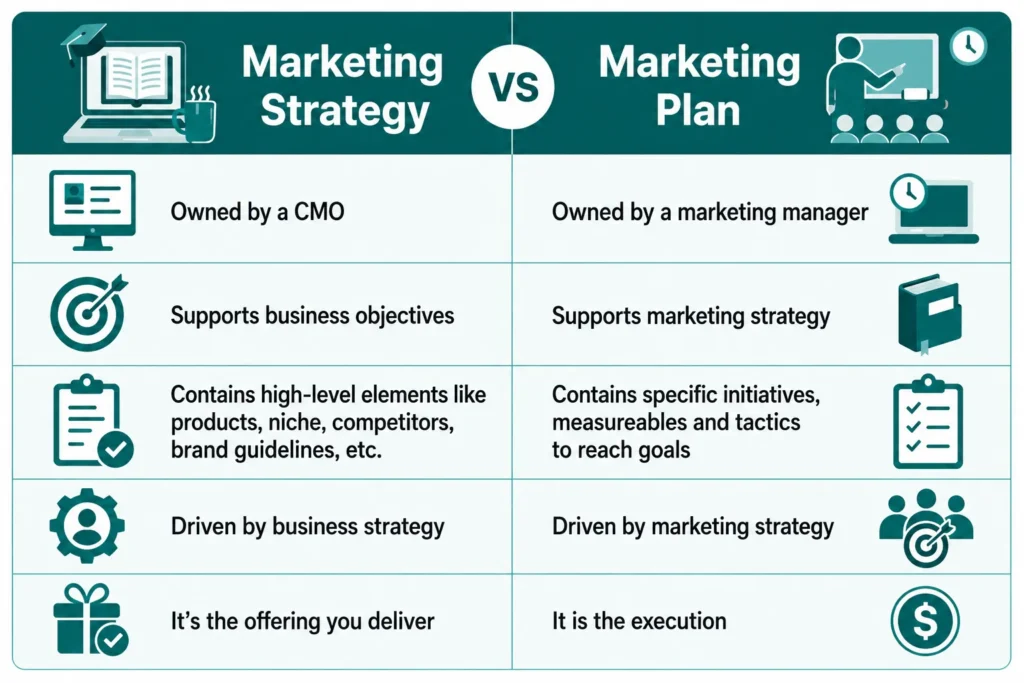
3. What is the difference between a SaaS marketing plan and a saas marketing strategy template?
A saas marketing strategy template defines direction: which customer you target, how you position the product, and which channels you use. A saas marketing plan template turns that direction into execution by adding goals, budgets, owners, and timelines.
Strategy answers why and what. The plan answers how, when, and who is responsible.
4. How often should a SaaS marketing plan template be updated?
Review it every quarter: goals, channels, budget allocation, and ICP assumptions. Check KPIs monthly against targets, and update immediately if a significant shift occurs, such as a new competitor or a measurable ICP change.
5. Which channels should a b2b saas marketing plan focus on at each stage?
It depends entirely on your current growth stage. The right channel at scale will drain the budget at pre-launch.
Pre-launch focuses on a waitlist landing page, LinkedIn outreach, and two to three foundational SEO articles.
Early traction adds one paid testing channel and direct outbound. At every stage, maximize what is already working before adding anything new.