



Some backlinks build authority for your website. Others build authority for backlinks. That second idea is the entire premise behind tiered link building. To build the first kind for a SaaS site, explore SERP Forge SaaS backlinks.
It’s a structured approach to organizing link-building tiers that has split the SEO community for over a decade.
A careless tiered backlink strategy can look exactly like the link schemes Google’s spam systems are built to catch.
A deliberate one, with tier 1, tier 2, and tier 3 backlinks layered correctly, can compound the value of a few strong placements without the cost of building everything at full strength.
This guide covers what tiered link building is, how each tier works, whether it still matters in 2026, and how to build tiered links without tripping a penalty.
What Is Tiered Link Building?
Tiered link building is a link-building method that organizes backlinks into layers.
Lower layers point at the backlinks above them instead of pointing directly at your website.
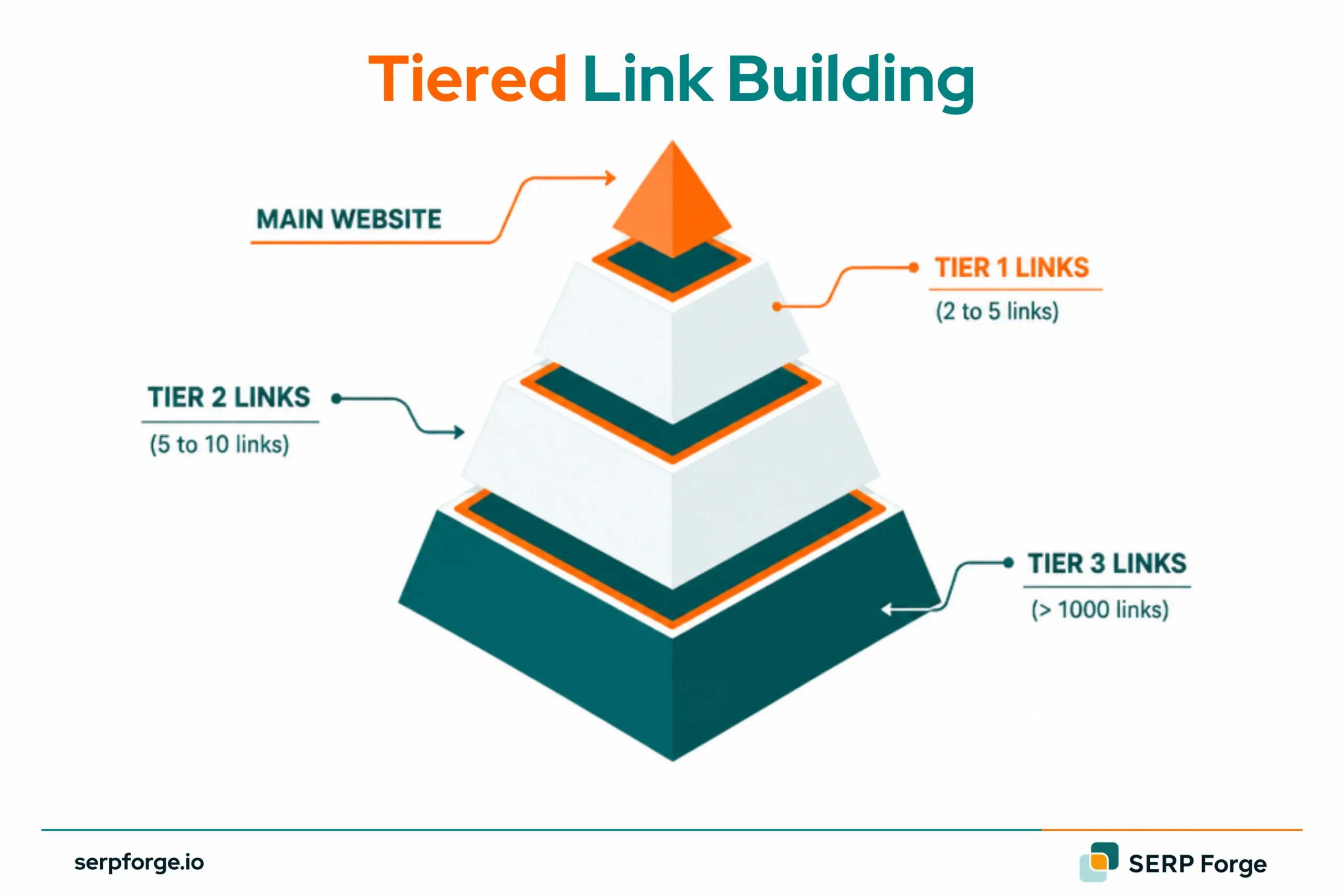
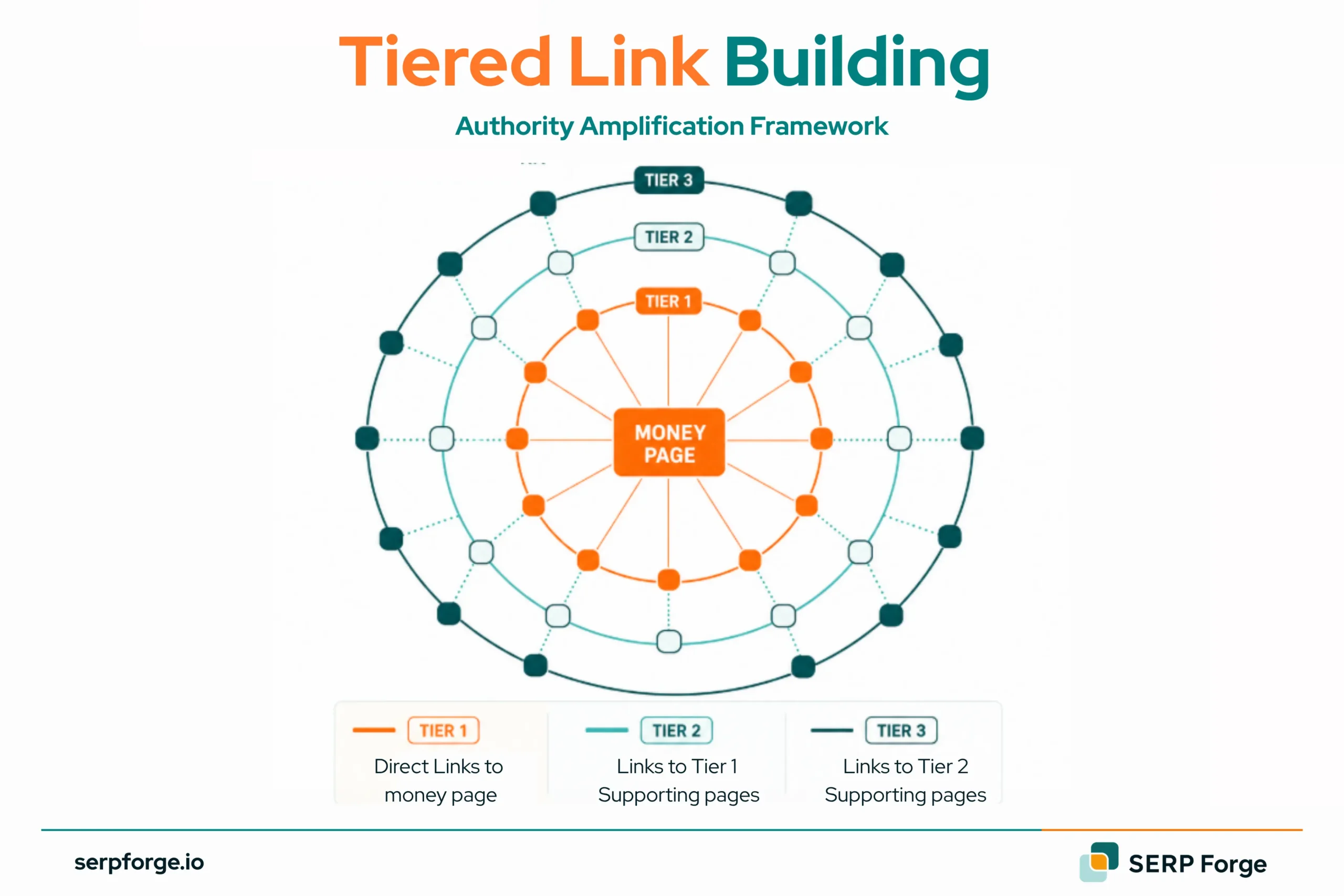
Picture three rows stacked like a pyramid. Some practitioners call this link pyramid SEO.
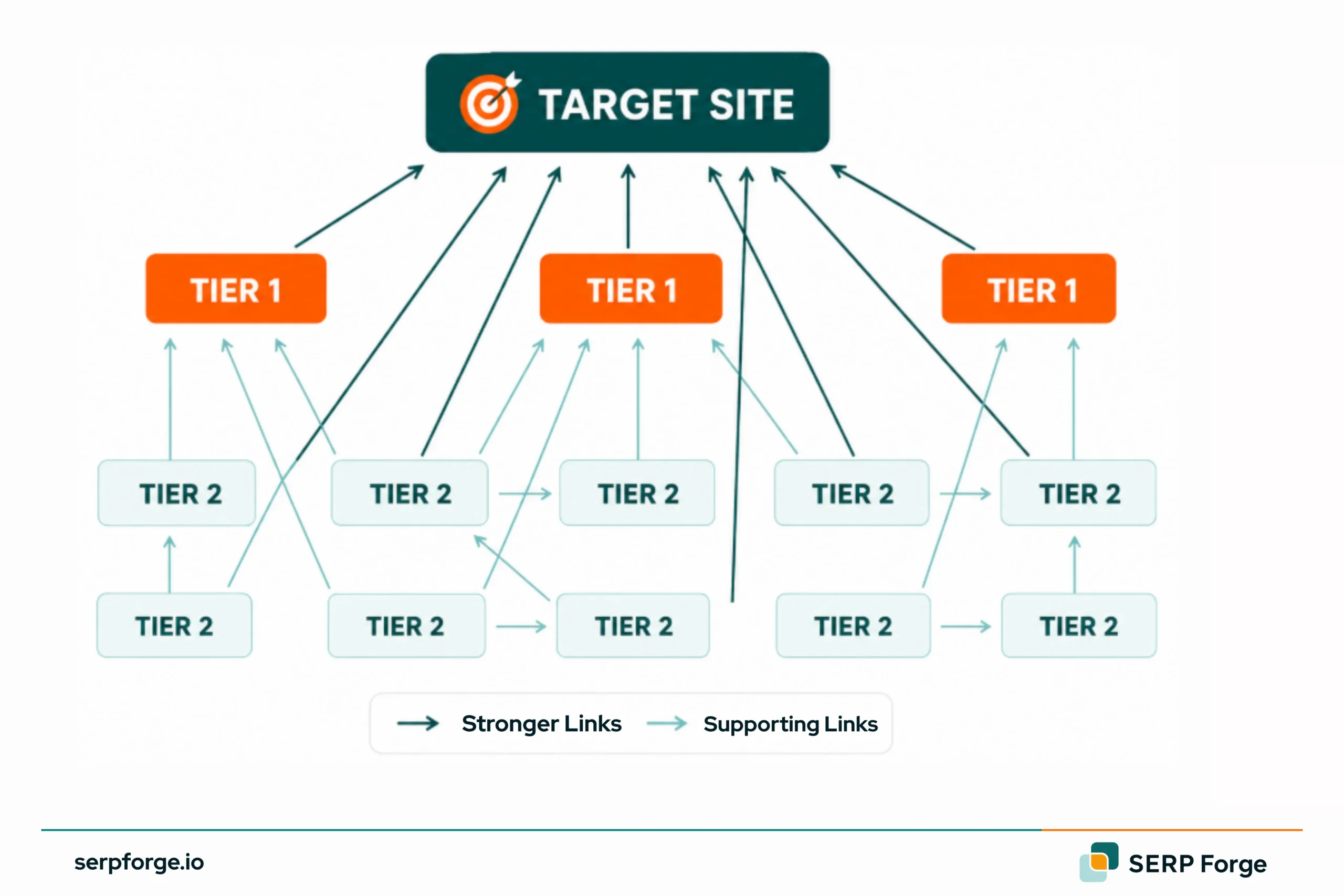
Tier 1 sits at the top and links straight to your site. Tier 2 links to those Tier 1 pages. Tier 3, when it’s used at all, links to Tier 2.
Each layer passes authority, often called link equity or link juice, up to the layer above it. The goal isn’t more links to your website. It’s stronger links to your website, without paying Tier 1 prices for every one of them.
Google’s guidelines treat aggressive versions of this as a link scheme. Where any tiered link building strategy lands on the white-hat-to-black-hat spectrum depends almost entirely on execution. We cover that later in this guide.
How Does Tiered Link Building Work?
Every tiered link building strategy moves authority in one direction: downward.
Tier 3 → Tier 2 → Tier 1 → your website.
Each arrow is a backlink. Each layer is allowed to be a little less polished than the one above it.
Tier 1 Links -The Foundation
Tier 1 links point directly to your website. They need to be the strongest, most defensible links in the entire structure.
Common Tier 1 sources:
- Genuine guest posts
- Digital PR placements
- Niche edits on relevant, high-authority sites
- Links earned naturally by standout content
Build these manually. Place them editorially. Keep the count small.
Quality matters more than quantity at this layer.
Tier 2 Links -The Amplifiers
Tier 2 links don’t point to your website. They point at your Tier 1 pages.
Their job is to reinforce the authority Tier 1 passes on to you. This is where tier 2 link building gets flexible.
Common Tier 2 sources:
- Active forum threads
- Niche directories
- Social profiles
- Medium or LinkedIn articles
- Podcast or video mentions
Relevance still matters here. Tier 2 links carry less authority than Tier 1, but a healthy batch of them meaningfully strengthens the layer above.
Tier 3 Links -The Volume Layer
Tier 3 links point to your Tier 2 links. They exist to add volume and diversity at the base of the pyramid.
This is the most expendable layer. It’s also the most commonly automated and the riskiest to overuse. Many experienced link builders skip it entirely.
If you use Tier 3, treat it as bulk reinforcement for Tier 2. Never as a shortcut to your own site.
How Many Links Do You Need Per Tier?
There’s no universal formula. Most practitioners work within similar ranges:
- 2–5 Tier 1 links per target page
- 5–10 Tier 2 links per Tier 1 link
- A larger, variable batch of Tier 3 links, sometimes in the hundreds per Tier 2 link
Treat these ratios as a starting point, not a rulebook. Competitive niches, existing authority, and how aggressive your competitors’ profiles look should shift these numbers.
A strategy built on borrowed ratios, applied to every page regardless of context, is exactly the kind of formulaic pattern Google’s link-spam systems are built to flag.
Benefits of Tiered Link Building
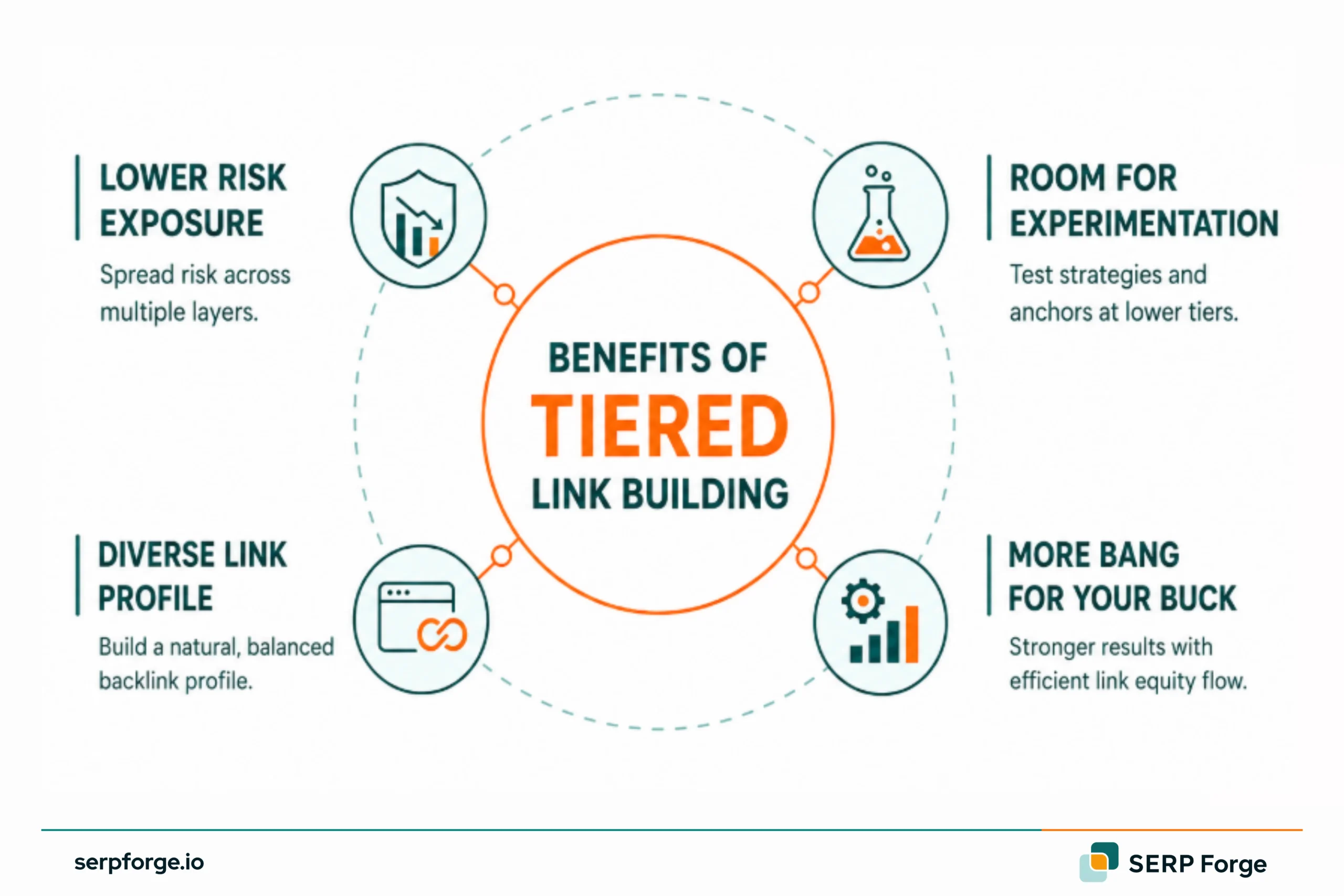
A well-planned tiered backlink strategy offers four real advantages over building every link at full strength.
Cost-Effective Link Equity
Tier 1 links cost the most time and money to earn. Guest posts, digital PR, and niche edits all require real outreach.
Tiering multiplies the value of those expensive links using cheaper Tier 2 and Tier 3 placements. You stop paying full price for every backlink in your profile.
Easier Risk Containment
Distance is the safety feature here. Tier 2 and Tier 3 links never point directly at your domain.
If a batch starts looking risky, one cut removing the connecting Tier 1 link disconnects it. Your own backlink profile is never directly implicated.
More Natural-Looking Backlink Diversity
Real backlink profiles are messy. High- and low-authority sources. Dofollow and nofollow links. Forums, directories, editorial coverage.
A tiered structure pushes that natural-looking noise into Tier 2 and Tier 3. The links pointing at your own site stay clean and defensible.
Indirect Self-Promotion Workaround
Most online communities limit self-promotion. Linking instead to a Tier 1 page passes authority in your general direction, without breaking those rules.
This only works when the Tier 1 content is genuinely relevant to the conversation.
Does Tiered Link Building Still Matter in the AI Search Era?
Yes. But its job has narrowed.
AI Overviews, ChatGPT, and Perplexity decide what to cite based on indexed eligibility, entity clarity, and passage-level usefulness. Not on how many tiers of backlinks point at a page. Those are the signals a GEO and AEO agency works on first.
Link equity still feeds the ranking signals that determine whether a page gets crawled, indexed, and is eligible in the first place. It just isn’t the lever AI systems pull when choosing which eligible page to cite.
We don’t think tiered link building disappears in the AI search era. We think its ceiling drops.
It can still help a competitive page earn retrievable status. It can’t manufacture the entity consistency, original evidence, or citation-worthy passages that get a page chosen once it’s in the running.
The enforcement side has changed more. Google’s SpamBrain system now flags manipulative link patterns close to real time.
It’s the March 2026 spam update rolled out in under 20 hours, down from 27 days for the equivalent update in August 2025.
A tiering pattern that once took months to get noticed can now be caught far faster.
In Ahrefs’ analysis of 75,000 brands, branded web mentions showed the highest correlation with AI Overview visibility (r = 0.664), while backlinks correlated at only r = 0.218–0.295, roughly 3× weaker.
Tiered Link Building vs. Traditional Link Building
| Aspect | Traditional Link Building | Tiered Link Building |
|---|---|---|
| Primary Goal | Earn links that point directly to your site | Strengthen the links you already have |
| Link Target | Your website | Your existing backlinks (Tier 1, then Tier 2) |
| Typical Volume | Lower volume, higher individual quality | Higher volume, decreasing quality by tier |
| Speed to Build | Slower outreach-dependent | Faster at lower tiers, slower at Tier 1 |
| Cost | Consistently high per link | Front-loaded at Tier 1, cheaper below it |
| Risk Level | Low, when links are earned editorially | Moderate to high, depending on execution |
| Google Guideline Status | Compliant when earned naturally | Can violate link-scheme guidelines if manipulative |
| Best Suited For | Long-term authority building | Reinforcing a small set of proven Tier 1 links |
A tiered link building strategy isn’t a replacement for traditional link building. It’s an amplifier you apply on top of links you’ve already earned the traditional way.
Is Tiered Link Building Safe? White Hat vs. Gray Hat vs. Black Hat
Safe tiered link building isn’t one technique. It’s a spectrum, defined by what you build each tier from and how fast you build it.
White hat tiering: Genuinely earned guest posts and digital PR at Tier 1. Real engagement on relevant forums, directories, and social profiles at Tier 2. Usually no Tier 3 at all. Nothing here violates Google’s link-scheme guidelines, because nothing is fabricated.
Gray hat tiering: A clean, manually built Tier 1. Lower-effort, semi-automated placements at Tier 2 and Tier 3 bulk directory submissions, thin profile links, and low-context comments. Not outright spam. Close enough to the pattern Google’s systems are trained to discount.
Black hat tiering: Private blog networks (PBNs), link farms, or fully automated link-blasting tools at multiple tiers. This is the version most commonly behind tiered link building’s black-hat reputation. It’s also the version most exposed to penalty.
The main tiered link building risks trace back to detectability:
- Shared hosting or footprints across “different” sites
- Unnatural anchor-text repetition
- Sudden link velocity spikes
- Irrelevant placements
An Ahrefs analysis of more than 14 million websites found that 55% had picked up at least one inbound link from a domain already flagged as spammy. Link profile contamination is common, even for sites that were never meant to build a single bad link.
We wouldn’t call a tiered structure safe just because it hasn’t been caught yet. Safety means the structure would still look defensible under manual review, not that it’s currently flying under the radar.
Only 30% of penalized websites recover their rankings within a year. For businesses, fewer than 40% survive beyond six months after a penalty.
Step-by-Step: How to Build a Tiered Link Building Strategy
Here’s how to build tiered links in a sequence that limits risk at every stage. Not bolted onto an existing profile all at once. Use this link building checklist before building each tier.
Step 1 – Audit Your Existing Backlink Profile
Pull your full referring-domain list from Ahrefs, Semrush, or Moz. Cross-reference it against Google Search Console’s Links report.
You’re looking for two things: which pages already have strong, defensible backlinks worth reinforcing, and whether any existing links already look manipulative.
Building a new tiered structure on a contaminated profile compounds risk. It doesn’t contain it.
66.31% of pages have zero backlinks, and only 0.08% of pages have 100 or more based on Ahrefs Content Explorer analysis of 1 billion pages.
Step 2 – Identify and Prioritize Tier 1 Candidates
Choose the pages that matter commercially. The ones driving traffic, leads, or conversions.
Shortlist Tier 1 prospects that can provide relevant backlinks, with real organic traffic and authority levels that match your industry’s baseline.
A link-intersect report that sites linking to competitors but not to you surfaces realistic candidates fast.
Step 3 – Build Tier 1 Links
Build these manually and editorially:
- Guest posts on relevant sites
- Digital PR placements
- Niche edits
- Linkable assets like original research or free tools
- Broken-link replacements
Keep the count small. 2 to 5 per target page is typical. Don’t trade relevance for speed.
Step 4 – Build Tier 2 Links to Support Tier 1
Point this layer at your Tier 1 pages. Never at your own site.
Use UGC platforms, niche forums, business directories, social profiles, and republished articles on platforms like Medium. Only where there’s real context for the link.
A common starting ratio: 5–10 Tier 2 links per Tier 1 link, varied across sources and anchor text.
Step 5 – Decide Whether You Need Tier 3 at All
Tier 3 is optional. For most businesses, it’s skippable.
It earns its place only in genuinely high-competition niches where Tier 1 and Tier 2 alone can’t close the gap. Even then, it demands near-constant maintenance and carries the highest risk in the structure.
If you’re unsure, leave it out.
Step 6 – Stagger Link Velocity
Release links gradually. Across weeks or months. Not all at once.
A sudden spike in referring domains is one of the clearest signals real-time spam systems look for. Pacing your link-building tiers to resemble organic growth lowers risk without changing what you’re building.
Step 7 – Monitor, Audit, and Disavow if Needed
Re-run your backlink audit on a recurring schedule. Watch Search Console’s Manual Actions report. Flag anything that starts looking toxic.
Google has said the disavow tool matters less than it once did. It’s still reasonable for large-scale, clearly manipulative patterns, not for every borderline link you find.
In a controlled Ahrefs disavow study, removing links via disavow caused traffic drops of 13.3%–18% on test pages. Restoring those links recovered 99–144% of traffic.
Tools for Managing a Tiered Link Building Campaign
Two categories cover most of the work. You don’t need a large stack.
Prospecting and monitoring tools: Ahrefs, Semrush, Moz. Used for finding Tier 1 candidates, tracking referring-domain growth per tier, and flagging links before they become a liability.
Outreach and CRM tools: Used to manage the relationship-heavy work at Tier 1 pitches, follow-ups, and placements. At Tier 2 and below, a spreadsheet or simple tracker is usually enough.
Common Mistakes That Trigger Penalties
- Pointing Tier 2 or Tier 3 links straight at your money pages, instead of at the tier above them.
- Building every tier at once, creating a referring-domain spike, and real-time spam systems are built to catch.
- Using PBNs or link farms for Tier 1, especially networks sharing hosting, templates, or registration footprints.
- Over-optimizing anchor text with the same exact-match keyword across dozens of links.
- Ignoring topical relevance at lower tiers, stacking generic, off-topic directories for volume.
- Treating Tier 3 as a numbers game with no upkeep, leaving broken links unmonitored.
- Copying someone else’s tier ratios without adjusting for your niche or risk tolerance.
CTA
Not Sure If Your Backlink Profile Would Survive a Manual Review? Audit your tier structure before Google’s spam systems do.
Book a Link Profile Audit
Conclusion
Tiered link building isn’t a penalty waiting to happen. It isn’t a guaranteed shortcut either.
It’s a structural choice with a real range of outcomes, depending entirely on execution.
Built with genuine Tier 1 links, relevant Tier 2 support, staggered velocity, and consistent auditing, it extends the value of backlinks you’ve already earned. Built on PBNs, automation, and impatience, it can undo months of legitimate SEO work in a single spam update.
The safest version of this strategy is also the most boring one: real links, a reasonable pace, regular checkups.
FAQs
1. What is tiered link building in simple terms?
A backlink strategy where lower-tier links point at your existing backlinks instead of your website. It builds authority for your links, not just more links to your site.
2. Is tiered link building against Google’s guidelines?
It can be. Aggressive tiering, especially with PBNs or automated link-blasting, falls under Google’s link-scheme guidelines. Conservative, manually built versions stay closer to compliant link building.
3. How many Tier 1, Tier 2, and Tier 3 links should I build?
Common starting ranges: 2–5 Tier 1 links per page, 5–10 Tier 2 links per Tier 1 link, and a larger, variable batch of Tier 3 links if you use that layer. Adjust for your niche’s competitiveness.
4. How long does it take to see results from tiered link building?
Most practitioners report initial movement within 4–8 weeks of Tier 1 and Tier 2 links being indexed. Staggering link velocity for safety naturally slows this timeline.
5. Can small businesses use tiered link building safely?
Yes, on the white-hat end of the spectrum: real Tier 1 placements, relevant Tier 2 sources, little or no Tier 3. The bigger risk is outsourcing to providers who quietly use PBNs to hit Tier 1 numbers fast.
6. What’s the difference between tiered link building and PBNs?
Tiered link building is a structure. A PBN is one risky way to fill that structure. PBNs can populate any tier, but using them turns an otherwise gray-hat strategy fully black-hat.
7. Do I need Tier 3 links at all?
No. Most tiered link building strategies work fine with just Tier 1 and Tier 2. Tier 3 adds volume and risk in roughly equal measure.