



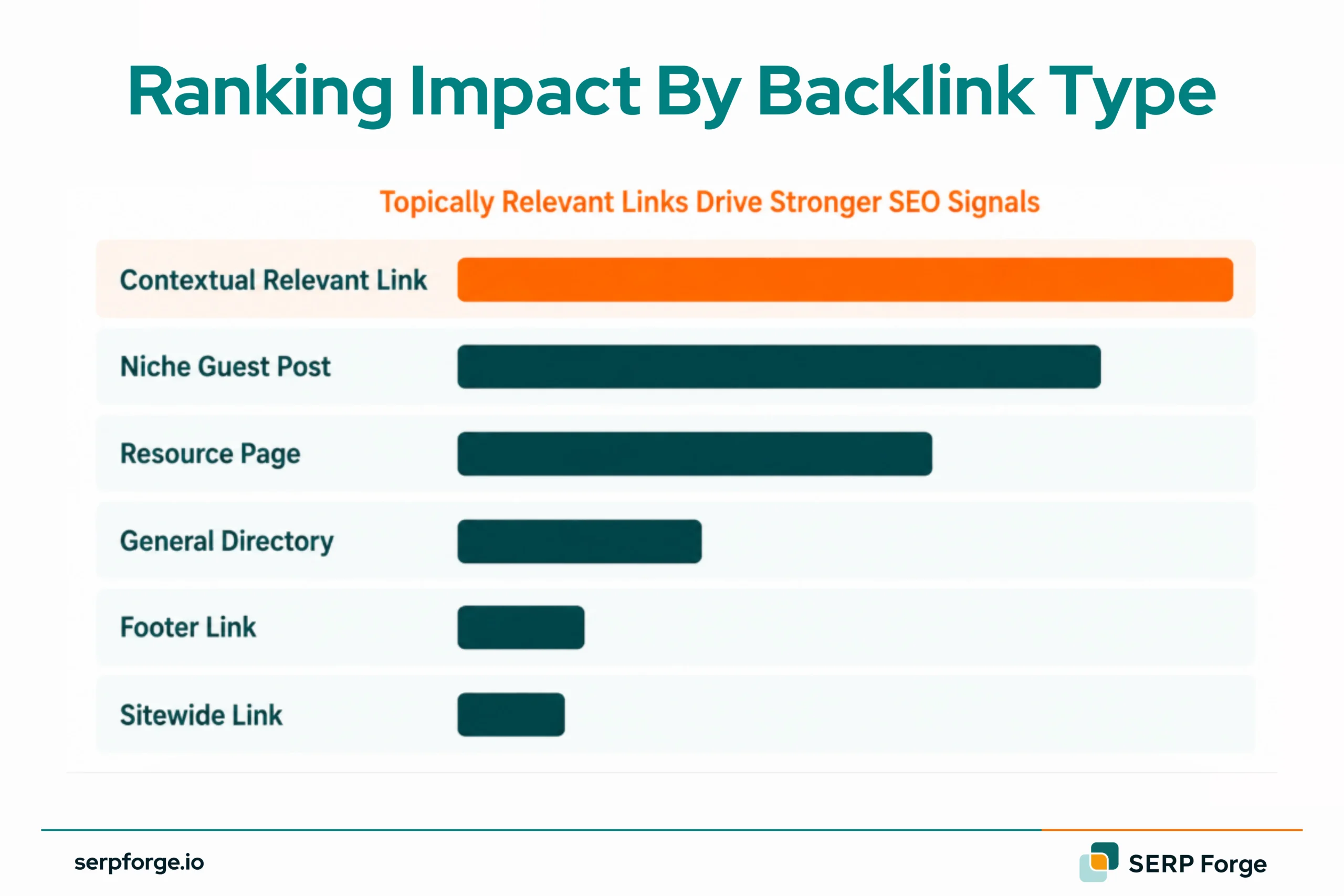
A backlink’s domain rating doesn’t decide how much it helps you rank. Its relevance does.
Search engines and AI search systems increasingly reward links that come from pages already trusted on your topic.
One backlink from a site your buyers already read can move rankings faster than ten links from unrelated, high-authority domains that happen to have a bigger number next to them.
AI Overviews, ChatGPT, and Perplexity often retrieve single passages rather than ranking entire pages, and they rely on the same trust signals that search engines use to decide which sources deserve citation. For software brands, AI SEO for SaaS puts those signals to work.
A backlink profile built around topical fit feeds both systems at once; one built purely around domain rating feeds neither particularly well. A SaaS link building agency can help you build a profile around topical fit.
In Ahrefs’ analysis of 1 million SERPs, external backlinks correlated much more strongly with rankings than internal links, and links show a higher correlation for informational queries, which are typically the most competitive.
This guide covers what makes a backlink relevant, how Google and AI search evaluate that relevance, and the exact steps to build a link profile that earns trust instead of just volume.
What Are Relevant Backlinks?
Relevant backlinks are links to your site from pages, domains, or publications that share the same topic, niche, or audience as your own content.
A backlink becomes relevant when three things line up: the linking page covers a related subject, the surrounding content supports or references your claim, and the audience reading that page would plausibly care about your page too.
- All three signals work together; a topical match on a page nobody in your niche reads still counts as weak relevance.
- Relevance is contextual, not domain-wide. A link can be highly relevant on one page of a website and irrelevant on another page of that same domain.
- A general news site might publish one article that’s genuinely relevant to your product and ten that aren’t. The link only inherits the relevance of the specific page it sits on.
This is a different concept from a “contextual backlink,” which refers to the placement of a link embedded in body content rather than in a sidebar, footer, or author bio.
The number of unique referring domains is the single strongest correlating backlink factor for organic traffic, based on a study of approximately 920 million pages, more than total backlink count, anchor text, or domain-level metrics alone.
Why Does Relevance Matter More Than Authority?
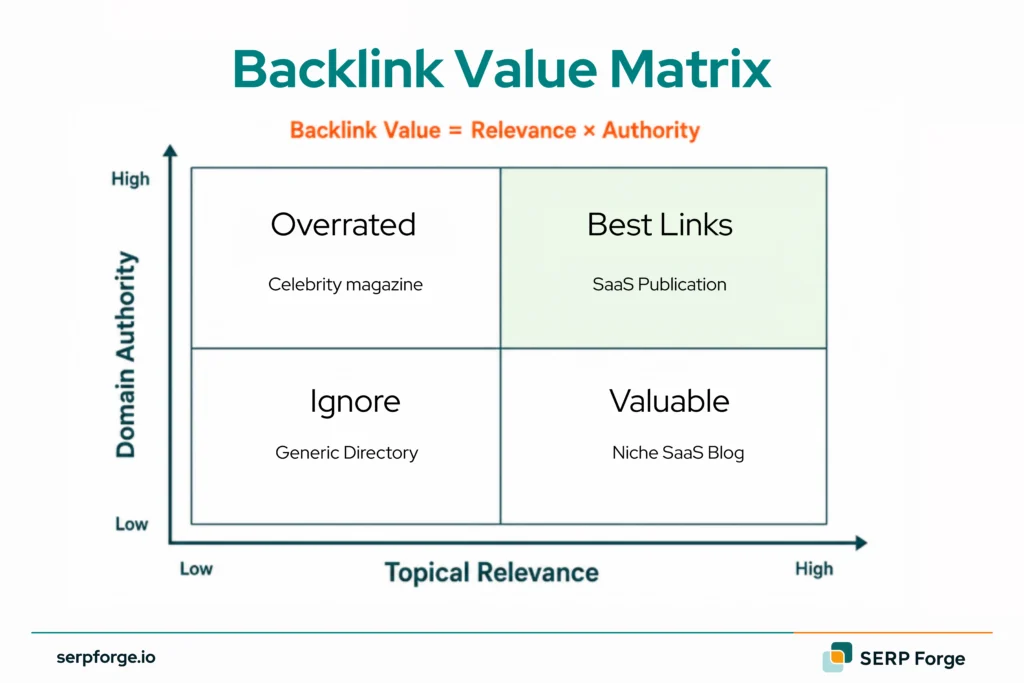
Authority measures how trusted a domain is overall. Relevance measures how trusted a domain is on your specific topic. Those are different questions, and search systems increasingly answer them separately.
A link from a celebrity gossip site with a domain rating of 80 carries little topical signal for a B2B accounting page.
A link from a niche accounting blog with a domain rating of 25 tells search engines something far more concrete: a site that already covers your category is vouching for you.
Three reasons relevance tends to outweigh raw authority in practice:
- Topical trust compounds: Search engines build trust profiles around a domain’s subject coverage over time, not just around its total backlink count.
- Irrelevant high-DR links dilute the signal: They often sit beside paid placements, link farms, or unrelated niches on the same domain, which can invite more scrutiny than ranking benefit.
- AI search systems weigh source confidence: Tools like Google AI Overviews and Perplexity factor entity and topic alignment into which sources they trust enough to cite or recommend.
Consider two sites publishing the same announcement about a new accounting tool. A general news aggregator with a domain rating of 70 runs it as a one-line mention in a roundup of unrelated funding news.
A mid-sized accounting blog with a domain rating of 30 covers it as a dedicated feature, with surrounding analysis of how the tool fits the category.
The second link carries less raw authority and more practical weight, because it arrives already wrapped in a topical context that the first link never had.
SEMrush’s Ranking Factors Study found that content relevancy and quality showed the strongest correlation with higher rankings across all factors analyzed, stronger than backlink volume or domain-level authority metrics.
How Do Google and AI Search Evaluate Backlink Relevance?
Google and AI search systems judge relevance using signals around the link itself, not just the destination page you’re trying to rank.
Five factors determine how strongly that relevance registers:
1. Topical Alignment
Topical alignment checks whether the linking page’s overall subject matches your page’s subject.
A link to a project management tool from an article comparing productivity software shows alignment.
The same link sitting inside a recipe blog post does not, regardless of that blog’s overall traffic.
2. Anchor Text Context
Anchor text context examines the words used in and immediately around the link.
Descriptive, topic-relevant anchor text such as “best project management software for remote teams” signals relevance much more effectively than generic anchors like “click here” or unrelated phrases.
3. Surrounding Content
Surrounding content is the paragraph immediately before and after the link. Search systems read this passage to confirm the link supports a claim related to your page’s subject, rather than appearing inserted at random into unrelated text.
4. Linking Domain’s Niche
The linking domain’s niche reflects its overall publishing history, not just one page. A domain that consistently covers your industry builds cumulative topical authority, which strengthens every relevant link it gives out, including future ones.
5. Audience Overlap
Audience overlap considers whether the linking site’s readers resemble your own target audience. A backlink from a site your buyers already read carries more practical and ranking value than a backlink from a site with no overlap in readership, even at similar traffic levels.
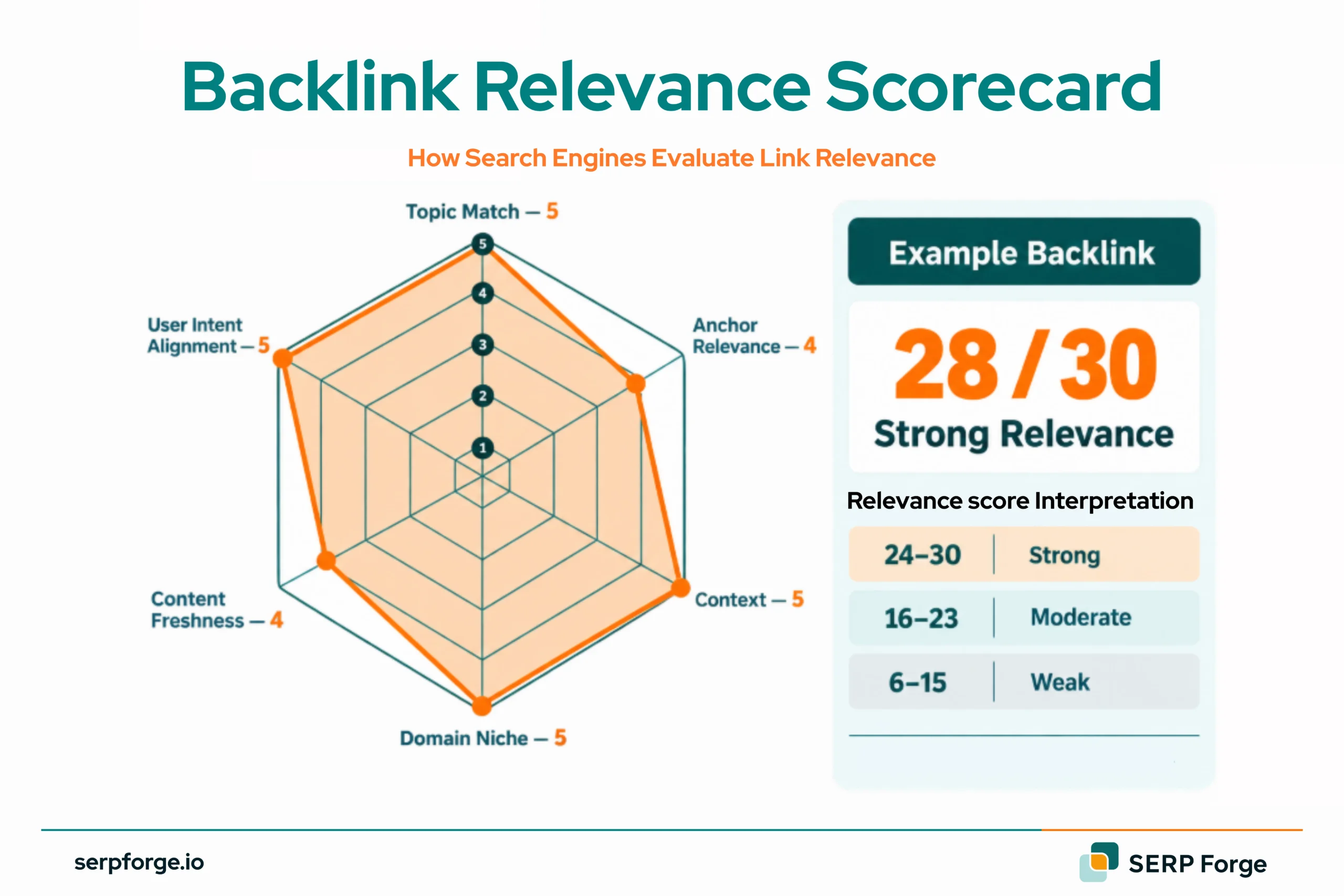
What are Relevant and Irrelevant Backlinks?
The same link can look identical on paper, with the same anchor and similar domain rating, and still land completely differently depending on where it actually sits.
Here’s how that plays out across five common scenarios:
| Linking Site | Anchor Text | Context | Relevant? |
|---|---|---|---|
| Project management blog | “best task tracking software” | Article comparing PM tools | Yes, topic, anchor, and audience all align |
| Local bakery blog | “best task tracking software” | Unrelated post about sourdough recipes | No, no topical or audience connection |
| SaaS tools directory | Company name | Listing page for project management software | Yes, niche-specific directory, audience match |
| “Top 100 Websites” link list | Company name | No surrounding context, automated aggregation | No, no topical context, common link-farm pattern |
| HR software comparison site | “alternative to [competitor]” | Detailed head-to-head comparison article | Yes, direct competitive and topical relevance |
The pattern across these examples: relevance comes from the combination of niche, anchor, and context, not from any single factor in isolation.
A niche-correct domain with a generic, contextless link is still a weaker signal than a slightly smaller domain with a descriptive, in-context one.
How to Build Relevant Backlinks?
Building a relevant backlink profile takes more deliberate targeting than a generic outreach blast.
These six tactics consistently produce links that pass the relevance test:
Step 1- Map Your Niche and Identify Topically Relevant Sites
Start by listing the sub-topics, audience segments, and competitor categories your content belongs to. Search those terms alongside modifiers like “blog,” “resources,” “best tools,” or “guide” to surface sites already publishing in your space.
Build a working list before you pitch anyone, and prioritize sites that consistently publish on your topic, not just those with high traffic or Domain Rating. A smaller site that covers your exact category beats a larger one that only touches it occasionally.
Step 2- Earn Relevant Backlinks Through In-Niche Guest Posting
Pitch guest posts to publications that already serve your target audience, not just any site that happens to accept contributor content.
A guest post should add genuine insight to that publication’s existing coverage, with a contextual link back to a directly relevant page on your site, using a naturally relevant anchor instead of forcing commercial keywords.
Step 3- Use Broken Link Building on Niche-Relevant Sites
Find broken or outdated links on resource pages within your niche, then offer your own page as a working, topically equivalent replacement.
This tactic works because the original link already proves the page owner values that exact topic enough to have linked to it once. Your replacement content should satisfy the same search intent as the broken page.
Step 4- Get Quoted Through HARO and Digital PR Outreach
Respond to journalists’ and writers’ queries specifically within your industry through HARO-style platforms or direct outreach. Digital PR helps you earn backlinks from relevant publications while building topical and editorial trust.
A quote placed in a relevant publication earns a backlink with built-in topical and editorial trust attached, especially when your expertise directly answers the journalist’s request.
Step 5-Get Listed on Niche Resource Pages and Industry Directories
Search for curated “best tools,” “resources,” or vetted directory pages within your specific industry and request inclusion.
These pages are pre-organized around a topic, which makes the resulting backlink relevant by structure rather than by negotiation. Focus on editorially reviewed directories instead of open-submission link farms.
Step 6- Reclaim Unlinked Brand Mentions on Relevant Sites
Track mentions of your brand or product on industry sites that referenced you without linking.
Reach out and ask for the brand mention to be converted into a link; it’s one of the lowest-effort ways to convert relevance that already exists into a measurable signal. Personalize your outreach by referencing the exact page and explaining where the link adds value for readers.
Examples of Relevant Backlinks
The easiest way to identify a relevant backlink is to compare the topic of the linking page with the destination page.
If both serve the same audience and intent, the backlink is likely to carry stronger topical relevance:
| Linking Page | Linked Page | Why It’s Relevant |
|---|---|---|
| A guide on “Best Password Managers” links to a product page for Bitwarden Password Manager. | Bitwarden’s password manager landing page. | Readers are comparing password managers, and the destination page directly matches their intent. |
| An article about small business accounting software links to QuickBooks Online Pricing. | QuickBooks pricing page. | The backlink connects readers with the exact software discussed in the article, reinforcing topical relevance. |
| A blog covering technical SEO audits links to a guide on how to fix crawl errors. | Crawl error optimization guide. | Both pages focus on technical SEO, making the link contextually valuable for users and search engines. |
| A resource page about email marketing tools links to a comparison of Mailchimp vs. ConvertKit. | Email marketing comparison page. | The linked content expands on the same topic and helps users evaluate relevant solutions. |
| An article on plant-based nutrition links to a vegan meal planning guide. | Vegan meal planning resource. | Both pages target the same audience with closely related informational intent. |
Across all of these examples, the pattern remains the same: the linking page, anchor text, and destination page all revolve around the same topic, making the backlink useful for readers not just search engines.
How to Audit Your Existing Backlinks for Relevance
Export your full backlink profile from a tool such as Ahrefs, Semrush, or Google Search Console.
Categorize each linking domain by niche, then check whether the specific linking page’s topic matches your linked page’s topic, not just the domain’s general category. A finance domain that happens to link to you from an unrelated lifestyle section still counts as a weak match.
Flag links with generic, automated, or unrelated anchor text, along with links sitting in sidebars, footers, or undifferentiated link lists with no surrounding context.
Sort your backlink list into three groups: highly relevant, loosely relevant, and irrelevant. Prioritize future outreach and content updates toward strengthening the first group, and avoid building your strategy around growing the third.
Re-run this audit on a quarterly cadence rather than treating it as a one-time exercise. Backlink profiles shift as old guest posts get repurposed, directories change focus, or partner sites pivot into different niches; relevance earned last year doesn’t necessarily hold today.
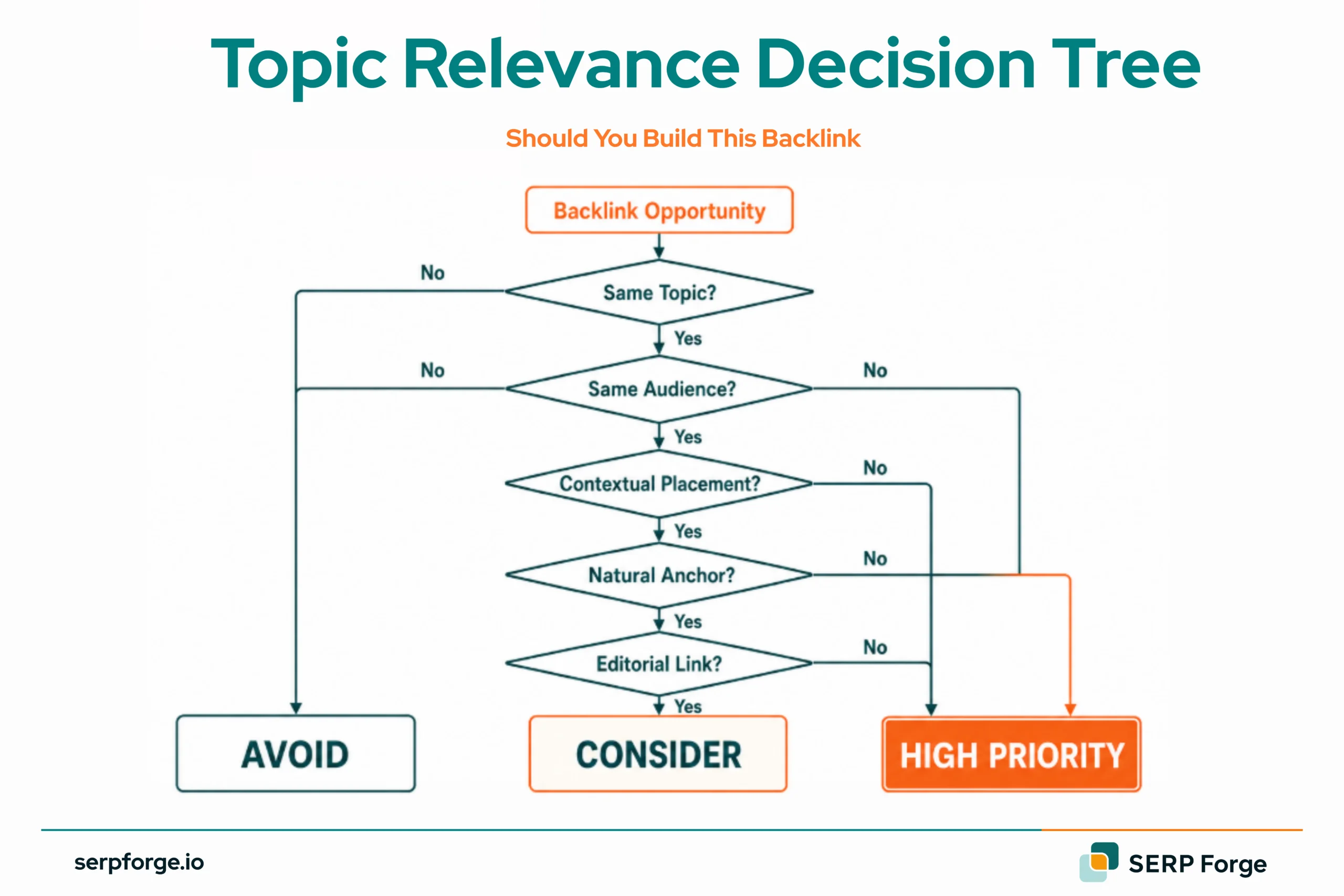
Common Mistakes That Hurt Backlink Relevance
Most relevant problems trace back to a handful of recurring habits, usually adopted in the name of speed or scale:
- Chasing domain rating instead of topical fit produces a profile of high-authority but unrelated links that underperform expectations.
- Using generic guest post networks that publish across unrelated niches purely to place links, regardless of subject match.
- Buying or trading links from “any niche, any DR” marketplaces, where relevance is rarely part of the offer.
- Ignoring anchor text and surrounding context when negotiating link placements, settling for generic anchors out of convenience.
- Treating directory submissions as relevant by default, without checking whether the directory itself is genuinely niche-specific or just broad and unmoderated.
- Skipping backlink audits, which lets irrelevant historical links accumulate unaddressed for years.
SEMrush’s study of 1,000 domains found that the quality of backlinks, specifically Authority Score, showed a strong positive relationship with how often a domain appeared in AI-generated answers.
A few backlinks from authoritative, relevant websites drove far more AI visibility than dozens of weak or unrelated ones.
Conclusion
Relevant backlinks work because they tell search engines and AI systems something authority alone can’t: that a trusted source on your exact topic believes your content is worth linking to.
Building them takes more research and outreach than buying high-DR placements, but the resulting link profile holds up better against algorithm updates and earns trust that compounds rather than decays.
Audit what you already have, prioritize niche-aligned outreach over volume, and let relevance, not domain rating alone, guide your next link-building campaign.
FAQs
1. Can an irrelevant backlink actually hurt my rankings?
A single irrelevant backlink rarely causes direct harm on its own. A pattern of irrelevant, spammy, or unnatural links can raise red flags and trigger manual review or algorithmic devaluation over time.
2. How does Google determine the topical relevance of a backlink?
Google evaluates the linking page’s overall topic, the anchor text used, the surrounding content, and broader signals about the linking domain’s subject focus and trustworthiness.
3. How many relevant backlinks does a site actually need to rank?
There’s no fixed number. Competitive, well-established niches typically require more relevant links than smaller or less contested topics. Consistency and quality matter more than hitting a specific count.
4. What’s the difference between a relevant backlink and a contextual backlink?
A contextual backlink describes the placement of a link embedded within body content rather than a footer or sidebar. A relevant backlink describes topical and audience fit. The strongest links are both contextual and relevant at once.
5. Do niche directories count as relevant backlinks?
Yes, when the directory is organized around your specific industry or category. General, unmoderated directories that accept any business carry far less relevance value, even if they look similar on the surface.
6. Is a high-DR irrelevant backlink better than a low-DR relevant one?
Not necessarily. A low-DR relevant backlink from a trusted niche source often supports rankings more reliably than a high-DR link from an unrelated domain, especially as search engines weight topical signals more heavily.