

Most content is created to rank. Linkable assets are created to be referenced. A linkable asset is a page, tool or dataset built to earn backlinks on its own merit, because other writers would rather cite it than recreate it.
That matters because ranking alone rarely produces traffic. Ahrefs’ study of about 14 billion pages found that 96.55% get zero traffic from Google, and that pages with more referring domains tend to get more traffic.
This guide covers 11 types of linkable assets with real link data, a 6-criterion Linkability Score for testing ideas, and a 6-step build process. It also explains how to find the assets you already have and how to make them the pages AI Overviews and ChatGPT cite.
Quick answer: Linkable assets are content pieces such as original research, free tools, statistics pages, templates and definitive guides. They are designed to attract backlinks because they give other sites data, utility or a framework worth citing. The formats that earn the most links are original studies, free tools and coined frameworks.
What Is a Linkable Asset?
A linkable asset is content created specifically to attract backlinks without direct outreach for every link. Other publishers link to it because it saves them work, whether that’s a statistic to cite, a tool to recommend or a definition to reference.
A homepage or pricing page rarely earns links, because an unrelated site has no reason to reference it. A statistics page, calculator or industry study gives other sites a concrete reason to link: it supports their claims with your data instead of their own. This is the engine behind organic link building, where links are earned rather than requested.
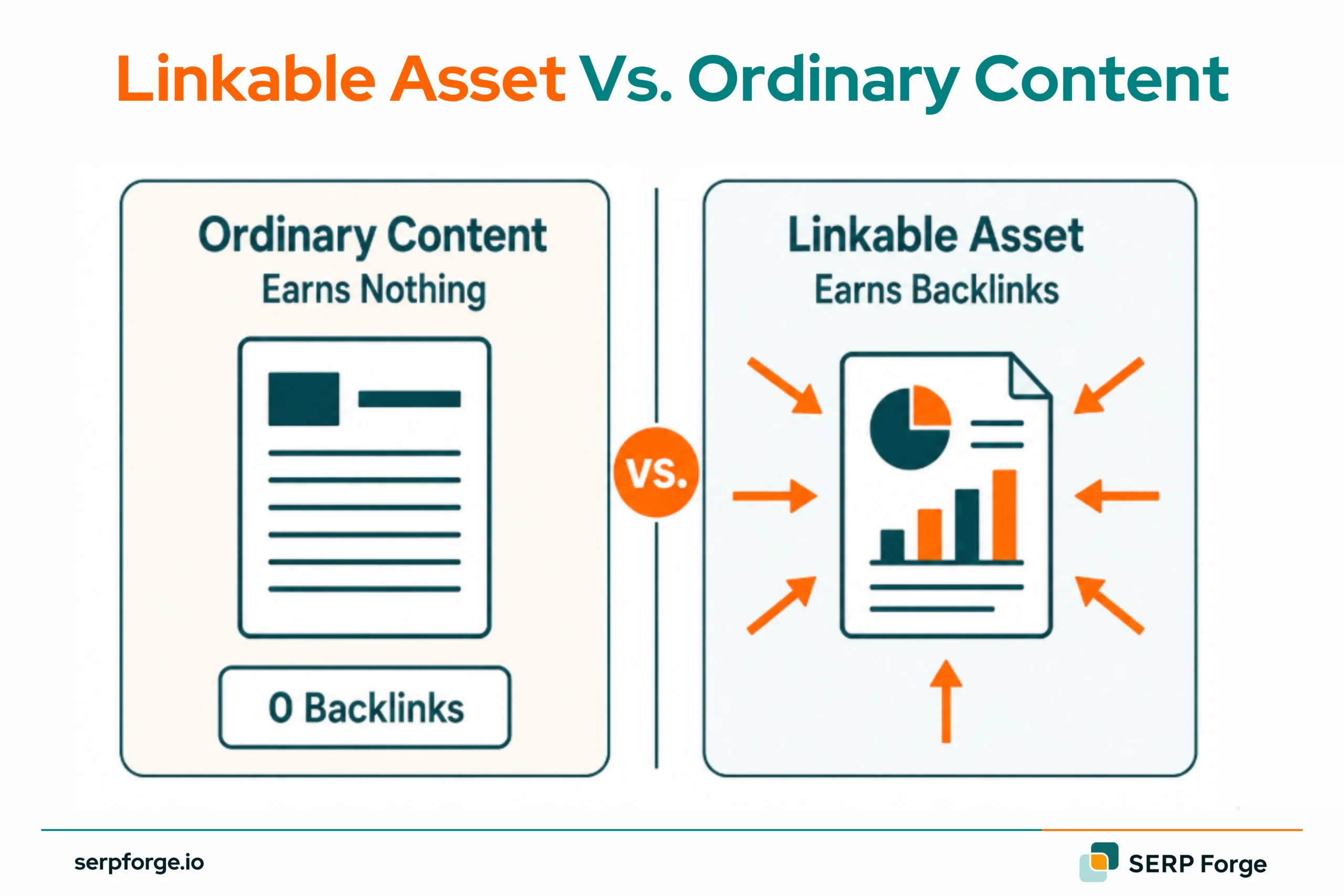
Linkable asset vs ordinary content
| Ordinary blog post | Linkable Asset | |
|---|---|---|
| Built to | Rank for a keyword | Be cited by other sites |
| Core value | Explains a topic | Supplies data, utility or a named idea |
| Can a writer paraphrase it? | Easily | No: they have to cite the source |
| Link pattern | Spikes after outreach, then stops | Compounds for years |
| Typical owner | Content team | Content, data and PR together |
Why do linkable assets matter for SEO and AI search?
Linkable assets pay off in five ways:
Compounding backlinks. One asset keeps earning links after the campaign ends. Ahrefs’ backlink growth study of 200,000 top-ranking pages found that most #1 page gain followed links from new referring domains at +5% to +14.5% per month.
Authority that lifts other pages. Links to an asset pass link equity through internal links to your commercial pages.
Referral traffic that doesn’t depend on rankings. Every linking site sends its own readers to you.
Material for PR and outreach. Outreach teams get a data point or tool to pitch, not just a request for a link.
AI citations. Language models and AI Overviews prefer to cite pages that state a fact clearly and back it with a source. Original data is the easiest content for them to attribute, which is why an AI SEO agency often starts with it.
The trade-offs: Links land on the asset, not your money page, so you need an internal linking bridge (covered below). Production takes weeks, not days. Links aren’t guaranteed without promotion.
What makes content linkable? The Linkability Score
An asset becomes linkable when it gives someone else a specific, low-effort reason to reference it instead of writing around it. That’s the same principle behind link baiting.
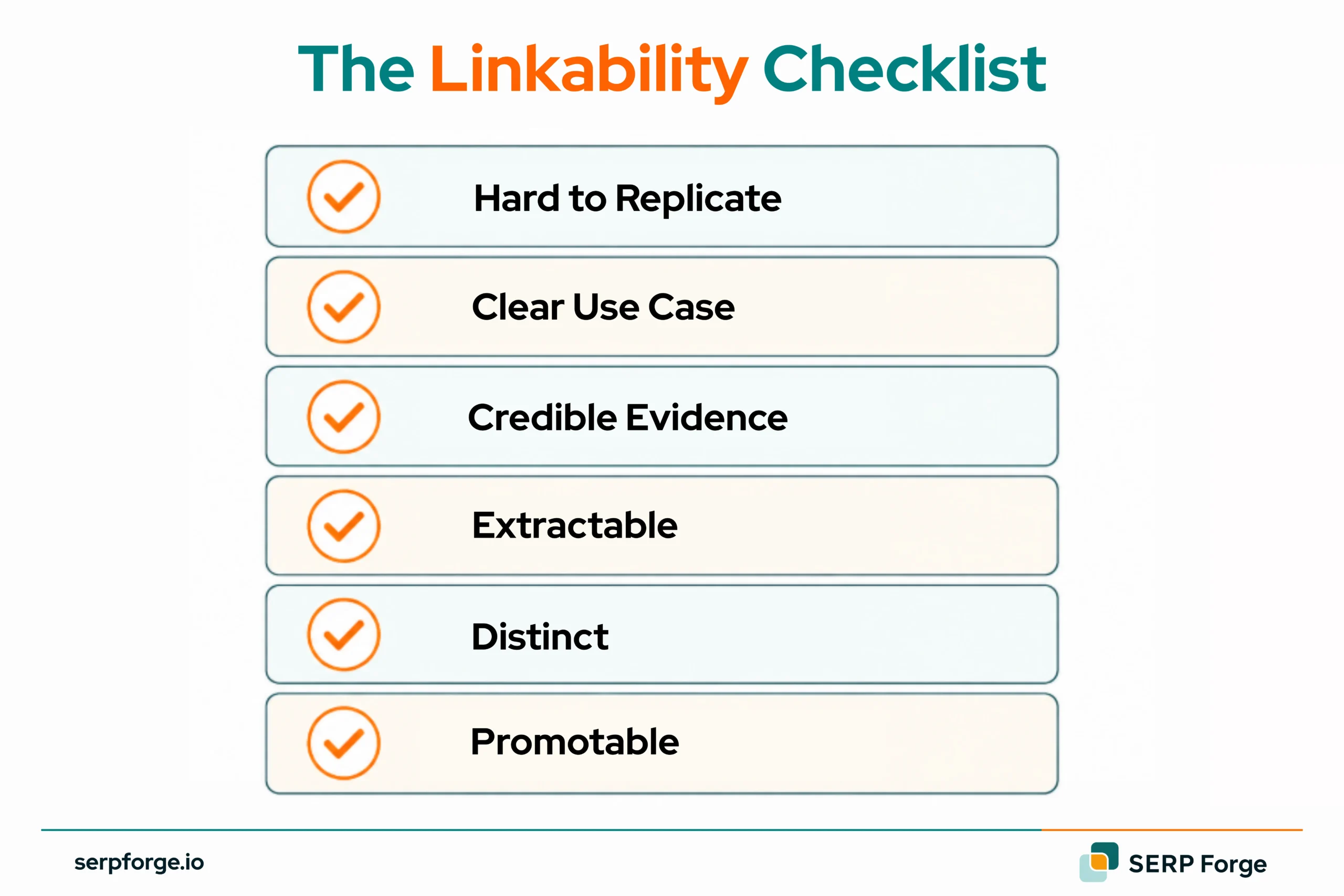
Score any idea against the six criteria below, giving 0 (no), 1 (partly) or 2 (clearly) for each.
Build ideas scoring 10–12, improve those scoring 7–9, and rethink anything at 6 or below.
| Sr no | Criterion | Scores 2 when |
|---|---|---|
| 1 | Hard to replicate | It uses proprietary data, a working tool or a named framework |
| 2 | One clear use case | It solves one specific problem, not a broad topic |
| 3 | Credible evidence | Sample size, methodology and date are stated on the page |
| 4 | Easy to extract | One stat, quote or chart works on its own out of context |
| 5 | Distinct format | It’s a tool, map or original chart, not another 2,000-word post |
| 6 | Promotable | Your team would send it to a contact unprompted |
Criterion 4 matters twice over. The single, self-contained sentence a blogger quotes is also
the passage an AI engine lifts into its answer.
11 types of linkable assets (with real examples)
The list runs from the highest-leverage formats to more situational ones. Link counts come from the source cited and reflect when that source measured them.
| Type | Best for | Effort | Example |
|---|---|---|---|
| Original research and data | Media pickup, AI citations | High | Industry surveys, product-data studies |
| Free tools and calculators | Recurring long-term links | High | ROI calculators, generators |
| Statistics pages | Ongoing citations | Low | “[Industry] statistics” hubs |
| Definitive guides | Topical authority | Medium | Full how-to resources |
| Coined terms and frameworks | Branded citations | Medium | Named methodologies |
| Awards and rankings | Links from winners | Medium | “Top 50 [niche] blogs” |
| Templates and checklists | Resource-page links | Low | Audit checklists, report templates |
| Infographics and map-o- graphics | Visual shares, local press | Medium | State or city comparison maps |
| Case studies | Proof and peer links | Low | Before-and-after results |
| Listicles and roundups | Vendor and curation links | Low | “Best tools for X” |
| Videos and interactive embeds | Embeds with attribution | Medium | Quizzes, embeddable charts |
1. Original research and industry studies
Original research turns data only you have into something other sites must cite. According to Ahrefs, four of the five most-linked pages on its blog are studies. Its study of 2 million featured snippets earned 600+ links from 330+ referring domains.
Why it works: A writer covering featured snippets can’t reproduce 2 million data points, so
they cite the study.
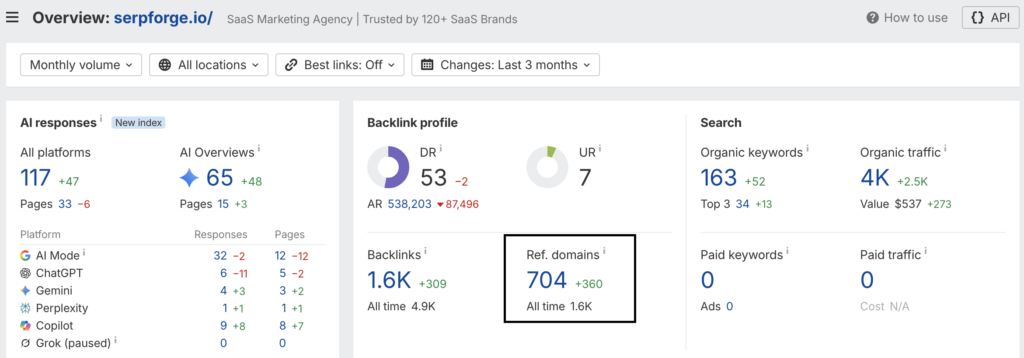
SERP Forge example: Our AI chatbot privacy report and SEO ranking factors research
follow the same model.
2. Free tools and calculators
A free tool solves one narrow problem instantly, with no sign-up. It keeps earning links because new users keep discovering it and writing about it. Per Ahrefs, CoSchedule’s Headline Analyzer earned 16K+ links from 3.6K+ referring domains, and the Coolors palette generator earned 154K+ links from 5K+ domains.
3. Statistics and trends pages
A statistics page collects the latest data points on one narrow topic, each one sourced and dated. Writers need quick, citable numbers, so a well-kept stats page gets linked every time someone needs support for a claim.
SERP Forge example: Our link building statistics and trends page is built to be the go-to reference. It works only if we refresh it every 6–12 months.
4. Definitive guides and tutorials
A definitive guide covers a topic so completely that other writers link to it rather than re explain the basics. W3Schools’ HTML Tutorial had 1M+ links from 4.4K+ referring domains when Ahrefs measured it. This only works when your guide is clearly deeper than what already ranks.
5. Coined terms and frameworks
A coined term gives a concept a name, so every later explanation credits the origin. Brian Dean’s Skyscraper Technique was still attracting 50–100 new referring domains a month, per Ahrefs. Named frameworks also become entities that LLMs attribute to you by name. The Linkability Score above is one.
6. Awards and rankings
Rank the best people, companies or blogs in your niche, then tell the winners. Many add a badge or a press-page link. Ahrefs reports that Nomad List earned 36K+ links from 3.8K+ referring domains. If you lack authority, survey 50–100 respected practitioners and publish the ranking their votes produce.
7. Templates and checklists
Templates save the reader from building a structure from scratch. They earn links from “best resources for X” roundups, which makes them ideal for resource page link building. SEJ found that ProjectManager’s Excel budget template had earned 100+ referring domains.
8. Infographics and map-o-graphics
Map-based visuals of regional data, such as cost by state or salaries by city, earn links from local publications that care about only one data point. The Periodic Table of SEO Success Factors from Search Engine Land had 2.3K referring domains per Ahrefs. See our guide to infographic link building for the pitching process.
9. Case studies
A case study documents one result with methodology and real numbers. A claim with a number, a timeframe and a method can be cited. “SEO works” can’t. Case studies earn links from peers, agencies and “examples of X” posts.
10. Listicles and resource roundups
Curated roundups give readers a shortcut. The vendors you feature often link back or share. Use our listicle ideas to find angles.
11. Videos and interactive embeds
Quizzes, interactive charts and explainer videos can be embedded on other sites, and most embed codes carry an attribution link. That gives you a second channel on top of the standard backlink.
How to create a linkable asset (step by step)
1. Research your audience and competitor gaps
2. Score the idea and pick the format
3. Build for quality, not speed
4. Optimize the page for search and AI extraction
5. Promote it with a tactic matched to the format
6. Refresh it and promote it again
1. Research your audience and competitor gaps
- Pull the backlink profiles of the top 5–10 pages for your topic
- Flag anything outdated, thin or badly designed. These are your “steal the links” targets Note which format earns the most referring domains in your niche
2. Score the idea and pick the format
Run the idea through the Linkability Score. Choose a format your niche already links to and that you can resource properly. Search “[topic] statistics”, “[topic] calculator” and “[topic] study” to see what you’re up against.
3. Build for quality, not speed
A rushed asset competes with established, well-funded pages. Publish the methodology behind any data, test any tool with real users, and design to a standard a journalist would be comfortable embedding.
4. Optimize the page for search and AI extraction
Use a clear H1 and question-style subheadings. Place a 40–60-word answer near the top, add internal links from related pages, and use the right schema: Article, Dataset, ItemList or FAQPage. Keep the core asset ungated and in crawlable HTML, not only inside a PDF or behind JavaScript.
5. Promote it with a tactic matched to the format
Most assets earn few links from publishing alone. Lead every pitch with one citable data point or feature, then log each link’s anchor and referring domain.
| Asset type | Highest-return promotion tactic |
| Research and statistics | Pitch journalists through digital PR and HARO-style requests. Contact sites that still cite an outdated study |
| Tools and calculators | Pitch articles that explain the manual process your tool automates, plus tool roundups |
| Guides | Contact sites linking to weaker competing guides |
| Coined terms | Guest posts that use the term, and alerts on related phrases |
| Awards and rankings | Notify the winners and offer an embeddable badge |
| Templates and checklists | Resource pages and “best templates” roundups |
| Infographics | Offer the graphic with ready-to-paste embed code to sites that covered the topic |
6. Refresh it and promote it again
Refresh statistics and research every 6–12 months. Each update gives you a real reason to pitch again, especially to people who didn’t link the first time.
How to find linkable assets you already have
Most sites already own one or two linkable assets they don’t know about. Here’s how to find them in about 30 minutes.
1. Ahrefs: Open Site Explorer, then the Best by links report. Sort by referring domains. Anything well ahead of the rest is an asset worth expanding.
2. Google Search Console: Go to Links, then Top linked pages. Cross-check against pages with high impressions but low clicks, which are assets that deserve a refresh.
3. GA4: Open Reports, then Acquisition, then Traffic acquisition. Filter Session medium to “referral” and add Landing page as a secondary dimension. Pages that pull referral traffic are being cited.
4. Unlinked mentions: Set up mention alerts for your brand, your studies and your coined terms. Then turn mentions into links with link reclamation.
5. Competitors: Use Content Explorer with “[industry] study OR survey OR statistics” and sort by referring domains to see which formats win in your space.
Linkable asset ideas for SaaS and B2B companies
SaaS companies have an advantage most publishers don’t: product data. Anonymized, aggregated usage data can become a benchmark report that no competitor can copy.
| SaaS asset idea | Why people link | Links naturally to |
| Benchmark report from product data | Nobody else has the data | Product and category pages |
| Free calculator (ROI, pricing, churn) | Solves a task in seconds | Pricing and demo pages |
| State of [category] survey | Fresh numbers for journalists | Solution pages |
| Integration or template library | Partners and users reference it | Integration pages |
| Category glossary with a coined term | Becomes the reference definition | Pillar content |
For more tactics built for software companies, see our SaaS link building tips.
How to make linkable assets get cited by AI Overviews and ChatGPT
AI engines cite passages, not pages. A Kevin Indig study of 1.2 million ChatGPT responses found that 44.2% of citations come from the first 30% of a page. Clear “X is” definitions were
nearly twice as likely to be cited, and so was content with question headings.
To make an asset citation-ready:
Answer first. Put the definition and the headline finding in the first 30% of the page. Keep each stat self-contained. Put the number, the source and the date in the same sentence.
Use question headings that match how people prompt, such as “What is…”, “How do I…” and “Which…”.
Name things. Named frameworks, tools and studies are entities that models attribute to you.
Use tables for comparisons. Structured rows are easy to parse and quote. Show freshness. Include a visible updated date and the year in the data. Keep it crawlable. Let OAI-SearchBot, PerplexityBot and Googlebot fetch the page, and don’t gate the core content.
Track the results with the steps in our guide to AI search visibility.
How to pass link equity from assets to money pages
Links usually land on the asset, not your service or product page. Close the gap on purpose:
Link from the asset to one or two relevant commercial pages, with descriptive anchors in the body copy
Keep each money page within two clicks of every asset
Add a short, relevant CTA block (for example “Need links to your product pages?”), not a generic banner
Only link to relevant commercial pages. A salary study shouldn’t point at an unrelated feature page
How to measure a linkable asset’s success
| Metric | Where | Healthy Sign |
| Referring domains | Ahrefs or GSC Links | Steady monthly growth after launch |
| Link velocity | Ahrefs, new referring domains per month | Still growing 6 months in |
| Referral sessions | GA4 Traffic acquisition | Recurring sources, not a one-off spike |
| AI citations | Peec AI, ChatGPT and Perplexity checks | The page is cited for its target prompts |
| Money-page lift | GSC positions for linked commercial pages | Better rankings 2–3 months after links land |
Report these monthly with our link building report template.
Linkable assets vs link building: what’s the difference?
A linkable asset is the content itself. Link building is the active process of getting links, whether or not an asset exists.
| Linkable Asset | Link Building | |
| Primary goal | Create something worth citing | Actively acquire backlinks |
| Main method | Data, tools, design, frameworks | Outreach, guest posts, broken links, digital PR |
| Output | Links earned over time | Links acquired through effort |
| Time horizon | Long-term, compounding | Campaign-based, and can plateau |
The two share a budget and a timeline. An asset with no outreach sits unnoticed, and outreach with nothing to pitch stalls. Combining both is how most effective link building techniques work. A SaaS link building agency can run the asset and the outreach as one program.
Common mistakes that keep content from being linkable
| Mistake | Why it kills links | Fix |
| Calling any blog post an asset | Nothing unique to cite | Build around data, a tool or a named framework |
| Skipping promotion | Nobody discovers it | Pair every asset with a format-matched outreach plan |
| Letting stats go stale | Writers stop citing old numbers | Refresh every 6–12 months |
| Gating the core asset | Writers won’t link to a signup form | Gate only the bonus extras |
| Burying the key finding | Neither bloggers nor AI can extract it | Put it in the first 30% as a standalone sentence |
| Thin content with heavy schema | Markup can’t replace evidence | Pair schema with real insight |
Conclusion
A linkable asset earns backlinks because it gives another site a specific, credible reason to cite it. Score the idea, build it to the standard of what already ranks, structure it so both writers and AI engines can lift its key facts, and pair it with outreach matched to the format.
Want linkable assets built and promoted for you? See how SERP Forge’s link building for SaaS works.
FAQ
What is an example of a linkable asset?
Ahrefs’ study of 2 million featured snippets is a classic example. It earned 600+ links from 330+ referring domains because other SEO writers cited its data instead of running their own study. Free tools such as CoSchedule’s Headline Analyzer are another.
What are the best types of linkable assets?
Original research, free tools and coined frameworks earn the most links over time. Statistics pages and templates are the cheapest to produce and still earn steady links.
How do I find linkable asset ideas?
Find the pages in your niche with the most referring domains using Ahrefs’ Best by links report or Content Explorer. Then build a newer, deeper or more usable version and score it with the Linkability Score.
How do I find linkable assets on my own site?
Sort your pages by referring domains in Ahrefs or in GSC’s Top linked pages report. Then check which landing pages get referral traffic in GA4. Pages that lead on both are your existing linkable assets.
Is linkable content the same as link bait?
They overlap. Link bait usually aims for a fast spike through controversy or novelty. A linkable asset is built for steady, long-term citations through data or utility.
Do linkable assets help with AI search?
Yes, when they’re structured for extraction. AI engines tend to cite pages with clear definitions, sourced statistics and question headings, which are the same traits that make an asset linkable.
How long does it take a linkable asset to earn links?
With active promotion, the first links usually arrive within weeks. The compounding effect builds over 6–12 months as the asset starts ranking and gets discovered organically.