



Most pages on the internet have never earned a single backlink. Ahrefs has found that pages with at least one backlink rank roughly 10 times better in organic search than pages with none.
That gap is the entire argument for organic link building: it isn’t a tactic bolted onto a content marketing plan at the end of a campaign, it’s the difference between content that ranks and content that sits on page nine.
This guide covers what organic link building actually is, why it works, and the organic link earning techniques, processes, and case studies behind an organic backlink strategy that earns links without paying for them, disguising them, or risking a Google penalty.
What Is Organic Link Building?
Organic link building, also called natural backlink building, is the process of earning backlinks naturally: other websites cite, reference, or recommend your content because they find it valuable, not because you paid for the placement or negotiated a specific exchange.
The link itself is a byproduct. A journalist cites your data because it answers a question they’re already researching.
A blogger references your guide because it’s the most complete one on the topic. Nobody asked them to add a link; the content did the asking for them.
These are sometimes called editorial links, since the decision to link sits entirely with the writer or editor on the other end, not with you.
Why Organic Link Building Matters
Search engines use links as one of the strongest indicators of authority and trust.
When reputable websites link to your content, they effectively pass a portion of their trust and authority through link equity.
Organic links help improve:
Higher Search Visibility
Pages with strong backlink profiles typically rank better because search engines view them as authoritative resources.
Stronger Topical Authority
Consistent links from relevant websites reinforce your expertise within a specific topic area.
Better Organic Traffic
Higher rankings naturally lead to more qualified traffic from search engines.
Long-Term SEO Growth
Unlike purchased links that may disappear or lose value, organic links often continue generating value for years.
Stronger Brand Recognition
Many organic links come through earned media, journalist outreach, and industry mentions that increase brand awareness.
Simply put, organic link building creates a compounding SEO effect where rankings attract traffic, traffic attracts mentions, and mentions attract more links.
Organic Link Building vs. Manual Link Building vs. Link Reclamation
These three categories get blended together constantly, and the differences matter for both strategy and risk.
| Metrics | Organic Link Building | Manual Link Building | Link Reclamation |
|---|---|---|---|
| How the link happens | Earned without a direct request | Actively requested or negotiated | Recovered from an existing unlinked mention |
| Typical tactics | Original research, digital PR, free tools | Guest posts, niche edits, broken link outreach | Finding unlinked brand mentions and asking for a link |
| Effort per link | High effort, asset-driven | Medium effort, outreach-driven | Low effort, high success rate |
| Risk profile | Lowest; fully aligned with Google’s guidelines | Moderate; depends on execution and disclosure | Low |
| Scalability | Compounds over time, harder to start | Scales with outreach volume and budget | Limited by existing mention volume |
Link reclamation deserves a specific mention because it’s the most underused tactic on this list.
When a site already mentions your brand without linking to it, recovering that link has a success rate close to 100%, since the site already decided you were relevant enough to mention.
How Organic Link Building Works
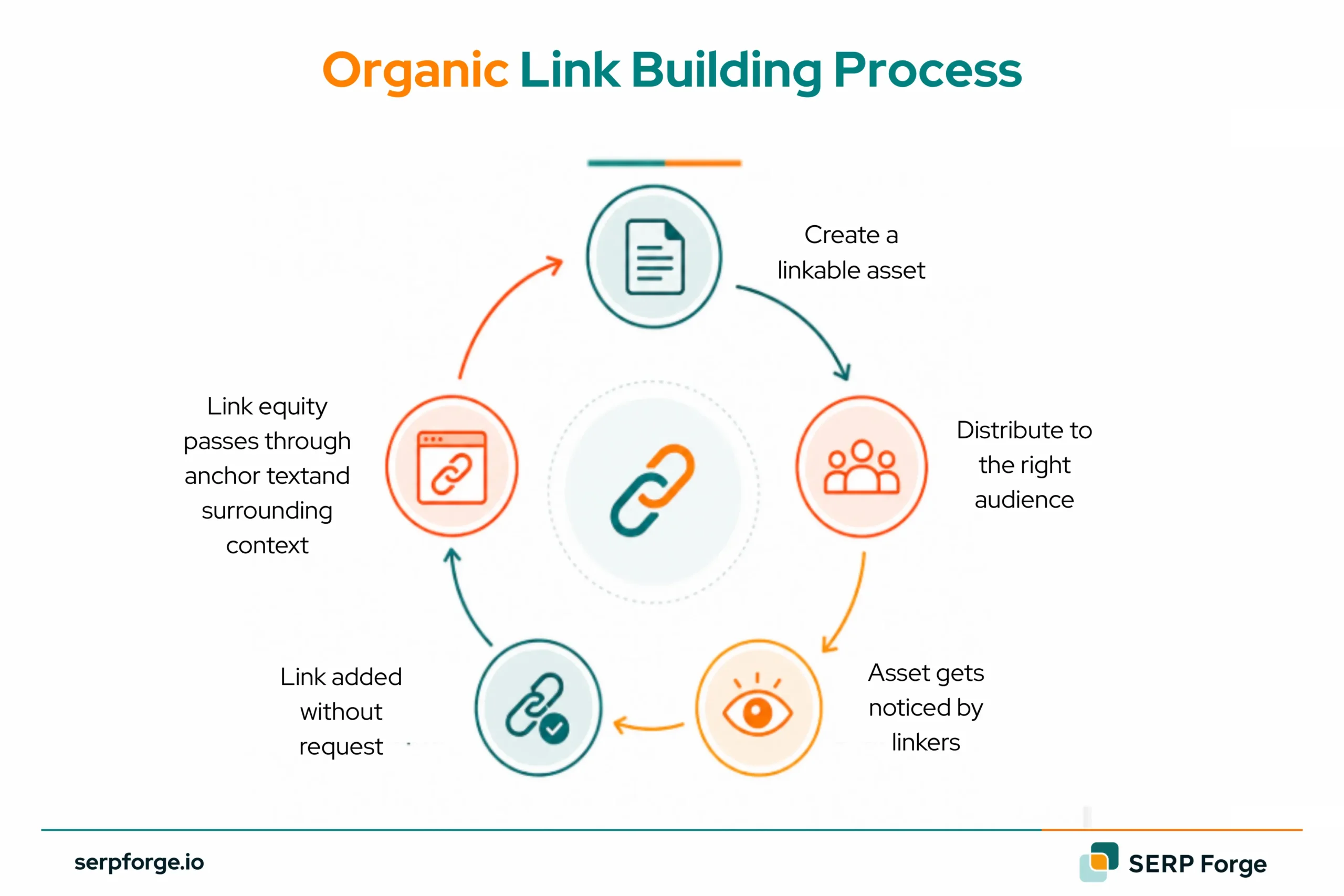
Google’s original PageRank algorithm treated every link as a vote, weighted by the authority of the page casting it.
Decades of algorithm updates later, the core idea hasn’t changed much: a link from a page search engines trust passes link equity to the page it points to, and the anchor text and surrounding content tell search engines what that page is about.
Organic link building follows a predictable process.
Step 1: Create Value
Develop content, tools, research, or resources that solve a problem.
Step 2: Increase Visibility
Promote the asset through content marketing, social media, communities, newsletters, and digital PR.
Step 3: Earn Attention
Journalists, bloggers, researchers, and businesses discover the asset.
Step 4: Receive Editorial Links
They reference your content because it improves their own content.
Step 5: Build Authority
The backlinks strengthen your authority signals, trust signals, and PageRank.
Step 6: Improve Rankings
Better authority often results in higher search visibility and increased organic traffic.
This cycle continues as more people discover and reference your content.
9 Proven Organic Link Building Strategies
For a broader approach, explore these link building techniques beyond organic link earning.
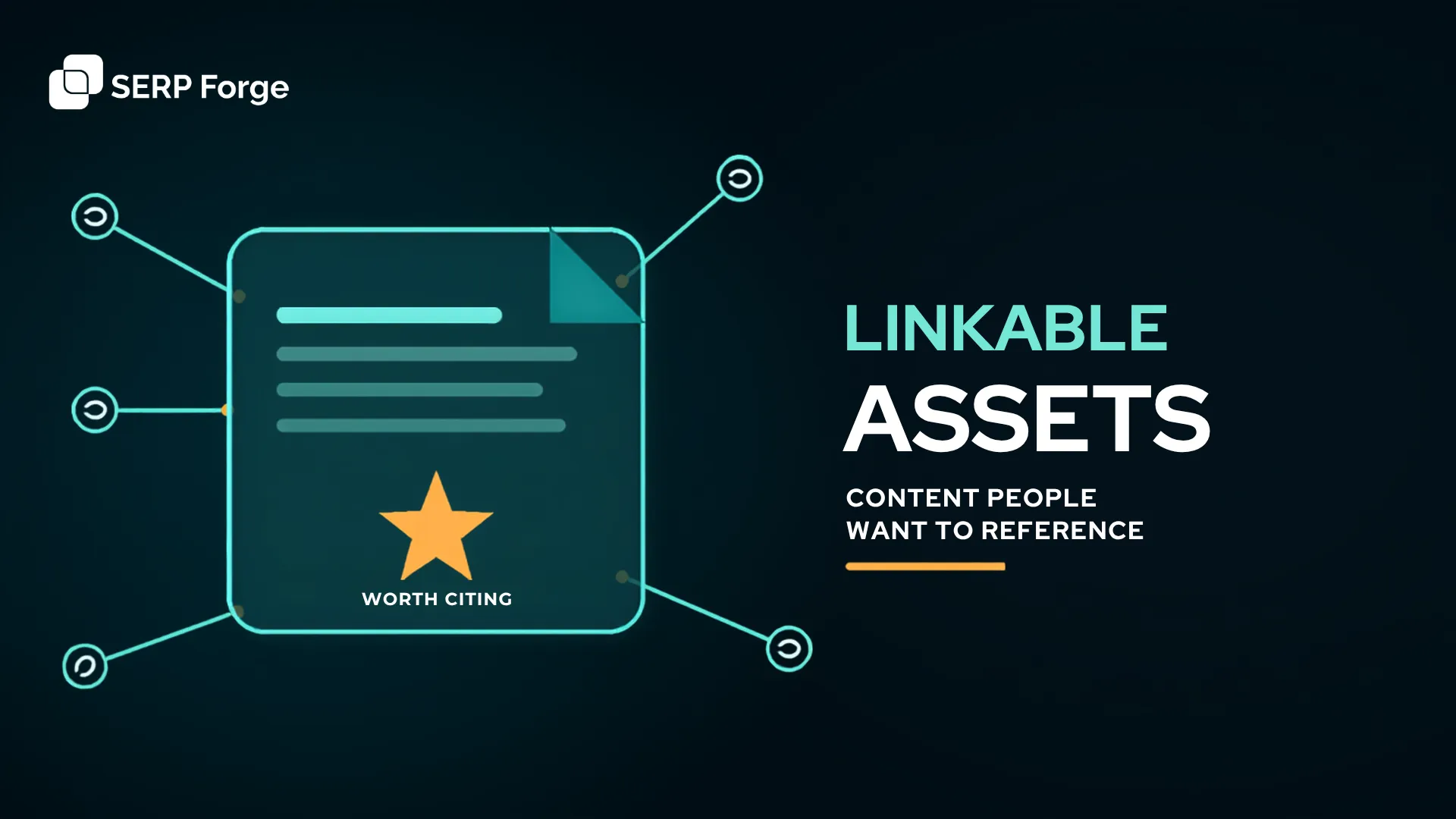
Not every piece of content qualifies as one of the linkable assets below, even when it’s well-written.
Before investing in any strategy, run the idea through a quick filter: does it offer Evidence, Authority, Relevance, or Novelty (EARN) that the linker’s own readers don’t already have access to? If an idea fails all four, outreach won’t fix it.
Proven techniques that help build authority, increase visibility, and earn links without relying on aggressive outreach:
Create Original Data & Research
Content built on proprietary data earns 2 to 3 times more backlinks than content without it, according to link-tracking data compiled by LinkCrafters.
Vena Solutions published an 85-point SaaS benchmark report that pulled links from MarketingProfs, PayPro Global, and Insivia, sites that would never link to a generic “SaaS trends” post but will cite a specific number they can reuse in their own writing. SaaS teams that want help earning links like these can work with a SaaS link building agency.
Build Free Tools & Calculators
A free calculator, generator, or diagnostic tool keeps getting linked from resource pages and “best tools” roundups long after the launch buzz fades.
Ahrefs built its free keyword generator and backlink checker specifically to give SEO blogs something concrete to recommend to readers, and those tool pages still pull in new referring domains years after launch.
Publish Skyscraper-Style Content
Brian Dean coined the Skyscraper Technique at Backlinko in 2015: find a page that already attracts links, build something measurably better, then make sure the people linking to the original know your version exists. It still works because most “definitive guides” online are years out of date, and a genuinely current version is an easy swap for anyone maintaining a resource page.
Digital PR & Newsworthy Campaigns
Digital PR campaigns earn links from an average of 42 unique referring domains per asset, according to Digitaloft’s research, with more than a fifth coming from publications in the Domain Rating 70-79 range.
Asbestos.com’s animated 9/11-anniversary data study illustrates this well: it has pulled 87 links to date, including placements on Scientific American and Yahoo, because the data answered a question journalists were already covering.
Create Linkable Visual Assets
Infographics and other visual data formats earn 30% to 40% more backlinks than text-only pages, since a chart or diagram is easier for another writer to embed and cite than a paragraph they’d have to summarize themselves.
The asset only works if the underlying data is real; a polished infographic built on guesses gets shared on social media, not cited in articles.
Become a Source for Journalists
Journalist-outreach query services connect reporters who need a fast quote or stat with sources who can provide one.
The link you get back is usually a single citation, but it often comes from a domain you couldn’t access through any other channel, and a few of these placements done consistently build the kind of citation links that AI summarization tools now weigh heavily.
Publish Industry Surveys & Benchmark Reports
HubSpot’s Marketing Statistics hub is the clearest example of this strategy compounding over time. Instead of a one-off study, HubSpot maintains an evergreen, regularly updated page of marketing benchmarks that has pulled in thousands of backlinks over its lifetime from sites like Inc.com, Entrepreneur, and CBS News. The lesson isn’t “publish a survey,” it’s “maintain the survey,” since a stale stats page stops earning new citations within a year.
Write Genuinely Definitive Guides
Long-form content over 3,000 words earns roughly 3.5 times more backlinks than shorter posts, but length alone isn’t the variable doing the work.
A 3,000-word guide that repeats what ten other guides already say earns nothing; length is just often where someone actually answers every sub-question a reader has, and that completeness is what gets cited from resource pages.
Leverage Community & Forum Engagement
Genuine participation in niche communities (Reddit threads, industry Slack groups, specialized forums) rarely produces a direct do-follow link, but it produces brand mentions, and brand mentions now correlate more strongly with AI search visibility than backlinks do.
Treat forum engagement as a citation-building channel even when it isn’t a traditional link-building channel.
Step-by-Step Organic Link Building Process
If you want to know how to build organic links repeatedly rather than chase one-off wins, the six steps below turn any of the nine strategies above into a system instead of a single campaign.
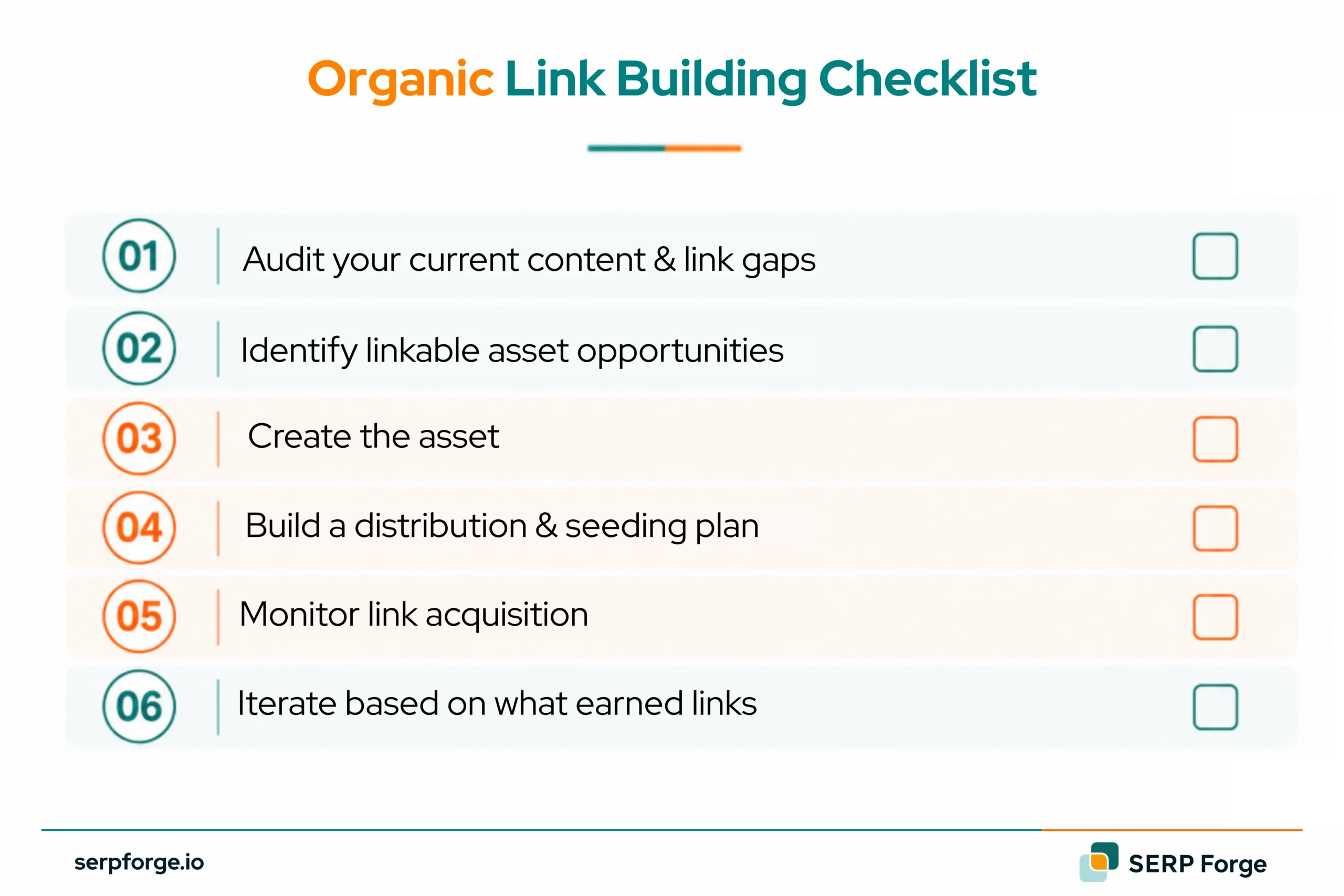
Step 1: Audit your current content & link gaps
Pull your existing backlink profile in Ahrefs, Semrush, or Google Search Console and compare it against two or three direct competitors. The gap between what links to them and what links to you usually points straight at the content types worth building first.
Step 2: Identify linkable asset opportunities
Look for sub-topics where every existing resource is outdated, incomplete, or missing data entirely. The EARN filter from earlier works well here: if an idea can’t check at least two of Evidence, Authority, Relevance, or Novelty, pick a different angle.
Step 3: Create the asset
Build the actual research, tool, or guide with enough specificity that summarizing it requires citing it. Vague claims get paraphrased and forgotten; a specific number, a downloadable dataset, or a working tool gets linked because it can’t be reproduced inline.
Step 4: Build a distribution & seeding plan
Identify the journalists, bloggers, and resource-page maintainers most likely to care, then reach out with a specific reason your asset helps their specific piece, not a generic “check out our content” email.
The first wave of coverage is what makes the second wave possible, since most secondary links come from people who found the asset through someone else’s citation.
Step 5: Monitor link acquisition
Track new referring domains weekly for the first two months after launch, then monthly after that. A spike followed by silence usually means outreach worked once and stopped; sustained growth usually means the asset is being discovered organically through search or social sharing.
Step 6: Iterate based on what earned links
Look at which specific data points, headlines, or visual elements got cited most often, then build the next asset around that pattern. Most teams treat every campaign as a fresh start; the ones that compound results treat each campaign as a data point for the next one.
How to Measure Organic Link Building Success
Referring domains matter more than raw backlink count, since ten links from the same site carry far less weight than ten links from ten different domains. Track that figure alongside five other metrics that tell you whether a campaign is actually working:
- New referring domains per month, tracked in Ahrefs, Semrush, or GSC
- Average Domain Rating or Domain Authority of the sites linking to you
- Organic traffic to the specific page that earned the links
- Keyword ranking movement for that page’s target terms
- Branded search volume, which often rises before rankings fully catch up
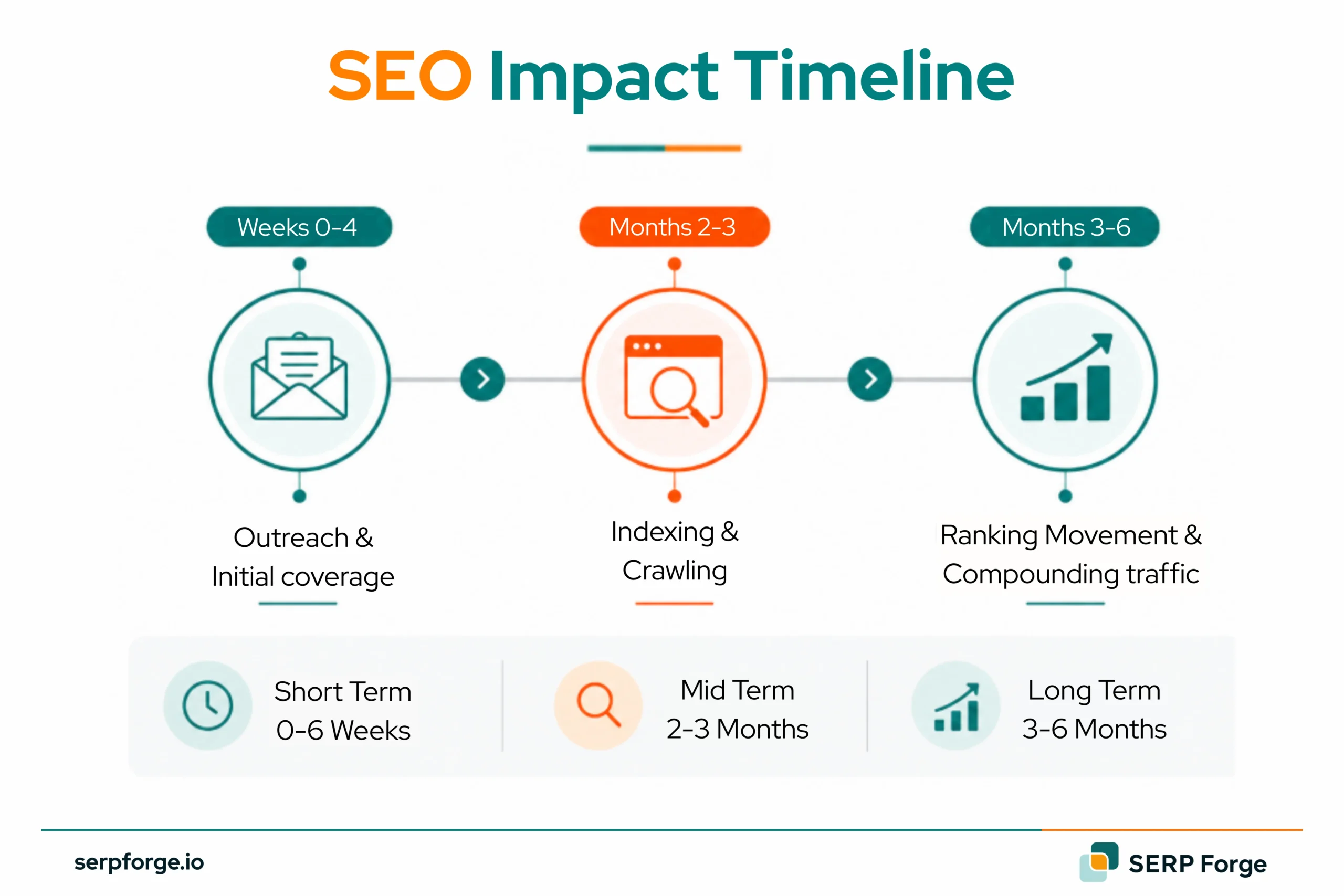
Backlink acquisition itself is a leading indicator, not the goal. Most campaigns take an average of 3.1 months after a link is acquired before ranking movement becomes visible, based on industry tracking from Moz and DemandSage, so judge a campaign on a quarter, not a week.
Common Mistakes That Stop Links From Being Earned
Most failed organic link building campaigns trace back to one of five mistakes, and almost none of them are about the quality of the writing.
- Buying links disguised as “organic.” Paying for a placement and calling it earned doesn’t change what it is to Google’s link spam systems, and it removes the entire benefit of organic link building, which is that the link is genuinely unprompted.
- Targeting DR/DA instead of real organic traffic. A high-authority site with no real audience in your niche passes some link equity but little relevance signal and almost no referral traffic; a moderate-authority site your actual customers read often performs better.
- Generic outreach with no specific value offer. An email that doesn’t reference the recipient’s specific page, audience, or recent coverage reads as mass outreach, and mass outreach gets ignored at scale no matter how good the underlying asset is.
- Ignoring internal linking to support the linkable asset. A page earning external links still needs internal links pointing to it from related content on your own site, or the link equity it earns has nowhere else on the domain to flow.
- Publishing once and not promoting/distributing. The asset doesn’t do the work by existing. Content promotion, the seeding, the journalist outreach, the community sharing, is usually 60% to 70% of the total effort a successful organic campaign requires, not an afterthought tacked onto publishing day.
Final Thoughts
Organic link building is not about collecting backlinks. It is about creating assets that deserve attention.
The websites winning in search today are investing in original research, useful tools, digital PR campaigns, benchmark reports, and genuinely valuable content. These assets attract editorial links, strengthen authority signals, improve search visibility, and generate sustainable organic traffic growth.
If your goal is long-term SEO success, focus less on acquiring links and more on earning them. The strongest backlink profiles are rarely built through shortcuts; they are built through value, trust, and consistent contribution to your industry.
FAQs
What’s the difference between organic and natural link building?
In practice, most SEOs use the two terms interchangeably. Where a distinction gets drawn, “organic” tends to describe the strategy (building content designed to attract links), while “natural” describes the resulting link profile (one that looks unmanipulated to search engines). Both describe links earned without payment or direct exchange.
How long does organic link building take to show results?
Expect the first links within 2 to 6 weeks of a strong distribution push, with measurable ranking movement following roughly 3 months after that, based on industry benchmarks from Moz and DemandSage. Evergreen assets like data hubs or free tools keep earning links well past that window, sometimes for years.
Can small businesses do organic link building without a PR budget?
Yes. A well-run customer survey, a unique angle on public data, or a guide that’s genuinely more complete than what currently ranks can all earn links without a media buy. The real constraint for small businesses is usually time and consistency, not budget.
Is organic link building safer than guest posting or link buying?
Yes, by a wide margin. Organic links carry no risk under Google’s link spam guidelines because nothing was exchanged or negotiated. Guest posting carries some risk depending on execution and disclosure, and paid links carry direct penalty risk if detected.
How many organic backlinks do I need to rank?
There’s no fixed number. Competitive analysis of the current top 10 results for your target keyword tells you more than any general benchmark: a local service page might rank with five relevant links, while a competitive national keyword might need fifty or more from genuinely authoritative sources.
What tools help track organic link-building progress?
Ahrefs, Semrush, and Google Search Console cover the core metrics: new referring domains, lost links, anchor text distribution, and which specific pages are earning links. GSC is free and shows the exact queries driving traffic to a linked page, which the paid tools don’t surface as directly.