



Run almost any site through a backlink checker, and the toxic-score report fills up fast: foreign-language directories, abandoned forums, low-authority blogs nobody visits. The instinct is to panic and disavow everything on the list.
Most of that list isn’t actually dangerous.
Genuinely harmful toxic backlinks are a narrower, more specific category than toxic-score dashboards suggest.
This guide separates the two.
We’ll define what really counts as a toxic backlink, where these links usually come from, how to run a backlink audit for toxic links without overreacting to noise, and exactly how to disavow toxic backlinks when removal isn’t an option.
What Are Toxic Backlinks?
Toxic backlinks are inbound links built or acquired through manipulative, low-quality, or spam-driven tactics that violate Google’s link spam guidelines and can put a site’s organic visibility at risk.
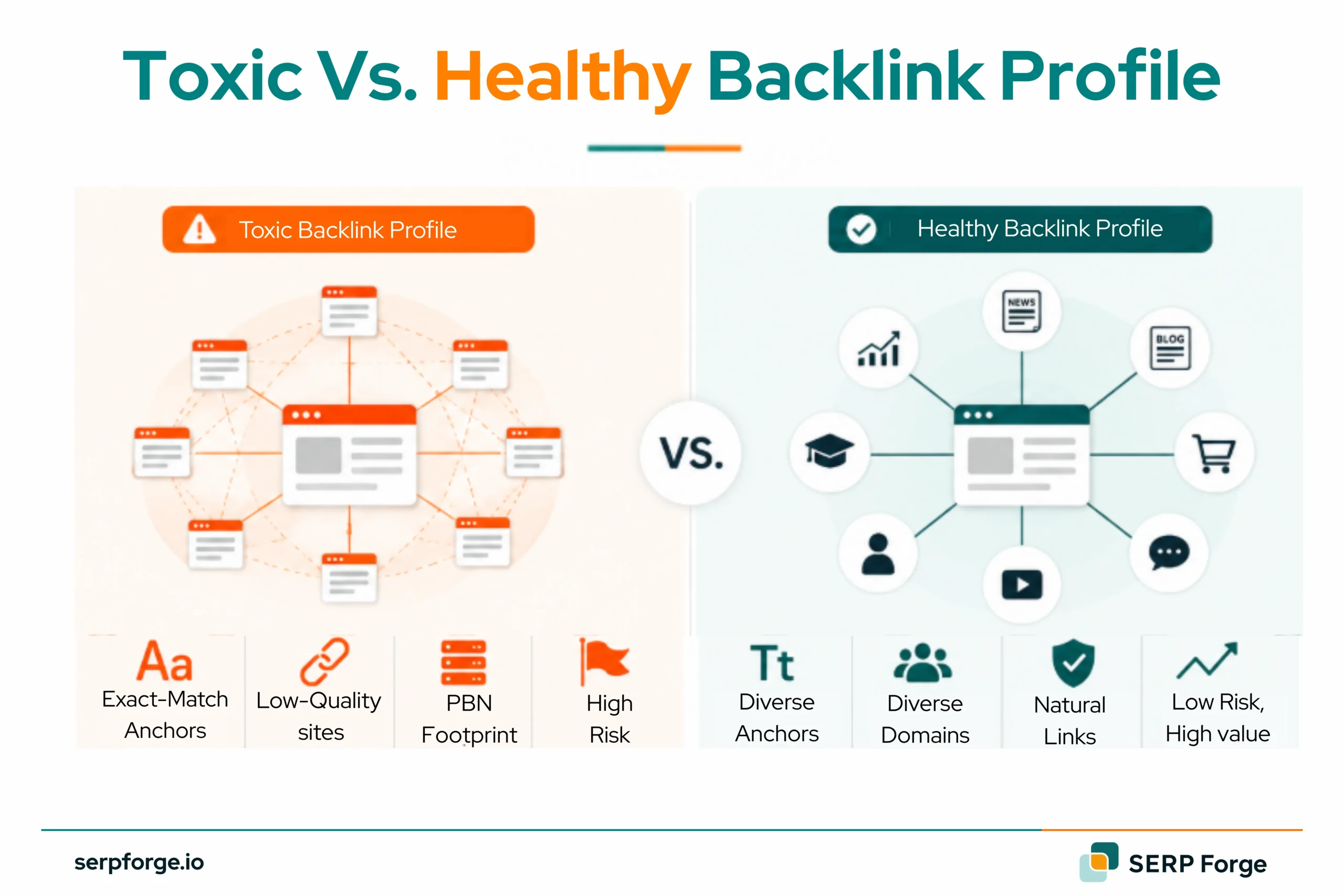
A toxic link profile, by contrast, usually shares several traits at once:
- Built to manipulate rankings, not to send real referral traffic
- Part of a network of interlinked, low-value domains, think PBNs or link farms
- Anchor text over-optimization, exact-match commercial phrases repeated across dozens of domains
- No topical relevance to your business or industry
- No editorial review auto-approved comments, scraped directories, and undisclosed paid placement
A single odd-looking link rarely fits this profile on its own. A repeated pattern across many links usually does, which is the core idea behind every toxic link profile audit in this guide.
According to Google’s Spam Policies, link schemes designed to manipulate rankings, including paid links, excessive link exchanges, and large-scale article marketing, violate Google’s guidelines and may result in manual actions or ranking suppression.
The practical risk isn’t every link that looks unusual. It’s the small subset that fits a manipulative pattern that Google’s systems or a human reviewer can clearly identify.
How Do Toxic Backlinks Impact Your Website?
Toxic backlinks affect a website on three levels: rankings, traffic, and the time it takes to clean things up.
- Rankings & visibility: a confirmed manual action can suppress rankings until it’s resolved and a reconsideration request is approved
- Traffic & leads: ranking drops mean fewer organic sessions and fewer leads on affected pages
- Time & trust: auditing, outreach, and disavowing pull resources away from real growth work, and a manipulative-looking profile can make future link building harder
Most of this is preventable. Sites that struggle longest usually build a manipulative profile at scale, not the ones with a few stray low-authority links.
That said, the term gets used more loosely than the actual risk it describes.
Penguin has been part of Google’s core, real-time algorithm for years, and its default behavior is to devalue manipulative links rather than penalize the site.
Google’s guidance is consistent: disavow is for sites that built spammy links themselves, or are confident they’re facing a negative SEO attack, not routine housekeeping.
That’s split SEO practice into two camps:
| Camp | Position | Typical Action |
|---|---|---|
| Reactive-only | Algorithms already devalue most spam | Disavow only after a manual action or attack |
| Proactive housekeeping | A clean profile reduces long-term risk | Periodic audits and disavow files regardless |
Our view: treat “toxic” as a label for a small set of manipulative or attack-driven links, not every link your dashboard flags.
Ahrefs reports that top-ranking pages typically gain new followed backlinks from unique websites at a rate of 5% to 14.5% each month.
The SERP Forge 3-Factor Toxic Link Test
A single toxicity score hides more than it tells you. Check any flagged link against three questions instead. Act only if it fails two or more.
- Pattern: Part of a network, or an isolated one-off?
- Intent: Could it send a real visitor, or does it exist only to pass ranking value?
- Proximity to action: Tied to a manual action or known attack, or just theoretical risk?
Fail one, it’s noise. Fail two or three, it’s worth acting on.
Example: A SaaS site flags 187 backlinks. 140 are isolated and fail with only intent left alone. 31 share hosting, anchor text, and a live manual action disavowed. 16 are a sudden spam-comment spike with no real intent, disavowed as a precaution. Only 47 of 187 needed action.
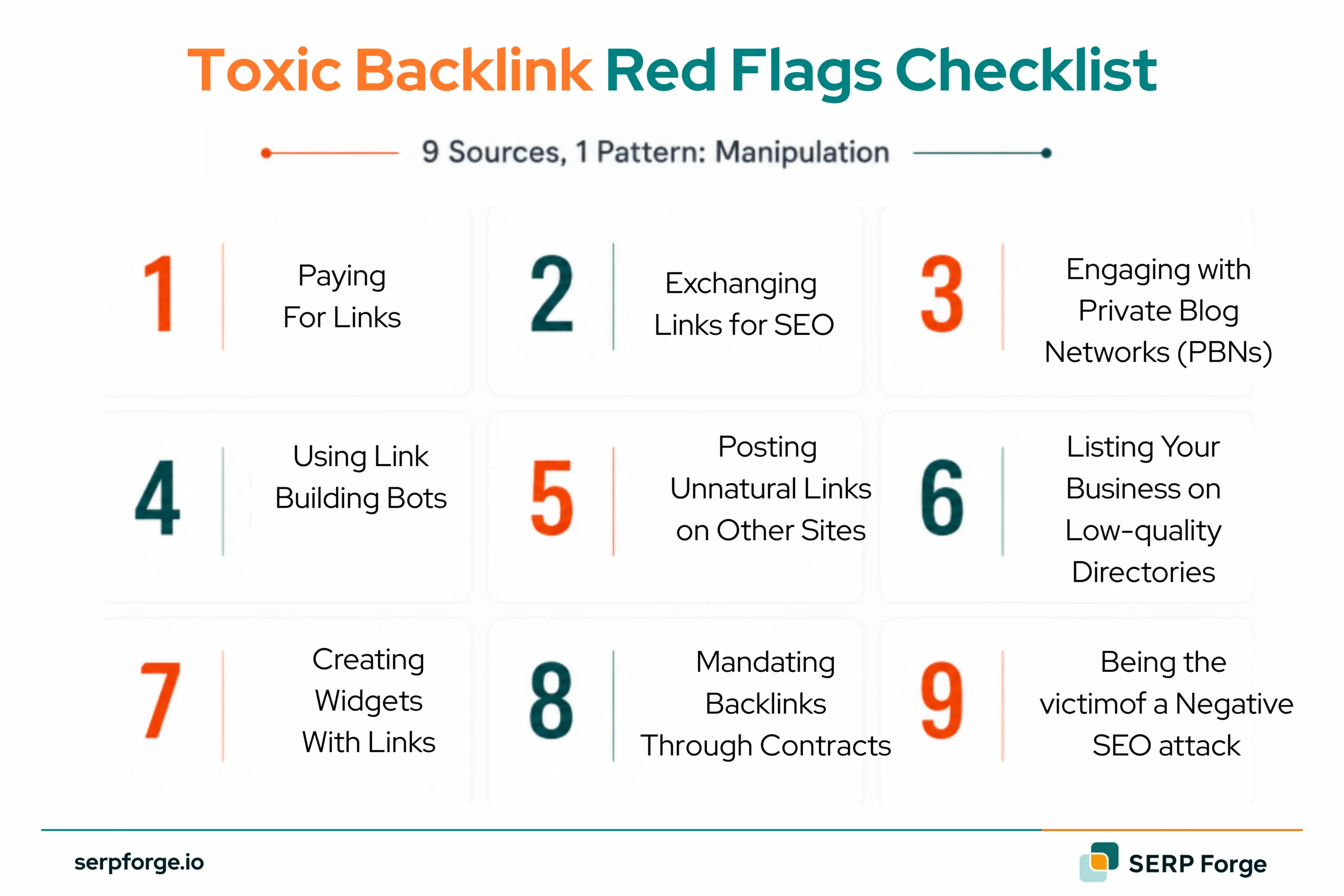
What are 9 Common Sources of Toxic Backlinks?
Most genuinely harmful links trace back to a recurring set of practices, whether a site built them on purpose or inherited them through a vendor, agency, or attacker.
1. Paying for Links
Paying for placement directly or through “sponsored content” that hides the commercial relationship violates Google’s link spam guidelines whenever the link passes ranking value without a nofollow or sponsored attribute.
Scaled paid-link campaigns are one of the easiest patterns for algorithms to detect, since the anchor text and target pages tend to repeat across unrelated domains.
2. Exchanging Links for SEO
Reciprocal link exchanges (“link to me and I’ll link to you”) and three-way schemes that obscure the exchange both count as manipulative link building.
Google’s systems are tuned to spot the circular pattern, even when a middleman site is inserted to disguise it.
3. Engaging with Private Blog Networks (PBNs)
PBNs are networks of expired or purpose-built domains, often dressed up as independent blogs, that exist only to pass links to client sites.
They’re risky precisely because they look normal in isolation; the toxic link profile only becomes visible once shared hosting, ownership, or template patterns connect the dots.
4. Using Link Building Bots
Automated tools that blast links into blog comments, forum profiles, and open directories generate volume fast and toxicity faster.
These links typically carry no editorial review, no relevance, and identical footprints across thousands of low-value pages.
5. Posting Unnatural Links on Other Sites
Guest posts stuffed with exact-match commercial anchors, comment spam, and forum signature links fall into this category.
The content itself may be legitimate; the link is inserted purely to manipulate rankings rather than to support the reader.
6. Listing Your Business on Low-Quality Directories
Mass directory submissions often sold in bulk packages place a business on hundreds of domains with no editorial standard, no traffic, and no topical focus. Individually harmless, collectively they can form a recognizable spam footprint.
7. Creating Widgets with Links
Embeddable badges, buttons, or “powered by” widgets that carry a hidden follow link back to your site can scale into thousands of placements once syndicated across unrelated, low-relevance domains, exactly the kind of pattern a toxic backlinks checker is built to flag.
8. Mandating Backlinks Through Contracts
Sponsorship, supplier, or affiliate agreements that require a followed backlink as a contractual condition create the same manipulative pattern as paid links, just dressed in different paperwork.
Scaled across dozens of partners, the anchor text and placement patterns tend to repeat in ways that are easy to detect.
9. Being the Victim of a Negative SEO Attack
Sometimes a toxic link profile isn’t self-inflicted. Competitors or bad actors build large volumes of spammy links pointing at a target domain, hoping the pattern triggers a manual action or algorithmic suppression.
This is the one source on this list where the disavow tool is unambiguously the right response.
Google confirmed that its systems are designed to prevent competitors from harming rankings through large-scale spam link attacks. In most cases, Google’s algorithms can identify and ignore these links without requiring action from the site owner.
How AI Search Changes the Toxic Backlink Equation
AI-generated answers add a citation and trust layer on top of traditional ranking, so a toxic link profile can undercut brand credibility even when classic rankings hold steady.
Google AI Overviews, ChatGPT Search, and Perplexity lean on signals beyond link equity, entity consistency, review sentiment, and topical authority among them. An AI SEO agency audits these signals alongside your backlink profile.
A site can rank acceptably while still failing to earn citations, particularly if its backlink profile looks manipulative on closer inspection by a human reviewer or a content partner doing due diligence.
There’s also a newer negative SEO angle: bad actors increasingly aim spam campaigns at suppressing a competitor’s visibility not just in classic rankings but in AI-cited source pools, since these systems appear to favor sources with consistent, verifiable signals.
Disavowing won’t directly raise your odds of being cited by an AI answer engine. But a cleaner link profile removes one more inconsistency in these systems, and the people checking your brand before recommending it might weigh against you.
How to Identify Toxic Backlinks (Step-by-Step)
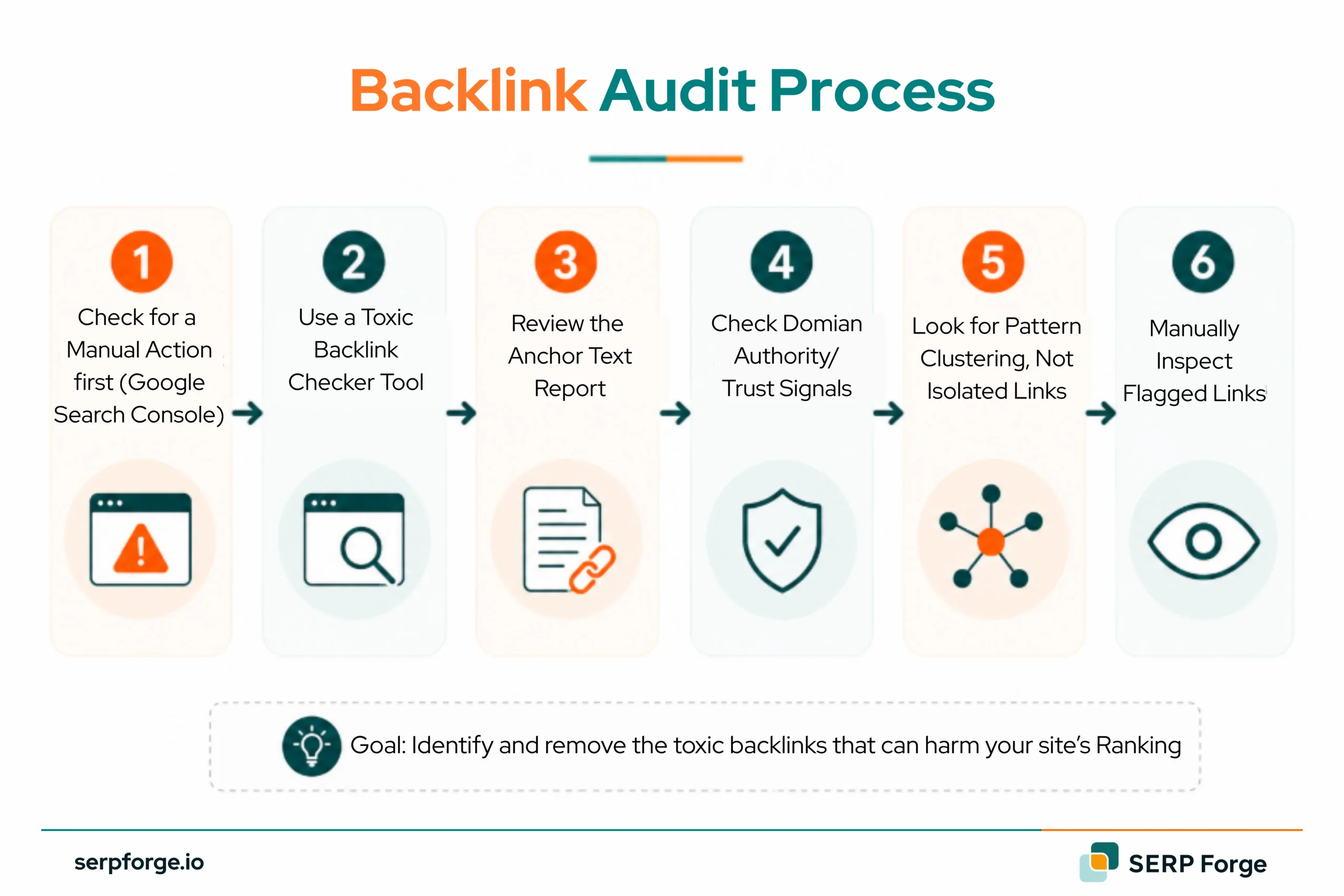
A reliable backlink audit for toxic links combines automated screening with manual judgment. No single toxic backlinks checker should be the final word on its own. Need a hand with the manual review on a SaaS site? Explore SERP Forge SaaS backlinks.
Below is the step-by-step process for finding toxic backlinks:
1. Check for a Manual Action First (Google Search Console)
Before running any tool, open Search Console’s Manual Actions report.
If Google has already flagged unnatural links, that single signal outranks every other diagnostic step; it tells you exactly what triggered the toxic backlinks penalty and where to start.
2. Use a Toxic Backlink Checker Tool
A toxic backlink checker (Semrush, Ahrefs, Majestic, and similar platforms all offer one) is the fastest way to triage volume.
Treat the output as a shortlist for review, not a disavow list. These scores are built on heuristics, not confirmed penalty correlation.
3. Review the Anchor Text Report
Pull your full anchor text distribution and look for over-concentration on exact-match commercial phrases.
A natural link profile skews toward branded terms, naked URLs, and generic phrases like “click here.” A heavy tilt toward keyword-stuffed anchors is one of the clearest toxic link profile indicators.
4. Check Domain Authority/Trust Signals
Cross-reference flagged domains against authority metrics, estimated traffic, and indexing status.
A domain with no organic traffic, no indexed pages beyond the linking page, and no real editorial footprint is a stronger candidate than one that’s simply niche or small.
5. Look for Pattern Clustering, Not Isolated Links
The strongest toxic signal is repetition: the same hosting provider, the same template, the same anchor phrasing, or the same outbound link patterns appearing across many domains. Isolated odd links rarely matter; clusters almost always do.
6. Manually Inspect Flagged Links
Before adding anything to a disavow file, visit the linking page directly. Confirm the link still exists, check whether the surrounding content is spun or scraped, and note whether the domain shows any sign of real audience or editorial intent.
According to Semrush, websites frequently accumulate suspicious backlinks from low-authority directories, spam networks, and irrelevant domains over time, making regular backlink audits an important part of maintaining a healthy link profile.
Should You Remove or Disavow?
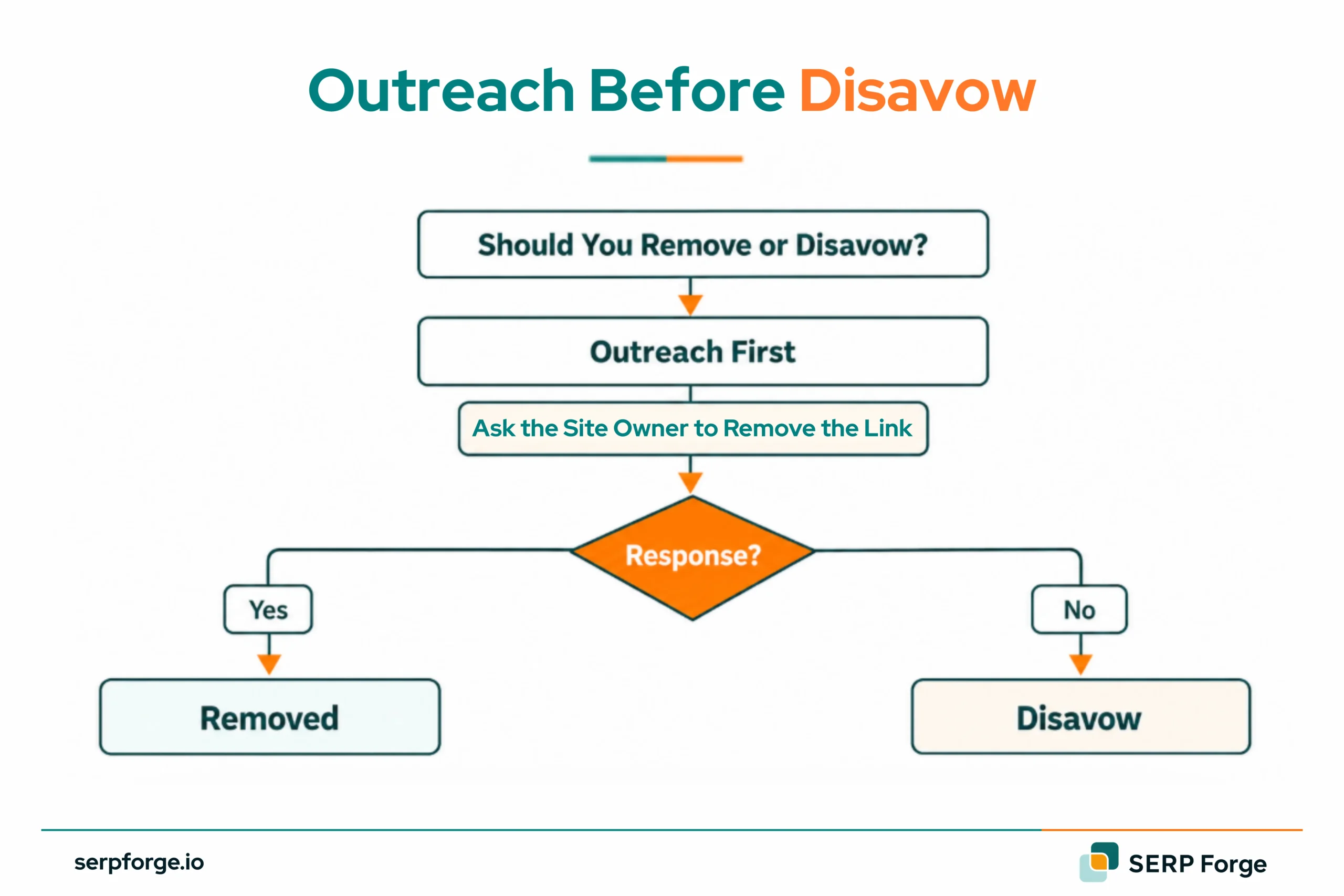
Removal should always be the first move. Disavowing through Google Search Console is the fallback tool for links you cannot get taken down directly.
Try Removal via Outreach First
Contact the webmaster and request removal before disavowing. This preserves your option to recover link equity if the link turns out to be legitimate, and it avoids disavowing pages that might later become genuinely valuable.
Keep a simple log of contact dates and responses; it’s useful evidence if you ever need a reconsideration request.
When Disavowal Is the Right Call
Disavow toxic backlinks when outreach fails, when the source is unreachable (expired domains, anonymous PBNs), when you’ve received a manual action tied to unnatural links, or when you’ve identified a clear negative SEO attack.
In each of these cases, the link’s owner either can’t or won’t remove it, leaving the disavow file as the only practical lever.
The Risk of Over-Disavowing
Disavowing too broadly can strip away link equity from pages that were never actually harmful, particularly when teams disavow based on toxic-score thresholds alone.
Over-disavowing has been linked anecdotally to ranking drops in cases where legitimate, if low-authority, links were removed from the equation. Treat the disavow file as a scalpel, not a routine maintenance task.
How to Disavow Toxic Backlinks
- Export your full backlink profile from Search Console and your preferred backlink checker tool.
- Filter for confirmed toxic links using the identification steps above: manual action data, anchor text concentration, pattern clustering, and manual inspection.
- Attempt outreach for any link source with a working contact method.
- Build your disavow file as a plain .txt file, one entry per line. Use domain: to disavow every link from a domain, or a full URL to disavow a single page.
# Disavow file for example.com
domain:spam-link-network. example
domain:pbn-cluster-site.net
- Upload the file through Google Search Console’s Disavow Links tool, selecting the correct property.
- If you have an active manual action, submit a reconsideration request referencing the disavow file and the outreach steps you took.
- Keep a dated copy of every disavow file you submit. Disavow toxic backlinks decisions should be auditable, not a black box six months later.
What Happens After You Disavow?
Google typically processes a new disavow file within a few weeks, though full re-crawling of every affected linking page can take longer.
Google states that the Disavow Tool should only be used when a site has a significant number of spammy, artificial, or low-quality links pointing to it and there is a risk of manual action. For most websites, Google’s algorithms can already ignore many spammy links automatically.
Disavowing removes the link’s ranking influence going forward; it doesn’t retroactively undo any damage already factored into rankings, and it won’t lift a manual action on its own.
If no manual action existed, don’t expect a visible ranking jump in most cases; those links were already being ignored, so disavowing mainly protects against future risk rather than unlocking immediate gains.
Toxic Backlinks vs. Manual Penalty Removal
Proactive cleanup and manual penalty removal both rely on the same disavow tool, but they’re triggered by different problems and carry different stakes:
| Metrics | Proactive Toxic Link Cleanup | Manual Penalty Removal |
|---|---|---|
| Trigger | Audit findings, risk reduction, and negative SEO concerns | Manual Actions report in Search Console |
| Primary tool | Disavow file (optional, targeted) | Disavow file + reconsideration request (required) |
| Urgency | Low to moderate | High rankings actively suppressed |
| Typical timeline | Ongoing, scheduled audits | Days to weeks for review after submission |
| Outcome if done well | Reduced long-term risk, cleaner link profile | Manual action lifted, rankings restored |
| Outcome if overdone | Lost link equity from over-disavowing | Reconsideration request rejected, repeat submissions needed |
Don’t disavow anything until you’ve run this.
Get the point audit as a printable PDF, sorted by phase: Diagnose, Investigate, Act, Document, so you’re not second-guessing the order.
[ Download the Checklist (PDF) ]
Conclusion
Most of what gets flagged as a toxic backlink is already being quietly ignored by Google’s algorithms. The links worth your attention are the smaller set tied to a manual action, a clear manipulative pattern, or a negative SEO attack, not every low-authority domain your checker tool underlines.
Run the audit, but audit twice before you disavow once. A targeted disavow file protects against real risk. An over-broad one can quietly cost you link equity you never needed to give up.
FAQs
1. How do I check for toxic backlinks for free?
Google Search Console’s Links report and Manual Actions report are free starting points. Several backlink checker tools also offer limited free toxic-score scans, though paid tools provide deeper anchor text and pattern analysis.
2. Does Google penalize toxic backlinks automatically?
Rarely. Google’s systems mostly devalue spammy links algorithmically without any visible penalty. Manual actions that suppress rankings require a human reviewer to flag an unnatural link pattern.
3. How long does disavowing take to show results?
Google generally processes a new disavow file within a few weeks, but visible ranking changes depend on whether a manual action was involved. Without one, disavowing mainly reduces future risk rather than producing an immediate shift.
4. Can disavowing hurt my rankings?
Yes, if links are disavowed too broadly. Removing links that were providing real, if modest, value can erase positive link equity along with the toxic links you intended to remove.
5. What’s the difference between toxic and spammy backlinks?
“Spammy” describes the tactic or source: comment spam, bot-built links, scraped directories. “Toxic” describes the outcome: a link genuinely capable of triggering a penalty or being devalued. Many spammy links exist without ever becoming toxic in practice.