


Link building gets results. The numbers back that up every single time.
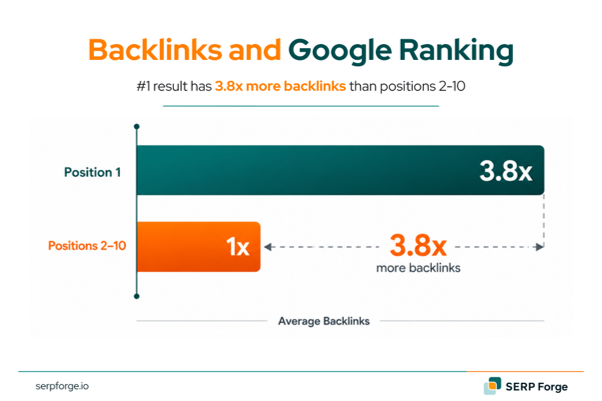
The #1 result on Google has 3.8x more backlinks than pages sitting in positions #2 through #10. Zoom out further and 92.3% of the top 100 ranking domains have at least one backlink pointing to them.
So if your pages are not ranking, your link profile is worth a hard look.
The tricky part? Good link building statistics for 2026 are scattered across a dozen reports, buried in PDFs, or tagged with dates that are not relevant anymore. You need current backlink statistics to set benchmarks, pick the correct tactics and justify the budget.
This guide pulls it all together. You get 90+ sourced link building statistics across rankings, costs, outreach, ROI and AI search. If you are planning SaaS backlinks, use them to set realistic benchmarks.
Link building is important in 2026 because backlinks help pages build authority, earn rankings, attract referral traffic and appear in AI-led discovery. The best campaigns use relevant links, useful content, internal linking, publisher fit and ongoing reporting together.
Link Building Industry Statistics
The industry data explains why link building remains difficult in 2026. Many pages still fail to earn traffic, many pages have no backlinks, and search discovery is spreading across Google, AI tools, and brand-led search journeys.
- Around 96.55% of pages get zero organic traffic from Google. (Ahrefs)
This makes link building useful for pages with search demand and ranking potential. - Around 66.31% of pages have zero backlinks. (Ahrefs)
A few relevant referring domains can separate a page from a crowded SERP. - Around 32.8% of connected consumers discover brands through online search. (DataReportal)
Search visibility still shapes how buyers find and compare brands. - Google held 90.39% worldwide search engine market share in May 2026. (StatCounter)
Google remains the main benchmark for backlink planning. - As of April 2026, Google had a 90.02% share of global search referrals. (Statista)
Search visibility still depends heavily on Google-led discovery. - Over 92% of marketers use, or plan to use, SEO optimization for traditional and AI-powered search. (HubSpot)
SEO now covers rankings, AI visibility, answer quality and citation readiness.
These link building statistics show the same pattern across the web. Visibility is still scarce and links remain one way strong pages prove authority.
Link Building and Google Rankings Statistics
Ranking data explains why backlinks still matter in competitive SERPs. The top pages usually have more backlinks, deeper content, and wider keyword coverage than pages below them.
- The #1 Google result has 3.8x more backlinks than results in positions two to ten. (Backlinko)
Backlinks still separate leading pages from the rest of page one. - Backlinko’s ranking study analysed 11.8 million Google search results. (Backlinko)
This dataset gives SEOs a large benchmark for backlink and ranking patterns. - The average Google first-page result contains 1,447 words. (Backlinko)
Ranking pages usually need enough depth to answer the topic fully. - Long-form content earns 77.2% more backlinks than short-form content. (Backlinko)
In-depth assets give publishers more reasons to cite the page. - Around 94% of content gets zero backlinks. (Backlinko)
Publishing needs promotion, outreach, or original value to attract links. - The average top-ranking page ranks in the top 10 for nearly 1,000 other keywords. (Ahrefs)
One high-performing page can create value across many related searches. - Top-ranking pages gain new followed referring domains at 5% to 14.5% per month. (Ahrefs)
Link growth compounds when useful pages start earning visibility. - Around 94% of all webpages receive no traffic from Google. (SE Ranking)
Content needs demand, authority and better search fit to earn visits. - Only 1% of webpages receive over 10 clicks per month. (SE Ranking)
Small traffic lifts can still place a page above a large share of the web.
These backlinks statistics show why links, content depth and keyword reach should be measured together.
Link Building Cost Statistics
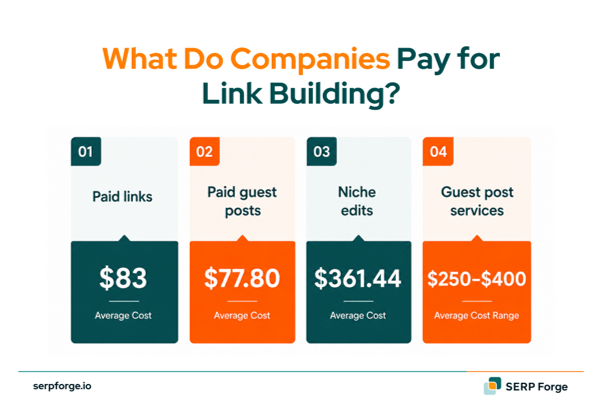
The safest cost data explains how link pricing changes by method and risk. Paid links, niche edits, guest posts, and managed services are priced differently because they need different levels of content, outreach, and review.
- Paid links cost $83 on average in Ahrefs’ paid link study. (Ahrefs)
Low-cost links need deeper checks for relevance, traffic and policy risk. - Niche edits cost $361.44 on average in Ahrefs’ paid link study. (Ahrefs)
Existing-page placements often cost more because the page already has history. - Paid guest posts cost $77.80 on average in Ahrefs’ paid link study. (Ahrefs)
Cheap guest posts need review for traffic, topic fit and editorial standards. - Around 74.3% of paid link sellers charge a fee for link placement. (Ahrefs)
Paid link requests are common, even in campaigns focused on earned links. - Proper guest post link building services often cost $250 to $400 per link. (Ahrefs)
Managed services include prospecting, outreach, writing, review and placement work.
These link building statistics 2026 show why cheap links need careful checks. Cost alone says little without relevance, traffic, editorial review and risk assessment.
Link Building Budget Statistics
Budget data explains how SEO spend is shifting toward wider visibility. Teams now plan for rankings, AI search, voice search, content updates, and reporting together.
- Over 92% of marketers use, or plan to use, SEO optimization for traditional and AI-powered search. (HubSpot)
SEO budgets now need to cover Google rankings and AI search visibility. - Nearly 24% of marketers are exploring SEO strategy updates for generative AI search. (HubSpot)
AI search is already changing organic planning. - Nearly 30% of marketers reported decreased search traffic as consumers turn to AI tools. (HubSpot)
Brands need authority signals across search pages and answer engines. - Around 73.7% of marketers plan to maintain or increase voice search optimization investment. (HubSpot)
Search strategy is expanding into conversational and answer-led formats. - Over 75% of marketers plan to increase or maintain search and display ad investment in 2026. (HubSpot)
Search remains central to demand generation across paid and organic channels. - Digital ad spending in the US is expected to exceed $383 billion in 2027. (Statista)
Search and digital visibility still compete for large budget pools.
The budget signal is clear. Link building now needs to support broader search visibility, not only classic organic rankings.
Link Building Tactic Statistics
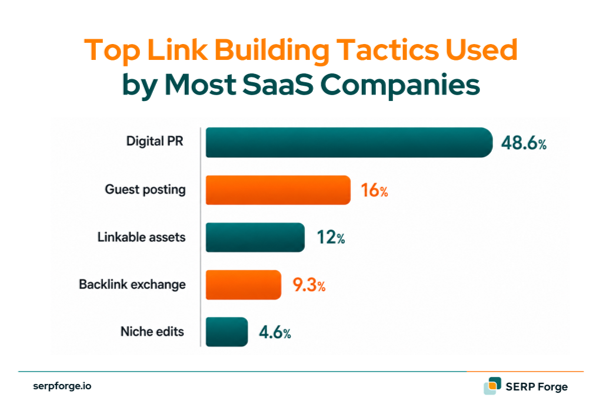
Tactic data explains how link growth works across different campaign types. Authority builds through link velocity, reciprocal linking patterns, foundational links, and consistent backlink discovery.
- Around 73.6% of domains have reciprocal links. (Ahrefs)
Reciprocal linking is common, so relevance and intent matter more. - Top-ranking pages gain followed referring domains at 5% to 14.5% per month. (Ahrefs)
Pages that rank well can keep attracting new referring domains. - Backlinko lists 170+ link building strategies in its link building resource. (Backlinko)
Tactic choice should match the site stage, niche and available assets. - Ahrefs suggests new websites build a few dozen foundational links before scaling outreach. (Ahrefs)
New domains need credibility signals before aggressive outreach starts. - Ahrefs’ live backlink index is updated every 15 to 30 minutes. (Ahrefs)
Backlink profiles change quickly, so monitoring should be regular. - Google AI Overviews cite pages from the top 10 search results around 75% of the time. (Ahrefs)
Classic rankings still influence AI citation opportunities.
The pattern is useful for campaign planning. Link building tactics should match site stage, keyword difficulty and the authority gap.
For new sites, foundational links come first. For competitive pages, content-led outreach and steady referring-domain growth matter more.
Guest Posting Statistics
Guest posting data explains the gap between cheap placement and useful authority. A guest post only helps when the page, publisher, topic, and link context make sense.
- Proper guest post link building services often cost $250 to $400 per link. (Ahrefs)
Quality guest posting needs outreach, writing, placement checks and follow-up. - Paid guest posts cost $77.80 on average in Ahrefs’ paid link study. (Ahrefs)
Very low pricing deserves extra review before approval. - Around 74.3% of paid link sellers charge a fee for link placement. (Ahrefs)
Guest posting often sits near paid placement territory. - Long-form guest-style content earns 77.2% more backlinks than short-form content. (Backlinko)
Better guest posts add depth, data and useful examples. - The average Google first-page result contains 1,447 words. (Backlinko)
Thin guest posts rarely support serious SEO goals. - Blog posts were among the top 5 highest-ROI content formats, cited by 22.26% of marketers. (HubSpot)
Guest content works best inside a planned content strategy.
These guest posting statistics show why shallow placements are risky. Strong guest posts need content quality, editorial fit and real topical relevance.
Link Building Outreach Statistics
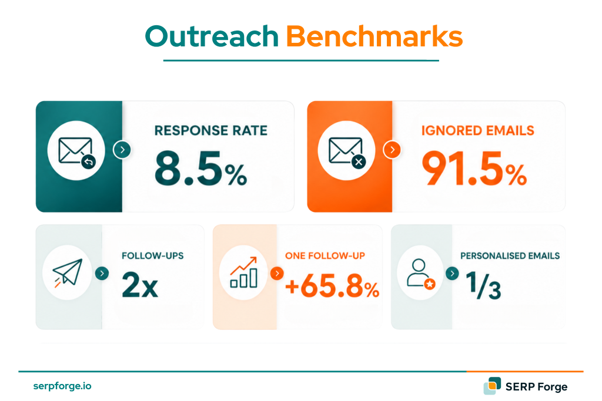
Outreach data explains why many cold emails fail. Publishers ignore generic pitches, while follow-ups, longer subject lines, and personalization improve reply rates.
- Backlinko analysed 12 million outreach emails. (Backlinko)
Large outreach datasets give better benchmarks than small campaign examples. - Only 8.5% of outreach emails receive a response. (Backlinko)
Campaigns need precise targeting to become efficient. - Around 91.5% of outreach emails are ignored. (Backlinko)
Generic outreach wastes prospects and lowers campaign productivity. - Long subject lines get 24.6% higher response rates than short subject lines. (Backlinko)
Specific subject lines can beat vague short pitches. - Sending follow-up emails can generate 2x more responses. (Backlinko)
Follow-ups should be part of every serious outreach workflow. - A single follow-up email can increase replies by 65.8%. (Backlinko)
One thoughtful reminder can recover missed opportunities. - Personalized outreach emails get around one-third more replies than generic emails. (Backlinko)
Personalization works when it proves relevance to the publisher.
The lesson is direct. Better outreach is not about sending more emails; it is about giving publishers a clearer reason to respond.
Linkable Content Statistics
Linkable content data explains why average blog posts struggle. The content that earns backlinks is usually deeper, fresher, easier to cite, and more useful as a reference.
- Long-form content earns 77.2% more backlinks than short-form content. (Backlinko)
Deep content is easier for writers and journalists to cite. - Backlinko and BuzzSumo analysed 912 million blog posts for content performance. (Backlinko)
Large content datasets give better direction than isolated examples. - Around 94% of content gets zero backlinks. (Backlinko)
Linkable assets need a specific reason to be referenced. - The average Google first-page result contains 1,447 words. (Backlinko)
Search-winning content usually answers more of the topic. - Blog posts were used by 38% of marketers in 2025. (HubSpot)
Blogs remain widely used, so differentiation matters more. - Blog posts were among the top 5 highest-ROI content formats, cited by 22.26% of marketers. (HubSpot)
Blog content can produce ROI when planned around search intent. - Around 94% of marketers plan to use AI in content creation processes in 2026. (HubSpot)
AI makes originality, expertise and data more valuable. - AI-cited content is 25.7% fresher on average than organic Google ranking pages. (Ahrefs)
Freshness can help content become more useful in AI search.
Link Building ROI Statistics
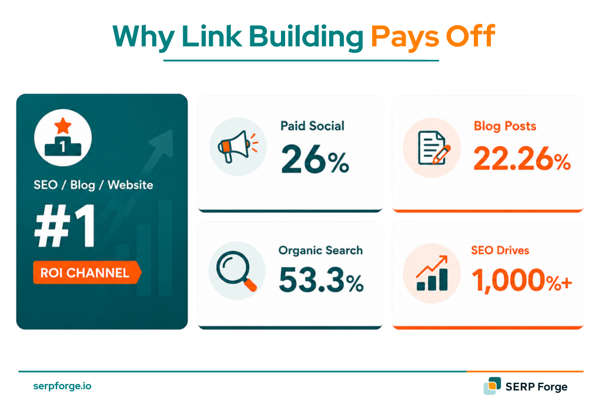
ROI data explains why link building works best with good content. Search, blogs, and SEO remain high-return channels when pages can earn visibility and trust.
- Website, blog and SEO efforts were the #1 ROI-generating channel for marketers. (HubSpot)
Organic visibility remains one of the highest-value marketing investments. - Paid social followed website, blog and SEO as an ROI channel at 26%. (HubSpot)
SEO still competes with major paid channels for return. - Blog posts were among the top 5 highest-ROI content formats at 22.26%. (HubSpot)
Linkable blog assets can support traffic and conversions. - Small businesses are 23% more likely than average to see ROI from blog posts. (HubSpot)
Smaller brands can win through focused organic content. - Organic search accounts for 53.3% of all website traffic. (Ahrefs)
Better rankings can influence a large share of website growth. - SEO drives 1,000%+ more traffic than organic social media. (Ahrefs)
Link building supports a channel with long-term traffic potential. - Search engines remain the top brand discovery channel at 32.8%. (DataReportal)
Organic discovery still shapes brand demand before direct visits happen.
These link building metrics connect backlinks to business value. Better links support stronger rankings, more traffic and longer-term organic returns.
Internal Linking Statistics
Internal link data explains how much discovery depends on crawlable site structure. Search tools need simple paths to find, render, and understand pages.
- Ahrefs tracks 22.21 trillion internal backlinks in its index. (Ahrefs)
Internal links shape how large sites are understood. - Ahrefs’ newer data lists 28.7 trillion internal backlinks. (Ahrefs)
Internal linking matters at web scale and page level. - Ahrefs renders around 80 million pages per day to capture JavaScript links. (Ahrefs)
JavaScript-heavy sites need crawlable internal links. - Ahrefs crawls around 5 million pages every minute. (Ahrefs)
Search tools can detect link changes quickly. - Ahrefs has 493.9 billion pages in its index. (Ahrefs)
Internal links help priority pages stand out in huge indexes.
These internal linking statistics show why site architecture matters. External links bring authority, but internal links help distribute it.
Local SEO Link Building Statistics
Local SEO data explains how trust signals shape regional visibility. Reviews, search discovery, and mobile Google usage all affect how nearby customers find brands.
- Around 80% of US consumers search online for local businesses weekly, while 32% search daily. (SOCi)
Local brands need search visibility before buyers visit, call, or compare options. - Around 46% of consumers always or often add “near me” to local search queries. (BrightLocal)
Near-me searches make local links, citations and review signals more valuable. - Around 61% of consumers use business information sites to learn about a local business they have not used before. (BrightLocal)
Directory listings and third-party profiles still influence local discovery. - Around 62% of consumers would avoid a business if they found incorrect information online. (BrightLocal)
Citation accuracy can affect whether local traffic turns into customers. - Customers are 2.7x more likely to consider a business reputable if it has a complete Google Business Profile. (Google)
Complete profiles support trust before a visitor reaches the website. - Customers are 70% more likely to visit and 50% more likely to consider purchasing from businesses with a complete Business Profile. (Google)
Profile completeness can influence local action, not just visibility. - Only 68% of business contact information on ChatGPT and Perplexity matches Google Business Profile details. (SOCi)
Consistent local data now matters across AI search platforms too. - Around 21% of ChatGPT users switch to Google to verify local business information. (Sagapixel)
AI discovery can still lead users back to Google before they decide. - Around 97% of consumers read reviews for local businesses. (BrightLocal)
Reviews and local mentions support trust around the backlink profile. - Around 71% of consumers use Google to read local business reviews. (BrightLocal)
Google remains the main reputation layer for local search. - Around 67% of consumers often or always check reviews after a local business search. (BrightLocal)
Local SEO campaigns should connect links, listings and review signals.
For local link building, relevance matters more than raw volume. Local citations, reviews, news mentions and community links all support trust.
Link Building and AI Search Statistics
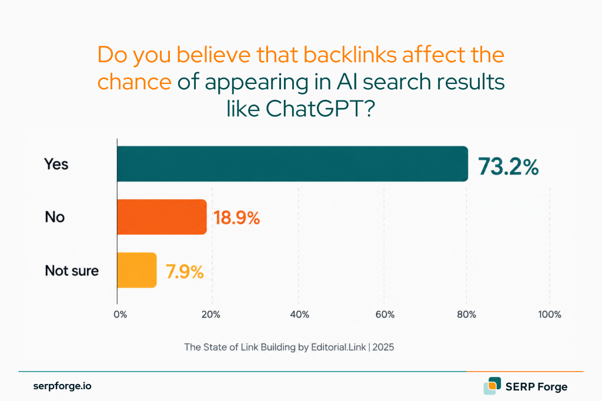
AI search data explains why backlinks now support more than rankings. Authority, freshness, citations, and brand visibility matter as AI answers reshape discovery. Working with an AI SEO company can help you plan for both.
- Google AI Overviews reached over 2 billion monthly users. (Google)
AI visibility now affects mainstream search planning. - Google AI Overviews became available in 200+ countries and territories in 2025. (Google)
AI results now affect global search visibility. - A 2026 study found AI Overviews activated for 13.7% of trending queries. (arXiv)
AI visibility depends heavily on query type and topic. - The same study found AI Overview activation rose to 64.7% for question-form queries. (arXiv)
Question-led content can face higher AI Overview exposure. - A 2026 study analysed 55,393 trending queries across 19 topical categories. (arXiv)
AI search research now has large enough datasets for planning. - Another 2026 study found AI Overviews appeared for 51.5% of representative real-user queries. (arXiv)
AI Overviews can appear far more often in broad query samples. - The same study used a benchmark of 11,500 user queries. (arXiv)
Large query samples help compare Google Search, AI Overviews and Gemini. - A 2026 study found AI Overviews increased daily Reddit comments by 12.0% in eligible communities. (arXiv)
AI search can change user behaviour across source platforms. - The same study found the number of commenting users rose by 12.3%. (arXiv)
AI search impact can affect engagement, not only clicks. - A 2026 study found Google AI Overview exposure expanded from 7 to 229 countries between 2024 and 2025. (arXiv)
AI search adoption has expanded quickly across global markets.
This is where link building trends are moving. Links, mentions, freshness and expert-backed content now support AI visibility too.
Link Building Measurement and Reporting Statistics
Measurement data explains why backlink reporting needs scale and speed. Teams now track links, lost links, domains, automation, and campaign impact together.
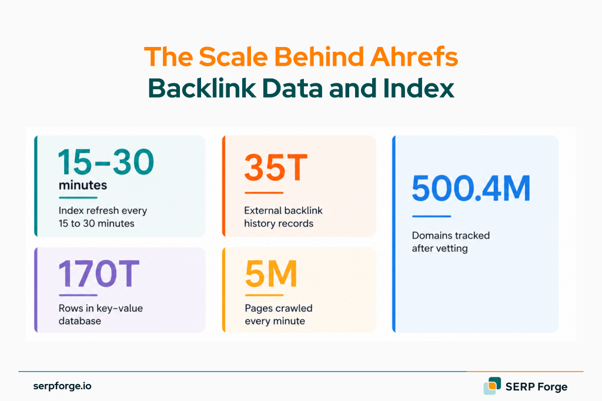
- Ahrefs’ live backlink index refreshes every 15 to 30 minutes. (Ahrefs)
Backlink reporting should use fresh data. - Ahrefs has 35 trillion external backlink history records. (Ahrefs)
Historical link data helps teams track growth and decay. - Ahrefs tracks 500.4 million domains after vetting. (Ahrefs)
Domain-level reporting gives context beyond individual links. - Ahrefs stores 170 trillion rows in its key-value database. (Ahrefs)
Link measurement depends on huge data infrastructure. - Ahrefs crawls around 5 million pages every minute. (Ahrefs)
New and lost links can appear in reports quickly. - Around 92% of marketers use automation for data analysis and reporting. (HubSpot)
Manual reporting is harder to scale across campaigns. - Around 44% of marketers analyse campaign performance weekly. (HubSpot)
Link reports should fit regular performance reviews. - Around 39% of marketers rank lead quality and MQLs as a top success metric. (HubSpot)
Reporting should connect links to pipeline quality where possible.
These SEO link building data points show why reporting should connect backlinks to traffic, leads, rankings and revenue.
SERP Forge Link Quality Filter
This guide uses data from SEO studies, search datasets, marketing reports, local SEO research, AI search studies and platform documentation. Sources include Ahrefs, Backlinko, HubSpot, DataReportal, Statista, StatCounter, Google, BrightLocal, SOCi, SE Ranking, Sagapixel, and academic AI search research. Older studies are included only when they remain accepted industry benchmarks.
Terms Used in This Guide
| Term | Meaning |
| Backlink | A link from another website to your page |
| Referring domain | A unique website linking to your site |
| Link velocity | The rate at which a page earns new backlinks |
| Linkable asset | Content created to earn links naturally |
| Niche edit | A link added to an existing page |
| AI citation | A brand, page, or source mention inside an AI-generated answer |
Conclusion
These link building statistics show one thing clearly: links still shape search visibility in 2026.
The data points to a tougher market. Pages without backlinks rarely earn traffic. Top-ranking pages attract more referring domains. AI search is also changing how brands earn visibility across answer engines.
For SEOs, the goal is practical. Build links to pages that deserve visibility. Use content depth, topical relevance, publisher fit, internal links and reporting together.
A good link building strategy should help teams measure rankings, referral quality, traffic, brand mentions and AI visibility. That is how backlinks become more than a monthly count.
FAQs
How many backlinks does a #1 ranking page have on average?
There is no fixed backlink count because it depends on keyword difficulty, niche, content quality and competitor authority.
What percentage of web pages have zero backlinks?
A large share of web pages have no backlinks, which makes relevant link building a useful advantage.
What is the average cost of a high-quality backlink in 2026?
High-quality backlink costs depend on publisher authority, niche, content standards and outreach effort.
Teams should check traffic, relevance, link context and spam risk before approving any placement.
Is link building still relevant with AI search?
Yes. Link building still matters because AI search also looks for trusted sources, authority signals, mentions and credible references.
Links now support rankings, citations, brand trust and answer-led visibility.
Which link building tactic has the highest ROI in 2026?
The best ROI usually comes from linkable assets that can keep earning links over time.
Original research, data reports, tools, comparison pages and expert-led content work well for SaaS and B2B teams.
These assets can support backlinks, referral traffic, brand mentions and AI visibility together.
How long does it take to see results from link building?
Link building results take time because search engines need to crawl new links and reassess page authority.
Track early signs like referring domains, indexation, ranking movement, impressions, referral traffic and assisted conversions.