



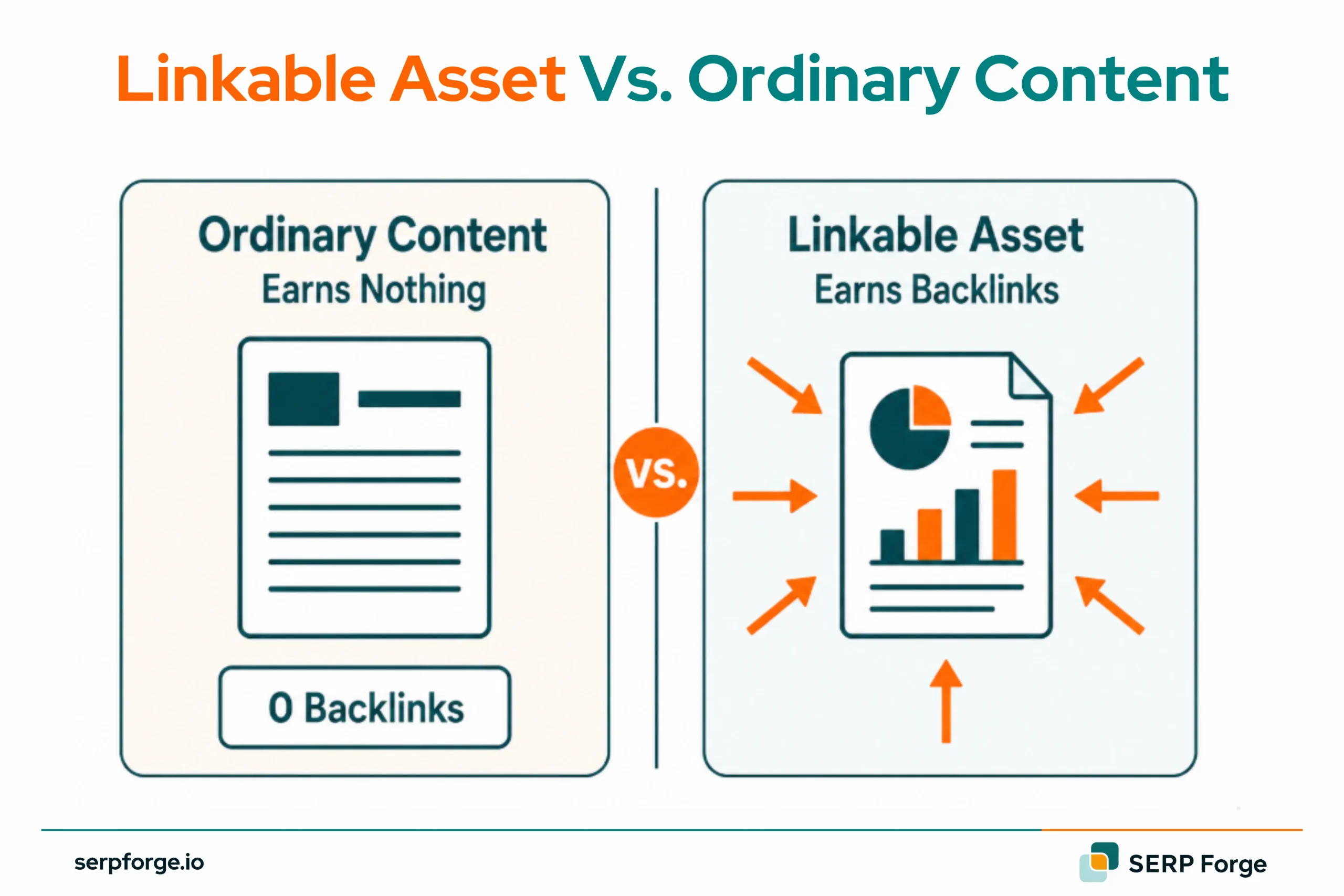
Most content is created to rank, but linkable assets are created to be referenced. A linkable asset is a page, tool, or piece of content designed to attract backlinks by offering original data, practical value, or information worth citing.
Ahrefs found that 96.55% of pages in a study of roughly 14 billion URLs receive zero organic search traffic from Google, making it even more important to create content that can earn visibility through backlinks and referrals.
In this guide, you’ll discover 10 types of linkable assets, see real-world examples, and learn a practical framework for creating assets that attract backlinks. You’ll also learn how linkable assets fit into a broader link-building strategy and what makes an asset genuinely worth linking to.
If you’re looking for linkable content ideas or want to turn existing content into something more link-worthy, this guide covers both.
What Is a Linkable Asset?
A linkable asset is a page, tool, or piece of content created specifically to attract backlinks on its own merit, without requiring direct outreach for every single link.
Common linkable assets include original research, free tools, definitive guides, and visual data, anything another writer, journalist, or content creator would rather cite than recreate from scratch.
The distinction matters for content strategy. A homepage or pricing page rarely earns organic backlinks because there’s little reason for an unrelated website to reference it.
A statistics page, calculator, or industry study gives other sites a concrete reason to link to supporting their own claims with your data, tool, or framework instead of building their own.
This makes linkable assets an important part of organic link building, where useful content earns backlinks because publishers genuinely find it worth referencing.
What Are the Benefits of Linkable Assets
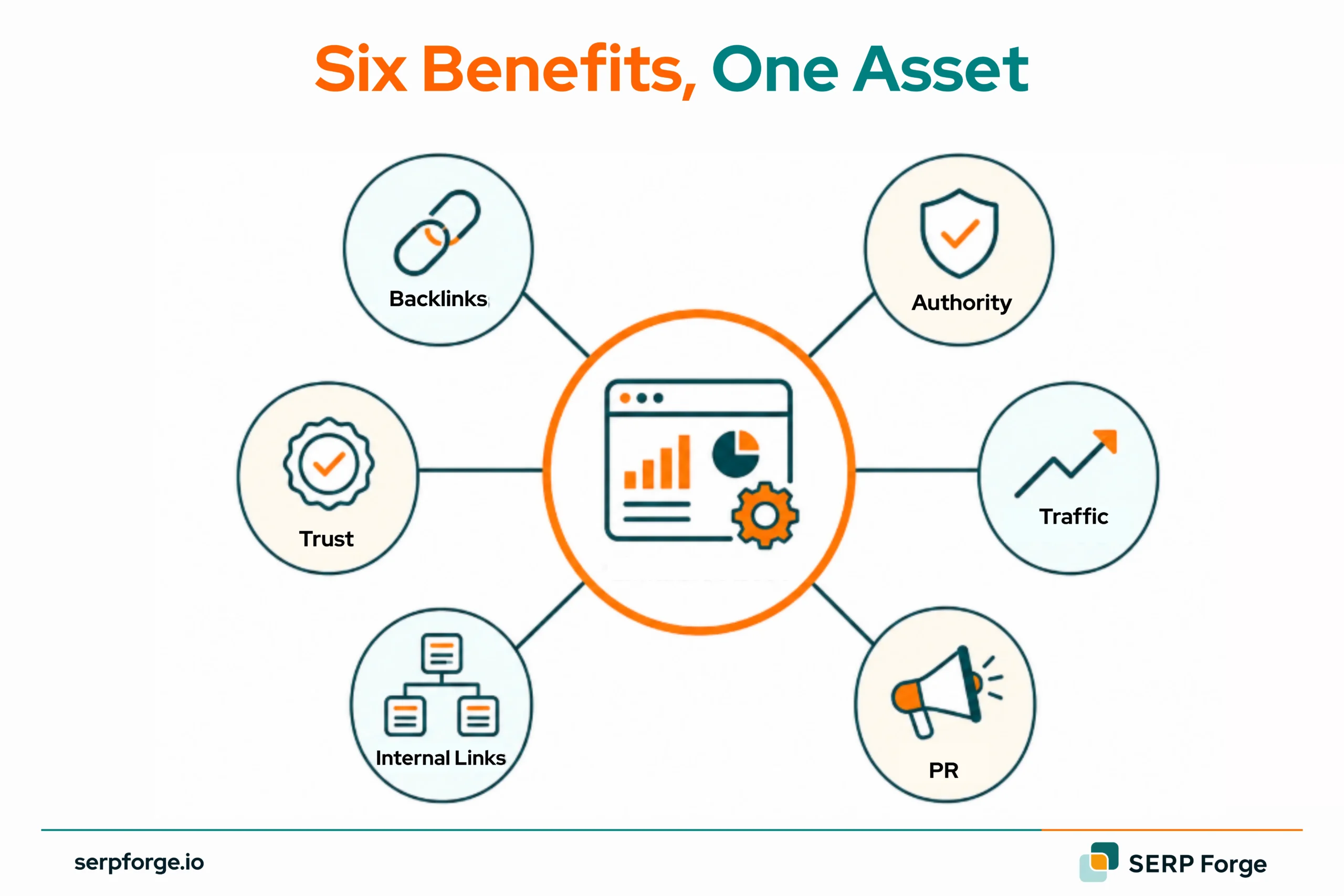
Linkable assets do more than collect backlinks. They support several parts of an SEO and content marketing program at once:
- Compounding backlinks. A single well-placed asset can keep earning new links for years after publication, unlike a one-time outreach campaign that stops the moment the campaign ends.
- Stronger domain authority. Backlinks from relevant, trustworthy sites improve how search engines and AI systems weigh your overall domain, which lifts ranking potential across pages well beyond the asset itself.
- Referral traffic is independent of rankings. Every linking site sends its own readers your way, so visibility doesn’t depend entirely on holding a top search position.
- Reusable PR and outreach material. A finished asset gives outreach and digital PR teams something concrete to pitch, a data point, a tool, a framework, instead of asking for a link with nothing new to offer.
- Brand authority and trust signals. Original research, named frameworks, and credible tools support the experience, expertise, authoritativeness, and trust (E-E-A-T) signals that both search engines and readers use to judge a brand.
Ahrefs’ own analysis found a clear positive correlation between how many websites link to a page and both its ranking position and the organic traffic it receives
What Makes an Asset Actually “Linkable”?
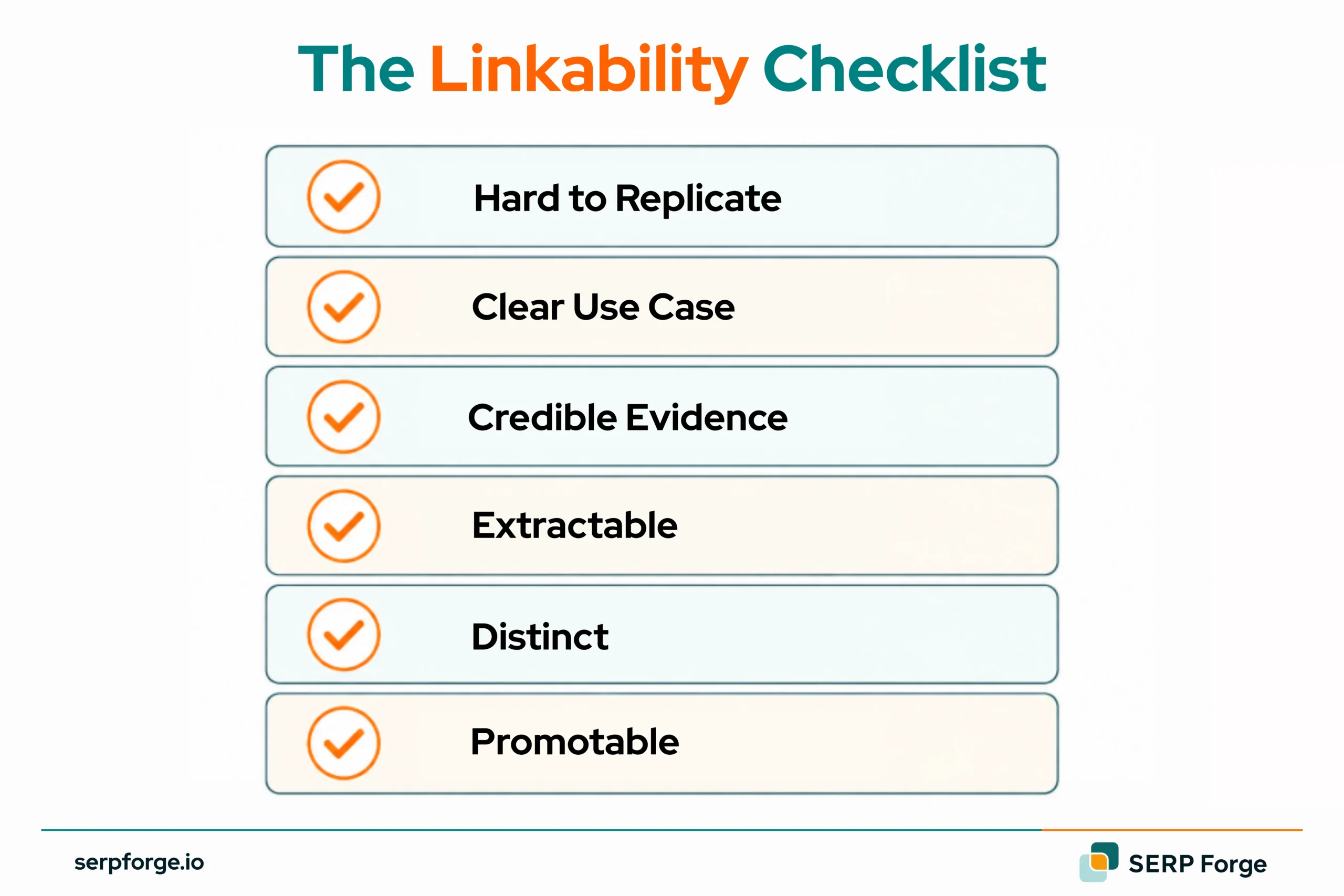
Not every well-written page earns links. This is the real difference between link-worthy content and content that simply sits unlinked: an asset becomes linkable when it gives someone else a specific, low-effort reason to reference it instead of writing around it.
This same principle drives link baiting creating content specifically to attract links.
- It offers something hard to replicate. Proprietary data, a working tool, or a named framework can’t be paraphrased the way a generic explainer can.
- It serves a clearly defined use case. Writers link to pages that solve one specific problem well, not pages that vaguely cover a broad topic.
- It’s backed by credible evidence. A sample size, methodology, or named source makes a claim citable. An unsupported number is not.
- It’s easy to extract and reference. A single stat, quote, or downloadable graphic should be usable outside the page itself; that’s often the exact passage that earns the link.
- It’s visually or functionally distinct. A calculator, interactive map, or original graphic stands out in ways that another 2,000-word article does not.
- It’s genuinely promotable. Someone, a journalist, a niche blogger, a competitor’s audience, has to want to share it. If nobody on your own team would proactively send it to a contact, it’s unlikely to earn outreach links either.
10 Types of Linkable Assets (With Real Examples)
Some formats earn backlinks far more reliably than others.
If you’re looking for linkable asset ideas, the list below moves from the highest-leverage formats toward more situational ones, with linkable asset examples for each.
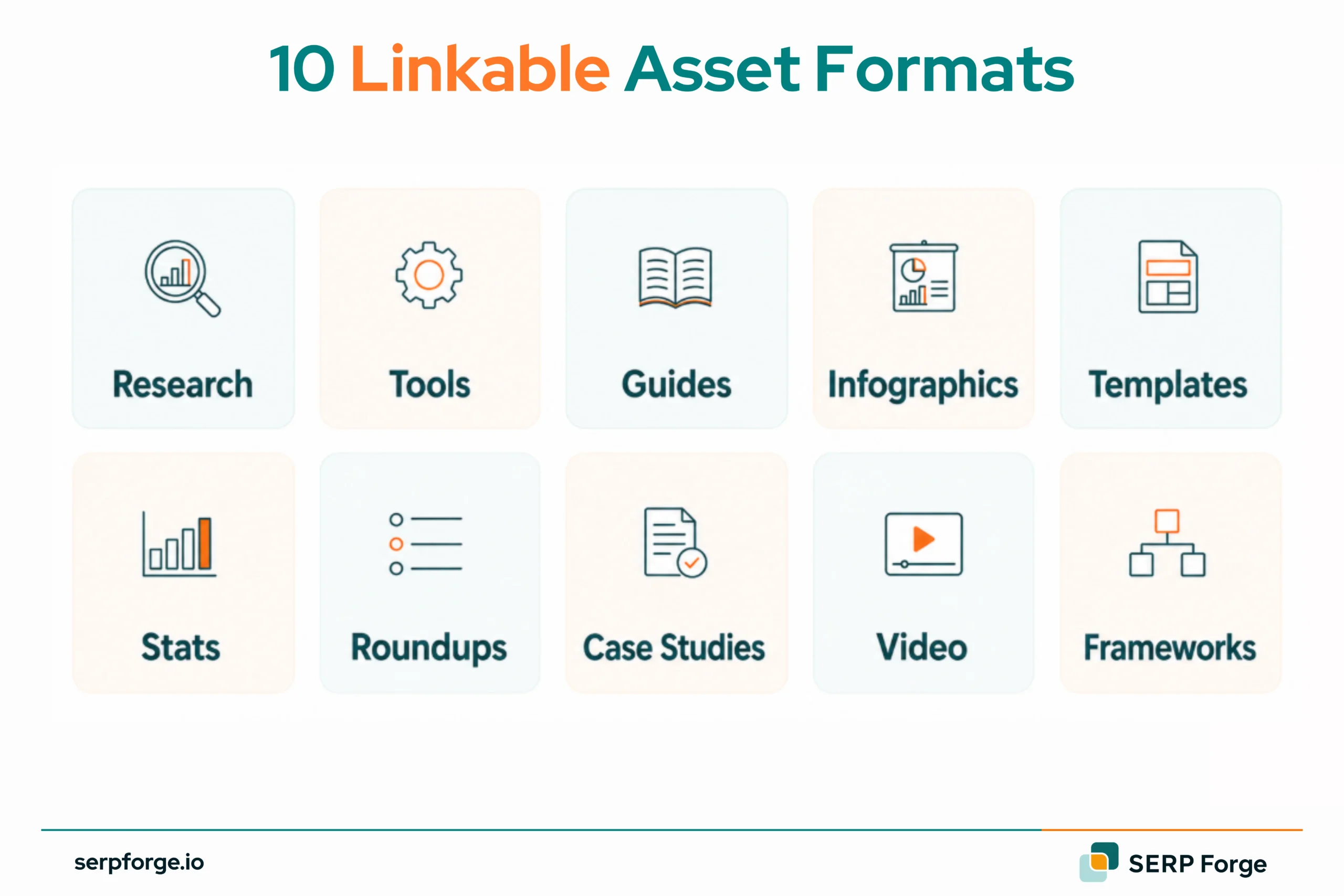
| Type | Best For | Example |
| Original research & data | Authority, media pickup | Industry survey reports |
| Free tools & calculators | Recurring, long-term backlinks | ROI calculators, generators |
| Ultimate/definitive guides | Topical authority | Full how-to resources |
| Infographics & map-o-graphics | Visual shareability | City or region comparison maps |
| Templates & checklists | Practical utility | Audit checklists, planning templates |
| Statistics & trends pages | Ongoing citations | “Industry statistics” hub pages |
| Listicles & resource roundups | Niche curation | “Best tools for X” lists |
| Case studies | Trust and proof | Before-and-after results write-ups |
| Videos & interactive content | Engagement, embeds | Quizzes, interactive charts |
| Coined terms/frameworks | Long-term branded citations | Named methodologies |
1. Original research & industry studies/data
Original research turns proprietary data into a resource other websites can cite. Because publishers need credible statistics and fresh findings to support their own claims, original studies can become long-term backlink sources.
Real example: Ahrefs’ Study of 2 Million Featured Snippets
Ahrefs published a data-driven study analysing 2 million featured snippets to uncover patterns around how Google displays them. The study attracted 600+ backlinks from more than 330 referring domains, according to Ahrefs.
Why it attracted links: The study provided original data that other SEO publications could reference instead of conducting their own research. A publisher writing about featured snippets could simply cite Ahrefs’ findings and link to the study as the original source.
2. Free tools & calculators
A free tool solves one narrow problem instantly, without requiring a sign-up or a sales conversation first.
Tools earn links repeatedly because new users keep discovering them and writing about them long after launch.
Ahrefs’ free keyword generator and CoSchedule’s headline analyzer are referenced across thousands of marketing posts for exactly this reason; each one solves a specific task well enough that writers recommend it instead of explaining the process manually.
3. Ultimate/definitive guides
A definitive guide covers a topic comprehensively enough that other writers link to it instead of re-explaining the basics themselves.
This only works when the guide genuinely outranks the depth of competing content. Moz’s beginner’s guide to SEO has held this position for years, specifically because it’s treated as a default reference point rather than just another explainer.
4. Infographics & map-o-graphics
An infographic package compares geographic data into a visual format that’s easier to share than a raw data table.
Map-based versions of cost-of-living comparisons across cities, salary maps by region perform especially well because local publications and niche blogs link to the specific data point relevant to their own audience, even when they ignore the rest of the page.
Articles with seven or more images earn about 555% more backlinks than articles with none
5. Templates & checklists
A template or checklist saves the reader time by giving them a ready-made structure instead of requiring them to build one from scratch.
These earn links from practical resource roundups and tool lists, making them particularly effective for resource page link building.
Content calendar templates and SEO audit checklists are common examples that consistently appear in “best resources for X” posts.
6. Statistics & trends pages
A statistics page collects relevant data points on a narrow topic into one continuously updated resource.
Because writers need quick, citable numbers, a well-maintained “industry statistics” page becomes a go-to source that gets linked every time someone needs a supporting data point, provided the numbers stay current and properly sourced.
7. Listicles & resource/tools roundups
A curated roundup organizes tools, resources, or examples by category, giving readers a shortcut instead of requiring independent research.
“Best SEO tools” and “best email marketing software” lists earn links from related content because other writers reference the roundup as a starting point, and tool vendors themselves sometimes link back when they’re featured.
8. Case studies
A case study documents a specific before-and-after result with clear methodology and real numbers attached.
These earn links primarily from industry peers and agencies, citing proof points a documented jump in organic traffic is a far more linkable claim than a generic statement about SEO working.
9. Videos & interactive content
Interactive formats, quizzes, calculators, and embeddable charts increase dwell time and give other sites a reason to embed the asset directly rather than just linking to it.
Embeds function as a form of link in their own right, and many platforms still attach an attribution link when content is embedded, which adds a second visibility channel beyond a standard backlink.
10. Coined terms/frameworks
A coined term gives a concept a name, which means every future explanation of that concept needs to credit where the term originated.
Brian Dean’s “Skyscraper Technique” and Moz’s “Domain Authority” metric are both still cited as the origin point whenever someone explains the underlying concept, long after the original publication date.
A named framework can outlast almost any other asset type because the citation is built into the language itself.
How to Create a Linkable Asset (Step-by-Step)
Earning backlinks predictably depends on following a repeatable process; this is how to create linkable assets that actually get cited, not just published.
- Research your audience and competitor gaps
- Pick the right format and validate the idea
- Build for quality, not speed
- Optimize the page for search
- Promote it through outreach and digital PR
- Refresh and promote it again over time
1. Research Your Audience and Competitor Gaps
Start with a competitor backlink analysis to see which existing pages in your space already earn links, and which obvious gaps remain unaddressed.
Look for outdated statistics pages, tools with poor user experience, or guides that cover a topic shallowly.
A content gap analysis here often reveals exactly which format your audience already links to, saving you from guessing at a format nobody in your niche responds to.
- Pull the backlink profiles of the top 5–10 ranking pages in your niche
- Flag any asset that’s outdated, thin, or poorly designed
- Note which format (research, tool, guide) earns the most links in your space
2. Pick the Right Format and Validate the Idea
Match the format to what’s actually achievable with your resources and what your specific niche already links to, rather than copying whatever format performed well in an unrelated industry.
Validate the idea early: check whether the data, tool concept, or framework is genuinely unique, and confirm a realistic audience exists before committing significant production time.
A quick search for “[topic] statistics” or “[topic] tool” shows you exactly what you’re competing against.
3. Build for Quality, Not Speed
A rushed linkable asset competes directly with established, well-resourced pages so it needs to be built to the standard of what already ranks, not to a publishing deadline.
This means real methodology behind any data, genuine usability testing for any tool, and design quality that matches what a journalist or blogger would feel comfortable embedding.
A thin version of a good idea rarely outperforms a thorough version of the same idea.
4. Optimize the Page for Search
Once built, the asset still needs standard on-page SEO: a clear H1, descriptive subheadings, internal links from related pages, and appropriate schema markup Article, ItemList, or HowTo, depending on the format.
Search visibility and link acquisition reinforce each other.
A well-optimized asset ranks for its own target keywords, which increases organic discovery and gives outreach teams a stronger page to pitch in the first place.
5. Promote It Through Outreach and Digital PR
Most linkable assets don’t earn meaningful links from publication alone.
They need a deliberate outreach push: pitching journalists, niche bloggers, and industry newsletters with a clear reason the asset is relevant to their audience.
This promotion can help earn editorial backlinks from publishers that genuinely find the asset worth referencing.
Keep the task specific. A pitch built around one citable stat or one tool feature converts better than a generic request to “check out our new guide.”
Track anchor text and referring domains from each outreach wave so future pitches can reference what’s already worked.
- Build a targeted list of journalists, bloggers, and newsletters covering the topic
- Lead each pitch with one specific, citable data point or feature
- Log every link earned, plus the anchor text and referring domain
6. Refresh and Promote It Again Over Time
Linkable assets lose relevance as data ages, and competitors publish newer versions, so they need a refresh cadence typically every six to twelve months for statistics and research-based assets.
Each refresh is also a second promotion opportunity.
An updated study, a new year’s data, or an expanded tool feature set gives outreach teams a legitimate new reason to re-pitch the same asset to people who didn’t link the first time.
Most top-ranking pages gain new followed backlinks at a pace of roughly 5% to 14.5% per month
Linkable Assets vs. Link Building: What’s the Difference?
A linkable asset is the content itself, built to attract backlinks passively because of its inherent value. Link building is the active process of acquiring backlinks, whether or not a linkable asset exists yet.
| Linkable Asset | Link Building | |
| Primary goal | Create content worth citing | Actively acquire backlinks |
| Main method | Original data, tools, design, frameworks | Outreach, guest posting, broken-link fixes, digital PR |
| Main output | Backlinks earned passively over time | Backlinks acquired through manual effort |
| Time horizon | Long-term, often compounding | Campaign-based, can plateau without new assets |
A linkable asset without any outreach often sits unnoticed, since even strong content rarely gets discovered and cited purely through organic search.
In practice, the asset and the campaign share a budget and a timeline. Treating them as two separate line items, content production with no outreach plan, or outreach with no asset to pitch, is one of the most common reasons link-building programs stall.
Common Mistakes That Keep Content From Being Linkable
| Mistake | Why It Kills Linkability | Fix |
| Treating any blog post as an asset | No unique data, tool, or framework to cite | Build around original research, a proprietary tool, or a named framework |
| Skipping promotion entirely | Strong assets still need outreach to get discovered | Pair every asset with a dedicated digital PR push |
| Letting statistics go stale | Writers stop citing outdated numbers | Set a refresh cadence of six to twelve months |
| Gating the core asset | Outreach targets rarely link to a signup form | Keep the primary asset open; gate bonus extras only |
| Weak page experience | Slow load times and clunky design reduce shares | Prioritize speed, mobile usability, and visual clarity |
| Thin content with heavy schema | Markup can’t substitute for genuine evidence | Pair schema with real original insight |
Most of these mistakes trace back to the same root cause: treating “linkable” as a label to add after publishing, rather than a requirement built into the page from the start.
Conclusion
A linkable asset earns backlinks because it gives another website a specific, credible reason to reference it, not because it was tagged, optimized, or promoted after the fact.
The format matters less than the underlying value: original data, genuine utility, or a framework worth naming. Pick a type your audience already links to, build it to the standard of what currently ranks, then pair it with real outreach instead of waiting for organic discovery alone.
Done well, a single linkable asset can outperform months of standard link-building outreach and keep earning links long after the campaign that launched it ends.
That’s the core of how to build link-worthy content: less about one inspired idea, and more about repeating a process that already works.
FAQ
1. What type of linkable asset earns the most backlinks?
Original research and free tools tend to earn the most backlinks because they give other publishers a specific number or feature to cite rather than content to paraphrase. The strongest choice still depends on the industry; data-heavy niches respond well to research, and technical niches respond well to tools.
2. How long does it take for a linkable asset to start earning links?
Most assets take three to six months to build consistent backlink momentum through organic discovery alone. A focused outreach or digital PR push can generate the first links within weeks, since it doesn’t depend on being found through search.
3. Do you need a big budget to create one?
No. A checklist or template can be built in-house with minimal cost beyond time and design. Interactive tools, calculators, and large-scale original research generally require more development or research investment, so it’s reasonable to validate a lower-cost format before committing budget to a bigger one.
4. Can AI help create linkable assets?
Yes, for research synthesis, first drafts, and formatting, but not for the underlying originality. AI can help summarize survey data or draft a template structure, but the actual data, methodology, or proprietary insight still needs to come from a real, verifiable source for the asset to remain credible.
5. Should you gate a linkable asset behind an email signup?
No. Outreach targets and casual visitors rarely link to a page that requires registration to view, which removes most of the asset’s link-earning potential. If a signup makes sense for monetization, reserve it for bonus material like a raw dataset or extended report rather than the core linkable page itself.