



Every time someone types a question into Google, a decision gets made in a fraction of a second: which handful of websites, out of billions, deserve to be shown first.
That decision is happening right now, millions of times a minute, and it’s the single biggest reason some businesses get found effortlessly online while others, sometimes with better products, stay invisible.
SEO is the process of helping search engines discover, understand, and trust your website so it can appear in front of the right audience. While many predicted that social media, mobile apps, or AI would replace SEO, organic search continues to be one of the most reliable and sustainable drivers of online traffic.
SEO is no longer just about keywords. Today, it focuses on expertise, content quality, and building trust that stands the test of algorithm updates.
This guide explains what SEO is, how search engines work, the core elements of an effective SEO strategy, how to measure success, and how SEO differs for SaaS, enterprise, and fintech businesses.
What Is SEO?
SEO (Search Engine Optimization) is the practice of improving a website so it appears higher in organic (unpaid) search results for the queries people are actively searching.
The goal isn’t to manipulate search engines; it’s to create the most helpful, relevant answer for a search query and make it easy for search engines to discover, understand, and rank that content.
Organic Search accounts for 53.3% of all website traffic, making it the largest single source of measurable traffic for most businesses.
Why Does SEO Exist?
Search engines succeed by delivering the best possible results. If users consistently saw irrelevant or low-quality pages, they would stop using the search engine.
That’s why SEO exists. Websites that provide trustworthy, useful, and well-structured information are more likely to earn higher rankings because they align with what search engines want to show users.
Think of SEO this way: Search engines want to recommend the best answer, and SEO helps your website become that answer.
SEO vs Paid Advertising
One of the biggest differences to understand is the difference between SEO and paid advertising.
| SEO (Organic Search) | Paid Advertising (PPC) |
| Earns visibility naturally | Buys visibility instantly |
| No cost per click | Pay for every click |
| Takes time to build | Generates traffic immediately |
| Delivers long-term results | Stops when the budget ends |
While paid advertising can produce quick results, SEO builds long-term visibility that continues generating traffic long after the initial optimization work is complete.
A Simple Example
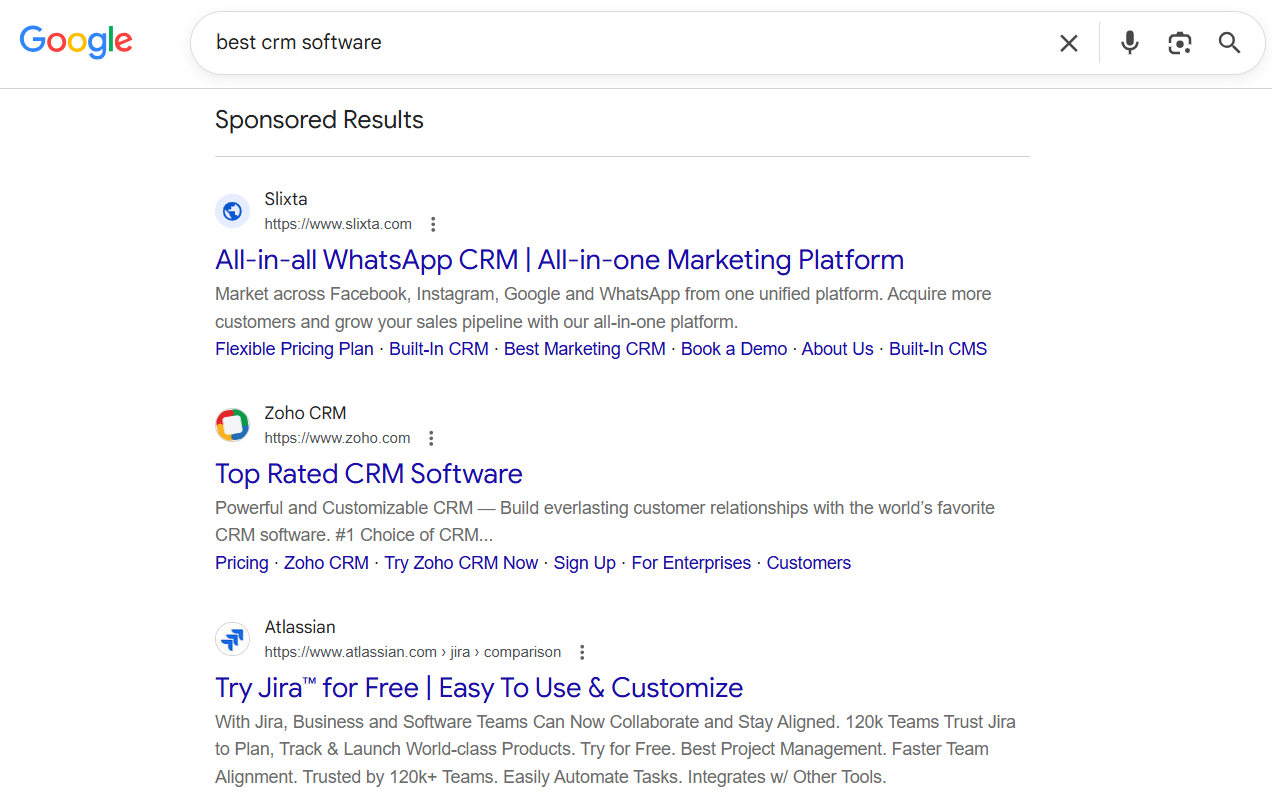
Imagine someone searches for “best CRM software.”
At the top of Google, they’ll usually see a few Sponsored results; these are paid advertisements.
Below them are the organic search results, which Google has ranked based on relevance, quality, authority, and usefulness rather than advertising spend.
SEO is the process of helping your website earn a place in those organic results.
Why Is SEO Important for Businesses?
SEO matters because it consistently delivers value across every stage of the customer journey, and that value compounds rather than resets every month like paid advertising does.
The core benefits include:
- Organic traffic that keeps arriving without an ongoing cost per visitor, unlike paid ads
- Brand awareness, since simply appearing repeatedly in relevant searches builds familiarity over time
- Authority, as consistently ranking well for a topic signals expertise to both search engines and real visitors
- Trust, because people generally trust organic results more than obviously paid placements
- Leads and revenue, since organic search traffic tends to convert well when it’s matched to genuine search intent
- Long-term ROI, since a well-optimized page can keep generating traffic and leads for years after it’s published
Organic search still accounts for roughly 53% of all website traffic in 2026, making it the largest single traffic channel for most businesses, larger than paid search, social, and direct traffic combined in many cases.
And position still carries real weight: the #1 organic result earns an average click-through rate of about 39.8%, more than positions 3 through 10 combined.
How Do Search Engines Work?
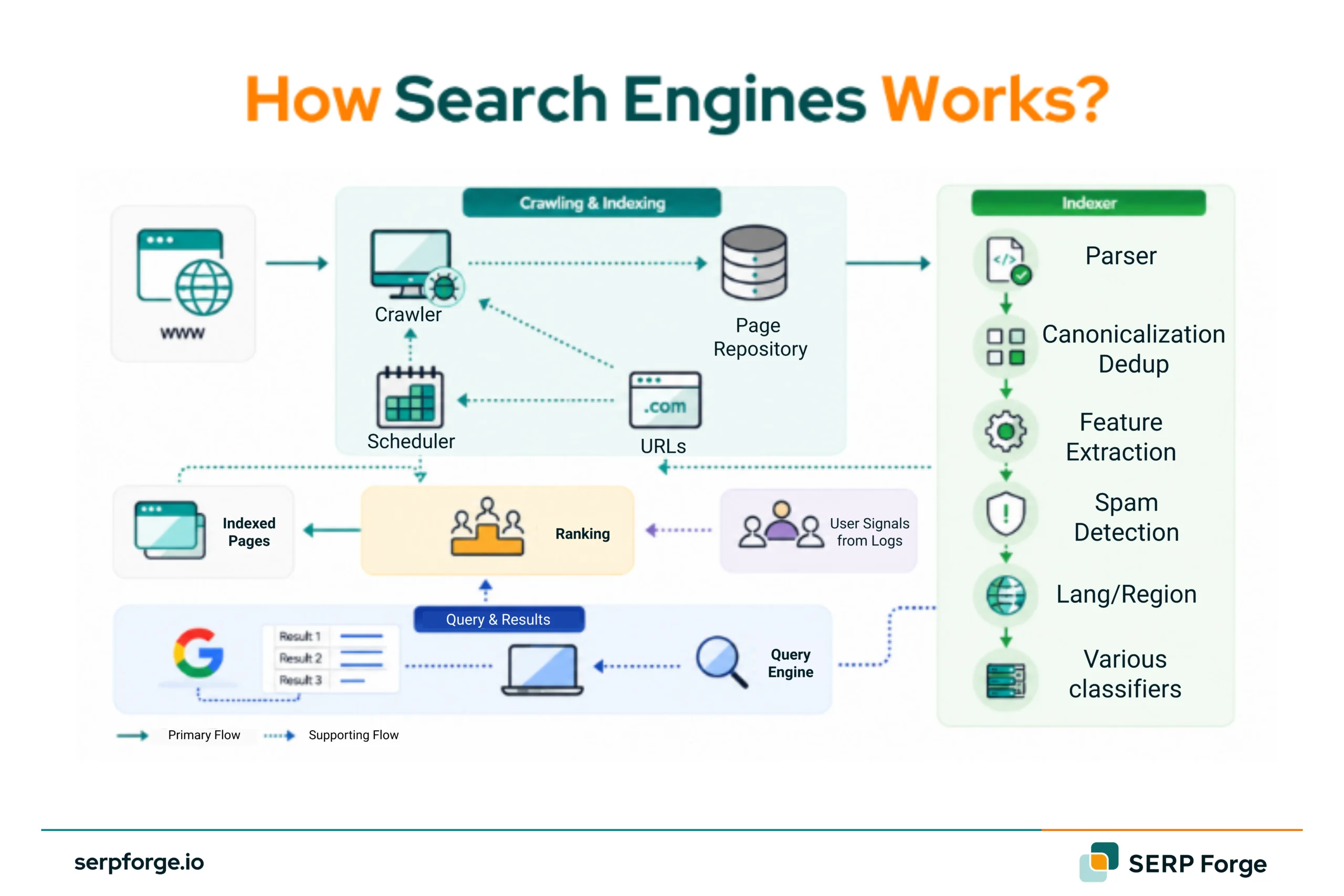
Before optimizing your website, it helps to understand what happens behind the scenes every time someone performs a search.
The process follows three core stages:
1. Crawling
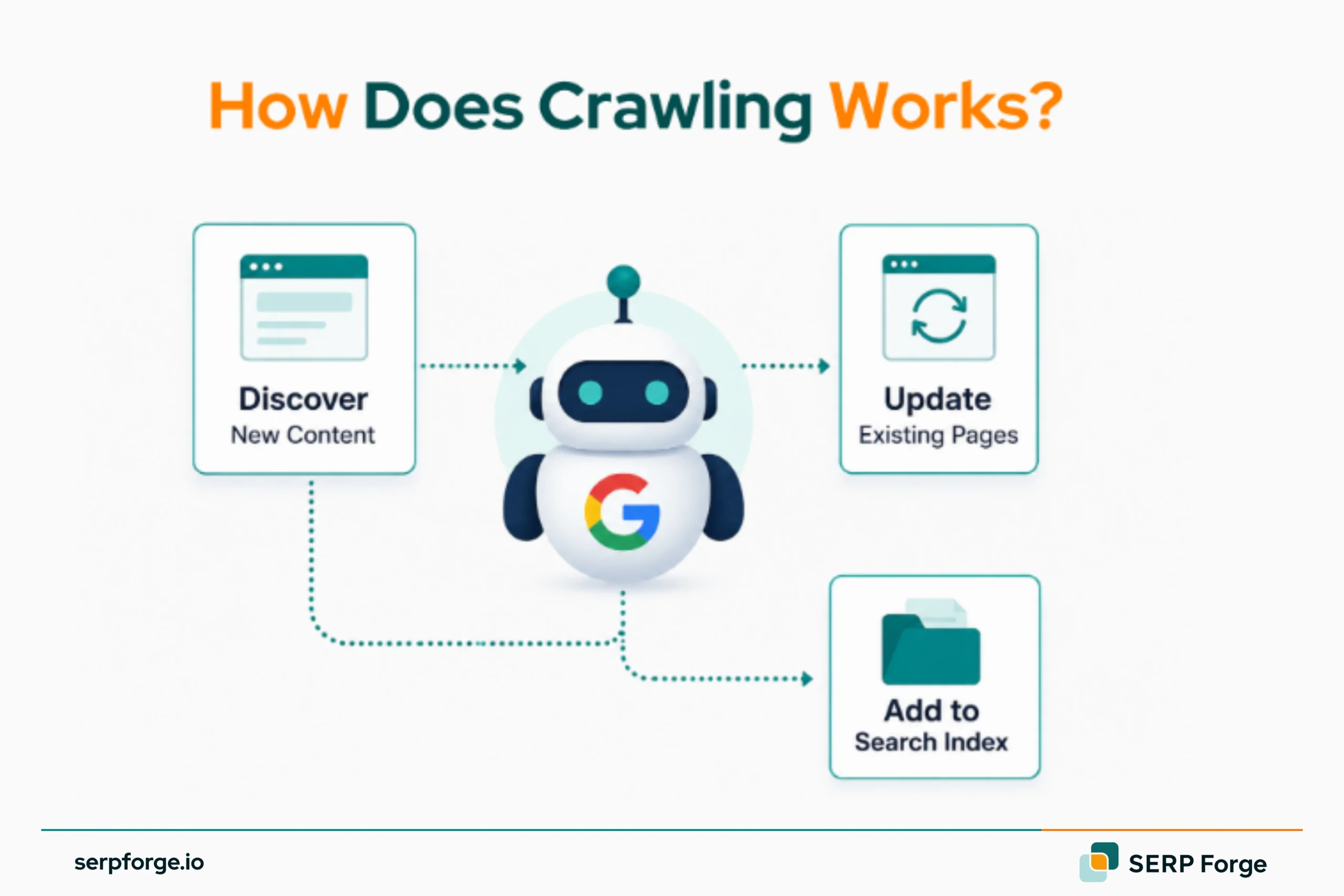
This is how search engines discover your website.
Automated bots (called crawlers or Googlebot) continuously visit web pages by following internal links, XML sitemaps, and links from other websites. Whenever they discover new or updated content, they add it to Google’s list of pages to evaluate.
To help crawlers work efficiently, your website should have:
- A clear internal linking structure
- An up-to-date XML sitemap
- A properly configured robots.txt file
- Minimal crawl errors
Why does this matter?
Large websites don’t have unlimited crawling resources. That’s where crawl budget optimization becomes important.
Removing duplicate pages, fixing broken links, and improving your site’s architecture helps Google spend more time crawling your valuable pages instead of wasting resources on low-value content.
Practical example:
An eCommerce website with 100,000 pages should prioritize crawling product and category pages instead of filtered URLs that generate little SEO value.
Google Search processes billions of searches every day, which is why efficient crawling, indexing, and ranking systems are essential for delivering relevant results.
2. Indexing
Once a page is crawled, search engines analyze its content before deciding whether to store it in their search index.
During this stage, Google evaluates factors such as:
- Content quality
- Uniqueness
- Page structure
- Canonical tags
- Meta directives
- Internal links
If everything looks good, the page becomes eligible to appear in search results.
Help search engines understand your content
Adding structured data (Schema Markup) provides extra context about your page, such as whether it’s an article, product, FAQ, review, or recipe.
This can improve how your content is interpreted and may increase your chances of earning rich results.
Remember: A page must be indexed before it can rank.
3. Ranking
After indexing, your page competes with thousands of others for relevant search queries.
Search engines compare pages using hundreds of ranking signals, including:
- Content relevance
- Search intent alignment
- Backlinks and authority
- Content freshness
- User experience
- Page speed
- Topical authority
The pages that provide the most useful and trustworthy answers are the ones most likely to appear at the top of the search results.
Crawling helps search engines find your content, indexing helps them understand it, and ranking determines where it appears in search results.
What Are the Core Components of SEO?
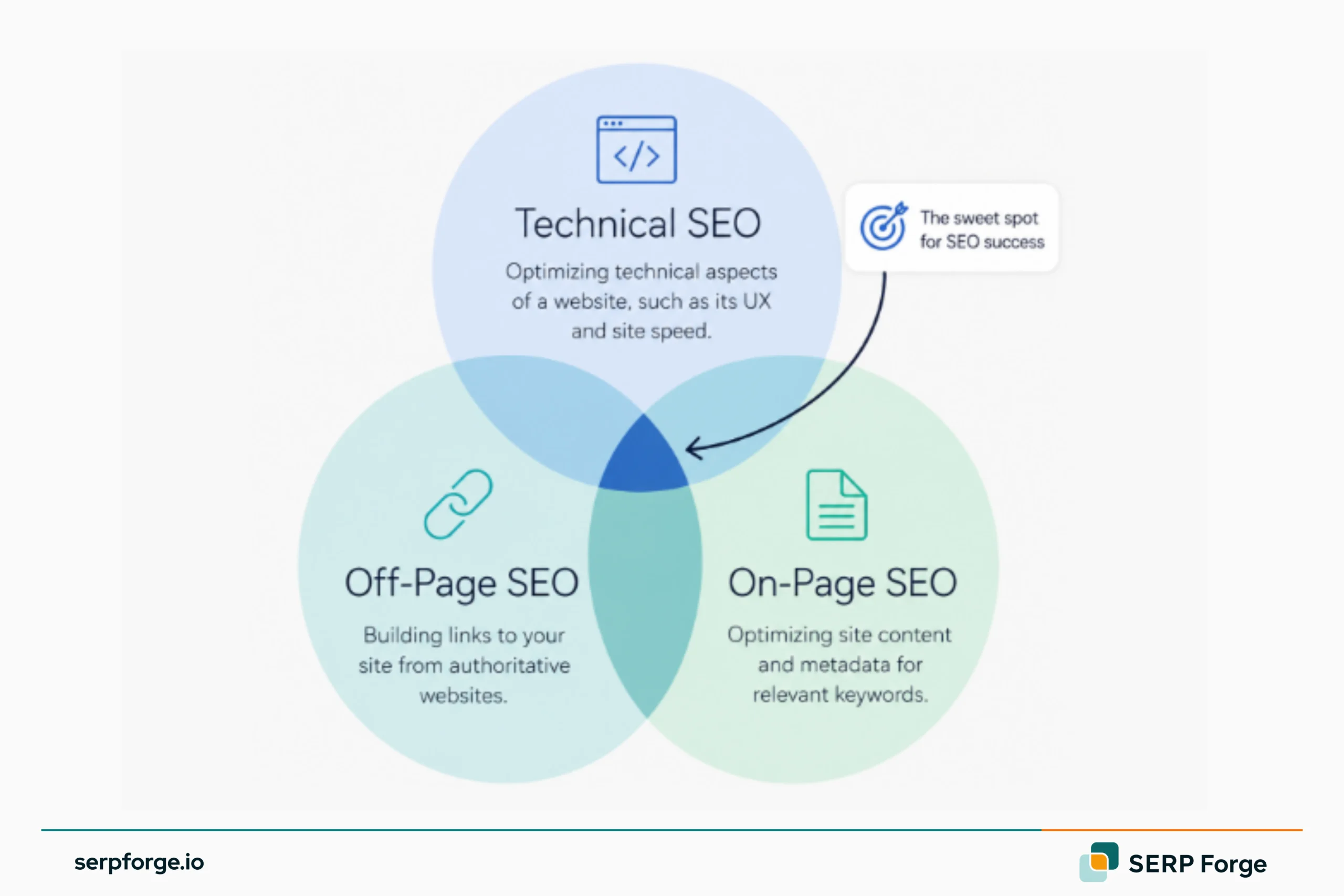
SEO is often described as resting on four core pillars, and a real strategy needs to address all of them rather than picking a favorite.
| Pillar | What It Covers | Key Focus Areas |
| On-Page SEO | Everything you control directly on a given page | Title tags, meta descriptions, heading structure, content quality and depth, image optimization, internal linking, schema markup, and semantic SEO clearly defining entities (people, places, concepts) and their relationships so search engines understand meaning, not just keywords |
| Off-Page SEO | Everything that builds authority from outside your own website | Backlinks from relevant, trustworthy sites; digital PR (earning media coverage and links through genuine stories or original research); brand mentions even without a link; overall reputation across the web |
| Technical SEO | Making sure search engines can access, render, and understand your site at all | Site speed, Core Web Vitals, crawlability, indexability, HTTPS security, correct canonical implementation, an accurate XML sitemap, and clean rendering (including lazy-loaded content) |
| Local SEO | Visibility for location-based searches (“plumber near me,” “coffee shop downtown”) | A complete, accurate Google Business Profile (GBP), consistent NAP information (Name, Address, Phone number) across the web, genuine customer reviews, and visibility in Google Maps results |
Technical SEO deserves special attention for software companies.
SaaS technical SEO issues are common because many SaaS platforms rely on JavaScript-heavy single-page applications, which can create crawling and indexing challenges if search engines struggle to render the content properly.
Server-side rendering, proper canonical tags, and making sure marketing pages aren’t accidentally blocked behind authentication are recurring priorities for SaaS technical SEO specifically.
White Hat vs. Black Hat vs. Gray Hat SEO: What’s the Difference?
Not every SEO tactic is created equal, and it helps to know where the ethical lines actually sit before you start optimizing anything.
These SEO practices are commonly grouped into three distinct approaches:
| Approach | What It Means | Trade-Off |
| White Hat SEO | Following search engine guidelines, writing genuinely helpful content, earning links naturally, and building a site that would hold up even if you explained every tactic to a Google engineer directly | Slower to show results, but it compounds and lasts long-term |
| Gray Hat SEO | Tactics that aren’t explicitly banned but clearly bend the spirit of the rules, like buying expired domains purely for their old backlinks, or posting incentivized reviews | Not illegal today, but plenty of it eventually gets reclassified as black hat once search engines catch up to it |
| Black Hat SEO | Tactics that directly violate search engine guidelines to manipulate rankings: keyword stuffing, cloaking, hidden text, buying links in bulk | Can produce a short-term bump, but the eventual penalty (a manual action or algorithmic demotion) usually costs far more than the tactic ever gained |
The safest long-term strategy is also, conveniently, the most effective one, which is exactly why white hat SEO remains the standard every legitimate strategy is built on.
How Does SEO Actually Work, Start to Finish?
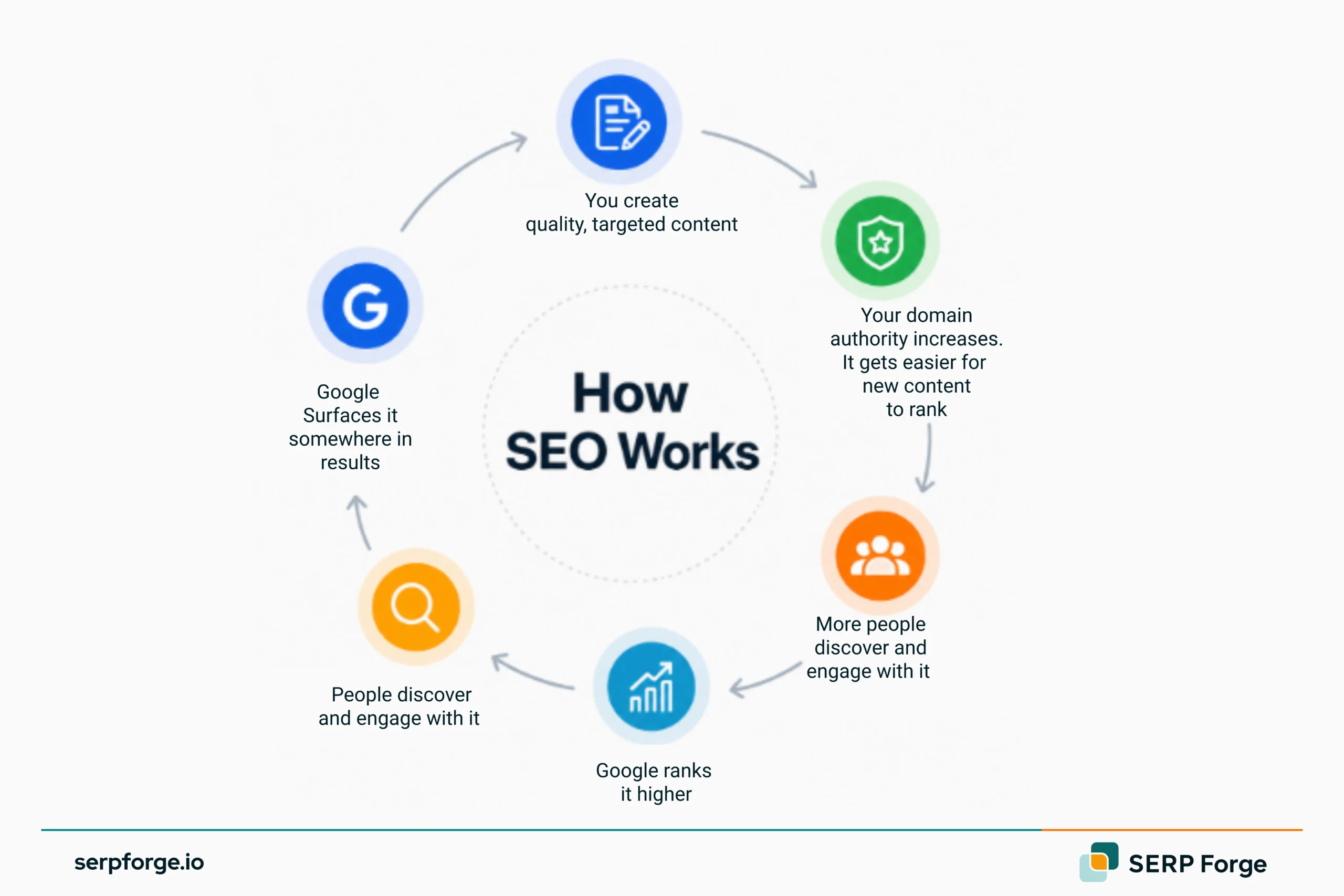
Pulling the pieces together, a real SEO workflow generally follows this loop:
Research → Create → Optimize → Index → Rank → Measure → Improve
You start by researching what your audience is actually searching for and why. You create content that genuinely serves that intent.
You optimize it on-page elements, internal links, and technical health so search engines can understand and trust it.
It gets crawled and indexed. It ranks, hopefully well. You measure the actual results against your goals.
And then you improve based on what that data tells you, feeding back into the next round of research. SEO rarely ends; it cycles.
What Are the Most Important Google Ranking Factors?
Google uses hundreds of ranking signals to evaluate web pages, but a smaller group consistently has the greatest impact on search visibility:
- Content quality and search intent alignment: Create helpful, accurate, and comprehensive content that directly satisfies what users are searching for.
- Backlinks: Earn links from relevant, authoritative websites to strengthen your site’s credibility and trust.
- E-E-A-T (Experience, Expertise, Authoritativeness, and Trustworthiness): Demonstrate first-hand experience, subject-matter expertise, credible authorship, and trustworthy sources, especially for sensitive topics.
- Topical authority: Build comprehensive coverage of a subject through interconnected, high-quality content rather than relying on a single page.
- Page experience: Deliver a fast, mobile-friendly, secure website with strong Core Web Vitals and an intuitive user experience.
- Helpful content: Publish original, people-first content that provides genuine value instead of content created primarily to manipulate search rankings.
- Content freshness: Keep information accurate and up to date, particularly for topics where users expect the latest information.
- Internal linking: Connect related pages with a logical site structure to help users and search engines discover and understand your content.
- Entities and semantic search signals: Use clear entities, contextual relationships, and structured information so search engines better understand your content and its relevance.
- Brand authority and trust signals: Build a recognizable brand through consistent expertise, authoritative mentions, positive reputation, and citations across the web.
Around 94% of all content receives zero external backlinks, highlighting why creating valuable, link-worthy content is essential.
What Types of SEO Exist?
The core pillars of SEO work together to improve a website’s visibility, but SEO also includes several specialized disciplines. Each focuses on a different platform, content format, or business need while supporting the same goal of improving organic search performance.
The main types of SEO include:
- Traditional SEO: The foundation of search engine optimization, covering on-page, off-page, and technical practices that improve a website’s visibility in organic search.
- Semantic SEO: A content strategy that focuses on entities, search intent, topical authority, and contextual relationships rather than exact-match keywords.
- Programmatic SEO: A scalable approach that uses templates and structured data to create hundreds or thousands of targeted landing pages efficiently.
- International SEO: The practice of helping websites reach audiences across multiple countries or languages through localization, hreflang implementation, and regional targeting.
- Mobile SEO: A discipline focused on delivering a fast, user-friendly experience on mobile devices while supporting Google’s mobile-first indexing.
- Video SEO: The process of improving a video’s visibility through optimized titles, descriptions, transcripts, thumbnails, and metadata.
- Image SEO: The practice of making images easier for search engines to understand and rank using descriptive filenames, alt text, compression, and structured data.
- Ecommerce SEO: A specialized branch of SEO that improves the visibility of product pages, category pages, and online stores to increase organic sales.
- Enterprise SEO: SEO for large organizations that manage thousands of pages, multiple stakeholders, complex workflows, and extensive technical infrastructure.
- SaaS SEO: A specialized strategy designed for software companies, focusing on long buying journeys, solution pages, product-led content, and comparison keywords.
- AI SEO: The practice of making content understandable, retrievable, and citable by AI-powered search experiences such as Google AI Overviews, ChatGPT, Gemini, and Perplexity.
- Voice SEO: An approach that helps content appear in voice search by answering natural, conversational queries in a clear and concise way.
Although these disciplines have different priorities, they often overlap. For example, Enterprise SaaS SEO combines the scalability and governance of Enterprise SEO with the product-focused content strategy, technical complexity, and long sales cycles associated with SaaS SEO.
Likewise, SaaS technical SEO becomes especially important because modern software websites often rely on JavaScript frameworks, dynamic rendering, and complex site architectures that require efficient crawling, indexing, and crawl budget optimization.
How Do You Create SEO-Friendly Content?
Creating SEO-friendly content starts long before you begin writing. A strong page is built on four core elements:
- Keyword research: Understand what your audience is searching for and identify the topics and queries that matter most.
- Search intent: Match your content to the user’s goal, whether they’re looking for information, comparing options, or ready to make a purchase.
- Entity optimization: Include relevant concepts, people, brands, and topics so search engines can better understand the context of your content.
- Topical authority: Cover the subject comprehensively by connecting related pages into a well-structured content cluster instead of publishing isolated articles.
Once those foundations are in place, focus on content structure, internal linking, schema markup, and supporting multimedia. Together, these elements make your content easier for both users and search engines to understand, increasing its ability to rank and perform over time.
Why Does an SEO Content Brief Matter?
Once the research is done, most content teams translate it into an SEO content brief before any writing starts.
A brief typically outlines the target keyword and its purpose, the sections the content needs to cover, entities that should be mentioned, questions the content needs to answer, competitor pages already ranking for reference, relevant internal linking opportunities, and the specific goal the content is meant to achieve.
Without this step, different writers naturally interpret “good content” differently, leading to inconsistent coverage across a site, which is exactly why a solid content brief tends to save far more time than it costs to create.
How Do You Measure SEO Success?
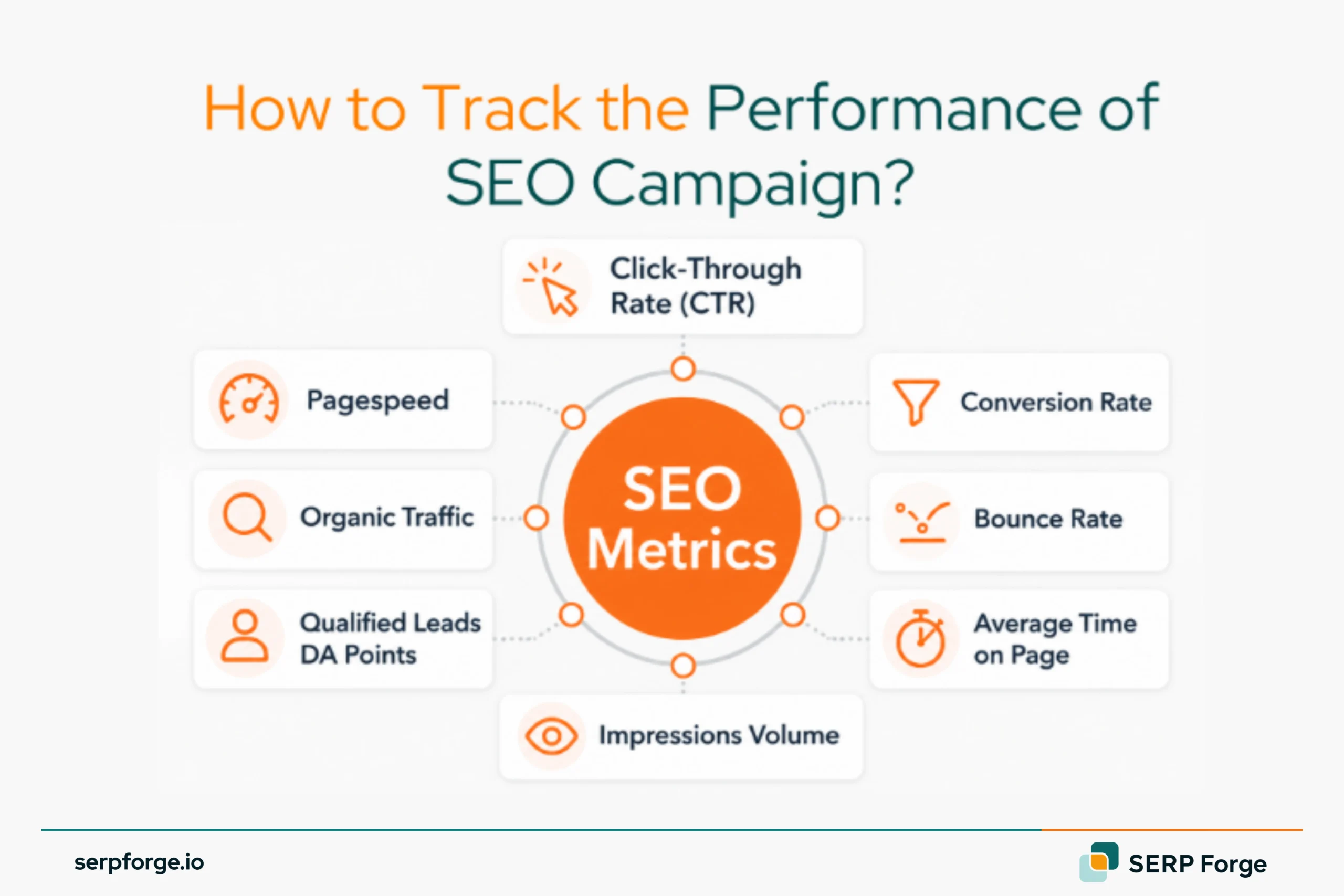
SEO success isn’t measured by rankings alone. The best way to evaluate performance is by tracking a combination of visibility, engagement, and business outcomes.
Some of the most important SEO metrics include:
- Organic traffic: The number of visitors arriving through unpaid search results.
- Keyword rankings: Your position for the search terms you’re actively targeting.
- Search visibility: How prominently your website appears across your target keyword portfolio.
- Click-through rate (CTR): The percentage of users who click your listing after seeing it in search results.
- Conversions: The number of visitors who complete a desired action, such as submitting a form, booking a demo, or making a purchase.
- Bounce rate: The percentage of visitors who leave without interacting further with your website.
- Revenue and leads: The business impact generated from your organic search traffic.
- Authority metrics: Third-party measurements, such as Domain Rating (DR) or Authority Score (AS), that provide a directional view of your website’s authority.
Track Rankings the Right Way
If you’re wondering how to check Google ranking for a specific keyword, Google Search Console is the best place to start. It shows your average ranking position, impressions, clicks, and click-through rate using Google’s own data.
For broader tracking, dedicated rank-tracking tools monitor hundreds or even thousands of keywords over time, helping you identify trends, compare competitors, and measure the impact of your SEO efforts.
The bigger picture: Rankings are only one piece of the puzzle. The most successful SEO strategies focus on growing qualified organic traffic, increasing conversions, and driving measurable business results—not simply reaching the #1 position for a handful of keywords.
What SEO Tools Should You Use?
No single tool can handle every aspect of SEO. Most businesses build a toolkit based on their goals, but the tools generally fall into a few core categories:
SEO Audit Tools
A solid technical foundation starts with the right SEO audit tools. These tools scan your website to uncover issues that may prevent search engines from crawling, indexing, or ranking your pages effectively.
They typically help identify:
- Broken links and redirect errors
- Missing or duplicate meta tags
- Slow-loading pages and Core Web Vitals issues
- Crawl errors and indexing problems
- Internal linking and site architecture issues
Popular options include Screaming Frog, Sitebulb, Ahrefs, Semrush, and Google Search Console, which remains an essential free tool for monitoring your site’s search performance.
Enterprise SEO Tools
As websites grow, managing SEO becomes more complex. Enterprise SEO tools are designed for organizations with thousands or even millions of pages, multiple teams, and large-scale content operations.
These platforms typically provide:
- Large-scale website crawling
- Enterprise-level rank tracking
- Technical monitoring and automation
- Workflow management for SEO teams
- Custom reporting and dashboards
Well-known enterprise SEO tools include Botify, BrightEdge, Conductor, seoClarity, and Deepcrawl.
They help large organizations monitor technical health, manage content at scale, and coordinate SEO efforts across multiple websites or business units.
If you’re a small or medium-sized business, you don’t need an enterprise platform. For most websites, a combination of Google Search Console, Screaming Frog, and either Ahrefs or Semrush provides everything needed to build and manage a successful SEO strategy.
This structure is much easier to scan, naturally integrates the keywords, and feels like a high-quality pillar page rather than a keyword-focused article.
61% of marketers state that improving SEO and growing their organic presence is their top inbound marketing priority.
What Is an SEO Audit?
An SEO audit is a comprehensive evaluation of your website’s overall search performance. Its purpose is to identify the issues preventing your pages from being crawled, indexed, and ranked effectively, then prioritize the improvements that will have the greatest SEO impact.
A typical SEO audit reviews several areas, including:
- Technical SEO: Crawlability, indexability, site speed, Core Web Vitals, and HTTPS.
- On-page SEO: Title tags, meta descriptions, headings, content quality, and keyword optimization.
- Off-page SEO: Backlink quality, referring domains, and the overall health of your backlink profile.
- Site architecture: Internal linking, navigation, orphan pages, and URL structure.
- Structured data: Schema markup implementation and opportunities for rich results.
- Content health: Duplicate pages, thin content, outdated information, and content gaps.
Rather than producing a long list of problems, a good SEO audit prioritizes issues based on their potential impact. That way, you can focus your time and resources on the changes most likely to improve rankings, organic traffic, and overall website performance.
How Does SEO Differ Across Industries?
The core principles of SEO stay the same across every industry, but the strategy changes depending on your audience, buying journey, competition, and regulatory requirements.
SaaS
SEO for SaaS companies focuses on long buying cycles and research-driven users. Instead of targeting only transactional keywords, SaaS brands often invest in comparison pages, solution pages, use cases, integration content, and product documentation that answers technical questions while building trust.
As SaaS businesses grow, technical complexity increases as well. That’s why many companies partner with the best SaaS SEO agencies, which specialize in product-led content, competitive software niches, and long-term organic growth strategies tailored to software businesses.
Enterprise
At enterprise scale, SEO becomes as much about processes as it does about rankings. Large websites often contain thousands or even millions of pages, making governance, collaboration, and automation essential.
This is where Enterprise SaaS SEO differs from traditional SEO. Enterprise software companies must balance complex approval workflows, scalable content production, technical governance, and ongoing optimization across large websites. Success often depends on combining strong technical foundations with enterprise-level content and reporting processes.
FinTech
SEO for fintech requires a greater emphasis on trust because financial content falls under Google’s Your Money or Your Life (YMYL) guidelines. Search engines expect higher standards of accuracy, expertise, and transparency before ranking content that could influence financial decisions.
Successful fintech websites typically strengthen credibility by:
- Publishing expert-written and regularly updated content.
- Demonstrating clear Experience, Expertise, Authoritativeness, and Trustworthiness (E-E-A-T).
- Including accurate regulatory information and appropriate financial disclaimers.
- Supporting content with trustworthy sources and factual data.
Because financial products, regulations, and market conditions change frequently, maintaining accurate and up-to-date content is just as important as technical optimization.
Enterprise websites often contain millions of URLs, making automation, crawl budget optimization, and enterprise SEO tools essential for maintaining search performance at scale.
What Are the Biggest SEO Mistakes?
A handful of mistakes show up again and again, across nearly every industry:
- Ignoring search intent and optimizing purely for keyword volume
- Publishing thin content that doesn’t fully answer the query
- Allowing duplicate pages to compete against each other for the same keywords
- Running a slow website that quietly suppresses rankings across the board
- Weak or inconsistent internal linking between related pages
- Treating technical SEO as optional because it’s less visible than content work
- Buying backlinks instead of earning them through genuine relevance
- Never measuring results, so there’s no way to know what’s actually working
- Publishing isolated articles instead of building real topical authority over time
Is SEO Still Worth It in the Age of AI Search?
Yes, but the shape of “winning” has changed. AI Overviews, ChatGPT, and other AI-driven search experiences now answer plenty of questions directly on the results page, without a click, and that’s real, measurable behavior, not hype. An AI SEO agency can help you adapt to that shift.
But Google itself has stated plainly that the same SEO fundamentals still underpin its generative AI features, since those features are rooted in the same core ranking and quality systems.
In practice, this means the sites getting cited inside AI answers are, overwhelmingly, the same sites already doing solid SEO technically sound, genuinely helpful, and backed by real expertise.
SEO isn’t being replaced so much as it’s gaining a second audience: the human searcher, and now the AI system summarizing an answer on their behalf.
Is SEO Different From SEM or Paid Search?
It’s worth clearing up a common point of confusion: SEO and SEM (Search Engine Marketing) aren’t the same thing, even though people sometimes use them interchangeably.
SEO covers organic, unpaid rankings. SEM is the broader umbrella that includes SEO alongside paid search ads, where you pay for placement rather than earning it.
Most mature strategies use both together: paid search for immediate visibility while organic SEO compounds in the background rather than treating them as competing options.
Ready to Put This Into Practice?
Reading about SEO and actually implementing it are two very different things, especially once real technical constraints, content backlogs, and competing priorities enter the picture.
If you’re optimizing a software business specifically, our SaaS SEO checklist walks through technical SEO, content planning, internal linking, and performance optimization step by step, so you can build a scalable SEO strategy without guessing what to tackle first.
FAQ’s
1. Can I do SEO myself without hiring anyone?
Yes, especially early on. The free essentials Google Search Console, a clean site structure, and genuinely useful content will take a small site a long way before outside help becomes necessary.
2. Does SEO still matter if I run paid ads?
Yes. Paid ads stop the moment you stop paying; SEO keeps working in the background and tends to become more cost-effective the longer you invest in it.
3. What’s the difference between SEO and SEM?
SEO specifically covers organic, unpaid rankings. SEM (Search Engine Marketing) is the broader umbrella that includes SEO alongside paid search ads. Most mature strategies use both together.
4. How much does professional SEO cost?
Most small businesses pay roughly $1,500–$3,000 per month for a legitimate ongoing program, while enterprise organizations in competitive industries often invest well beyond that. If a quote sounds too cheap to be real, it usually is.
5. Will redesigning my website hurt my SEO?
Redesigns themselves are fine; losing existing URLs, redirects, and internal links during one isn’t. Any redesign should include a plan to preserve what’s already ranking.
6. What’s the very first thing I should check if my site isn’t ranking at all?
Confirm the page is actually indexed in Google Search Console. A perfectly written page that search engines can’t crawl or index won’t rank, no matter how good it is.
7. Do backlinks still matter as much as they used to?
Yes, though quality now matters far more than quantity. A handful of relevant, authoritative links consistently outperforms a large volume of weak ones.