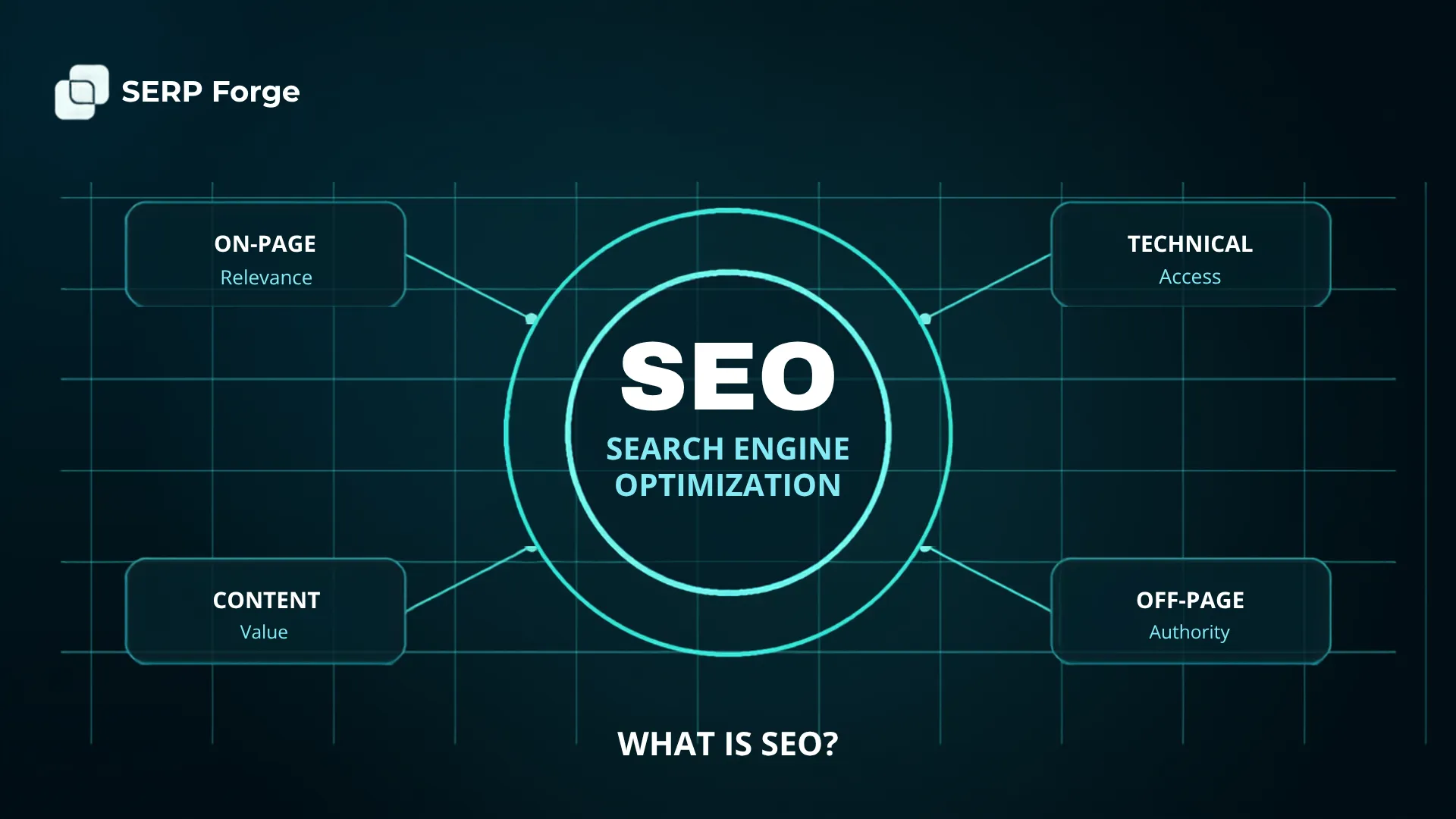



SaaS SEO is the practice of optimizing a software-as-a-service company’s online presence to attract qualified organic traffic from search engines. Unlike traditional SEO, it must align search intent with product value across every stage of the buying journey, from awareness to trial signup.
Many companies either focus too much on blogs without conversions or invest in technical fixes without a clear content direction. The result? Traffic that doesn’t convert, pages that don’t rank, and efforts that don’t scale.
This guide is designed to solve that gap. It brings together everything from technical SEO and keyword planning to content, link building, and performance tracking into a step-by-step system you can actually follow.
By the end, you’ll have a clear framework to:
- Organize SEO tasks based on priority and timing
- Build content that attracts and converts the right users
- Improve visibility for high-intent keywords
- Turn organic traffic into consistent trial and demo signups
Instead of guessing what to do next, you’ll have a structured approach to build SEO as a scalable growth channel for your SaaS.
Why Need an SEO Checklist for Your SaaS?
SaaS SEO involves multiple layers of technical setup, content strategy, on-page optimization, and link building, all working together to drive organic growth.
Each layer requires the right SaaS marketing tools without them, even a solid strategy stays theoretical. Without a clear checklist, it’s easy to miss critical steps like proper keyword mapping, internal linking, or indexing issues, which can directly impact your rankings and conversions.
Want us to do this for you instead? → [Explore Our SaaS SEO Services]
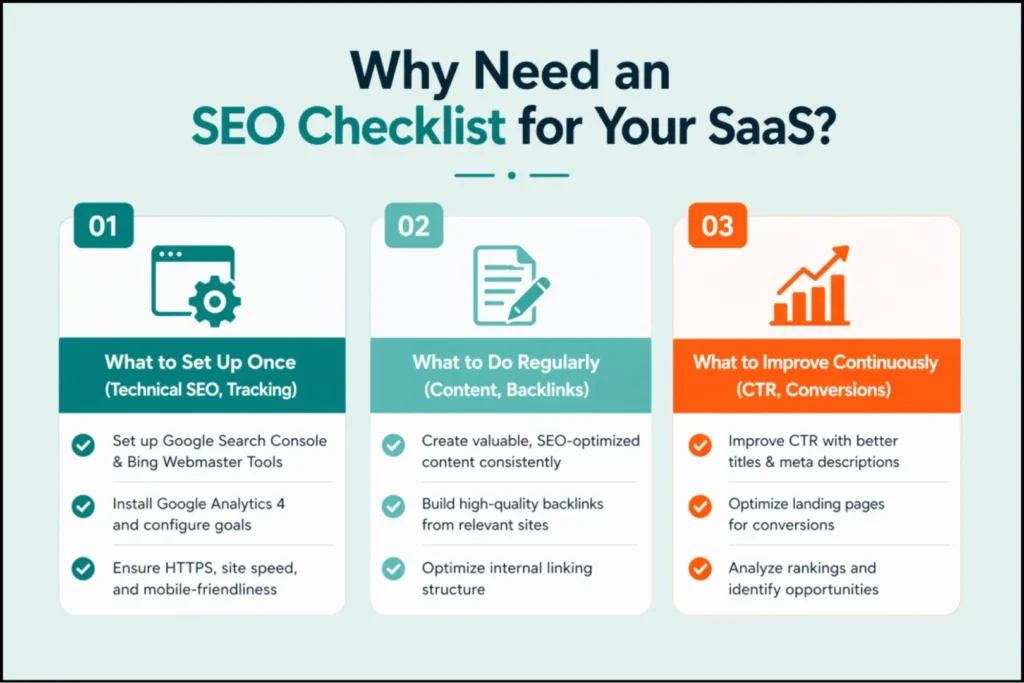
An SEO checklist helps you stay focused on what actually moves the needle. It ensures every page is aligned with search intent, optimized for users, and meets key ranking factors used by Google, such as relevance, authority, and user experience.
More importantly, it brings structure to your efforts by defining:
- What to set up once (technical SEO, tracking)
- What to do regularly (content, backlinks)
- What to improve continuously (CTR, conversions)
A well-followed checklist turns SEO into a repeatable growth system, not a one-time task.
The Complete 41 Point SEO Checklist for SaaS Companies
Below is a structured checklist that covers every stage of SaaS SEO from building a strong brand presence to driving conversions through content, technical optimization, and authority building. To prepare for AI search, add AI SEO for SaaS to that checklist.
Each section is designed to help you focus on what matters at different stages of growth:
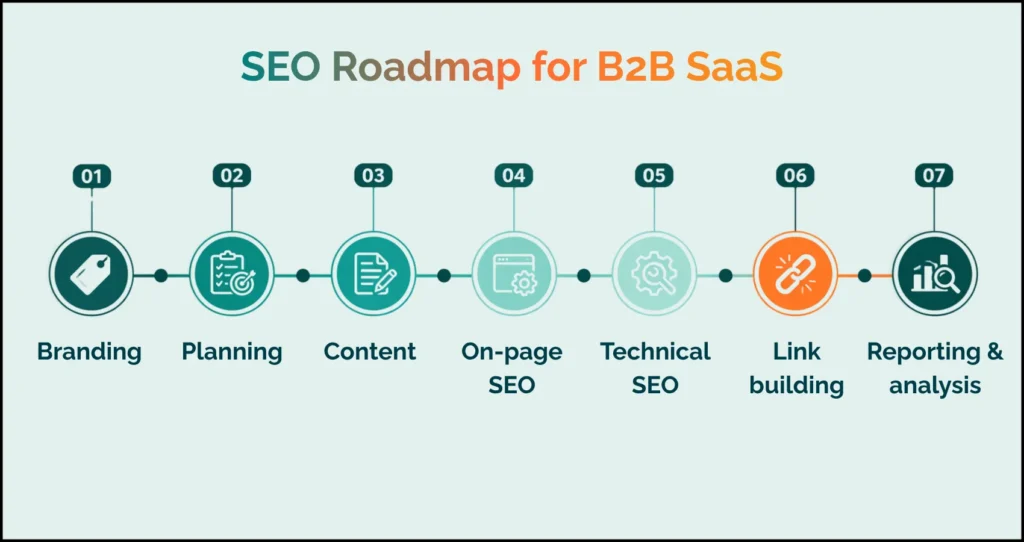
Branding
Branding plays a foundational role in SaaS SEO. Before users click on your page, they often see your name across search results, review platforms, and social channels.
A strong and consistent brand not only improves recognition but also builds trust, which directly impacts click-through rates, branded search visibility, and conversions. In SaaS, branding also influences how your product is discovered, compared, and chosen across the entire buying journey.
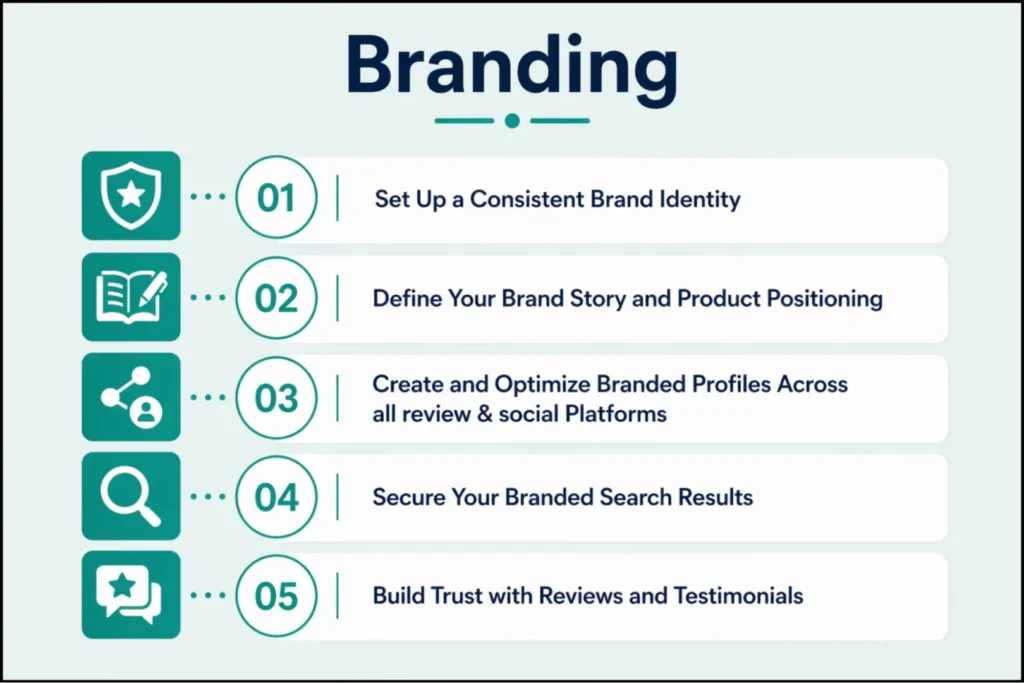
1. Set Up a Consistent Brand Identity
Your brand works as a recognizable search signal. When your name, visuals, and messaging stay consistent across platforms, search engines like Google can clearly associate all mentions with a single entity.
This strengthens visibility in branded searches and improves trust.
Keep your brand consistent across:
- Website, product interface, and landing pages
- Social profiles and review platforms
- Messaging, tone, and value proposition
This directly impacts click-through rates, branded keyword performance, and user familiarity over time, making it easier for users to recognize and return to your product.
2. Define Your Brand Story and Product Positioning
Clear positioning helps you rank for the right keywords, not just more keywords. Instead of broad messaging, define your niche and communicate your value clearly.
Make sure your positioning answers:
- What category do you belong to
- Who your product is built for (ICP)
- What problems does your product solve for your target audience
- What makes you different from competitors
This alignment helps you capture traffic across awareness, comparison, and decision-stage queries while supporting product-led SEO and attracting users who are more likely to convert.
3. Create and Optimize Branded Profiles Across All Review & Social Platforms
Branded profiles act as supporting assets in search results. Platforms like G2, Capterra, LinkedIn, and X (Twitter) often appear for branded queries and influence buying decisions.
Optimize these profiles by:
- Adding keyword-aligned product descriptions
- Keeping branding and visuals consistent
- Updating features, integrations, and screenshots regularly
This builds stronger off-page SEO signals, improves brand authority, and expands your presence across multiple search touchpoints, increasing your chances of being discovered at different stages of the funnel.
4. Secure Your Branded Search Results
Branded searches indicate high intent and existing awareness. If you don’t control what shows up, competitors or irrelevant pages can take that space.
Make sure your:
- Website pages rank at the top
- Social and review profiles are visible
- Messaging across results is accurate and consistent
Owning your branded SERP improves trust, protects your organic traffic, and ensures high-intent users land on your product instead of competitor pages.
5. Build Trust with Reviews and Testimonials
Reviews play a key role in both credibility and conversion. They also support trust signals evaluated by search engines.
Strong review signals include:
- Consistent new reviews over time
- Balanced feedback with active responses
- Testimonials are placed on key pages, such as product pages and landing pages
Reviews that naturally include product features, use cases, or outcomes can help you appear for long-tail keywords while improving trial signups and conversions by reinforcing real user value.
Planning
Planning is where your SaaS SEO strategy takes shape. Without a clear plan, efforts become scattered, leading to missed opportunities, keyword overlap, and inefficient content production.
This stage focuses on identifying the right keywords, aligning them with search intent, and structuring your content in a way that builds topical authority and drives consistent organic growth.
In SaaS, strong planning also ensures your SEO efforts connect directly to pipeline generation, not just traffic.
According to the HubSpot Marketing Report, Nearly 24% of marketers are already exploring updates to their SEO strategy for generative AI in search (e.g., ChatGPT, Gemini, Claude), showing how fast search behavior is evolving and why structured planning is becoming even more important.
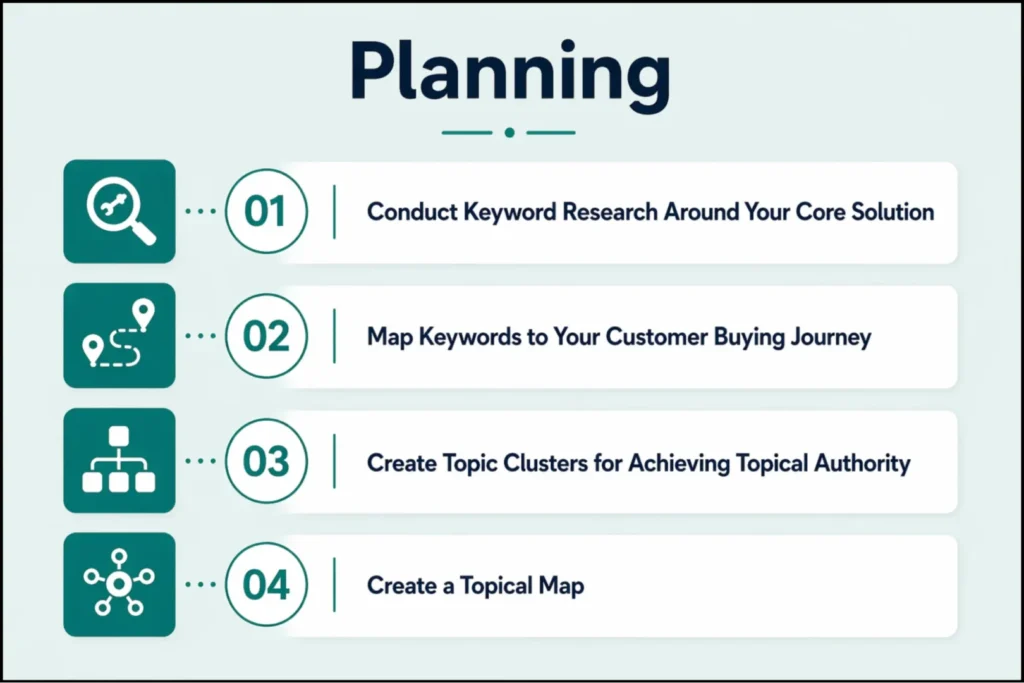
6. Conduct Keyword Research Around Your Core Solution
Keyword research for SaaS should start with your core product, solution category, and problem space, not just traffic potential. Instead of targeting broad, low-intent terms, focus on solution-aware keywords that directly relate to your product and the problems it solves.
Build your keyword list around:
- Product categories (e.g., “project management software”)
- Feature-specific searches (e.g., “task automation tool”)
- Problem-aware queries (e.g., “how to manage remote teams”)
This approach helps you attract high-intent traffic and users who are more likely to convert, while aligning with how Google interprets relevance, intent, and solution fit.
7. Map Keywords to Your Customer Buying Journey
Not all keywords have the same search intent. Some users are just exploring, while others are ready to sign up. Mapping keywords to the customer buying journey ensures you create the right content for each stage and guide users toward conversion.
Structure your keyword targeting like this:
- Awareness → Educational queries (“what is CRM software”)
- Consideration → Comparison queries (“best CRM for startups”)
- Decision → High-intent queries (“HubSpot vs Zoho CRM”)
This alignment improves both rankings and conversion rates by matching content with user intent and moving users smoothly through your SaaS Marketing funnel.
8. Create Topic Clusters for Achieving Topical Authority
Topic clusters help you build depth and authority around a specific subject. Instead of publishing isolated articles, connect related content under a central theme to strengthen topical relevance.
A strong cluster includes:
- A pillar page targeting a broad keyword
- Supporting articles covering subtopics in detail
- Internal links connecting all related content
This structure helps search engines understand your content ecosystem, improves rankings across multiple related keywords, and strengthens your position as an authority in your niche.
9. Create a Topical Map
A topical map is your long-term SEO blueprint. It outlines all the topics, subtopics, and pages you need to cover within your niche to build complete topical coverage.
It helps you:
- Avoid keyword cannibalization
- Identify content gaps
- Plan internal linking in advance
By organizing your content ecosystem upfront, you create a scalable system that supports consistent growth, better content prioritization, and stronger topical authority over time.
Use an SEO content brief for each article to align keyword, intent, and structure before writing
Content
Content is the core driver of SaaS SEO performance. It’s not just about publishing articles; it’s about creating pages that match search intent, explain your product clearly, and guide users toward action. In SaaS, content also acts as the bridge between traffic and revenue, turning organic visitors into trial users and demos.
According to Ahrefs, Around 95% of B2B decision-makers say strong thought leadership content makes them more receptive to a company’s offering, highlighting how high-quality content directly influences buying decisions.
A well-structured content approach helps you attract the right audience, build topical authority, and convert traffic into qualified leads, trials, and demos.
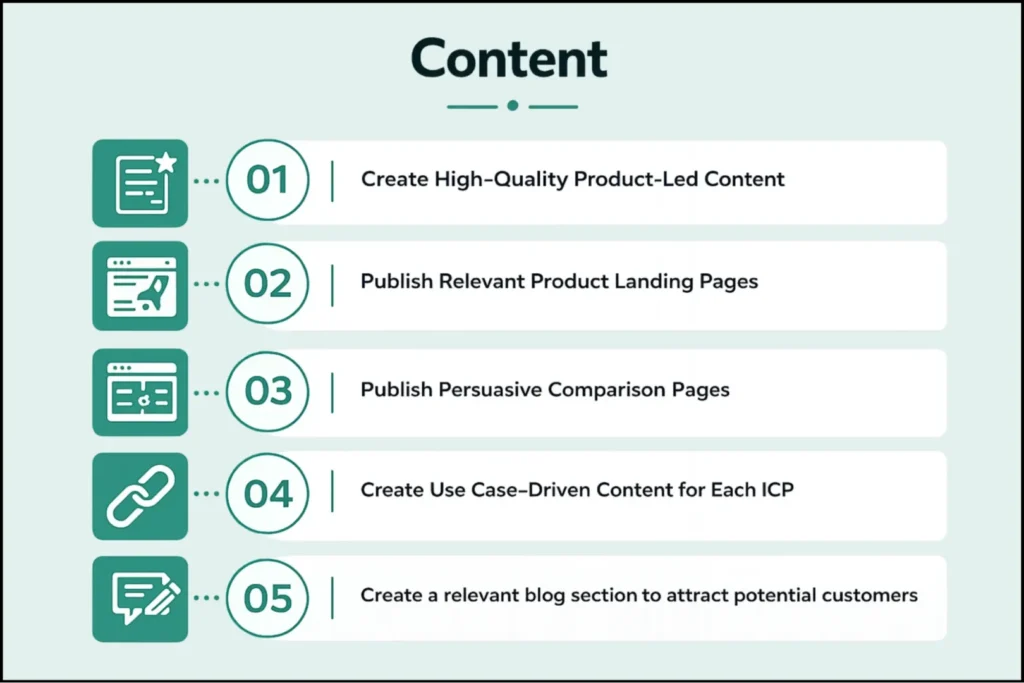
10. Create High-Quality Product-Led Content
Product-led content connects your solution directly with the problem being searched. Instead of writing generic informational blogs, create content that shows how your product solves real use cases and workflows.
This helps you attract high-intent traffic and naturally move users toward signups.
Strong product-led content includes:
- Real workflows, examples, or scenarios
- Screenshots or feature highlights
- Clear connection between problem → solution → outcome
This improves engagement, dwell time, and conversion signals, while aligning content with actual product value.
11. Publish Relevant Product Landing Pages
Each core feature or solution should have a dedicated landing page targeting a specific primary keyword. These pages are essential for capturing transactional queries and decision-stage traffic.
Well-optimized landing pages should:
- Focus on one primary keyword
- Clearly explain the feature and its benefits
- Include strong CTAs (free trial, demo, signup)
This ensures you rank for high-intent searches, improve conversion rates, and turn organic visitors into active users.
12. Publish Persuasive Comparison Pages
Comparison pages target users who are actively evaluating options. These are some of the highest-converting assets in SaaS SEO because they capture bottom-of-funnel intent.
Create pages like:
- “[Your Product] vs [Competitor]”
- “Best alternatives to [Competitor]”
Make sure the content is honest, structured, and highlights your strengths without sounding biased. These pages help capture commercial intent keywords and directly influence buying decisions.
13. Create Use Case–Driven Content for Each ICP
Different users have different needs, even if they use the same product. Creating content for each Ideal Customer Profile (ICP) helps you target niche keywords and improve relevance.
For example,
- A CRM SaaS can target “CRM for real estate” (use case page) + “HubSpot vs Zoho CRM” (comparison page) to capture both mid and bottom funnel traffic.
This approach expands your keyword coverage while improving conversion rates through better audience alignment and problem-solution fit.
14. Create a Relevant Blog Section to Attract Potential Customers
A blog helps you capture top-of-funnel traffic and build authority in your niche. It should focus on topics your target audience is actively searching for, not just random industry content.
A strong SaaS blog should:
- Cover problem-solving and educational topics
- Support your product and feature pages
- Link internally to key landing and conversion pages
To keep your blog performing over time, a SaaS content audit helps you identify which posts are losing traffic and need to be updated or consolidated.
Over time, this builds topical authority, drives consistent organic traffic, and feeds users into your conversion funnel by guiding them toward product-focused pages.
On-Page SEO
On-page SEO ensures that every page is clear, relevant, and easy to understand for both users and search engines.
It focuses on optimizing key elements like title tags, headings, URLs, and content structure so your pages can rank for the right keywords while also improving user experience, engagement, and conversion potential.
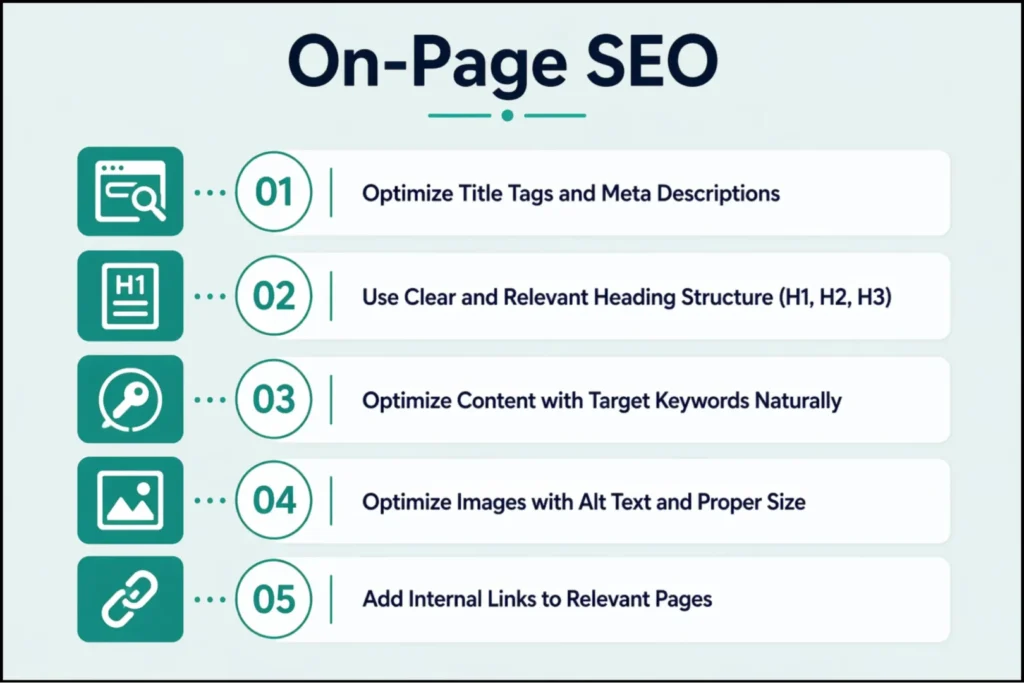
15. Optimise Title Tags & H1s for the Focus Keyword
Your title tag and H1 are the primary ranking signals for any page. They tell search engines what your page is about and influence whether users click on your result.
Make sure:
- The primary keyword is included naturally
- The title is clear, specific, and intent-driven
- H1 aligns with the title but doesn’t feel repetitive
A well-optimized title improves both rankings and click-through rates (CTR) in search results, especially for high-intent queries.
16. Ensure the Meta Description Has the Target Keyword
Meta descriptions don’t directly impact rankings, but they strongly affect CTR (click-through rate). Including the target keyword helps it stand out in search results and reassures users that your page matches their query.
Write descriptions that:
- Clearly explain what the page offers
- Include the main keyword naturally
- Encourage clicks with a benefit or outcome
A compelling meta description can improve organic traffic by increasing the number of users who choose your result over competitors.
17. Use Keyword-Rich Headings with Logical Hierarchy
Headings (H2, H3, H4) help structure your content for both users and search engines like Google.
Follow a clear hierarchy:
- H1 → Main topic
- H2 → Key sections
- H3/H4 → Supporting points
Include relevant keywords in headings without forcing them. This improves content readability, helps search engines understand topical depth, and keeps users engaged across the page.
18. Optimize URL Slug with Primary Keyword
Your URL should be short, clean, and keyword-focused. Avoid unnecessary words, numbers, or complex structures.
Best practices:
- Include the primary keyword
- Use hyphens to separate words
- Keep it simple and readable
A clean URL improves both indexing, crawlability, and user trust, especially when users evaluate links in search results.
19. Add Contextual Internal and External Links to Relevant Pages
Links help search engines discover content and understand relationships between pages.
A strong linking strategy includes:
- Internal links to related blogs, features, and landing pages
- External links to credible, relevant sources
This improves crawlability, distributes link equity, strengthens your site structure, and guides users toward high-value conversion pages.
20. Include Product Visuals with Optimized Alternative Text
Visuals like screenshots, dashboards, or feature demos improve engagement and clarity. They also create opportunities to rank in image search results.
Optimize images by:
- Adding descriptive alt text with relevant keywords
- Compressing files for faster page speed
- Using meaningful file names
This supports accessibility, improves user experience, and enhances overall SEO performance.
21. Use the Bucket Brigade Writing Method for Improved Readability
The bucket brigade technique keeps users engaged by using short, conversational phrases that guide them through the content.
Examples include:
- “Here’s the thing…”
- “Let’s break it down…”
- “But that’s not all…”
This improves dwell time, scroll depth, and engagement signals, helping users stay longer and increasing the chances of conversion.
Technical SEO
Technical SEO builds the foundation that allows everything else to perform. It ensures your website is discoverable, fast, and accessible so your content can be properly processed, indexed, and surfaced in search.
Without a strong technical setup, even well-optimized content can struggle to gain visibility and limit your ability to scale organic acquisition in SaaS environments.
For a complete breakdown of every technical element to audit, see the SaaS SEO checklist with 35 actionable items
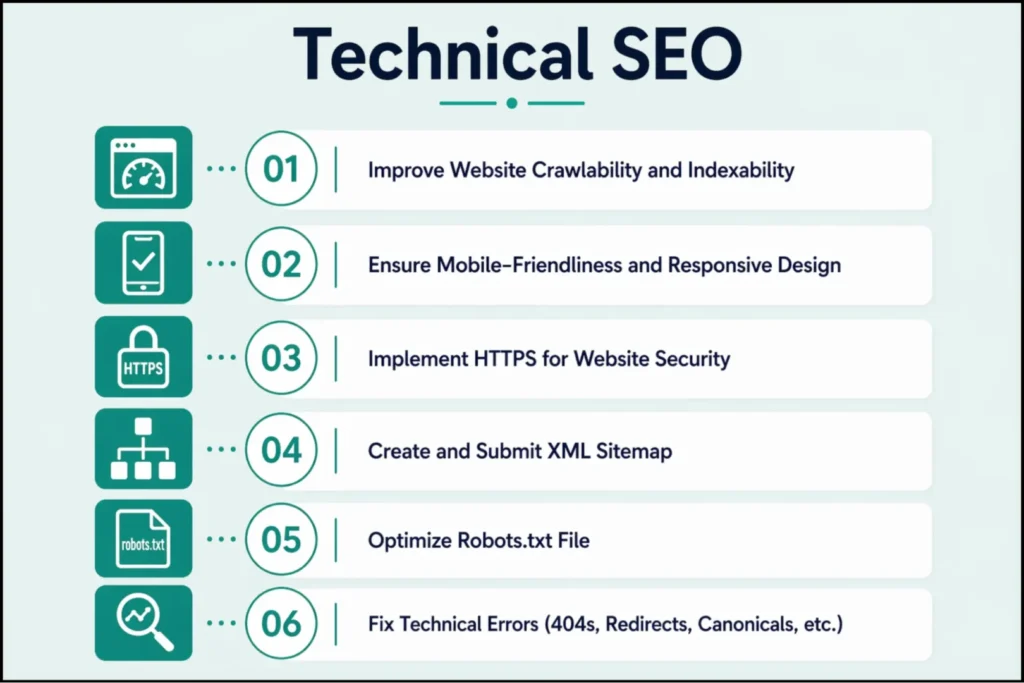
22. Ensure All Important Pages Are Crawlable by Search Engines
If search engines can’t access your pages, they won’t rank, no matter how good your content is.
Crawlability ensures that bots from Google can discover, access, and index your most important pages.
Make sure:
- Key pages are not blocked by robots directives or meta tags
- Internal links point to important pages
- No orphan pages exist (pages without internal links)
This ensures your high-value URLs are consistently visible and prioritized during crawling.
23. Keep the Sitemap Updated with Priority Pages
Your XML sitemap acts as a guide for search engines, helping them understand which pages matter most across your site.
Keep your sitemap:
- Updated with new and important pages
- Free from broken or redirected URLs
- Focused on indexable, high-value pages
This improves crawl prioritization, speeds up index discovery, and ensures important pages are processed faster.
24. Optimize robots.txt File to Control Blocking and Indexing
The robots.txt file helps you control which parts of your site should or shouldn’t be crawled.
Use it to:
- Block low-value pages (admin, duplicate URLs, filters)
- Allow access to important content and resources
- Avoid accidental blocking of critical pages
A properly configured robots.txt ensures search engines focus on what actually matters.
25. Improve Page Load Speed and Core Web Vitals (CWV)
Page speed directly impacts page experience and rankings. Core Web Vitals measure how fast and stable your site feels to users.
Google’s own documentation confirms that Core Web Vitals are a ranking signal, with Largest Contentful Paint (LCP), Interaction to Next Paint (INP), and Cumulative Layout Shift (CLS) being the three primary metrics evaluated.
Key areas to optimize:
- Largest Contentful Paint (LCP) → loading speed
- First Input Delay (FID) → interactivity
- Cumulative Layout Shift (CLS) → visual stability
Faster pages reduce friction, improve session quality, and support better performance across key engagement metrics.
26. Ensure Content Is Accessible Without Heavy JavaScript
Heavy JavaScript can block or delay content rendering, making it harder for search engines to fully understand your pages.
Ensure:
- Core content is visible in the initial HTML
- Important text and links don’t rely only on JS
- Critical elements load without user interaction
This improves rendering efficiency and ensures your content is accurately processed during indexing.
27. Implement Server-Side Rendering (SSR) or Prerendering
For SaaS platforms with dynamic content, SSR or prerendering helps deliver fully rendered HTML to search engines.
Benefits include:
- Faster initial page load
- Better crawlability and indexing
- Improved performance for JS-heavy applications
This is especially important for apps built with modern frameworks like React or Vue.
28. Ensure Mobile-Friendly Responsive Design
Most users and searches now come from mobile devices. Your site must provide a smooth experience across all screen sizes.
Most users and searches now come from mobile devices. Google has operated on a mobile-first indexing model since 2019, meaning the mobile version of your site is the primary version Google crawls and evaluates for ranking. Your site must provide a smooth experience across all screen sizes.
Make sure:
- Layout adapts to different devices
- Text is readable without zooming
- Buttons and navigation are easy to use
Strong mobile usability improves interaction signals and ensures consistent performance across devices.
29. Add Canonical Tags to All Pages
Canonical tags tell search engines which version of a page should be treated as the primary one.
Use them to:
- Prevent duplicate content issues
- Consolidate ranking signals across similar URLs
- Maintain clean indexing
This is critical for SaaS sites with multiple URL variations.
30. Implement Relevant Structured Data (Schema Markup) on Pages
Structured data helps search engines better understand your content and context. It also increases your chances of appearing in rich results.
Common schema types for SaaS:
- Product
- SoftwareApplication
- FAQ
- Review
This improves result presentation, enhances visibility, and can increase interaction from search listings.
31. Implement hreflang Tags for International SEO
If your SaaS targets multiple regions or languages, hreflang tags help search engines show the correct version of your page to the right audience.
They ensure:
- Users see content in their preferred language
- Duplicate content issues across regions are avoided
- Regional rankings improve
This is essential for scaling SEO across global markets.
Link Building
Link building helps you build domain authority and trust in your niche.
It signals that your content is valuable and worth referencing, which directly impacts your ability to rank for competitive search terms.
A consistent and quality-focused approach ensures steady growth while also supporting long-term search visibility and pipeline growth in SaaS.
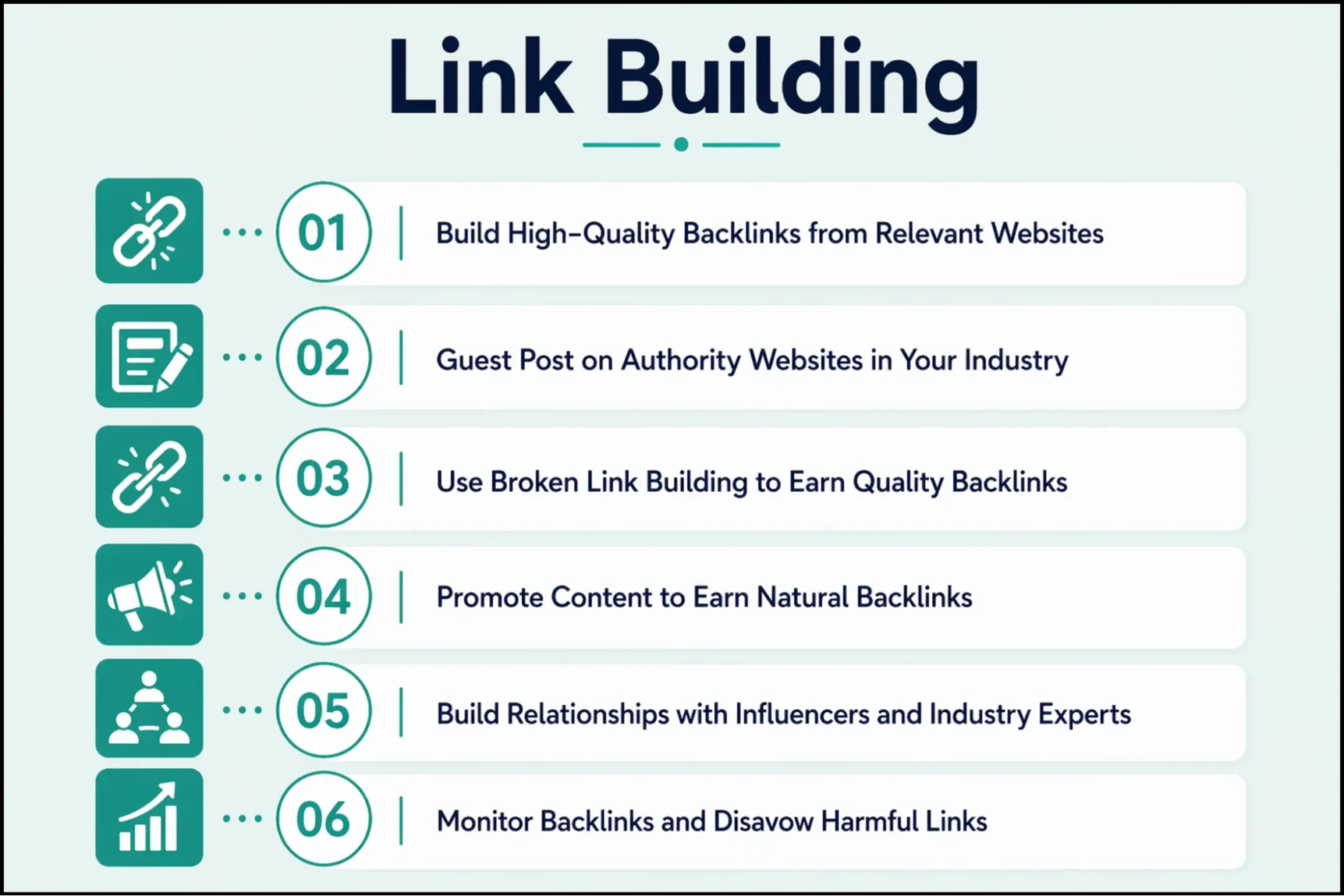
32. Maintain a Consistent Link Velocity Month Over Month
Link building for SaaS isn’t about spikes, it’s about steady, natural growth. A consistent link velocity signals to search engines like Google that your website is gaining authority organically, not through sudden or manipulative bursts. A SaaS backlink agency can help you keep that link velocity steady.
Instead of building too many links at once and then stopping, aim for a predictable monthly pattern. This helps:
- Build domain authority gradually
- Reduce the risk of algorithmic flags
- Maintain stable ranking improvements over time
Apply the SERP Forge benchmark to ensure quality over quantity:
- Minimum DR 50 (high-authority domains)
- Minimum 1K monthly organic traffic
- In-content, do-follow links (not sidebar or footer links)
This approach ensures that every backlink contributes real SEO equity, supports your key pages, and strengthens your overall search presence.
33. Ensure a Natural Backlink Profile with Link Diversification
A healthy backlink profile should grow in a way that looks organic and balanced. If most of your links come from a single source or format, it can limit authority growth and raise quality concerns.
Diversification means earning links from:
- Editorial mentions and niche blogs
- Guest posts and contextual placements
- SaaS directories and review platforms
- Resource pages and curated lists
This variety helps search engines like Google interpret your backlink profile as natural and trustworthy while improving your site’s overall link diversity signals.
34. Analyze Competitor Backlink Profiles for Link Opportunities
Competitor analysis gives you a shortcut to finding proven link opportunities. If a site is linking to your competitors, there’s a strong chance they may link to you as well.
Focus on identifying:
- Domains linking to multiple competitors
- Listicles and comparison pages
- Industry-specific blogs and publications
This approach helps you prioritize outreach efforts that are more likely to succeed and uncover scalable opportunities for authority growth.
35. Ensure a Natural Anchor Text Distribution for Your Manual Link-Building Strategy
Anchor text distribution should feel natural and varied. Overusing exact-match keywords can make your profile look manipulated, while a balanced mix improves long-term stability.
A strong distribution includes:
- Branded anchors (your product or company name)
- Partial keyword matches
- Generic phrases (“read more”, “visit website”)
- Limited exact-match keywords
This keeps your link profile aligned with natural linking patterns.
36. Acquire Backlinks and Monitor Link Performance for Potential BoFu Pages
Backlinks should not just build authority; they should support pages that drive conversions. For SaaS, this includes bottom-of-funnel pages like product, feature, and comparison pages.
Track link impact by:
- Monitoring keyword rankings for target pages
- Measuring traffic and conversions from linked pages
- Updating placements that are not delivering value
This ensures your link-building efforts contribute directly to revenue-focused pages and measurable business outcomes.
37. Include Your Brand Across All Industry-Relevant Listicles
Listicles are high-visibility assets that often rank for commercial intent queries and comparison keywords. Being featured in these lists increases both discovery and credibility.
Instead of random outreach, focus on getting included in:
- “Best [category] tools” articles
- “Top SaaS platforms for [use case]” lists
- Industry-specific recommendation pages
Consistent presence across these listicles strengthens brand mentions, improves visibility across the decision stage, and supports acquisition of high-intent users.
Reporting & Analysis
Reporting and analysis help you understand what’s working, what’s not, and where to improve.
Instead of relying on assumptions, this stage focuses on data-driven insights, tracking performance, user behavior, and conversions to continuously refine your SEO strategy and maximize results. In SaaS, this step is critical for connecting organic performance with actual business impact.
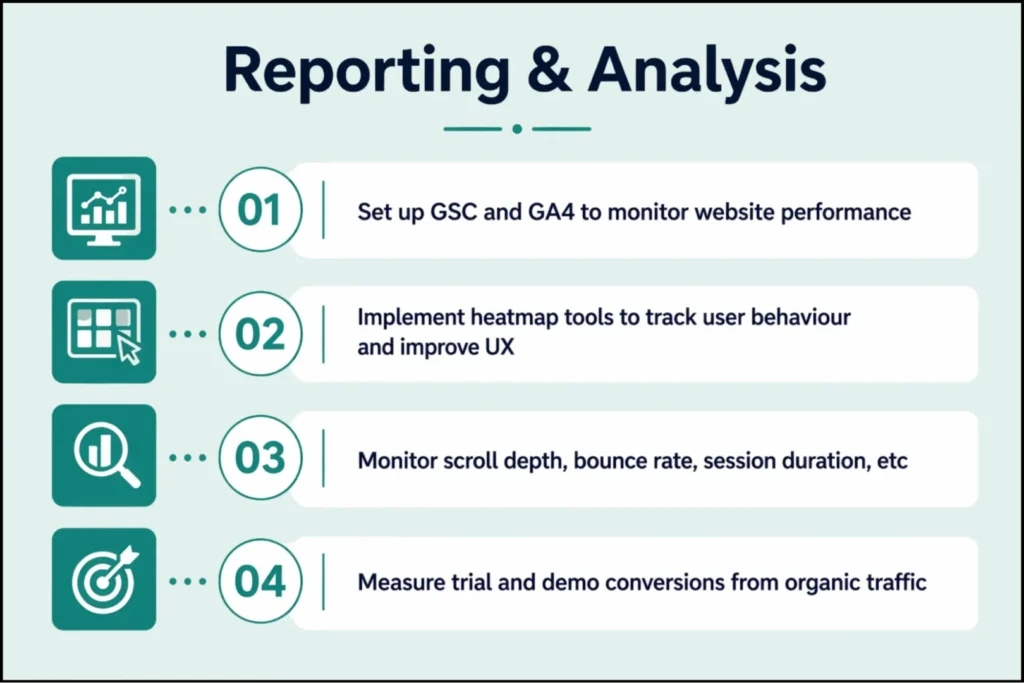
38. Set Up GSC and GA4 to Monitor Website Performance
Tracking is the foundation of SaaS SEO. Without proper data, you won’t know what’s working or where you’re losing opportunities.
Tools like Google Search Console and Google Analytics 4 help you monitor visibility, traffic, and user behavior.
For larger SaaS websites managing thousands of pages, using dedicated enterprise SEO tools alongside GSC and GA4 helps centralise data and scale reporting efficiently.
Use them to track:
- Keyword rankings and impressions
- Click-through rates (CTR)
- Indexed pages and technical issues
- Traffic sources and landing page performance
This gives you a clear view of how your SEO efforts are performing and helps you identify patterns in search visibility trends and user acquisition.
39. Implement Heatmap Tools to Track User Behaviour and Improve UX
Heatmap tools show how users actually interact with your pages, where they click, scroll, or drop off. This helps you identify friction points that impact engagement and conversions.
With heatmaps, you can:
- Understand which sections users engage with
- Identify ignored or underperforming areas
- Improve layout, CTAs, and content placement
Better user experience leads to stronger interaction signals and improved performance across key engagement touchpoints.
40. Monitor Scroll Depth, Bounce Rate, Session Duration, etc
Behavioral metrics help you understand how users engage with your content beyond just traffic numbers.
Key metrics to track:
- Scroll depth → how far users read
- Bounce rate → whether users leave quickly
- Session duration → how long they stay
These insights help you refine content quality, structure, and relevance while improving content engagement metrics that indicate how well your pages meet user expectations.
41. Measure Trial and Demo Conversions from Organic Traffic
For SaaS, traffic alone doesn’t matter; conversions do. You need to track how many users from organic search turn into free trials, demos, or signups.
Measure:
- Conversion rate by landing page
- Keywords driving high-intent traffic
- Pages contributing to signups
This helps you connect SEO efforts directly to revenue attribution, prioritize high-performing pages, and focus on strategies that generate measurable business results.
Common SaaS SEO Mistakes to Avoid
Identifying and fixing these early helps you build a stronger and more consistent SEO foundation.
Below are the most common mistakes SaaS companies make that limit rankings, reduce traffic quality, and impact conversions:
Targeting Keywords Without Search Intent
Focusing only on search volume without understanding intent leads to traffic that doesn’t convert. Align keywords with awareness, comparison, and decision stages to attract the right users.
Poor Internal Linking Structure
Lack of internal links makes it harder to distribute authority across your site and guide users to important pages.
Creating Content Without a Topical Strategy
Random content publishing leads to weak authority and keyword overlap. A structured topical approach helps you rank faster and more consistently.
Neglecting Technical SEO Basics
Issues like slow speed, poor mobile experience, or indexing problems can block your growth even with good content.
Over-Optimizing Anchor Text
Using too many exact-match anchors in backlinks can look unnatural. A balanced anchor mix keeps your profile safe and effective.
Ignoring Branded Search Presence
If you don’t control your branded results, competitors or third-party pages can take that space and affect trust.
How SERP Forge Builds Scalable SEO for SaaS Companies
SERP Forge focuses on building a structured SEO system that drives consistent traffic, qualified leads, and long-term growth for SaaS companies by aligning strategy with product, audience, and business goals.
Here’s how the approach is structured:
- Product and ICP-focused keyword strategy to attract high-intent users
- Full-funnel content covering awareness, comparison, and decision stages
- Product-led content that connects features with real use cases
- Strong topical authority through clusters and internal linking
- High-quality link building with consistent benchmarks and link velocity
- Continuous tracking and optimization based on performance and conversions
Final Thoughts
SaaS SEO is not just about ranking pages; it’s about building a connected growth engine where content, product, and user intent work together. Every page you create, link you build, and improvement you make should move users closer to a clear outcome, whether that’s a signup, demo, or upgrade.
The real advantage comes from compounding efforts over time. When your technical foundation is strong, your content is mapped to intent, and your authority grows consistently, each new page performs better than the last.
Instead of chasing quick wins, focus on building depth, clarity, and consistency. That’s what turns SEO into a predictable and scalable growth channel for SaaS.
Frequently Asked Questions
1. How long does it take for SaaS SEO to show results?
SaaS SEO usually takes 3 to 6 months to show noticeable improvements, depending on your domain authority, competition, and consistency. High-intent pages like comparison or feature pages can sometimes perform faster.
2. How many pages should a SaaS website have for good SEO?
There’s no fixed number, but a strong SaaS site typically includes product pages, feature pages, comparison pages, use case pages, and a well-structured blog. The focus should be on covering your niche completely rather than just increasing page count.
3. Should SaaS companies focus more on content or backlinks?
Both are important, but content should come first. Without strong, intent-driven content, backlinks won’t deliver full value. Once content is in place, backlinks help improve rankings and authority.
4. How do you find high-intent keywords for SaaS?
High-intent keywords usually include terms like “best,” “vs,” “alternatives,” “pricing,” or specific feature-based searches. These indicate users are closer to making a decision.
5. Can SaaS SEO work without a large budget?
Yes, SaaS SEO can work with a limited budget if you focus on the right priorities: strong keyword research, product-led content, and consistent optimization. Over time, organic growth can reduce dependency on paid channels.
6. What are the biggest risks of relying solely on SEO for SaaS growth?
Sole reliance on SEO creates vulnerability to algorithm updates and leaves a gap during the 6–12 month ramp-up period. The most resilient SaaS companies treat SEO as the long-term foundation, while using paid acquisition and product-led growth to generate short-term leads.