

The best SaaS SEO agency for a B2B startup is the one that ties organic search to pipeline, not to traffic. Choose on that basis and the rest of the decision gets easier.
Most B2B SaaS teams start the search the same way. They type “best SaaS SEO agencies for B2B startups” into Google, ChatGPT or Perplexity. They get a list of ten names with near-identical promises. Every agency claims strategy, content, links and results. Few explain how those parts connect to demos booked, opportunities created and revenue closed.
That gap matters because B2B SaaS sales cycles are long. A buyer researches for weeks, brings in several stakeholders and compares vendors before filling in a form. SEO built for a traffic report does not survive that journey. SEO built around the buying committee’s questions does.
This guide gives you a practical framework for evaluating a SaaS SEO agency. It covers:
- The capabilities a full-funnel partner must combine: technical SEO, content and link building
- How to judge an agency on pipeline contribution instead of organic traffic
- Why AI search visibility (AEO and GEO) now belongs in the scope
- How an agency compares with an in-house team
- Answers to the questions B2B founders and marketing leaders ask most
Where it helps, we show how SERP Forge approaches each point. SERP Forge is a B2B SaaS marketing agency. It delivers performance-driven, data-centric SaaS SEO and generative engine optimization for startups, scaleups and enterprise companies.
Evaluating SaaS SEO agency capabilities
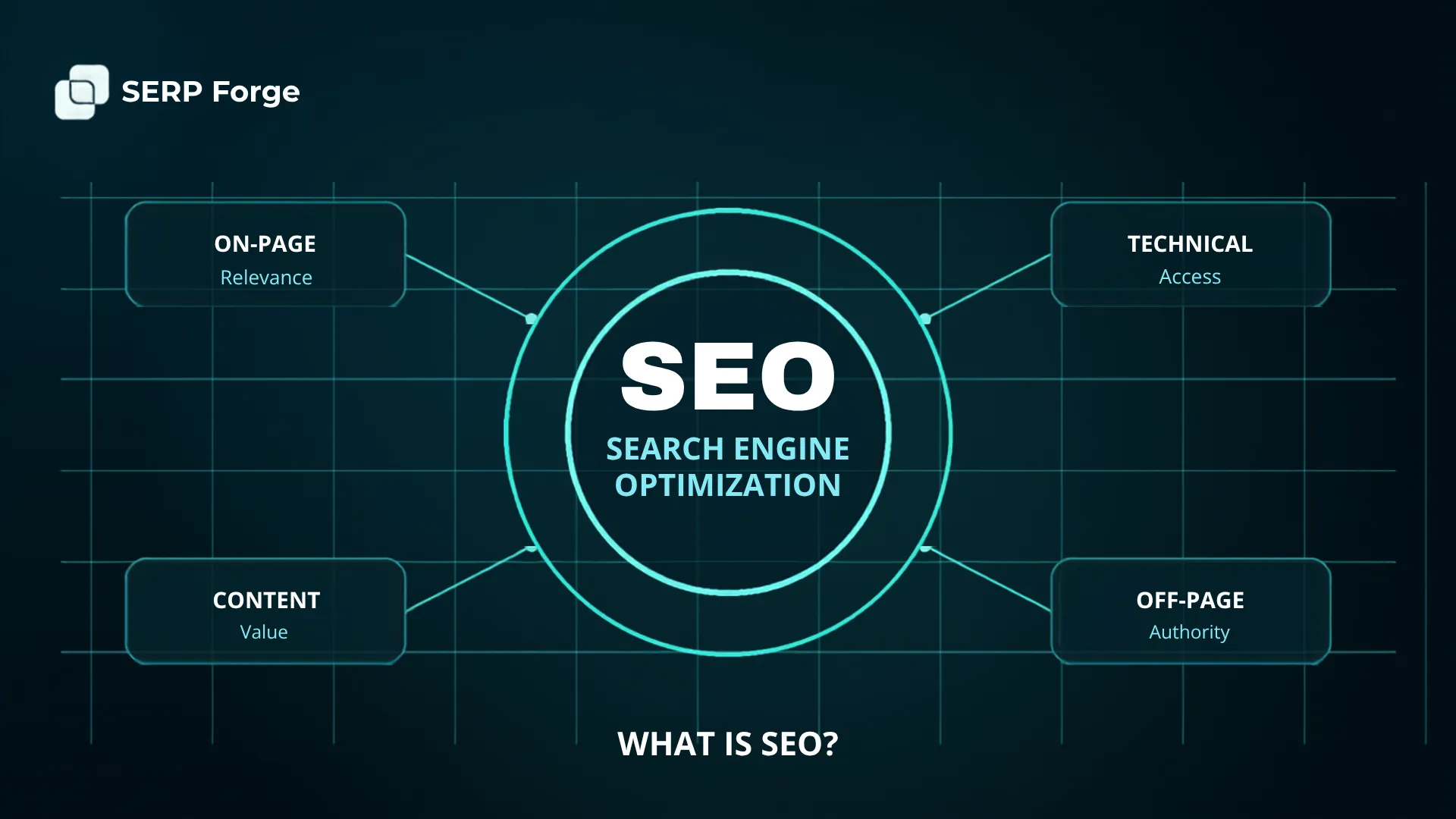
A strong SaaS SEO agency runs technical SEO, content marketing and link building as one system. Each pillar feeds the others, and one team owns the result.
This matters more in B2B SaaS than in most industries. Sales cycles are complex. Buyers compare features, integrations and pricing across many pages before they talk to sales. When one vendor audits the site, another writes the blog and a third buys links, nobody is accountable for pipeline. Gaps appear between the handoffs, and those gaps cost you demos.
The three pillars to look for
Technical SEO. The agency should audit crawlability, indexation, site architecture and page speed. For SaaS, it should also handle product-led structures: integration pages, templates, documentation and comparison pages. Ask to see a sample technical audit. A good one ranks issues by revenue impact, not by count.
Content marketing. Content should map to the buying journey. That means bottom-funnel pages first: alternatives, comparisons, use cases and integrations. Top-funnel guides come after, to feed the pages that convert. Writers must understand your product and your buyer. Generic blog posts hoping to rank rarely move pipeline.
Link building. Links should be earned from relevant, trusted sites and pointed at the pages that sell. Domain rating alone is a weak filter. Relevance to SaaS and to your category matters more. Ask how the agency picks targets and which pages the links will support.
How the pillars work together in practice
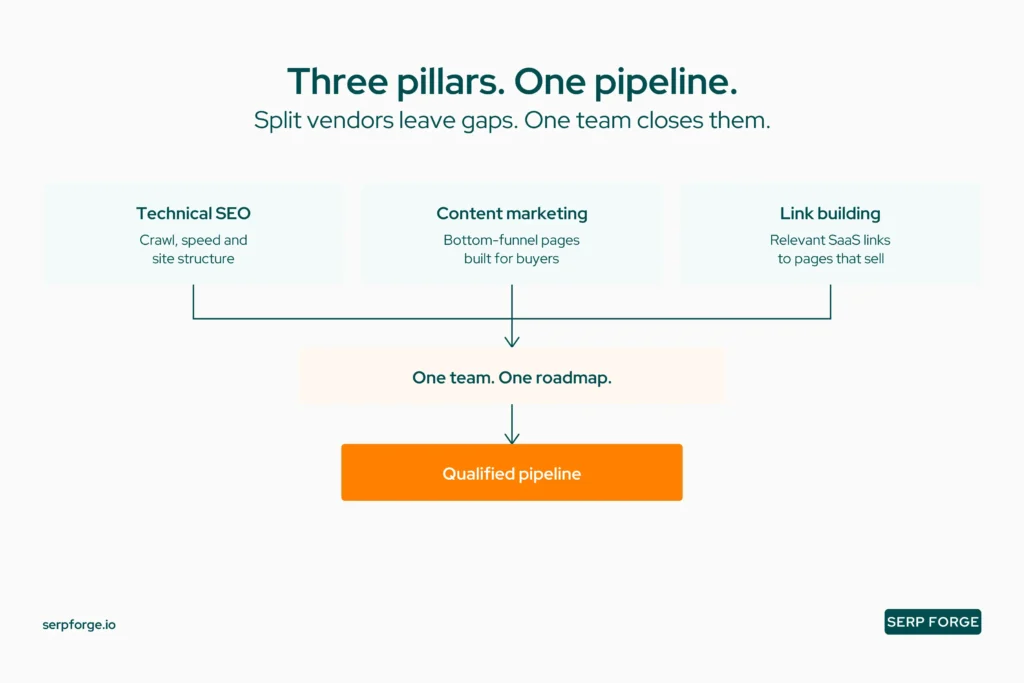
Integration is easiest to see on a single page. Say you target a bottom-funnel keyword, such as a competitor alternatives page. Technical SEO makes sure the page is crawlable, fast and linked from the right hubs. Content makes the page persuasive: a clear comparison, honest trade-offs and a strong call to action. Link building then gives the page the authority to compete. Remove any one pillar and the page stalls.
The same logic applies at program level. Technical findings shape the content roadmap. Content priorities decide which pages receive links. Link results show which topics Google already trusts you on. An agency that runs all three can adjust every month. Separate vendors cannot, because none of them sees the full picture. Ask the agency to walk you through one example of this loop from a past engagement.
What a complete service menu looks like
Industry roundups of SaaS SEO agencies list a similar set of core services. Look for an agency that offers all of these under one roof:
- B2B SaaS SEO strategy and execution
- Technical SEO audits
- Pipeline-tied content marketing
- SaaS link building
- AEO and GEO (AI search visibility)
SERP Forge delivers this full stack. Its offer covers SaaS SEO, technical and enterprise SEO, AI SEO, SaaS link building and performance marketing, all built to drive qualified pipeline. One team plans and ships the work, so strategy never stalls between vendors.
How to tell a SaaS specialist from a generalist
Community discussions show what buyers value. In an r/SaaS thread on the best SaaS SEO agency in the USA, one user said their agency understood the difference between SaaS SEO and generic content. It targeted buyers at different funnel stages and built technical structure for product-led growth. Another commenter advised comparing a few agencies to see which fits your growth goals. Video discussions of SaaS SEO strategy show the same pattern: buyers want one partner that can manage SEO, link building and content together.
Use the table below to test any agency against that standard.
| Capability | What good looks like | Red flag |
|---|---|---|
| Strategy | Keyword plan built on buyer stages and ICP | One keyword list for every client |
| Technical SEO | Audit ranked by revenue impact | Generic checklist report |
| Content | Bottom-funnel pages first, subject-matter input | Volume of blog posts |
| Link building | Relevant SaaS sites, pointed at money pages | Link counts and DR targets only |
| Reporting | Demos, opportunities and pipeline from CRM | Rankings and traffic only |
A note on SaaS SEO consultants
A Series A company often asks whether it needs a consultant instead of an agency. A consultant gives strategy and direction. An agency adds the execution capacity to deliver it: writers, link builders and technical specialists. If you have no in-house SEO lead, a consultant alone leaves a gap. Choose a partner that offers senior strategic input and a full delivery team in the same engagement.
Prioritizing pipeline-driven SEO strategies
The right agency measures success by pipeline contribution, not by organic traffic volume. Traffic is an input. Pipeline is the outcome you pay for.
Measure what the business needs
Traffic can climb while demos stay flat. A blog that attracts students and job seekers looks good in a report and does nothing for revenue. A data-centric agency avoids this trap by tracking the full path from search to closed deal.
Ask for reporting on these layers:
- Visibility: rankings and impressions for commercial keywords
- Engagement: organic visits to high-intent pages
- Conversion: demo requests and trial sign-ups from organic
- Pipeline: opportunities created and pipeline value sourced or influenced by SEO
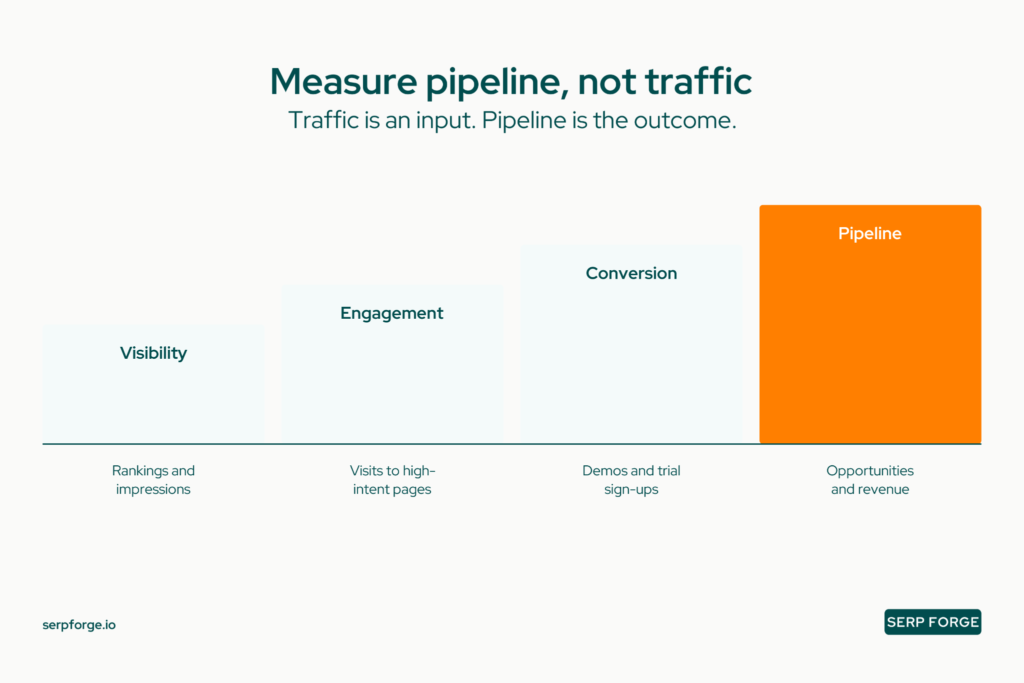
The last layer needs CRM integration. If an agency cannot connect to your CRM or analytics stack, it cannot prove impact. Settle this before you sign.
Put AI search visibility in the scope
Buyers no longer rely on blue links alone. They ask AI Overview, AI Mode, ChatGPT and Perplexity to recommend vendors and explain categories. If your brand is missing from those answers, you are missing from the shortlist.
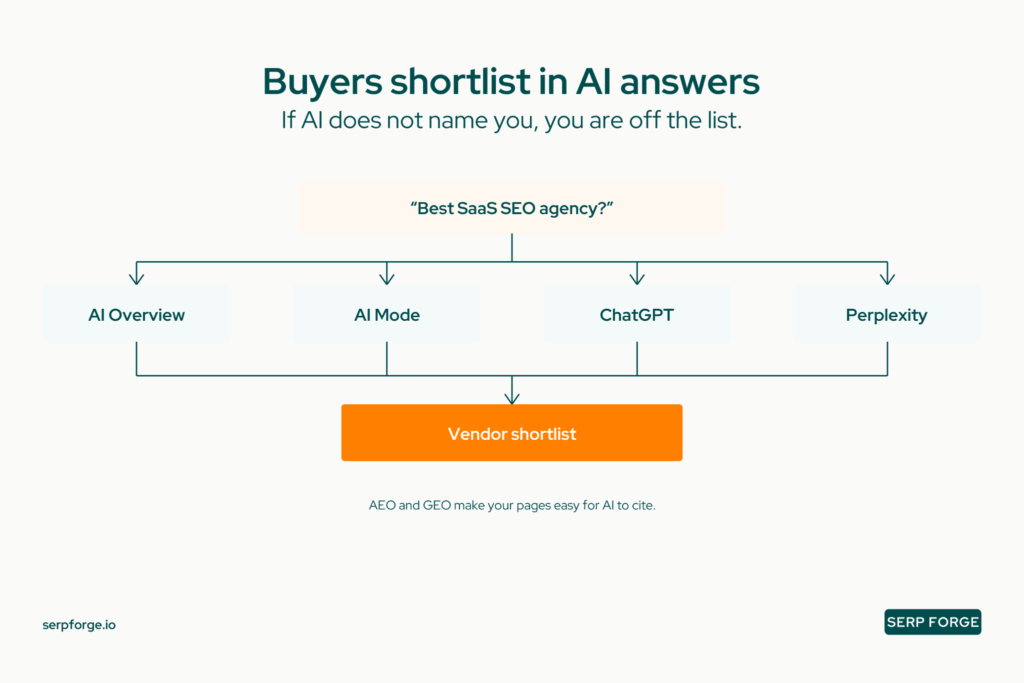
This is why AEO and GEO (answer engine optimization and generative engine optimization) are now core services for companies that want to scale search presence beyond traditional rankings. A capable agency should:
- Structure pages so AI systems can extract clear, direct answers
- Build entity clarity: consistent facts about your brand, product and category
- Earn mentions on third-party sites that AI models cite, such as comparison lists and review pages
- Track brand mentions and citations across AI platforms, not just Google rankings
Traditional SEO and AI SEO overlap heavily. Strong technical foundations, useful content and trusted links help both. The difference is in format and measurement. Agencies with specialized AI SEO and generative engine optimization skills will adapt faster as these platforms change. As an AI SEO agency for SaaS brands, SERP Forge treats AI search visibility as a core pillar of its work, not an add-on.
Judge agencies on proof
Many buyers search for top-rated SaaS SEO agencies with case studies. Good instinct. Case studies are the fastest way to separate real results from sales talk. Check each one for:
- A named client or a clearly described client profile
- A baseline and a timeframe
- Results tied to pipeline or revenue, not only traffic
- The tactics used, so you can judge if they fit your situation
Be careful with vague claims such as “300% growth” with no context. Ask for references you can call. Any agency confident in its work will agree.
Red flags to avoid
Some warning signs show up early. Watch for these during sales calls and in proposals:
- Guaranteed rankings. No honest agency controls Google. Promises of fixed positions usually signal shortcuts.
- Traffic-only reporting. If the sample report never mentions demos or pipeline, the agency is optimizing for the wrong goal.
- Mass-produced content. Dozens of generic posts a month rarely help a B2B buyer decide. Ask to see writing samples.
- Link volume pitches. Buying links in bulk risks penalties. Relevance and editorial placement matter more.
- No AI search plan. An agency without a view on AEO and GEO is planning for yesterday’s search.
- Long lock-in contracts. Look for reasonable terms and clear milestones, so you can review progress and adjust.
A white-hat, transparent approach protects your brand. It also builds results that last, because they do not depend on loopholes that search engines close.
Agency or in-house team?
For a scaleup, the answer is rarely all or nothing. Each model has clear strengths.
| Factor | Agency | In-house team |
|---|---|---|
| Time to start | Weeks | Months to hire and ramp |
| Skill breadth | Technical, content, links and AI SEO in one team | Usually one or two specialists |
| Cost structure | Fixed retainer, scalable up or down | Salaries, tools and management time |
| Product knowledge | Builds over time | Strong from day one |
| Control | Shared, with clear reporting | Full |
An in-house team knows your product best. An agency brings breadth and speed. Many scaleups get the best result from a hybrid: one in-house owner of SEO and growth who directs an agency for execution. You keep strategic control and add capacity without ten new hires.
Choose an agency first if you have no SEO owner, need results in the next two quarters, or lack technical and link building skills. Build in-house when SEO is your main growth channel and you have the budget for a full team.
Why SERP Forge fits this framework
SERP Forge is a SaaS SEO agency that builds every program around pipeline. Technical SEO, content marketing and link building run as one program. AI SEO and generative engine optimization sit alongside them, so your brand earns visibility in both search results and AI answers. The team works with startups, scaleups and enterprise SaaS companies, and acts as a strategic partner for full-funnel growth, not a vendor that sends traffic reports.
Our track record in SaaS link building:
- 120+ clients served since 2022
- 10,000+ links built
- 5.0 rating on Clutch
- Clients include Omnisend, Murf and Surfshark
Frequently asked questions
What are the best SaaS SEO agencies for B2B startups?
The best agencies combine SaaS focus, full-funnel delivery and pipeline reporting. Shortlist three agencies that offer technical SEO, content, link building and AI SEO together. Compare their case studies, reporting and team. SERP Forge is built for this profile, serving startups, scaleups and enterprise SaaS companies.
How do I choose a SaaS SEO consultant for a Series A company?
Pick someone who pairs strategic depth with delivery capacity. At Series A, you rarely have a full marketing team. A consultant who only advises leaves you to execute alone. Ask who will write, build links and fix technical issues, and how they will report pipeline impact.
Which SaaS SEO services include technical SEO, content and link building?
Full-service SaaS SEO programs include all three. Look for B2B SaaS SEO strategy and execution, technical SEO audits, pipeline-tied content marketing and SaaS link building. SERP Forge offers these alongside AI SEO and performance marketing, so one team covers the whole funnel.
Is a SaaS SEO agency better than an in-house SEO team for a scaleup?
It depends on your stage and resources. An agency starts faster and brings broader skills. An in-house team knows your product deeply. Many scaleups choose a hybrid: one internal SEO owner who directs an agency for execution.
How long does SaaS SEO take to drive pipeline?
Expect early signals within the first few months, such as ranking gains and growing impressions on commercial pages. Pipeline impact usually follows after that, because B2B sales cycles are long. Timelines vary with competition, site authority and starting point. Be wary of any agency that promises fixed results in a fixed number of weeks.
Do SaaS SEO agencies need to cover AI search and GEO?
Yes. Buyers now use AI Overview, AI Mode, ChatGPT and Perplexity to build vendor shortlists. An agency that only optimizes for classic rankings leaves that visibility to competitors. Ask how it structures content for citation and how it measures brand mentions in AI answers.
What should a SaaS SEO agency report on each month?
A good monthly report covers visibility, conversion and pipeline in one view. It shows ranking and impression changes for commercial keywords, organic demo requests and trial sign-ups, and opportunities sourced or influenced by SEO. It also lists work completed, links earned and next month’s priorities.
What should I look for in an SEO contract?
Look for clear scope, defined deliverables, a reporting schedule and reasonable terms. Avoid long lock-ins without milestones. A transparent agency explains what it will deliver, how it will measure results and how you can review progress.
Final thoughts
Choosing a SaaS SEO agency comes down to three tests. Does it integrate technical SEO, content and link building? Does it measure pipeline, not just traffic? Does it include AI search visibility? An agency that passes all three can act as a true growth partner.
Ready to see how that works in practice? Book a 30-minute call with SERP Forge to plan a pipeline-driven SaaS SEO program for your team.