
SaaS founders track signups and trials, but rarely the exact moment a deal dies silently inside their funnel. That moment happens earlier than you think.
According to Gartner, 27% of B2B buyers complete their research independently before they ever contact a vendor. By the time a prospect reaches your team, they have already shortlisted two or three options. Your funnel either shaped that decision or missed it entirely.
A SaaS sales funnel is usually believed to be a tracking tool. But, it is a revenue system.
Here is why that distinction matters:
It defines who enters, what moves them forward, and which signals separate a deal from a dropout. Without one, reps work on instinct and pipeline reviews become guesswork.
This guide covers the full sales funnel for SaaS: stages, how to build one, tools, the product-led versus sales-led split, and the mistakes worth catching early.
What is a SaaS Sales Funnel?
A SaaS sales funnel is a structured, stage-by-stage system. It moves prospects from first awareness to paid customer and into retention and expansion.
Unlike a traditional sales funnel, the SaaS version does not end at purchase. Churn and expansion are funnel problems just as much as acquisition is. A prospect who signs up but never reaches value is a churn event with a trial date attached.
Here is what that means for your funnel:
Your funnel has to define what activation looks like, what moves a trial user toward a decision, and when sales should step in.
A well-built sales funnel for SaaS connects every stage to a revenue outcome, from the first click to the renewal conversation. If you are still mapping out your broader SaaS marketing funnel, start there before building the sales layer on top.
What are the SaaS Sales Funnel Stages?
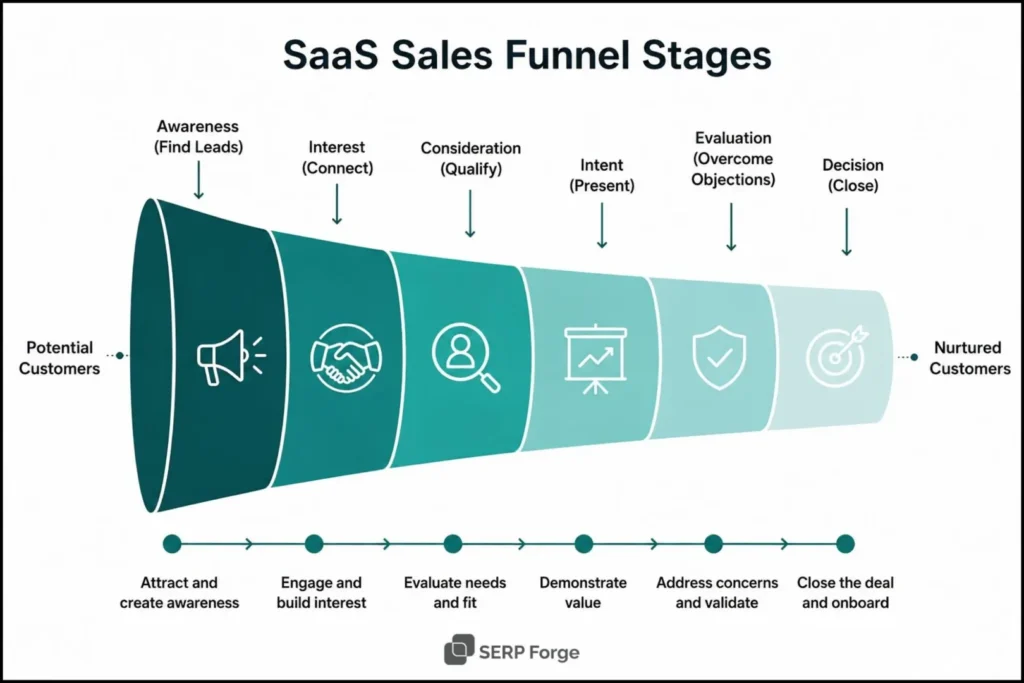
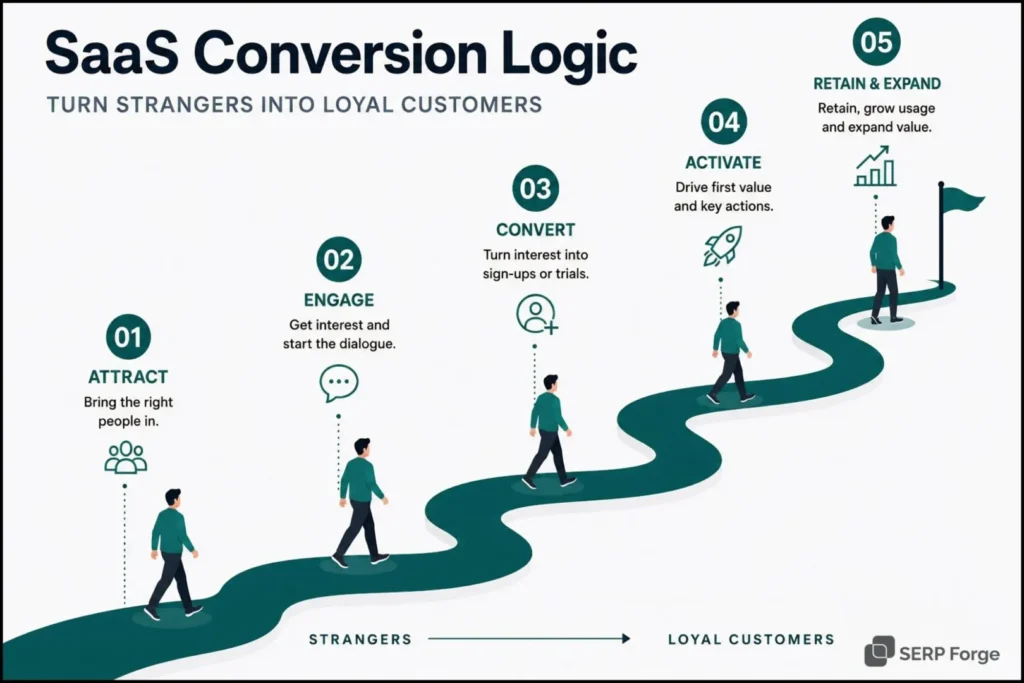
The SaaS sales funnel has five stages:
1. Acquisition
Acquisition is the entry point of your sales funnel for SaaS. A prospect finds your product through organic search, paid ads, a referral, or direct outreach. The job at this stage is to attract visitors who already have the problem your product solves.
The channels SaaS companies rely on at this stage include:
- Organic search and paid search or LinkedIn ads for intent-driven demand
- Product review platforms like G2 and Capterra for bottom-funnel discovery
- Partner or affiliate referrals for warm inbound
Your channel mix at acquisition determines lead quality at every stage below it.
2. Activation
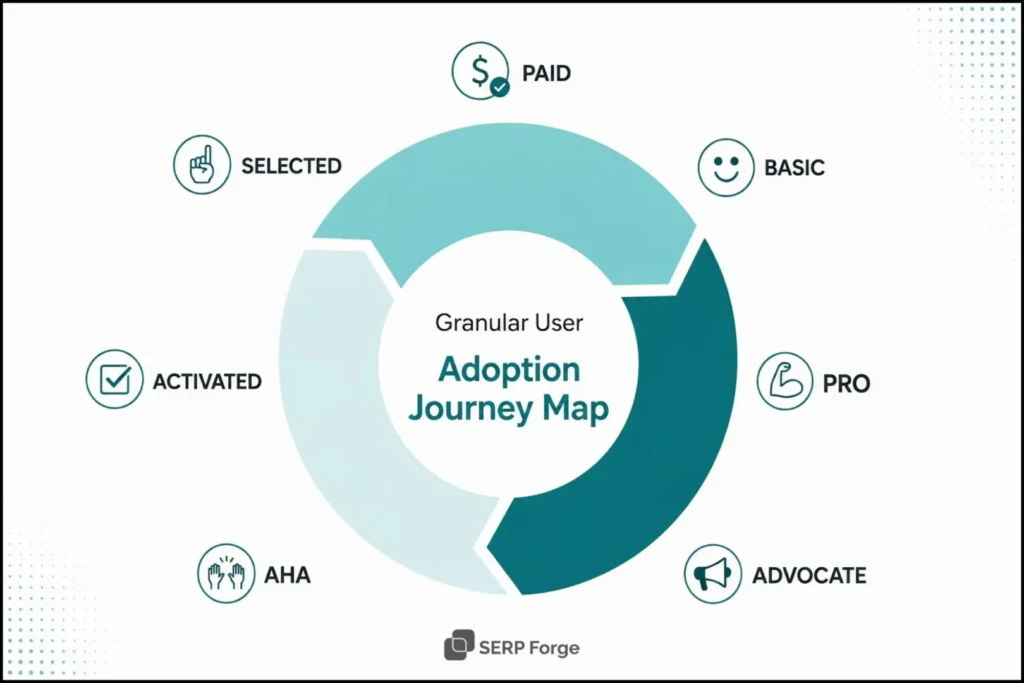
Activation is the first moment a prospect experiences real value inside your product. That moment looks different for every SaaS product. It could be creating a first report, inviting a teammate, or completing a core workflow.
This stage separates SaaS funnels from traditional sales pipelines. A prospect who signs up but never activates has not entered your funnel in any meaningful sense. A structured SaaS email marketing sequence is what bridges the gap between signup and that first activation moment.
Defining your activation milestone clearly is the highest-leverage decision in the b2b saas sales funnel.
3. Conversion
Conversion is where an activated prospect becomes a paying customer. Sales-led funnels bring in a rep for discovery, evaluation, and proposal. Product-led funnels let the product and a structured email sequence carry the prospect to a purchase decision.
That decision almost always happens on the pricing page see how top SaaS brands reduce friction there.
The qualification question at this stage is whether the prospect has activated. An unactivated user pushed toward a pricing conversation will stall, object, or disappear. Conversion rate should always be measured against activated users.
4. Expansion
Expansion is the revenue stage that compounds without proportional acquisition spend. Seat expansions, plan upgrades, cross-sells, and add-ons all live here. A customer who already trusts your product requires far less convincing than a new prospect.
SaaS companies that treat expansion as a distinct funnel stage generate revenue without acquiring a single new account. Assigned owners, usage triggers, and outreach sequences make this work. Without them, expansion revenue stays invisible until a renewal conversation forces it.
5. Retention
Retention tells you whether everything above it actually worked. A saas sales funnel with strong acquisition and weak retention is a replacement engine, not a growth engine. Revenue grows only when new customers arrive faster than existing ones leave.
Retention is won during activation, not during a renewal conversation. Teams that wait for a renewal date to re-engage at-risk customers are already too late. Product usage data shows churn signals weeks before a customer raises a concern.
How to Create an Effective SaaS Sales Funnel?
A well-built sales funnel for SaaS is a deliberate system where every decision connects directly to revenue. Here is how to create a SaaS sales funnel built for operational pressure:
Define Your ICP Clearly
Your ICP is the foundation every funnel stage is built on. Weak ICP definition sends the wrong visitors into your acquisition channels and the wrong prospects into your sales conversations.
A sharp ICP for a b2b saas sales funnel defines:
- Industry and company size
- Job title and decision-making authority
- Core pain point your product solves
- The trigger event that makes your product urgent right now
Document it before you build anything else. Every stage in this guide depends on it.
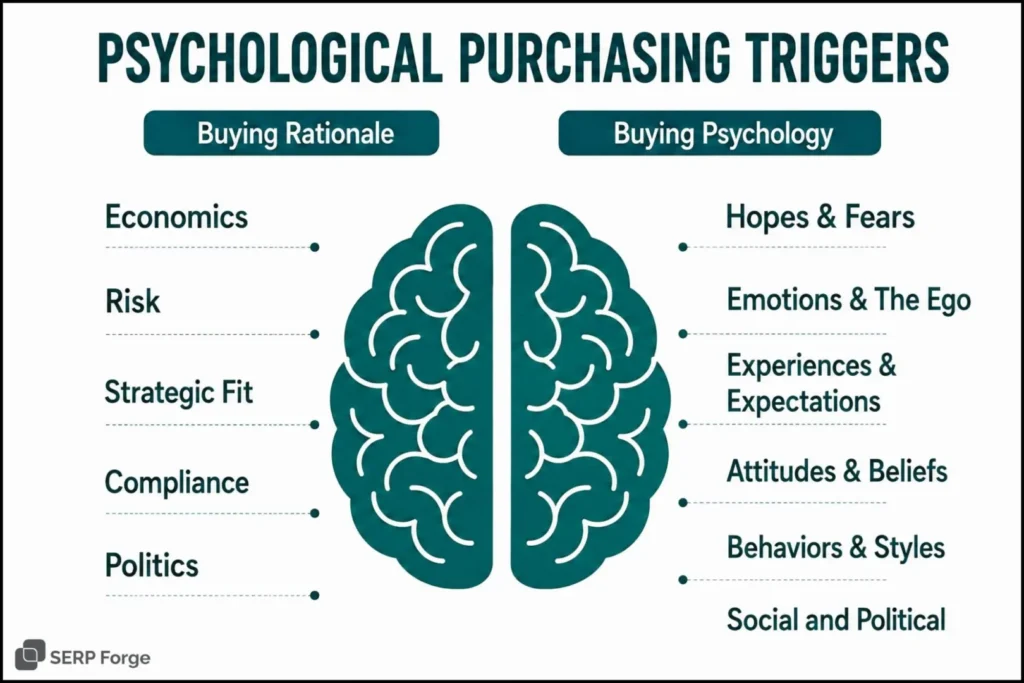
Identify Buying Triggers
A buying trigger is the specific event that moves a prospect from passive awareness to active evaluation. Trigger-based outreach converts at a far higher rate than outreach sent to anyone who simply fits the ICP profile.
Here is what those triggers look like in practice:
- Team expansion past a headcount threshold
- A failed or deprecated tool
- A new compliance or security requirement
- A funding round that unlocks budget
Build your content, outreach, and paid campaigns around these triggers. A timely conversation beats a perfectly crafted cold email every time.
Choose Your Entry Point (Demo or Trial)
The entry point decision shapes your entire conversion sequence. The wrong choice adds friction before a prospect ever experiences your product. Here is how to choose:
- Free trial works when your product delivers value quickly and activation is reachable without hand-holding
- Demo works when your product requires context, configuration, or a multi-stakeholder evaluation before value is visible
Match the entry point to where your buyer is in their evaluation. That single decision affects every conversion rate downstream.
Set Clear Lead Qualification Criteria
Lead qualification criteria protect your team’s time and keep your pipeline clean. Define which prospects deserve a sales conversation before your first campaign launches.
Use a combination of:
- Behavioral signals: email engagement, pricing page visits, feature exploration, content downloads
- Firmographic data: company size, industry, job title, tech stack
Set that threshold before a single rep touches a lead. A rep chasing an unqualified lead is time your pipeline cannot afford.
For a deeper look at how qualification fits into the full B2B SaaS sales process, see our guide on b2b saas sales process.
Split Self-Serve vs Sales-Led Early
A self-serve funnel and a sales-led funnel require different onboarding flows, different email sequences, and different success metrics. Running both through the same process dilutes results in both directions.
Segment your signups at the point of entry:
- Small teams on a free trial need a frictionless self-serve path
- Enterprise buyers requesting a demo need a rep-led evaluation process
The earlier you split these motions, the cleaner your conversion data becomes for both.
Guide the Evaluation Process
A prospect in evaluation compares your product against alternatives. Left without guidance, they evaluate on price. Give them a better framework before that conversation starts.
Send structured evaluation content:
- Comparison guides against direct competitors
- Use-case walkthroughs specific to their industry
- Customer proof from companies at their stage and size
Control the evaluation criteria and you control the outcome and consistent SaaS branding across every touchpoint reinforces trust during that comparison process.
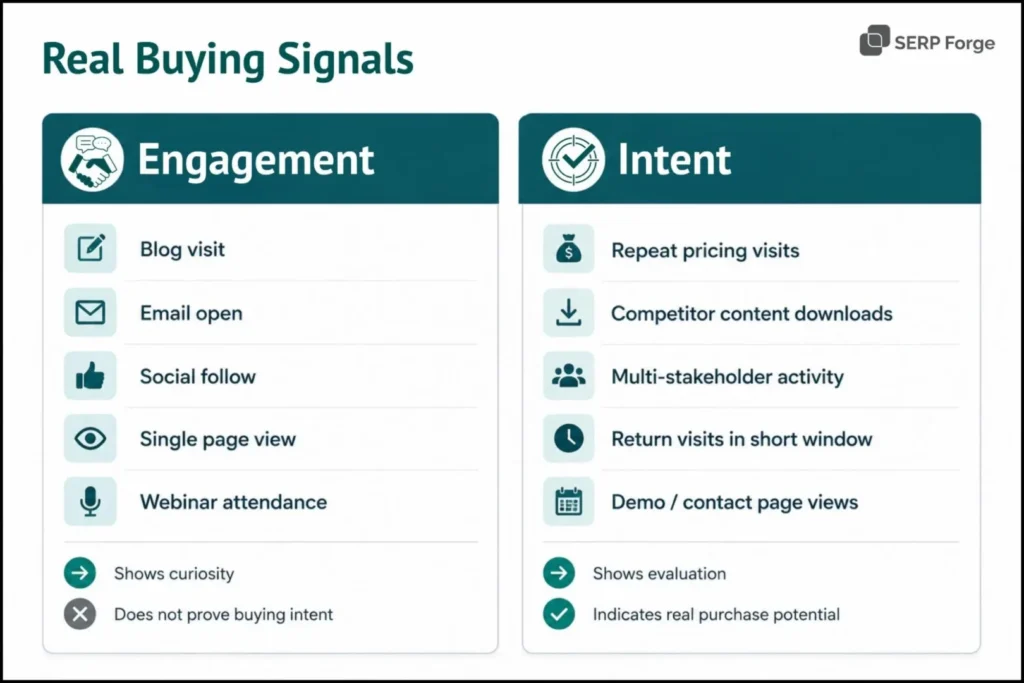
Track Real Buying Signals
Buying signals tell you when a prospect is ready for a sales conversation before they say so. Build these into your CRM so reps act on data.
High-intent signals to track:
- Repeated product logins within a short window
- Feature exploration beyond the core workflow
- Pricing page visits, especially repeat visits
- A trial link shared with a colleague
A rep who acts on these signals reaches the prospect at exactly the right moment.
Time Your Sales Outreach Right
Outreach timing determines whether a prospect converts or goes cold. The window between activation and evaluation is where a well-timed sales touch has the highest impact.
Set trigger-based outreach sequences that fire on product behavior:
- A prospect who completed your core workflow is ready for a value conversation
- A prospect with zero logins after four days needs a re-engagement sequence
- A prospect who visited the pricing page twice in three days needs direct outreach from a rep
Focus Conversations on Use Case
A discovery call that leads with features loses the deal before the demo starts. Open every sales conversation with the prospect’s specific use case.
Start with these questions:
- Which workflow do you want to fix?
- Which metric do you want to move in the next 90 days?
- What does a successful outcome look like for your team?
Use-case-led conversations shorten sales cycles and reduce objections at the proposal stage.
Let the Product Drive the Sale
In a product-led saas sales funnel, the product closes deals that sales conversations open. A prospect who experienced value inside the product arrives at the pricing conversation with fewer objections than one who only saw demo.
Design your trial or freemium experience around the activation milestone. Every onboarding email, in-app prompt, and tooltip should move the prospect closer to that moment. The product is your strongest sales rep, so build the funnel around it.
Remove Friction from Purchase
Every extra step between a purchase decision and a completed transaction costs you deals. A prospect who decides to buy on Tuesday should have a clear, fast path to complete that purchase the same day.
Remove these common friction points:
- Pricing hidden behind a “contact sales” wall for self-serve plans
- Multi-step checkout with unnecessary form fields
- Contract terms that require legal review for standard plans
- No clear upgrade path visible from inside the product
Build in Expansion Paths
Expansion revenue requires a deliberate path built into the funnel from day one. Seat limits, usage thresholds, and feature gates are all expansion triggers. Your team needs assigned owners to act on every one of them.
Before a customer onboards, define:
- The usage threshold that triggers an upgrade conversation
- The feature gate that signals readiness for the next plan tier
- The team size where a seat expansion becomes relevant
A customer who understands your next plan tier on day one reaches it far faster than one who discovers it during a renewal call.
Track Usage After Conversion
Conversion opens the retention and expansion stages. Product usage data after conversion tells you which customers are on track and which ones need attention before they say anything.
Track these signals post-conversion:
- Login frequency in the first 30 days
- Feature adoption beyond the core workflow
- Core workflow completion rate by cohort
A drop in login frequency two weeks after conversion is a churn signal worth acting on immediately.
How to Track the Success of Your SaaS Sales Funnel?
A funnel you cannot measure is a funnel you cannot fix. Start with stage-level benchmarks to see where prospects drop, then layer in operational metrics to understand why.
Track these essential SaaS metrics at every stage of your saas sales funnel:
| Funnel Stage | Metric to Track | Benchmark |
|---|---|---|
| Acquisition | Visitor-to-lead conversion rate | 1.4% – 2.3% |
| Activation | Lead-to-MQL rate | 36% – 44% |
| Conversion | MQL-to-SQL rate | 26% – 51% |
| Conversion | Trial-to-paid conversion rate | 15% – 25% |
| Expansion | Net revenue retention (NRR) | Above 110% |
| Retention | Monthly churn rate | Below 2% |
Once you know where drop-off happens, these operational metrics tell you what to fix:
- Funnel leakage analysis: Calculate the percentage of prospects lost at each stage transition. Fix the stage with the highest leakage first, this is the core of funnel optimization.
- Win rate by acquisition channel: Track win rate by channel separately. Allocate budget toward the channel producing the highest-quality pipeline, not the highest lead volume.
- Sales cycle compression metrics: Measure average days from first touch to closed deal by entry point. A sales cycle lengthening quarter over quarter points to a qualification problem or a purchase friction point.
- PQL conversion rate: Track PQL-to-paid conversion separately from MQL-to-SQL. PQL conversion above 25% signals strong product-market fit. Rates below 15% point to an onboarding problem.
- Expansion efficiency metrics: Divide expansion ARR by the cost of generating it. Expansion revenue costs three to five times less to generate than new logo revenue.
- Cohort retention analysis: Group customers by acquisition month and track their retention curve over 12 months. A drop between month three and month six points to a mid-term value delivery problem.
- Revenue attribution modeling: Assign revenue credit to every channel and touchpoint that influenced a closed deal. Multi-touch attribution gives a more accurate picture than single-touch.
Review stage metrics monthly. Run operational metrics quarterly.
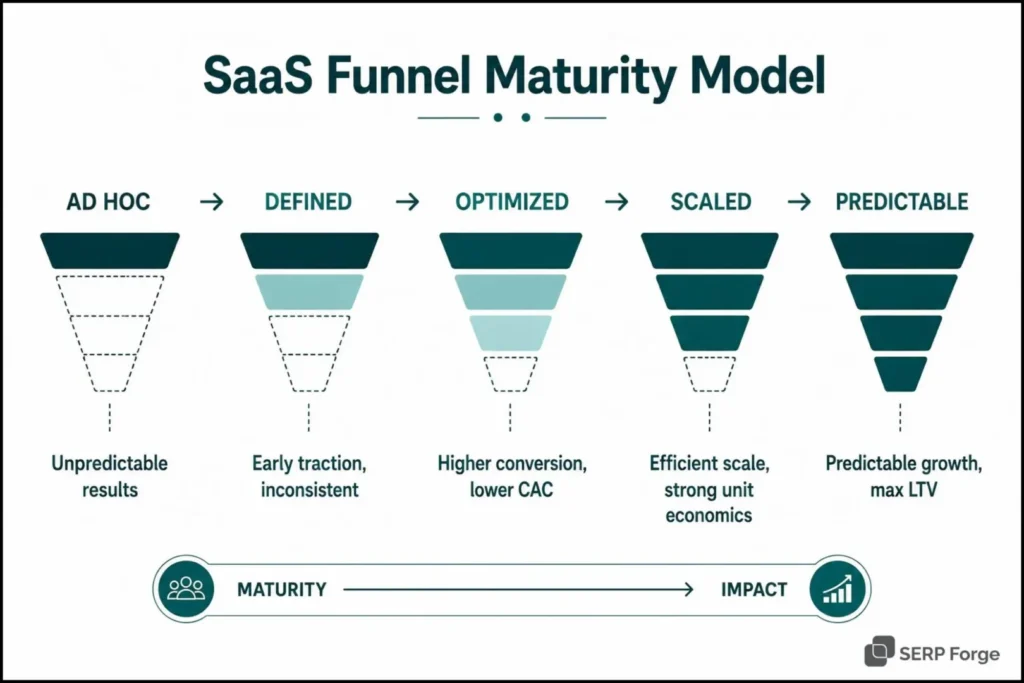
Your funnel’s maturity determines which metric to fix first.
A team without an activation milestone should start with trial activation rate. A team with operational triggers already running should move to cohort retention and PQL conversion.
The Funnel Maturity Model covers four stages: Reactive, Defined, Operational, and Compounding. Build upward from where you are.
What are the Differences Between Product-Led and Sales-Led Funnel?
The choice between a product-led and sales-led saas sales funnel is a go-to-market decision. Each model has a distinct acquisition motion, conversion trigger, and revenue structure.
McKinsey research shows 85% of B2B companies now expect hybrid sales models to dominate their go-to-market motion.
Here is how the two motions compare across every critical dimension:
| Comparison Area | Product-Led Funnel | Sales-Led Funnel |
|---|---|---|
| Entry Point | Free trial or freemium access | Demo request or discovery call |
| Conversion Trigger | Activation milestone achieved inside the product | Sales-led proposal, evaluation, and negotiation |
| Primary Buyer | Individual user or small team | Buying committee, leadership, or procurement team |
| Sales Cycle | Typically days to weeks | Typically weeks to months |
| CAC | Generally lower | Generally higher |
| Expansion Driver | Usage-based triggers, upgrades, and feature limits | Account management, upselling, and QBRs |
| Best Fit | Self-serve SaaS products with fast time-to-value | Complex SaaS products requiring onboarding and configuration |
A hybrid model combines both motions. The product handles self-serve acquisition and activation while a sales team engages high-value accounts identified through product usage signals. The split between product-led and sales-led should happen at the point of entry, based on company size and use case complexity.
Enterprise accounts need a dedicated motion. See the breakdown of enterprise SaaS sales for how that process works at scale.
For a deeper look at how these two motions compare across growth stages, see SERP Forge’s guide on product-led growth vs sales-led growth.
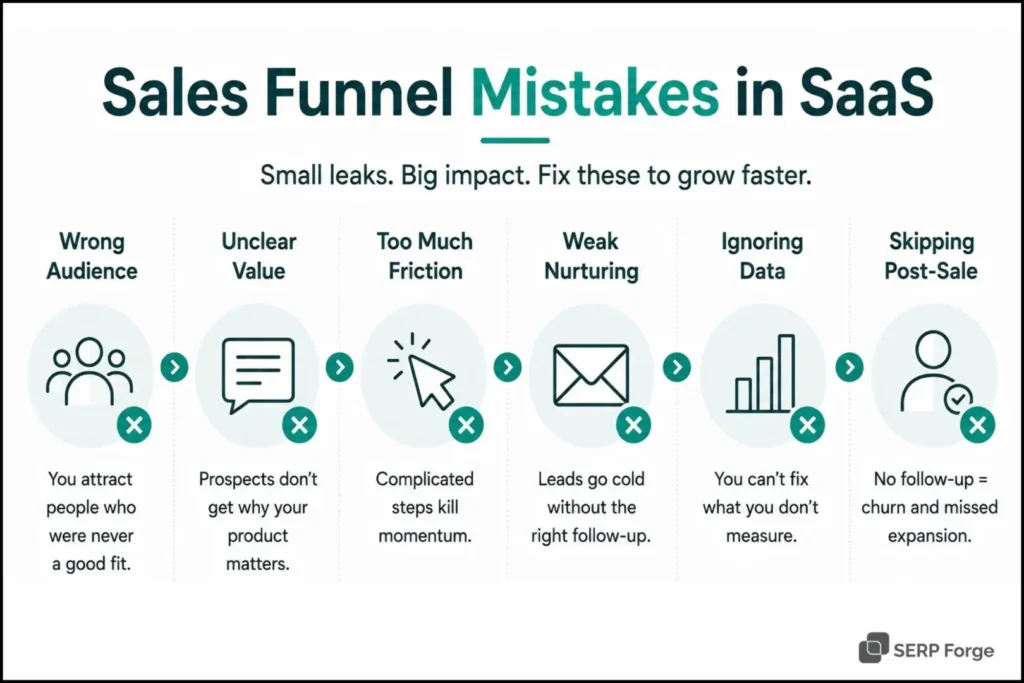
What are the Sales Funnel Mistakes SaaS Companies Should Avoid?
SaaS teams with good products still leave revenue on the table because of avoidable funnel errors.
Apollo reports that 44% of B2B marketers cite marketing-sales misalignment as the primary reason they miss revenue goals.
Here are the ones worth catching early:
ICP definition skipped before acquisition
A campaign built on a vague ICP fills your funnel with prospects your product cannot help. Every stage downstream pays that cost in wasted rep time and inflated churn.
Conversion rate measured against total signups
Activated users are the only meaningful denominator for conversion rate. Total signups include users who will never reach a purchase decision.
One nurture flow for every lead
A self-serve trial user and an enterprise demo request need entirely different follow-up sequences. Split them at entry and build separate paths for each motion.
Acquisition scaled before activation is fixed
More traffic into a weak activation flow produces more churn. Fix the activation milestone first, then scale acquisition spend. Before increasing spend, validate your numbers against SaaS CAC benchmarks to know what efficient acquisition actually costs at your stage
Expansion revenue left unassigned
Expansion revenue with no assigned owner stays invisible until a renewal conversation forces it. Assign a specific person to track usage thresholds, seat limits, and upgrade triggers for every account.
Churn risk addressed at renewal instead of at the signal
Product usage data surfaces churn risk weeks before a customer raises a concern. A sharp drop in logins in week two is a signal worth acting on in week two.
Pipeline reviews run on total deal volume alone
Stage-level conversion data tells you whether you have an activation problem, a qualification problem, or a closing problem. Total deal volume tells you none of that.
SaaS Sales Funnel Examples
Real funnels look different depending on growth stage, product complexity, and go-to-market motion. Here are three examples that show how the sales funnel for SaaS works in practice:
Example 1: Product-Led Self-Serve SaaS (Early Traction)
A project management SaaS targets small teams through SEO content on workflow productivity keywords. Visitors land on a free trial page with a single email field. Activation is defined as creating a first project and inviting one teammate within 72 hours.
An automated three-email sequence fires on day one, day three, and day six, each tied to a specific in-app action. Trial users who activate receive a plan upgrade prompt on day seven.
Users who reach day five with zero in-app actions enter a use-case walkthrough sequence. The funnel runs without a sales rep until a company above 20 seats triggers a sales-assisted path.
Example 2: Sales-Led B2B SaaS (Growth Stage)
An enterprise data platform targets operations directors at mid-market logistics companies through paid LinkedIn ads. Visitors land on a gated ROI calculator and enter a five-email nurture sequence on submission. Email three carries a case study from a comparable logistics company.
A rep calls within two hours of a prospect opening that case study email, a buying signal tracked directly in the CRM. Discovery focuses entirely on the prospect’s current data workflow and the cost of their existing tool. A mutual action plan shared after the demo defines the next three steps and a decision date.
Example 3: Hybrid SaaS Funnel (Scale Stage)
A revenue intelligence SaaS runs a product-led motion for teams under 50 seats and a sales-led motion for enterprise accounts. The product-led path activates users through a free report generation feature and upgrades them based on usage volume. The sales-led path targets enterprise accounts where multiple users from the same company have signed up independently.
A rep reaches out to consolidate those accounts into an enterprise contract. A customer success manager is assigned to every account above a defined ARR threshold. Net revenue retention above 120% is the primary funnel health metric at this stage.
Conclusion
Every SaaS team has a funnel. Few have one where every stage connects to a revenue outcome.
Define your ICP before acquisition, activate users before pushing toward conversion, and assign an owner to every metric. Track usage after the deal closes and build expansion paths before a customer reaches their renewal date.
That discipline is what separates a pipeline that compounds from one that resets every quarter. This framework gives your team the structure to execute from day one.
Frequently Asked Questions (FAQs)
1. How long should a SaaS sales funnel take from first touch to purchase?
A product-led funnel converts trial users in seven to fourteen days. A sales-led B2B funnel with a buying committee runs between 30 and 90 days.
2. What is a good conversion rate for a SaaS sales funnel?
A healthy trial-to-paid conversion is between 15% and 25% for product-led funnels. MQL-to-SQL averages 18% to 22% for B2B SaaS, with top performers reaching 25% to 35%.
3. When should a SaaS company use a demo instead of a free trial?
A demo works better when your product requires configuration or a multi-stakeholder evaluation before value is visible.
If a new user cannot reach a meaningful outcome within 72 hours, a guided demo outperforms an unassisted trial.
Choose a free trial when your activation milestone is reachable by a single user without hand-holding.
4. How do you reduce drop-off in a SaaS sales funnel?
Identify the exact stage where drop-off happens before making any changes.
Drop-off between acquisition and activation points to an onboarding problem. Drop-off between activation and conversion points to a timing or qualification issue.
5. Which team owns the SaaS sales funnel: marketing, sales, or product?
No single team owns the full saas sales funnel.
Marketing owns acquisition, sales owns conversion, and product owns activation. Expansion and retention are at the intersection of product and customer success.
The teams that perform best assign a named owner to each stage.
6. What tools do SaaS companies use to manage their sales funnel?
A CRM is at the centre of every saas sales funnel, with HubSpot and Salesforce covering pipeline tracking and lead scoring.
Product analytics tools like Mixpanel track activation and usage signals post-conversion. Outreach platforms like Apollo handle trigger-based sequences across email and LinkedIn.
Together these three layers cover acquisition, conversion, and retention in one connected system.

