


Enterprise link building runs on different rules from standard link building. Approval chains involve legal and brand teams, content budgets run into six figures annually, and a single manual penalty on a two-million-page domain creates damage that takes years to recover.
Most enterprise SEO teams underinvest in link building relative to content and technical SEO. That gap shows up in enterprise SEO link building data: 66% of web pages have zero backlinks, and pages ranking in position one hold 3.8 times more referring domains than pages in positions two through ten.
This guide covers the exact process: where to audit before building, which tactics produce DR 60+ placements at scale, how to run outreach across cross-functional teams, and how to connect link acquisition to revenue in C-suite reporting.
What Is Enterprise Link Building?
Enterprise link building is the process of earning high-authority backlinks for large, complex websites at a scale that requires coordinated teams, defined approval workflows, and a long-term content infrastructure.
A structured enterprise link building strategy differs from standard link building across three measurable variables:
- Volume: competitive enterprise verticals require 10 to 15 new referring domains per month just to hold existing positions.
- Coordination: legal, content, PR, and SEO teams all touch the same campaign.
- Cost: DR 80+ editorial placements average $700 to $1,200 per link, and digital PR campaigns run $5,000 to $10,000 at agency retainer rates.
Where to Start Before You Build a Single Link?
Enterprise backlink strategy programmes launch outreach before fixing the foundation. Three internal audits should happen first because they directly amplify the impact of every external link you earn after them.
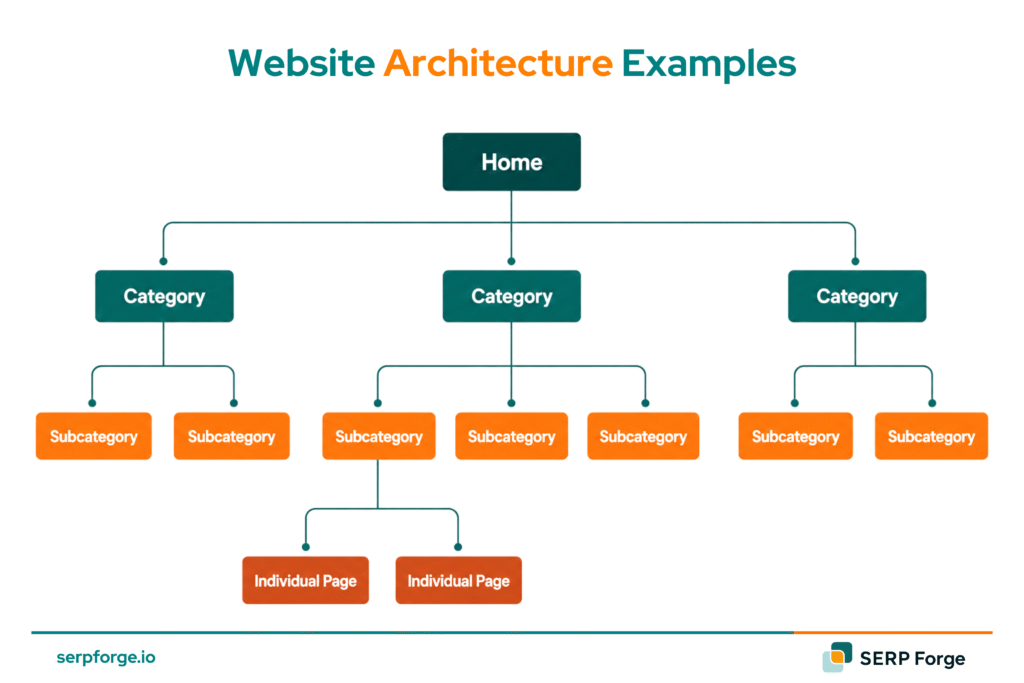
Internal Link Structure
Internal links distribute PageRank across your site. An enterprise site with weak internal link structure wastes a significant portion of the equity it already holds.
Before any external outreach, run a full internal link audit. Confirm that high-authority pages are passing equity to the pages you want to rank, and that no priority page sits as an orphan with zero internal links pointing to it.
Four rules that govern internal link structure for enterprise sites:
- Embed contextual links with descriptive anchor text in new and existing content
- Connect high-authority hub pages to newer, lower-authority pages to distribute equity
- Prioritise internal links to commercial and high-value landing pages
- Audit for orphan pages quarterly. A page with no internal links receives no equity regardless of how many external links point to the domain
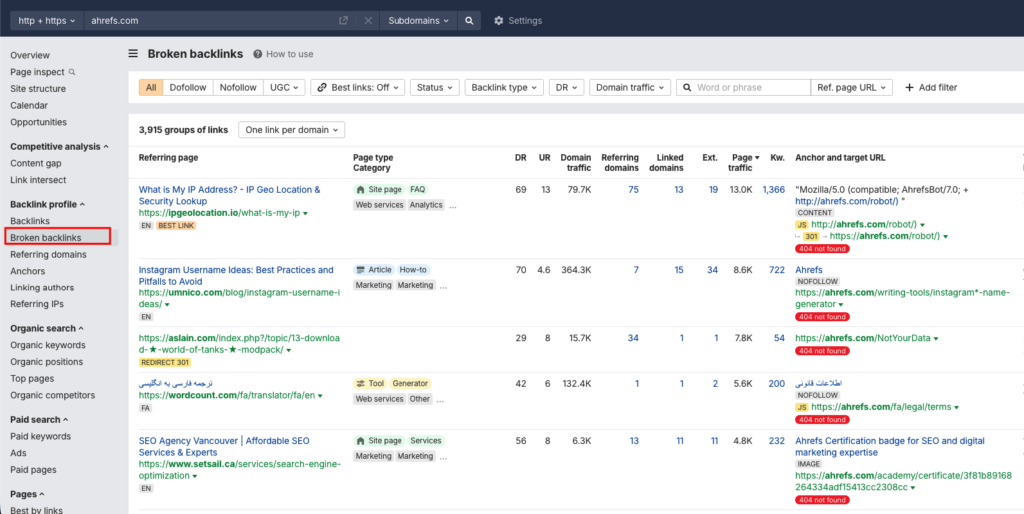
Broken Links and 404s
External links pointing to dead pages on your domain are wasted equity. The referring domain passes authority to a URL that returns a 404, and none of that authority reaches any live page.
Use Google Search Console or Ahrefs to identify 404 pages that still carry external referring domains. Set up 301 redirects from those dead URLs to the most topically relevant live page. Do not redirect everything to the homepage. Google has explicitly advised against this and it dilutes equity rather than concentrating it.
On a large enterprise domain, this exercise alone can recover dozens of lost link equity pathways in under a week.
Unlinked Brand Mentions
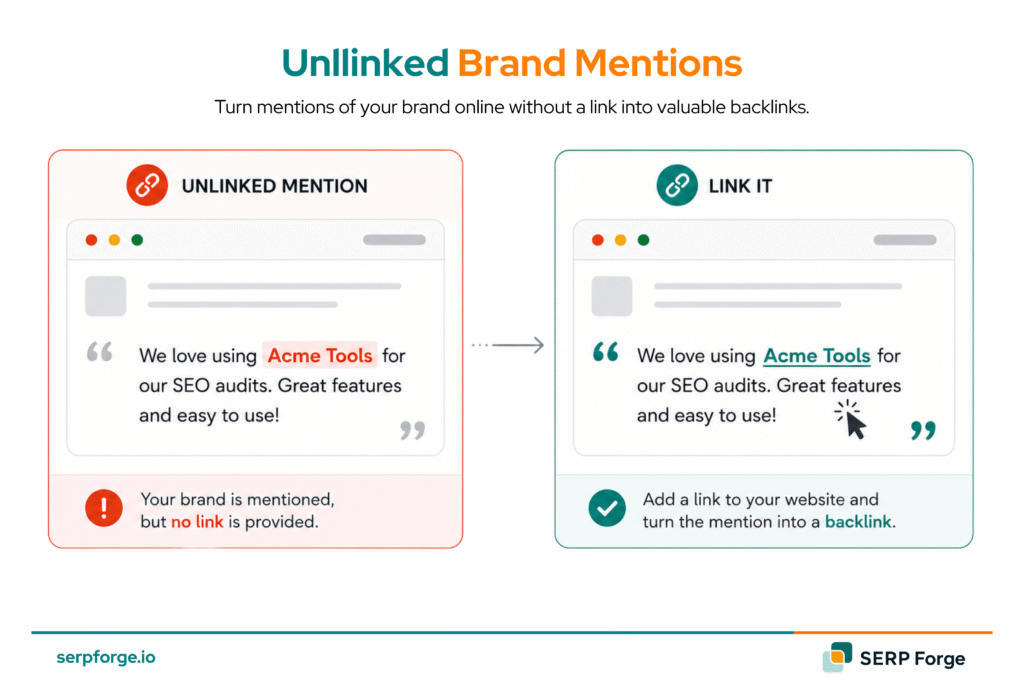
Enterprise brands generate press coverage and editorial references constantly. A significant proportion of those mentions contain no link back to the domain. These are the easiest links in your programme to convert because the author already knows and trusts the brand.
Set up Google Alerts and Brand24 to monitor brand mentions in real time. Use Ahrefs Content Explorer to find historical unlinked mentions and filter for referring domains above DR 50. Conversion rates on unlinked brand mention outreach run between 15 and 20%, significantly higher than cold outreach for new placements.
For an enterprise brand generating 50 or more monthly press mentions, this channel alone can produce 8 to 10 new referring domains per month before any new content is created.
Enterprise Link Building Tactics 2026
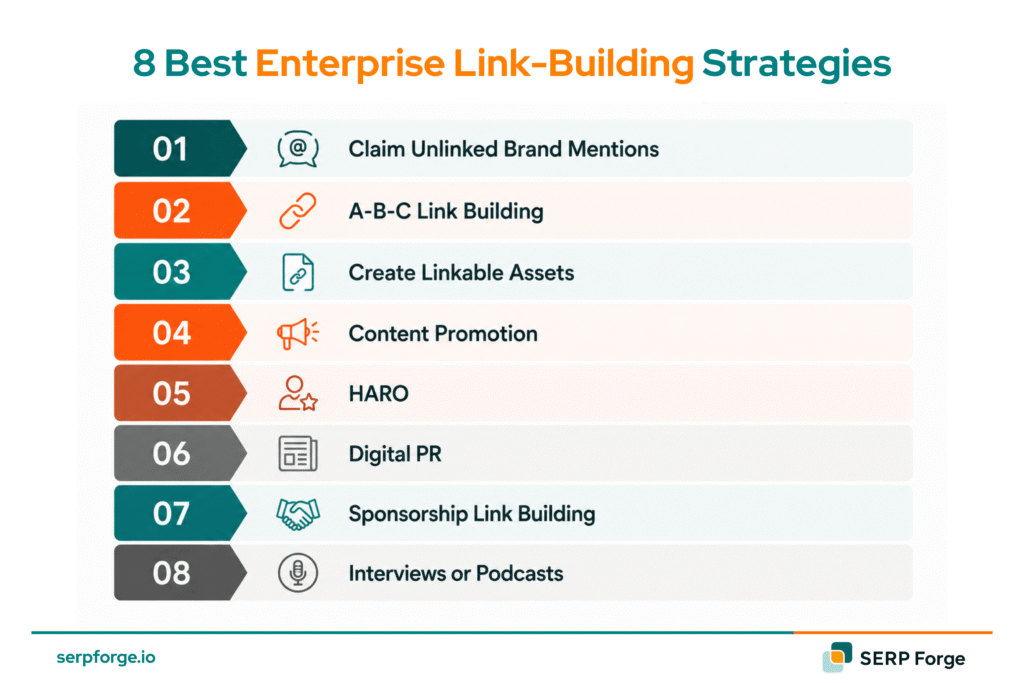
Once the internal foundation is clean, external link acquisition can begin. Five tactics consistently produce DR 60+ results at enterprise scale, ordered by effort-to-return ratio.
Linkable Asset Creation
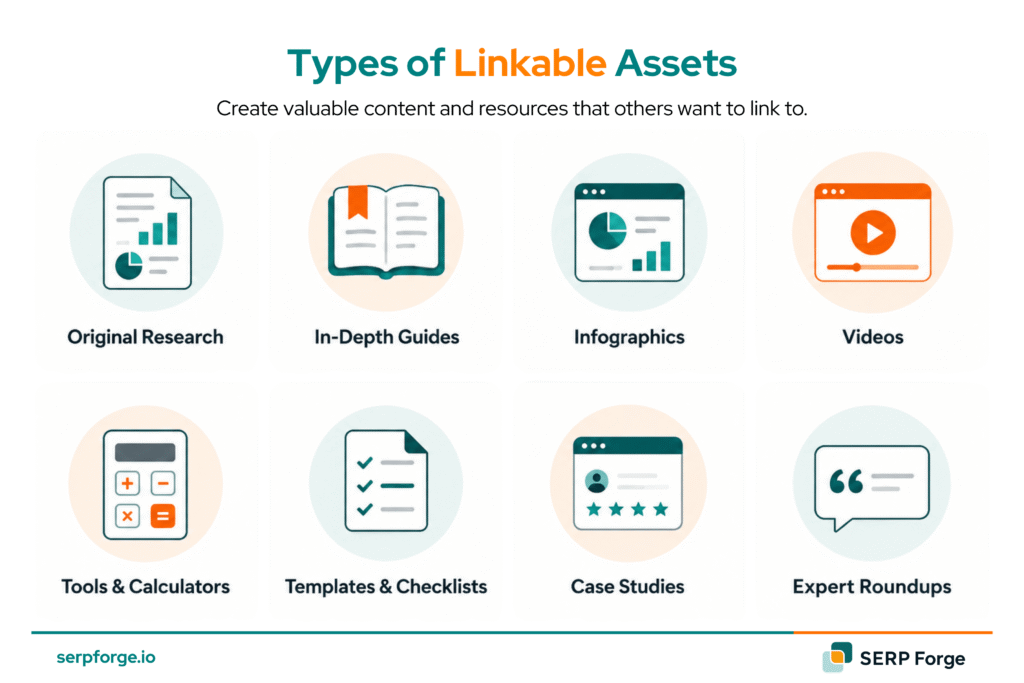
Original research, proprietary data, and interactive tools attract links at a rate that no outreach-only campaign can replicate.
- Long-form content gets an average of 77.2% more backlinks than shorter articles
- The most scalable format for enterprise link building is the annual industry report
- A single data study creates a citable reference that accumulates links for 12 months independently
Nextiva built an interactive customer service statistics resource with custom illustrations and shareable individual stats.
It ranked number one for its target keyword and generated hundreds of backlinks, establishing Nextiva as the primary citation source across the industry.
Digital PR and Original Data
The number one result in Google has an average of 3.8x more backlinks than positions two through ten.
Digital PR is the fastest way to close that gap at enterprise scale because earned media links arrive from high-DR domains that outreach alone cannot reach.
The four-stage process that works at enterprise scale:
- Identify the story: product launches, original research, and executive appointments all qualify
- Create the press release: write for the journalist’s reader, not for SEO rankings
- Distribute and pitch: follow up with personalised pitches to 10 to 15 target journalists
- Offer an exclusive: first access converts at a far higher rate than a mass press release send
Broken Link Building
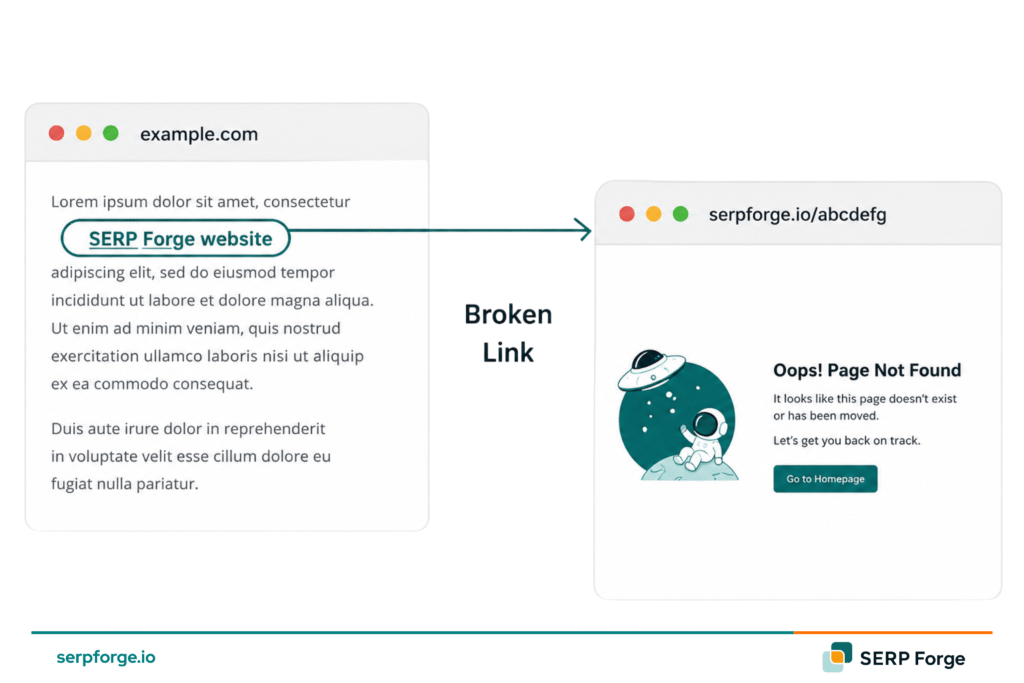
More than 66% of pages have zero backlinks pointing to them. Broken link building converts that gap into an opportunity by replacing dead competitor pages with your own content across domains already proven to link in your niche.
The process at enterprise scale:
- Use Ahrefs to find competitor 404 pages that still carry external referring domains
- Check whether existing content covers the same topic as the dead page
- Reach out to sites linking to the broken URL and offer your page as a replacement
- If no replacement exists, create it before sending any outreach
Network and Client Links
Enterprise companies already hold relationships that most link builders spend months trying to build.
Sending feeler emails where you offer value before asking for a link increases outreach conversion rates by over 40%. Three network link plays that convert consistently:
- Testimonials: offer social proof in exchange for a link from a domain that already trusts your brand
- Resource pages: one DR 70+ industry association placement outweighs 20 directory submissions
- Case study collaborations: co-authoring with a client produces a contextual link from a domain already in your network
Selective Guest Posting
An enterprise brand publishing 20 guest posts per month on DR 30 to 40 sites dilutes brand authority and produces marginal link equity.
In a 13-month Semrush study, nearly all 92.3% of the top 100 ranking domains had at least one backlink. The quality of those domains matters more than volume. Four criteria filter targets worth pursuing:
- Domain rating above 70
- Real editorial standards so the publication turns down pitches
- Audience overlap with your ICP
- Publication content ranks for keywords your audience searches
Executive bylines work better than standard guest posts at enterprise level. A CMO or VP-level byline in a top-tier publication carries both link equity and brand authority simultaneously.
How to Run Enterprise Link Building Outreach?
Outreach at enterprise scale fails for one reason above all others: unclear ownership. When nobody knows who approves a pitch, who sends the follow-up, or who handles legal review, campaigns stall for weeks and link opportunities expire.
Six steps separate enterprise outreach that produces consistent DR 60+ placements from outreach that produces a spreadsheet of unanswered emails:
Step 1: Define Roles Before the First Email Goes Out
Enterprise outreach touches at least four departments. Each needs a defined responsibility before any campaign begins:
| Forum | DR / DA |
|---|---|
| forum.audacityteam.org | 84 |
| forum.parallels.com | 92 |
| forums.futura-sciences.com | 90 |
| us.forums.blizzard.com | 92 |
| forum.utorrent.com | 88 |
| forum.adblockplus.org | 87 |
| neosmart.net/forums | 80 |
| kb.foxitsoftware.com | 80 |
| wilderssecurity.com | 65 |
| techsupportforum.com | 64 |
| pricescope.com/community | 56 |
The campaign owner is the single point of accountability for every placement decision.
Three ownership failures that kill enterprise outreach before it produces results:
- No single owner means nobody is accountable when placements stall
- Legal looped in after a placement is secured creates delays that cost the link entirely
- Outreach specialists operating without a brief produce inconsistent positioning across placements
Step 2: Build and Segment Your Outreach List
Segment outreach targets into three tiers before building any template or sending any email:
| Tier | DR Range | Monthly Volume | Approach |
|---|---|---|---|
| Tier 1 | DR 80+ | 5–10 targets | Fully personalized, executive-led pitches |
| Tier 2 | DR 60–79 | 20–40 targets | Segmented templates with personalized opening lines |
| Tier 3 | DR 40–59 | 50–100 targets | Template-based outreach with topic-specific personalization |
Use Apollo or Hunter to verify email addresses before sending. A 30% bounce rate on a 400-email campaign damages sender domain reputation and reduces deliverability on every future send.
Cap daily send volume at 50 emails per sender domain to protect deliverability across the full campaign window.
Step 3: Run Legal and Brand Approval in Parallel
Legal and brand approval is the most common cause of campaign delays in enterprise link building. A guest post pitched in week one sitting in a legal review queue in week four has already lost the placement.
The approval workflow that eliminates this problem:
- Submit all linkable assets, guest post angles, and approved data points to legal and brand before the outreach calendar begins
- Run legal and brand review simultaneously, not one after the other
- Build a pre-approved messaging library that outreach specialists can reference without individual approval on each pitch
- Name a single escalation contact who makes the final call when legal and brand disagree
Parallel review cuts the average approval cycle from three weeks to eight to ten days. Across a 20-placement quarter that adds two to three additional placements within the same budget.
Step 4: Write Pitches That Lead With Audience Value
Every outreach email needs four elements in this exact order: a specific reason you are contacting this person, the value you are offering their audience, the asset or idea you are pitching, and a single low-friction call to action.
Pitches that bury the offer in paragraph three convert below 2%. Pitches that lead with audience value convert at 8 to 12%.
Personalisation depth should match the tier:
- Tier 1 targets require fully personalised emails referencing a specific article or coverage gap at that publication
- Tier 2 targets require a personalised opening line with a templated body
- Tier 3 targets can run on segmented templates with topic-level personalisation
Send Tuesday through Thursday, 8am to 10am in the recipient’s time zone. Friday afternoon sends consistently underperform across every outreach vertical.
Step 5: Follow Up With a Three-Touch Sequence
A three-touch sequence that works without burning the relationship:
- Day 1: Initial pitch with the asset or idea fully presented
- Day 5: One-line follow-up: “Just checking this landed. Happy to send the full piece if useful”
- Day 12: Final follow-up: “Closing the loop. Let me know if timing works better another month”
Three touches is the ceiling. Beyond that, continued outreach damages the relationship and flags your domain with that publication for future campaigns.
Step 6: Convert Responses Into Live Placements
A positive response is not a live link. Four variables determine whether an interested editor becomes a confirmed placement:
- Response time: Reply to positive responses within two hours during business days. A 48-hour reply to an interested editor gives them time to fill the slot with another pitch.
- Asset readiness: Have the full piece ready to send immediately on acceptance. Editors who accept a pitch and then wait two weeks for the content frequently move on without publishing.
- Anchor text negotiation: Know your position before the conversation starts. A branded or partial-match anchor on a DR 85 domain outperforms an exact-match anchor on a DR 45 domain every time.
- Placement verification: Confirm the live URL, check that the link is dofollow and pointing to the correct target page, and log the referring domain in your tracking sheet on the day of publication. Links that go live with incorrect anchor text or broken target URLs need to be corrected immediately before the editor moves the page further down their update queue.
How to Report Enterprise Link Building Results to the C-Suite?
Link building reporting fails at the executive level when it leads with metrics that leadership does not connect to business outcomes. Referring domain counts mean nothing to a CFO.
Revenue impact and competitive positioning mean everything.
Referring Domains and Rankings
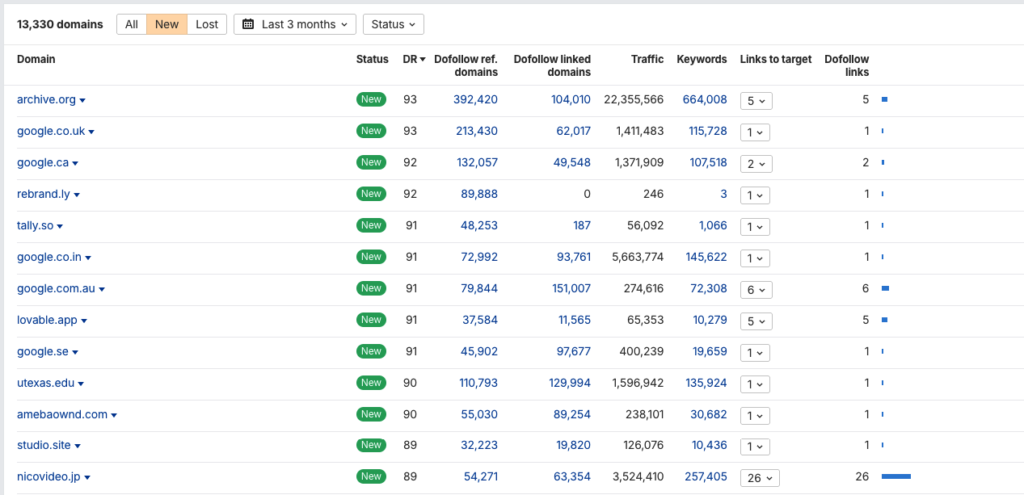
Referring domains are the baseline metric for link building velocity. Track new referring domains with dofollow links acquired each month, segmented by DR band.
The target is not a raw number. It is whether your referring domain growth rate matches or exceeds your top three competitors.
In competitive B2B verticals, enterprises targeting 50 to 200 new referring domains per month consistently outpace competitors who treat link acquisition as a secondary activity.
Use Ahrefs or Semrush to pull competitor referring domain growth monthly and present it as a gap chart.
That visual tells a leadership team whether the programme is keeping pace or losing ground, which is more actionable than a standalone referring domain count.
Connecting Links to Revenue
The most defensible enterprise link building report connects link acquisition directly to organic traffic growth and that traffic growth to pipeline or revenue.
The reporting chain that converts budget conversations:
- Page X received 8 new referring domains from DR 60+ sources in Q1
- Page X moved from position 6 to position 2 for its primary keyword over the same period
- Organic traffic to Page X increased 340% quarter over quarter
- Page X drove 47 qualified demo requests at a $280 average cost per acquisition
That chain gives the CFO a number to compare against the link building budget.
Reporting to Stakeholders
Different stakeholders need different versions of the same data. A single report presented identically to the SEO team, the CMO, and the board will fail to land with at least two of those three audiences.
Three report formats for three stakeholder types:
| Stakeholder | What They Care About | Report Format |
|---|---|---|
| SEO Team | Link velocity, DR distribution, and anchor text diversity | Comprehensive monthly report with DR breakdown and competitor gap analysis |
| CMO | Brand authority, share of voice, and organic traffic trends | One-page executive summary covering referring domain growth, average ranking changes, and organic traffic trends |
| CFO / Board | ROI, cost per link, and revenue attribution | Revenue bridge report connecting link-building investment to organic pipeline and revenue impact |
How to connect links to revenue: SEO team monthly, CMO quarterly, board annually or at budget review.
Conclusion
Enterprise link building produces returns that compound over time, but only when the foundation is clean, the tactics are selective, and the reporting connects link activity to revenue outcomes. For enterprise SaaS brands, a link building agency for SaaS can help execute this at scale.
Fix internal link structure and recover 404 equity before spending on outreach. Run unlinked brand mention campaigns before creating new content. Invest in linkable assets that generate citations independently. Build outreach with defined roles, parallel approval workflows, and two-touch follow-up sequences.
Six months of tight process execution produces referring domain growth that one-week burst campaigns cannot match. That gap widens every month the process runs.
FAQs
How many links does an enterprise site need per month?
Competitive enterprise verticals require enough new referring domains each month to match or outpace competitor link velocity. Track how many new referring domains your top three competitors acquire monthly and target 10 to 20% above their average.
What DR should enterprise backlinks have?
Target a minimum DR of 50 for meaningful ranking impact. DR 60 to 80 placements produce the best balance of cost and authority at enterprise scale.
DR 80+ editorial placements carry the highest equity and should be reserved for your highest-priority commercial pages. Cost per link at that tier runs $700 to $1,200, so placement selection matters.
How long does enterprise link building take to show results?
Ranking movement typically becomes measurable within 1 to 3 months of consistent link acquisition.
Should enterprise companies use a link building agency?
An enterprise link building agency works best for outreach execution and placement volume at scale. Strategy, content creation, and reporting typically stay stronger when handled in-house with agency support for execution.
How is enterprise link building priced?
Individual DR 60 to 80 placements cost $500 to $1,000 per link. Agency retainers vary based on volume targets and DR thresholds. Reserve the highest-cost placements for commercial pages where ranking movement directly impacts pipeline.