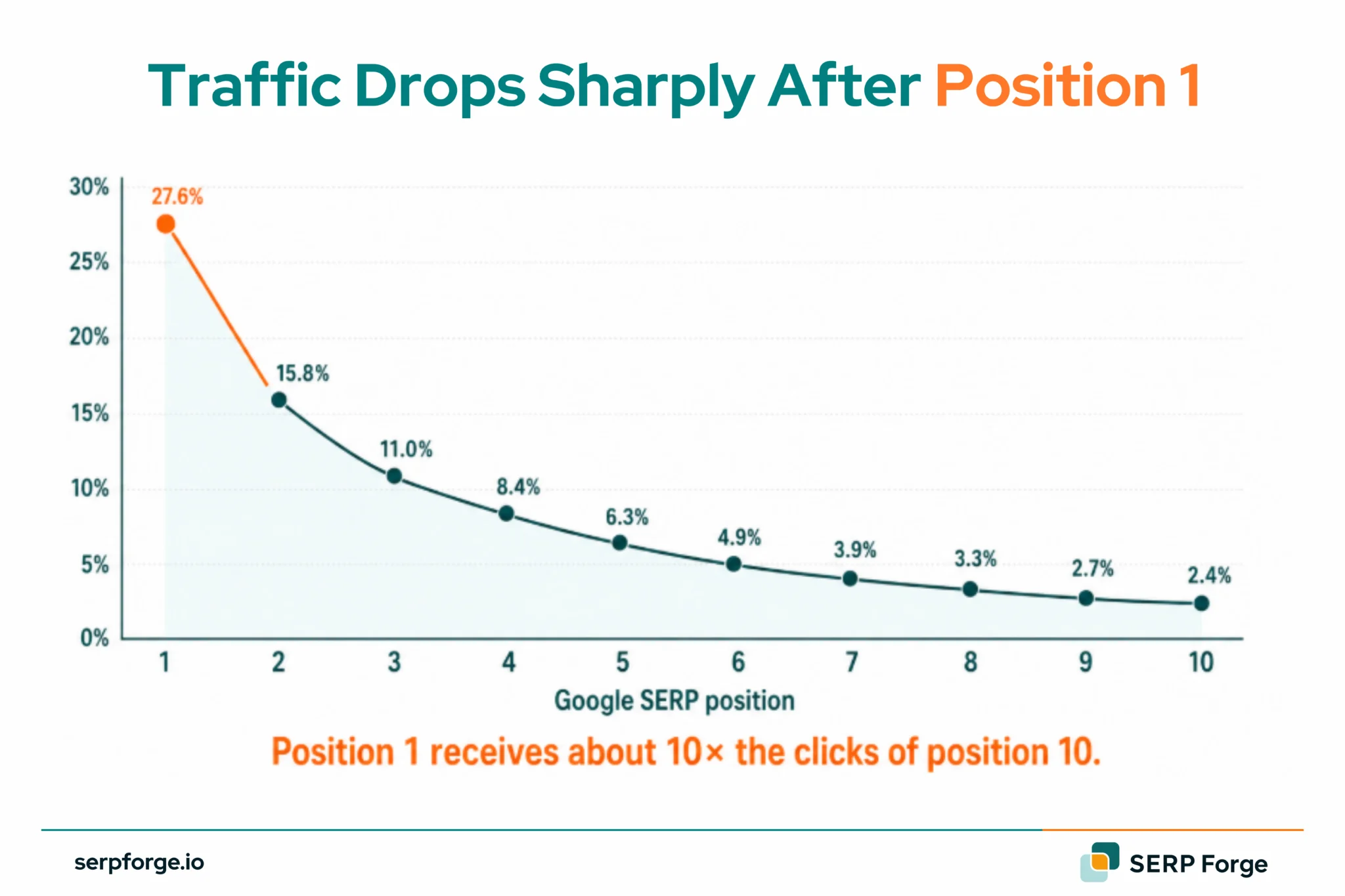



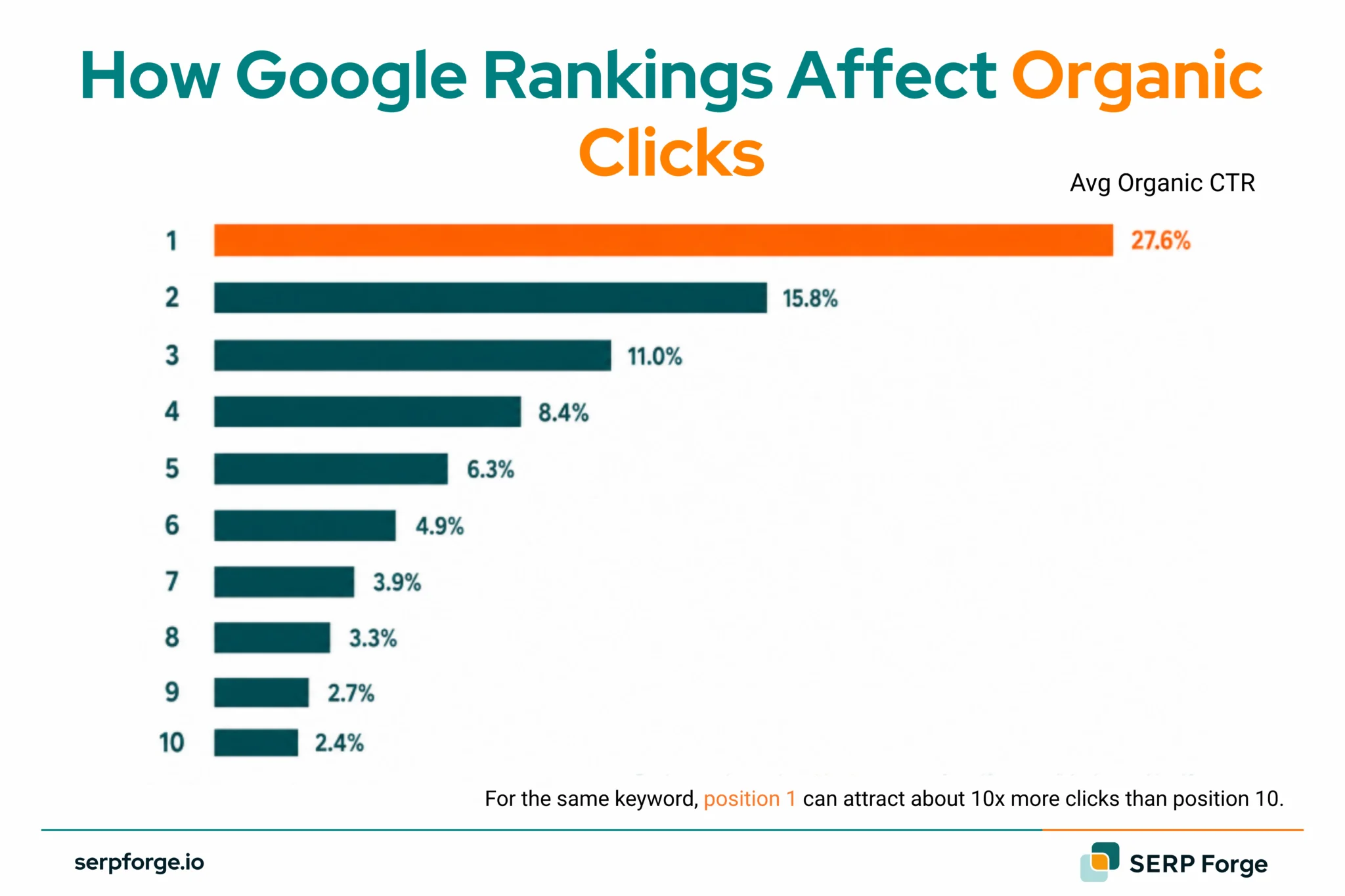
An SEO ranking is a webpage’s organic (unpaid) position on a search engine results page for a specific query. Position one gets the most clicks. Position eleven gets almost none.
Google Search Central confirms that rankings are determined by complex algorithms evaluating relevance, quality, and user experience across every indexed page. Your ranking position directly determines whether searchers ever find your content at all.
Note: Appearing as a link in Google’s AI Overviews is not considered an SEO ranking. However, many of the same practices that improve traditional rankings also improve AI visibility. Rankings also vary by search engine and by language or country version of the same engine. A page ranking third on Google US may rank differently on Google UK or Bing for the same query. If you target multiple markets, track rankings separately by region and search engine.
What Are the Core SEO Ranking Factors?
Search engines evaluate hundreds of signals to decide where your page ranks. 75% of users never scroll past the first page of search results, which confirms why ranking position directly determines organic traffic volume.
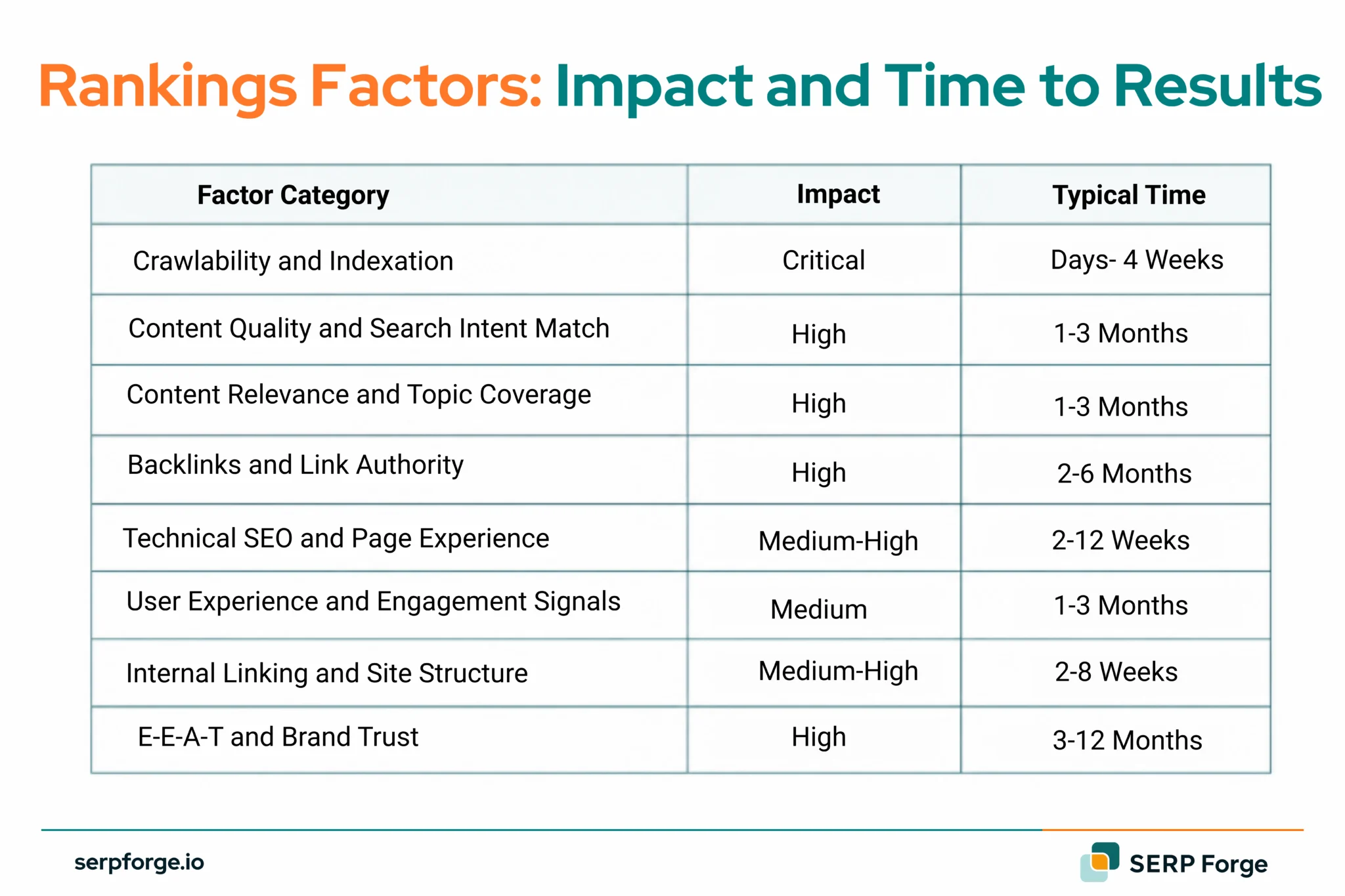
Here are the factors that consistently carry the most weight:
Crawlability and Indexation
A page that search engines cannot crawl will never rank in search engines or appear in organic search results. Check your robots.txt file allows crawlers, your sitemap is up to date, and you have no noindex tags on pages you want to rank. Use Google Search Console to check which pages are indexed and which are not. Make sure no important page is more than three clicks deep from your homepage.
Content Quality and Search Intent Match
Your content needs to answer the query a searcher typed. A page about “best CRM for startups” that leads with a product pitch rather than a comparison will not hold position one. Content should be helpful, reliable, and written for people first.
Content Relevance and Topic Coverage
Ranking well for a query requires covering the topic with enough depth. This will ensure the searcher does not need to return to the results page to find a better answer.
Check the top-ranking pages for your target keyword to see which subtopics they cover that you have missed. Pages that satisfy the full search intent and cover related subtopics consistently outperform thin pages targeting the same keyword.
Backlinks and Link Authority
When high-authority websites link to your page, search engines treat those links as votes of confidence. Quality matters more than volume.
One contextual link from a relevant authoritative site outperforms ten links from irrelevant directories. Google Search Central confirms that links are one of the primary ways Google discovers pages and assesses their credibility.
When evaluating link opportunities, check whether the linking site appears as a source in AI platforms like ChatGPT. Sites used for AI retrieval pass both traditional ranking authority and brand visibility in AI search. One link from an LLM feeder site is worth pursuing even if its domain authority is lower than you would normally target.
Technical SEO and Page Experience
Slow pages, broken links, missing HTTPS, and poor Core Web Vitals scores all suppress rankings. Technical SEO is the foundation that determines whether your content gets a fair chance to compete. Run a site audit quarterly to catch issues before they compound into larger ranking losses.
User Experience and Engagement Signals
If users click your result and immediately return to the SERP, search engines interpret that as a signal your page did not satisfy the query. Google uses its Navboost algorithm to track how users interact with search results. High dwell time and low pogo-sticking both confirm your page matched what the searcher was looking for.
Internal Linking and Site Structure
Internal links distribute ranking authority across your site and help crawlers understand which pages are most important. A product page with zero internal links pointing to it will struggle to rank even with strong external backlinks. Link from your highest-traffic pages to the pages you want to rank, and build internal links to updated content. This will help Google discover and understand how your pages relate to each other.
E-E-A-T and Brand Trust
Google evaluates Experience, Expertise, Authoritativeness and Trustworthiness to assess content quality. For topics covering finance, health, and legal content, E-E-A-T signals carry significant weight. Publish detailed author bios, cite credible sources, keep content accurate and up to date. Also, earn reviews on authoritative platforms relevant to your industry.
Why Do SEO Rankings Fluctuate?
Rankings change daily, sometimes dramatically, for reasons often outside your control. Here are the most common causes:
Algorithm Updates
Google runs thousands of algorithm updates each year. Core updates, which happen several times annually, can shift rankings significantly across entire categories of sites. A ranking drop after a core update signals that Google has re-evaluated how well your content serves the query compared to competitors.
Competitor Activity
If a competitor publishes a stronger page targeting your keyword, your position can drop without you changing anything. Rankings are relative to every other page competing for the same query.
Content Freshness and Accuracy
For queries where recency matters, outdated content loses rankings over time. Google favors pages that are actively maintained and reflect current information. A page with 2022 statistics competing against a page with 2026 statistics will lose ground consistently.
Changes in Search Behaviour
Searcher intent for a given keyword can shift over time. A keyword that historically returned listicles might now trigger how-to guides because searchers changed how they phrase the query. When intent shifts and your content format does not, rankings drop.
Search Engine and SERP Feature Changes
When Google adds a Featured Snippet, an AI Overview, or a Knowledge Panel to a SERP, organic positions shift. A page that ranked third might now sit in fifth position because SERP features appear above it. Track SERP features for your target keywords so you know what you are actually competing against.
How to Improve SEO Rankings
Here are the practical steps to improve your search engine ranking, in the order you should tackle them:
Start with Indexation and Technical Health
Open Google Search Console and go to Indexing > Pages. Check which pages are indexed and which are not, and review why certain pages are excluded. Fix crawl errors, Core Web Vitals failures, and HTTPS issues before anything else. A page that loads slowly or has broken internal links will not rank regardless of content quality.
Do Keyword Research and Match Search Intent
Target keywords where your page can realistically compete and where the search intent matches what your page delivers. Filter for a Personal Keyword Difficulty below 30% and a minimum monthly search volume of 100. Low PKD means your site has a realistic chance of ranking in the top ten without needing significant domain authority to compete.
Before you write a single word, look at the top-ranking pages for your target keyword and match the content format that is already proven to work.
Improve Existing Content Before Creating New Pages
Refreshing an existing page that already has some ranking history is faster than ranking a new page from scratch.
In Google Search Console, go to Search Results, check the Average Position box, and navigate to the Queries tab. Sort by position and look for queries where you rank between six and twenty. These are your fastest improvement opportunities.
Update statistics, align the page with search intent, and build internal links from authoritative pages on your site to the updated content.
Strengthen On-Page SEO
Include your primary keyword in your title tag, H1, first paragraph, and at least one H2. Write a meta description that matches search intent and gives searchers a reason to click.
Use structured data where relevant to qualify for rich results, including FAQ panels, How-to snippets, and review stars. Keep title tags under 60 characters and meta descriptions under 105 characters.
Build High-Quality Backlinks
Earn links from relevant, authoritative sites in your niche. Here are the most reliable approaches:
- Email outreach: Actively share useful content with publishers who may want to link to it
- Digital PR: Generate newsworthy stories and promote them to reputable publications
- Respond to media requests: Answer journalists’ requests for expert commentary and ask for attribution as a backlink
- Broken link building: Find broken backlinks pointing to competitor pages and offer your page as a replacement
One link from a site that appears as an AI retrieval source is worth pursuing even at lower domain authority. These links build both traditional ranking signals and AI search visibility simultaneously. AI SEO Optimization focuses on earning both.
Improve User Experience
If your page has a high bounce rate or short dwell time, search engines interpret that as a relevance problem. Do the following to improve your page experience:
- Use a clean design with consistent fonts, colours, and spacing
- Improve page speed using Google’s PageSpeed Insights to find and fix loading issues
- Make your site fully responsive so it works on any screen size
- Add breadcrumbs to show users where they are and help them navigate your site
- Simplify navigation with a clear menu hierarchy and logical categories
Fix Keyword Cannibalisation
If two pages on your site target the same keyword, they compete against each other and split your ranking authority. In Google Search Console, go to Search Results, add a Query filter for your target keyword, and navigate to the Pages tab.
If multiple pages appear for the same term, determine which page is most authoritative and consolidate the weaker pages into it using 301 redirects. This concentrates your link equity on one strong page rather than diluting it across several competing ones.
Optimise for Featured Snippets and SERP Features
Featured Snippets appear above organic position one and capture significant click share. To target them, use a question as a heading and provide a direct answer immediately below it.
For paragraph snippets, keep the answer between forty and sixty words. For list snippets, use a numbered or bulleted list that matches the format Google already shows for that query. Add a keyword-rich heading directly above the snippet content to help Google understand the context.
Monitor Rankings as Part of an SEO Audit
Track your target keywords weekly using Google Search Console. A ranking drop you catch in week one is far easier to diagnose and fix than one you notice after three months. Schedule a full technical SEO audit quarterly to catch crawl issues, content gaps, and link profile changes before they compound into larger losses.
Note: SEO is not a one-time task. Rankings fluctuate constantly. Integrate keyword monitoring, content updates, and technical checks into a regular workflow rather than treating them as one-off projects.