




What Is Voice Search SEO?
More people are searching by speaking instead of typing. Whether they’re asking for the nearest restaurant, checking the weather, or looking for quick answers, voice assistants are becoming a common way to access information online.
Voice search SEO helps your website appear as the spoken answer to those queries. Unlike traditional search, where users choose from multiple results, voice assistants typically provide a single response.
That makes it even more important to create clear, conversational content that matches search intent while supporting it with strong technical SEO, structured data, and local optimization.
How Does Voice Search SEO Work?
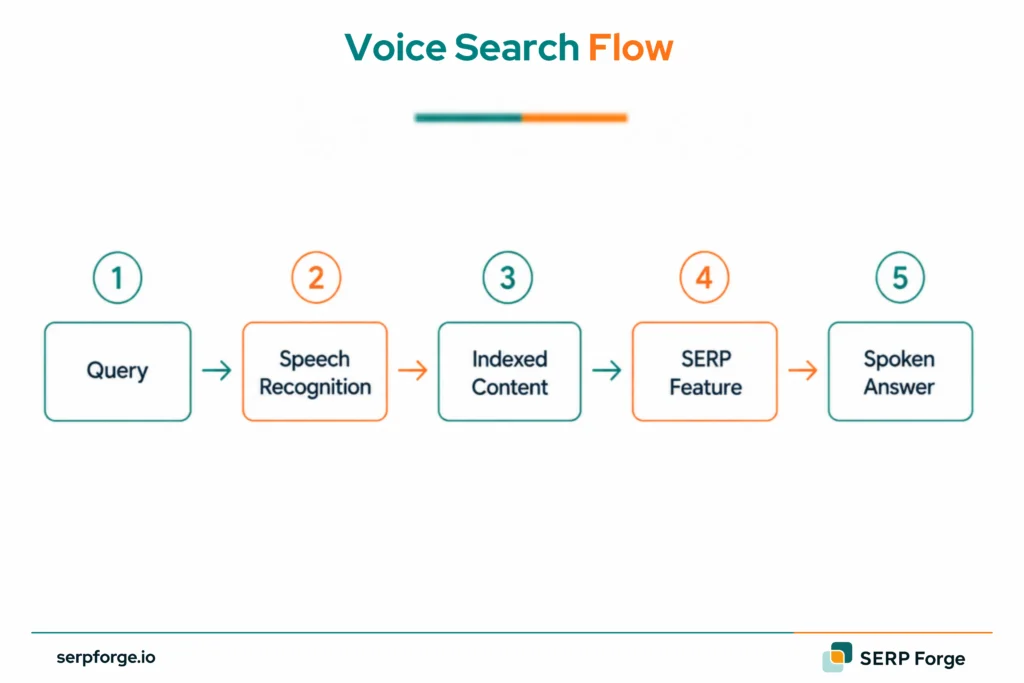
Voice search SEO works by helping voice assistants retrieve, verify, and read back one passage that directly answers a spoken query. A GEO and AEO agency can help you optimize for answer engines like these.
When you ask a voice assistant a question, it converts your speech to text, matches it against indexed content, and selects the single best answer, often the same passage already ranking in a featured snippet. Your page doesn’t need to rank #1.
It needs the clearest, most self-contained answer to that exact question.
Voice Search vs. Traditional Text Search
Voice and text search behave differently, even when someone wants the same information:
| Factor | Voice Search | Traditional Text Search |
| Query length and phrasing | Longer and conversational, e.g., “where’s the closest coffee shop that’s open right now?” | Shorter and fragmented, e.g., “coffee shop open now” |
| Result format | Returns one spoken answer | Returns a list of links |
| Intent | Skews local and immediate, with phrases like “near me” and “open now” | Less consistently local or time-sensitive |
You can think of text search as the keywords someone types into a box, and voice search as the full question they’d ask a person standing next to them.
Why Voice Search SEO Matters
Voice search SEO matters because a growing share of searches now happen without a screen, through smart speakers, in-car systems, and voice assistants built into phones.
Backlinko’s analysis of voice search results found that roughly 4 in 10 spoken answers come from a featured snippet, so position zero has a direct line to voice visibility. If your content isn’t structured to win that spot, a competitor will be.
Voice queries also carry strong local intent:
- Key Ranking Factors for Voice Search: No single signal decides voice search rankings, but these four are the most consistently cited.
- Featured Snippets and Position Zero: Content that already ranks in a featured snippet is the most common source for spoken answers, making position zero one of the top voice search ranking factors.
- Page Speed and Mobile-Friendliness: Voice queries are answered instantly, and assistants favor pages that load quickly and render cleanly on mobile devices.
- Local SEO and Google Business Profile: Because so many voice queries are local, an accurate, complete Google Business Profile and consistent business information across the web affect whether you’re the answer to a “near me” query.
- Structured Data and Schema Markup: Schema markup, such as FAQPage, LocalBusiness, and Speakable, helps voice assistants identify exactly which passage answers a given question.
6 Tactics to Improve Your Voice Search Optimization
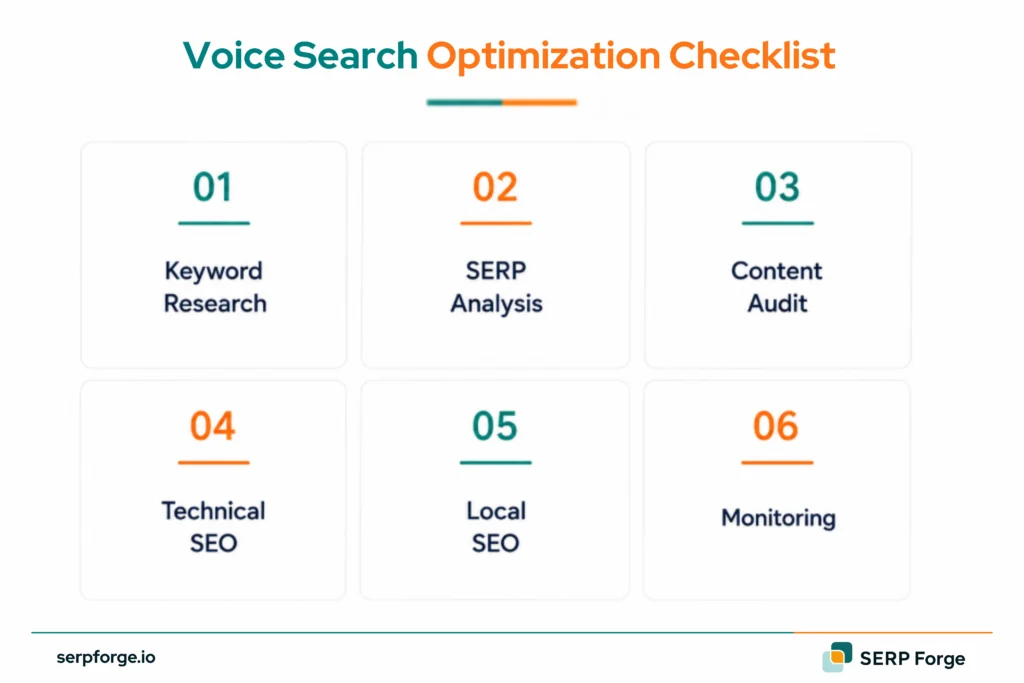
Use these six tactics together to build and maintain visibility in voice search results:
1. Research Keywords for Voice Search
Build keyword lists around full questions, not short fragments. Tools like Ahrefs and Semrush, plus Google’s “People Also Ask,” can surface the natural-language questions your audience asks out loud.
2. Analyze SERP Features for Your Target Keywords
Check which target queries already trigger featured snippets, local packs, or knowledge panels that voice assistants pull from most often.
3. Audit and Optimize Existing Content
Review existing pages for vague answers or passages that only make sense in context, then rewrite them to stand on their own.
4. Strengthen Technical SEO
Confirm your pages are crawlable, fast, mobile-friendly, and free of redirect chains or blocked resources.
5. Practice Local SEO
Keep your Google Business Profile complete, gather reviews, and match your business name, address, and phone number across directories and citation sites.
6. Continuously Monitor Performance
Track featured snippet wins, local pack rankings, and “People Also Ask” appearances over time, since voice visibility shifts as SERP features change.
Common Voice Search SEO Mistakes
These mistakes are the most common reasons why otherwise solid content still gets passed over in voice search:
- Writing long, unfocused paragraphs that bury the answer
- Ignoring local SEO despite having a storefront or service area
- Skipping schema markup that would help assistants parse your content
- Targeting only short-tail keywords instead of natural-language questions
- Treating voice SEO as a one-time audit instead of an ongoing practice
Conclusion
Voice search SEO means writing for one spoken answer instead of a page of blue links.
Start with the factors that already shape your visibility: featured snippets, page speed, local listings, and schema, then keep refining as the questions people ask out loud keep evolving.