




Want your website to rank for more than just a few keywords? Building topical authority is one of the most effective ways to improve long-term SEO performance.
Instead of creating isolated articles, topical authority focuses on publishing comprehensive, interconnected content that covers an entire subject from multiple angles. This helps search engines understand your expertise, strengthens semantic relevance, and increases your chances of ranking for a wider range of related searches.
Topical Authority vs Domain Authority
Although they are often confused, topical authority and domain authority measure different aspects of website strength:
| Factor | Topical Authority | Domain Authority |
| Focus | Topic-specific expertise | Overall website strength |
| Built Through | Content depth and semantic coverage | Backlinks and domain signals |
| Scope | Individual topic areas | Entire domain |
| Measures | Subject expertise | Ranking potential |
| Search Engine Evaluation | Semantic relevance and contextual coverage | Authority and trust signals |
A website can have high domain authority but weak topical authority if its content lacks depth within a specific subject area. AI SEO for SaaS builds on topical authority to help software brands get cited in AI search.
Likewise, a niche website may have lower domain authority but strong topical authority because it thoroughly covers one topic.
How Topical Authority Is Built
Building topical authority requires creating an interconnected ecosystem of information rather than publishing random articles.
- Topical Coverage: Topical coverage refers to how completely a website covers a subject, including its related topics, entities, and user questions.
- Historical Data: Historical data reflects a website’s long-term consistency, relevance, accuracy, and performance within a specific topic area.
- Content Depth and Breadth: Content depth and breadth describe how extensively a website covers related topics and how thoroughly it explains each concept.
- Publication Momentum: Publication momentum refers to the consistent creation and expansion of content that reinforces expertise within a topic ecosystem.
What Is Topical Coverage?
Topical coverage is the process of covering an entire subject area through interconnected content assets.
Instead of targeting one keyword, topical coverage focuses on answering every major question users may have about a topic.
For example, topical coverage for link building might include:
- Link building basics
- Outreach strategies
- Guest posting
- Digital PR
- Anchor text optimization
- Link audits
- Link velocity
- Competitor backlink analysis
Together, these articles create a comprehensive knowledge network.
What Is a Topical Map?
A topical map is a structured blueprint that organizes content according to semantic relationships and user intent pathways.
It identifies:
- Core entities
- Supporting entities
- Subtopics
- Content hierarchy
- Internal linking opportunities
A topical map serves as the foundation for building authority systematically.
Core Section vs Outer Section
Understanding the difference between the core section and outer section is essential for building a well-structured topical map:
Core Section: The core section consists of the primary topics that are directly related to the central entity. These topics form the foundation of a topical map and represent the main areas of expertise within a subject.
Outer Section: The outer section includes supporting and related topics that provide additional context around the core subject. These topics help expand topical coverage and strengthen semantic relevance.
Together, the core and outer sections create a comprehensive topical structure that helps build stronger topical authority.
How Topical Maps Build Authority
Topical maps help search engines understand:
- Topic relationships
- Knowledge depth
- Semantic connections
- Content hierarchy
- Expertise signals
The result is stronger topical authority and improved ranking potential.
The Relationship Between Topical Authority and Semantic SEO
Semantic SEO helps search engines understand the meaning, context, and relationships behind content, while topical authority demonstrates expertise across a subject. Together, they enable search engines to evaluate how comprehensively a website covers a topic and whether it can be trusted as a reliable source of information.
1. Entity-Based Optimization
Entity-based optimization focuses on identifiable concepts such as people, organizations, products, locations, and ideas. By clearly connecting related entities within content, websites can strengthen contextual understanding and topical relevance.
2. Semantic Relevance
Semantic relevance refers to how closely related concepts support a topic. Content that naturally incorporates associated terms, entities, and subtopics helps search engines better understand the subject matter and its context.
3. Query Intent Coverage
Users search with different goals, including informational, navigational, commercial, and transactional intent. Covering multiple intent types helps create a more complete content ecosystem and strengthens topical authority.
4. Information Retrieval and Information Extraction
Search engines use information retrieval to discover relevant content and information extraction to understand relationships between concepts. Content that clearly connects entities, topics, and supporting information makes it easier for search engines to evaluate expertise and topical depth.
Main Components of a Semantic Content Network
A semantic content network consists of interconnected content assets that help search engines understand topic relationships, entity connections, and contextual relevance across a website.
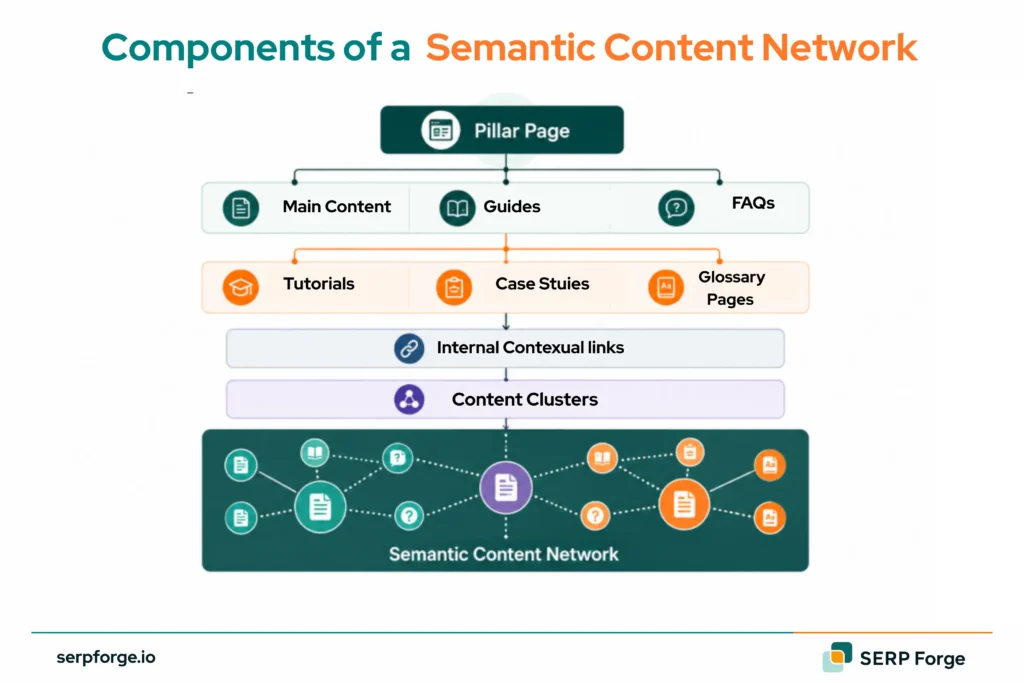
Main Content
Main content covers the primary topic, core entities, and key concepts that define a subject. It serves as the foundation of a website’s topical authority and semantic structure.
Supplementary Content
Supplementary content provides additional context and supporting information that enhances the value of the main content. Common examples include glossaries, guides, tutorials, FAQs, templates, and case studies.
Internal Contextual Bridges
Internal contextual bridges connect related pages through strategic internal linking. These connections help distribute topical relevance and guide users through related concepts and supporting topics.
Contextual Borders
Contextual borders define the scope of a topic and help maintain topical focus. They prevent content from drifting into unrelated subjects while preserving semantic consistency across the content network.
Content Clusters
Content clusters organize related articles around a central pillar topic. This structure helps search engines understand topic relationships while improving content discoverability and topical depth.
Semantic Content Networks
A semantic content network is created when content clusters, entities, internal links, and user intent coverage work together. This interconnected structure strengthens contextual relevance and supports the growth of topical authority.
Contextual Relevance and Topical Authority
Contextual relevance refers to how well content connects related concepts, entities, and supporting information around a central topic. Strong contextual relevance helps search engines understand expertise, topic relationships, and overall content quality.
Macro Semantics
Macro semantics focuses on the broader relationships between topics within a knowledge domain. These connections help search engines understand how different subjects relate to one another and contribute to overall topical authority.
Micro Semantics
Micro semantics focuses on detailed relationships between concepts within individual pages. It helps improve content precision by connecting closely related terms, entities, and supporting information.
Contextual Coverage
Contextual coverage measures how thoroughly a topic and its supporting concepts are addressed. Comprehensive coverage helps search engines identify deeper subject expertise and stronger topical relevance.
Contextual Flow
Contextual flow refers to the logical progression of information throughout a piece of content. Well-structured content guides users naturally from foundational concepts to more advanced discussions.
Contextual Hierarchy
Contextual hierarchy organizes information based on importance and topical relationships. A clear hierarchy helps both users and search engines understand the structure and relevance of content within a broader topic.
Topical Authority Framework
Building topical authority requires a structured approach that expands content coverage, strengthens semantic relationships, and demonstrates expertise over time.
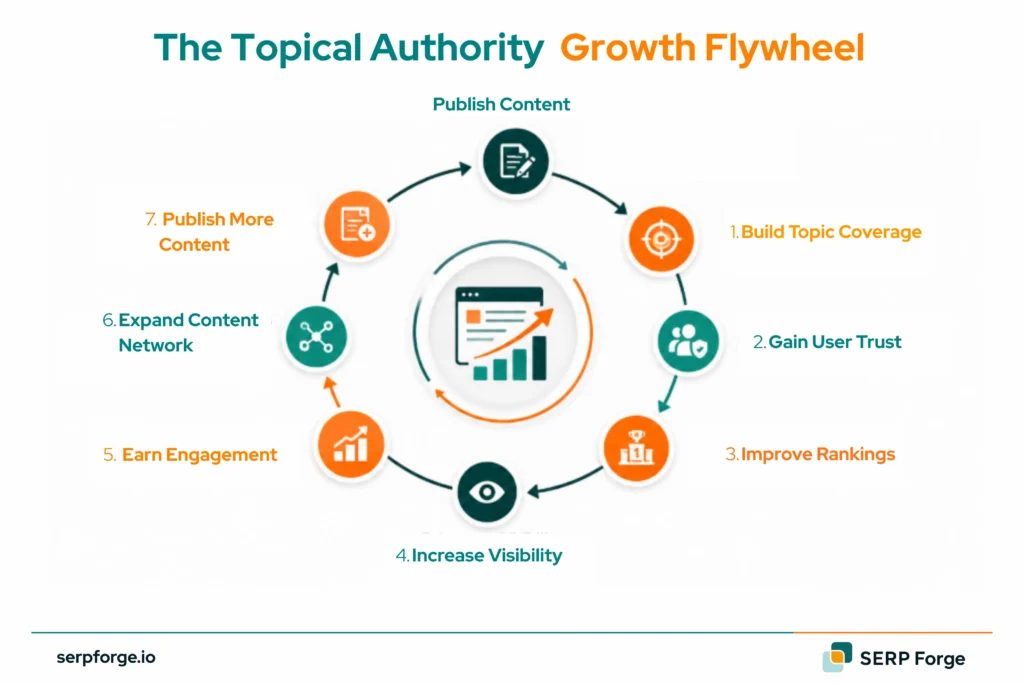
Step 1 – Define the Central Entity
Start by identifying the primary topic or entity you want your website to be known for. This topic becomes the foundation of your topical map and content strategy.
Step 2 – Build the Core Section
Create foundational content that covers the most important concepts, topics, and entities directly related to your central subject.
Step 3 – Expand the Outer Section
Develop supporting content around related topics, adjacent concepts, and complementary information to broaden topical coverage.
Step 4 – Create Contextual Bridges
Connect related content through strategic internal linking and semantic relationships to strengthen topic associations across the website.
Step 5 – Publish Consistently
Maintain a consistent publishing schedule to expand knowledge coverage and reinforce expertise signals within the topic area.
Step 6 – Improve Historical Data
Regularly update existing content to improve accuracy, freshness, completeness, and relevance as information evolves.
Step 7 – Reconfigure Content Over Time
Continuously refine your topical map, content structure, and internal linking strategy based on industry developments, user behavior, and emerging search trends.
Common Mistakes When Building Topical Authority
When building topical authority, avoid these common mistakes that can weaken topical relevance and limit long-term SEO performance:
- Publishing Without a Topical Map: Without a content structure, coverage becomes fragmented and inconsistent.
- Stuffing Entities Without Context: Mentioning entities repeatedly without meaningful relationships provides little value.
- Ignoring Supporting Topics: Authority is built through complete ecosystems, not isolated articles.
- Creating Thin Supporting Content: Weak supporting pages fail to contribute meaningful contextual depth.
- Chasing Keywords Instead of Knowledge Domains: Topical authority is built around knowledge expansion, not keyword accumulation.
- Weak Internal Linking: Poor contextual connections limit semantic understanding and content discovery.
The Hidden Layer of Topical Authority: Knowledge Modeling
A unique way to understand topical authority is through knowledge modeling.
Search engines increasingly evaluate websites as knowledge repositories rather than collections of pages.
Every article acts as a node.
Every internal link acts as a relationship.
Every entity acts as a knowledge object.
The stronger and more organized these relationships become, the easier it is for search engines to trust the website as an authoritative source.
This is why websites that build comprehensive semantic content networks often outperform competitors with stronger backlink profiles but weaker topical coverage.
Final Thoughts
Topical authority is no longer simply about publishing more content. It is about building a complete, interconnected knowledge ecosystem around a subject.
By combining topical coverage, semantic SEO, entity optimization, contextual relevance, and strategic internal linking, websites can establish expertise that search engines recognize and reward.
Organizations that focus on building semantic content networks rather than individual keyword rankings are better positioned to achieve sustainable organic growth, stronger visibility, and long-term search performance. A SaaS SEO agency can build that topical map for software brands.