



Why do some pages rank higher even when they target the same keyword? In many cases, the difference comes down to keyword intent.
Every search query reflects a specific goal. Some people want to learn something, others are comparing options, while some are ready to buy or book a service.
Creating content that matches this intent helps search engines understand your page and improves the chances of reaching the right audience. AI SEO Optimization extends the same intent-matching to AI search.
What Are the Four Main Types of Keyword Intent?
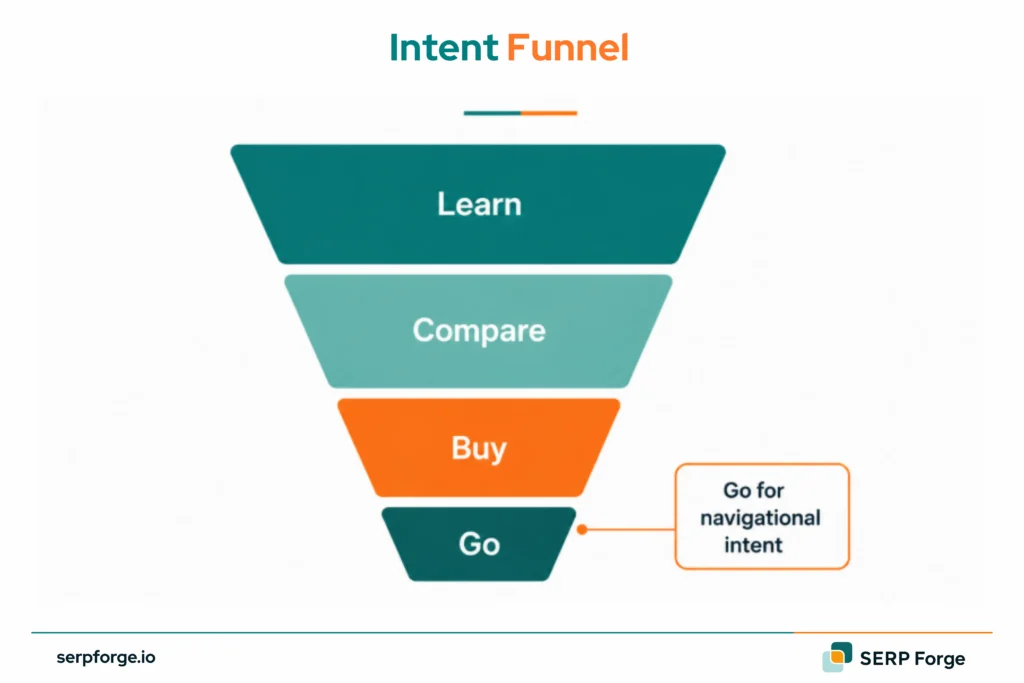
The four main keyword intent types are informational, navigational, commercial and transactional.
Use these types to match keywords with the right page format:
1. Informational
Informational intent means the searcher wants to learn something.
These searches often include words like “what is,” “how to,” “why,” “guide,” “tips” or “examples.”
Common informational keywords include:
- “what is search intent”
- “how to do keyword research”
- “keyword intent example”
- “how does SEO work”
The best content format is usually a glossary page, guide, tutorial, checklist, video or explainer.
Informational keywords work well when they build topical authority or introduce the reader to a problem your product solves.
For example, a SaaS SEO agency can target “what is keyword intent” with a glossary page. That page can later link to keyword research, content strategy and SEO audit services.
2. Navigational
Navigational intent means the searcher wants to reach a specific website, brand, page or tool.
These searches often include brand names, product names, login pages or account pages.
Examples include:
- “Semrush login”
- “Ahrefs keyword explorer”
- “SERP Forge services”
- “HubSpot pricing page”
Navigational keywords are usually best owned by the brand being searched.
A competing brand should be careful with these terms. If the whole SERP is controlled by the brand, ranking with a generic guide will be difficult.
Navigational intent can still support conversions when users are looking for your own brand pages.
3. Commercial
Commercial intent means the searcher is comparing options before making a decision.
These keywords often include words like “best,” “top,” “review,” “alternative,” “comparison” or “vs.”
Examples include:
- “best SEO agency for SaaS”
- “Ahrefs vs Semrush”
- “HubSpot alternatives”
- “best keyword research tools”
Commercial keywords are valuable because the searcher is already evaluating solutions.
The best page format is usually a comparison page, alternatives page, listicle, review page, case study or product-led guide.
For SEO strategy, commercial intent often sits close to revenue. These keywords can influence trials, demo requests, consultation bookings or product consideration.
4. Transactional
Transactional intent means the searcher is ready to take action.
The action could be buying, booking, subscribing, downloading, starting a trial or requesting a demo.
Examples include:
- “buy SEO audit”
- “book SaaS SEO consultation”
- “keyword research tool free trial”
- “download content calendar template”
Transactional keywords usually need pages built for conversion.
Good formats include product pages, pricing pages, booking pages, demo pages, landing pages and offer pages.
The page should make the next step easy. Add clear copy, proof, pricing context, trust signals and a visible call to action.
What Is Local Intent vs Branded Intent in SEO?
Local intent and branded intent are often missed in basic intent lists.
Use this table to decide what each intent needs:
| Intent Type | What It Means | Keyword Examples | Best SEO Response |
| Local intent | The searcher wants a result tied to a place. | “SEO agency near me”“dentist in Mumbai”“coffee shop Shoreditch”“best gym in Delhi” | Build location pages, optimise Google Business Profile, earn reviews, add location citations and keep NAP details consistent. |
| Branded intent | The searcher includes a brand name in the keyword. | “Ahrefs pricing”“Semrush alternatives”“HubSpot vs Salesforce”“SERP Forge case studies” | Use brand pages, pricing pages, comparison pages, alternatives pages or case study pages based on the query. |
Local keywords need a local SEO response because the SERP may show map packs, Google Business Profiles, directories and local landing pages.
Branded keywords can be navigational, commercial or transactional. For your own brand, they protect demand. For competitor brands, they can support comparison and alternatives pages.
How Do You Handle Mixed Intent Keywords?
Mixed intent keywords have more than one search goal.
For example, “project management software” can be informational and commercial. Some users want to understand the category, while others want tool options.
“Best deals on running shoes” can be informational, commercial and transactional. The searcher may want recommendations, comparisons and buying options together.
Handle mixed intent by checking the live SERP before choosing a page format.
Look at what Google shows:
- Blog guides
- Product pages
- Category pages
- Comparison pages
- Videos
- Local packs
- People Also Ask
- Shopping results
If one intent dominates, build for that format.
If the SERP is split, choose the intent your site can serve and convert. A SaaS site may use a product-led guide. An ecommerce site may use a category page with buying guidance.
For important mixed-intent topics, you can create more than one page. Each page should have a different job, such as a guide, comparison page and product page.
How Do You Identify Keyword Intent?
You can identify keyword intent by checking the SERP, SERP features and keyword research tools.
Use these checks before adding a keyword to your content plan:
Check the SERP Manually
Search the keyword in Google and study the top results.
Look at the page types ranking on page one.
Check:
- Are the results blogs, product pages or category pages?
- Are they short answers or long guides?
- Are brands, review sites or forums ranking?
- Are the titles educational or sales-led?
- Are the pages built for reading, comparing or buying?
The SERP shows what Google already rewards for that query.
If the top results are product pages, a glossary page may struggle. If the top results are guides, a product page may miss the intent.
Look at SERP Features
SERP features reveal what the searcher expects.
Look for:
- Featured snippets
- People Also Ask
- Product carousels
- Local packs
- Reviews
- Videos
- Shopping results
- Knowledge panels
A keyword with People Also Ask and a featured snippet often has informational intent.
A keyword with shopping results, product grids and pricing pages often has transactional intent.
A keyword with map packs or local listings has local intent.
Use a Keyword Research Tool
Keyword research tools can label intent at scale.
Semrush, Ahrefs and similar tools can show intent tags, keyword modifiers, SERP features and top-ranking pages.
Use tools to group keywords faster, then confirm key terms manually.
A tool can flag intent. The SERP confirms the page format.
How Do You Map Keyword Intent to Content?
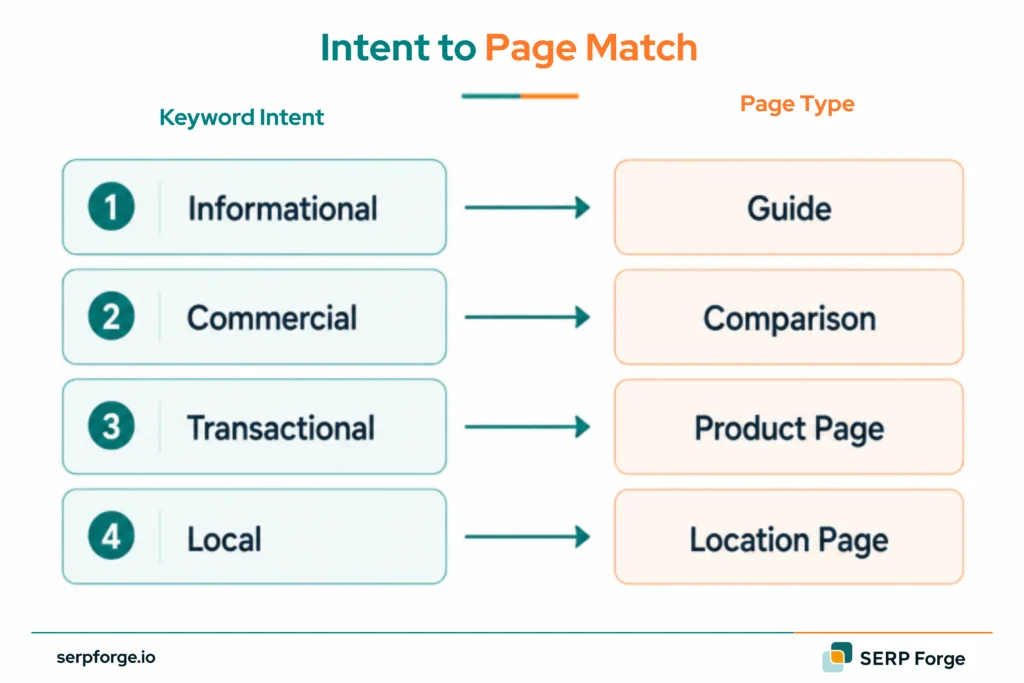
Keyword intent mapping means assigning each keyword to the right page type.
Map intent before writing content. This prevents blog posts from targeting product keywords, and product pages from targeting learning queries.
Use this mapping:
- Informational intent: glossary, guide, tutorial, checklist
- Navigational intent: brand page, login page, support page
- Commercial intent: comparison, alternatives, review, listicle
- Transactional intent: product, pricing, demo, booking page
- Local intent: location page, Google Business Profile, local landing page
- Branded intent: brand, comparison, pricing or alternatives page
A keyword should enter your content plan only when three things match.
Check:
- Search intent
- Page format
- Business value
For example, “keyword intent types” fits a glossary or guide. “best keyword research tools” fits a comparison page. “book SEO consultation” fits a conversion page.
The same topic can have several intent layers. Your job is to give each page a separate role.
What Is Intent Mismatch and Why Does It Kill Rankings?
Intent mismatch happens when your page targets a keyword but gives the wrong type of result.
A common example is writing a blog post for a keyword where Google ranks product pages. Another example is using a product page for a query where searchers want examples or definitions.
Intent mismatch creates three problems:
- Google may ignore the page for that keyword.
- Users may leave because the page format feels wrong.
- The page may attract traffic that never converts.
For example, a page targeting “keyword intent example” should show clear examples. A generic service page will likely miss the searcher’s need.
Intent mismatch usually appears in these signs:
- High impressions and low clicks
- Good ranking for the wrong page
- Low engagement
- Poor conversions
- SERP format different from your page format
Fix intent mismatch by changing the page format or choosing a better keyword.
Sometimes the fix is a rewrite. Sometimes it needs a new page.
Conclusion
Keyword intent is where a keyword turns into a page decision. “Near me” should not become a blog. “Vs” should not become a glossary. “Pricing” should not hide behind thought leadership.
The SERP tells you what the searcher expects before the outline begins. Match that expectation first, then choose the angle, proof, CTA and internal links that fit the page.