




Getting your content in front of people is only half the challenge. The real question is whether they choose to click.
Click through rate (CTR) measures how often people click a search result, advertisement, email, or link after seeing it. It’s one of the most important performance metrics because it reveals how effectively your headline, creative, offer, or call to action captures attention.
In simple terms, CTR shows how often visibility turns into a click.
If 1,000 people see your ad and 50 people click it, your click through rate is 5%.
CTR is used across SEO, Google Ads, email marketing, social media ads, display ads, app campaigns and landing pages. It helps marketers see whether the headline, creative, offer, placement or call to action is strong enough to earn action.
Here’s the key point:
CTR measures interest before conversion. A high CTR means people are clicking. It does not always mean they are buying, signing up or becoming qualified leads.
Pro tip:
Segment CTR by intent before you judge it. Brand, non-brand, retargeting, cold audience and informational SEO pages should never be compared in one average.
How to Calculate Click Through Rate?
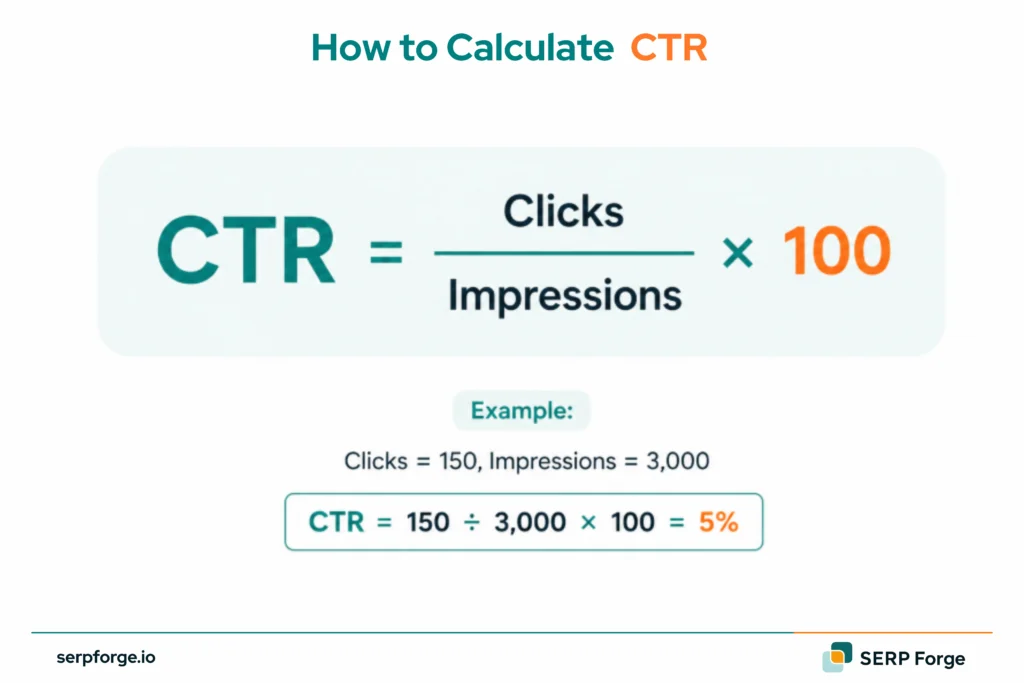
Click through rate is calculated by dividing total clicks by total impressions, then multiplying by 100.
Use this CTR formula:
CTR = (Total Clicks/Total Impressions) × 100
Here’s a simple example:
If a search result gets 500 impressions and 25 clicks:
25/500 × 100 = 5% CTR
So, the CTR is 5%.
Clicks are the number of times people clicked your result, ad, link, button or email CTA. Impressions are the number of times that asset was shown.
Pro tip:
Before reporting CTR, confirm what counted as an impression. Google Search Console impressions, delivered emails, opened emails and video ad views are different data points.
What Is a Good CTR?
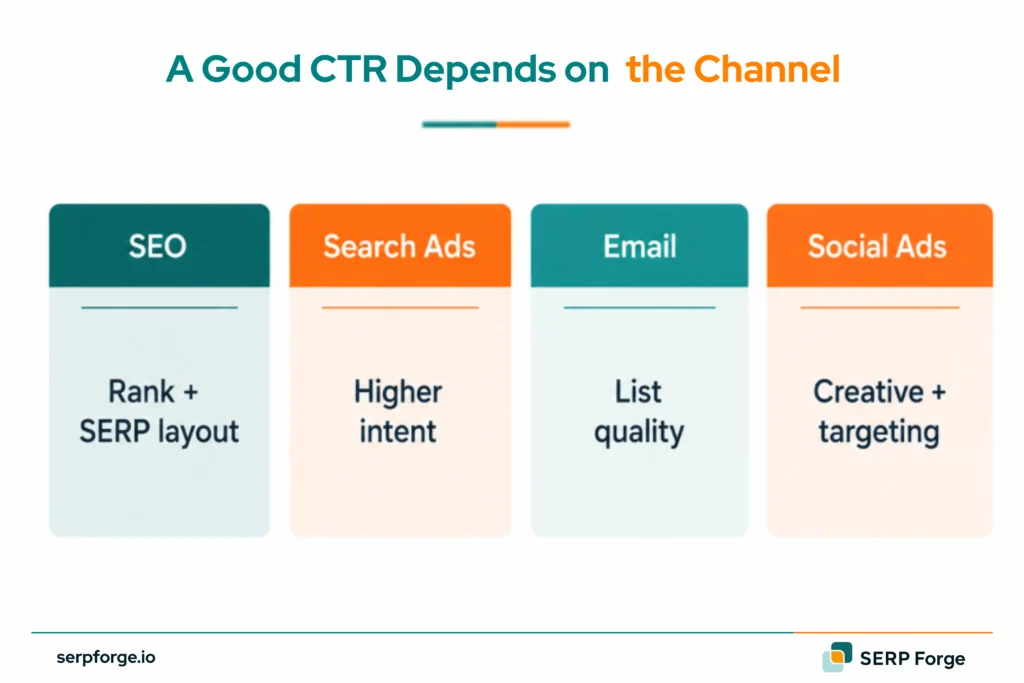
A good CTR depends on channel, intent, placement, audience, industry and campaign goal.
Search ads often get higher CTR because users are already looking for something. Display ads usually get lower CTR because users are browsing, reading or watching something else. Email CTR depends heavily on list quality and segmentation.
For SEO, 2026 benchmarks need extra context. Ahrefs’ June 2026 study of 422,421 websites found that a good whole-site organic CTR usually falls between 1% and 2%. That number looks at total site clicks divided by total site impressions.
A good CTR is the one that brings qualified traffic at a cost or effort your business can justify.
Pro tip:
Build your CTR benchmark by channel and page type. Compare glossary pages with glossary pages, search ads with search ads and nurture emails with nurture emails.
CTR Benchmarks by Channel
CTR benchmarks are useful starting points because each channel has a different intent level.
Use this table as a quick channel-level reference:
| Channel | Typical CTR Signal | How to Read It |
| Google Search Ads | Usually higher than display | Users already have search intent |
| SEO Organic Results | Affected by ranking and SERP layout | Titles, snippets, brand trust and intent match matter |
| Email Marketing | Depends on list and CTA quality | Segmentation affects the number |
| Social Media Ads | Creative-led and audience-led | Visuals, hooks and targeting drive clicks |
Google Search Ads
Google Search Ads usually get stronger CTR than passive placements because the user is actively searching.
CTR also connects to Google Ads Quality Score diagnostics through expected CTR, ad relevance and landing page experience. Expected CTR estimates how likely your ad is to be clicked when shown for a keyword.
Pro tip:
After a CTR lift, check search terms before scaling budget. A higher CTR can come from broader, cheaper or less qualified queries.
SEO Organic Results
Organic CTR shows how many people click your page after seeing it in search results.
The biggest drivers are ranking position, title tag, meta description, query intent, brand familiarity, rich results, freshness signals and SERP layout.
In 2026 organic CTR is also shaped by zero-click search. Featured snippets, People Also Ask boxes, knowledge panels, local packs and AI Overviews can answer the query before the user clicks. When an AI Overview appears, clicks to the top organic result fall by roughly 58%. AI SEO services can help you protect clicks when AI Overviews appear.
Pro tip:
In Google Search Console, filter pages with high impressions and falling CTR. Then check the live SERP for AI Overviews, featured snippets, People Also Ask boxes, ads or fresher competing titles.
Email Marketing
Email CTR measures how many recipients clicked a link inside an email.
It is affected by subject line quality, list segmentation, offer relevance, CTA placement, email design and mobile readability.
Read email CTR with open rate and click-to-open rate. This helps separate subject line issues from email content issues.
Social Media Ads
Social media CTR depends heavily on creative and audience fit.
A user is usually not searching for your offer. The ad has to interrupt the feed and earn the click.
In 2026, creative fatigue is a bigger CTR issue because AI tools have made ad production faster. Specific creative usually wins over generic polish.
How Does CTR Affect Google Ads Quality Score?
CTR affects Google Ads through expected CTR, one of the components used in Quality Score diagnostics.
Expected CTR estimates how likely your ad is to be clicked when shown for a keyword. A higher CTR can signal that the ad matches the query well.
CTR alone is not enough.
For example:
An ad can get many clicks because the headline is exciting. If the landing page does not match the promise, conversion rate drops and ad spend gets wasted.
Read CTR with conversion rate, cost per click, cost per acquisition, landing page experience, search term quality and return on ad spend.
Pro tip:
Do not optimise expected CTR in isolation. Pair it with ad relevance and landing page experience, or you may improve clicks while weakening lead quality.
CTR vs Other Marketing Metrics
CTR works best when compared with nearby metrics.
Use this table to understand CTR beside other performance metrics:
| Metric | What Does It Measure? | Best Used For |
| CTR | Clicks from impressions | Measuring message or creative pull |
| Conversion Rate | Actions from visitors or clicks | Measuring landing page and offer fit |
| View Through Rate | Completed video views from impressions | Measuring video attention |
| Click to Open Rate | Clicks from opened emails | Measuring email content engagement |
CTR vs Conversion Rate
CTR measures how many people clicked after seeing your asset.
Conversion rate measures how many people completed an action after arriving.
A high CTR with low conversion rate usually means the click promise and landing page experience are misaligned.
CTR vs View Through Rate
View through rate is mainly used for video campaigns. It measures how many people watched a video ad to the required point or completion.
CTR needs an active click. VTR measures passive attention.
CTR vs Click to Open Rate
Click to open rate is used in email marketing.
CTR usually looks at clicks against delivered emails. CTOR looks at clicks against opened emails.
CTOR is useful for judging the email body, design and CTA. CTR is better for judging the full campaign’s reach and action rate.
How to Improve CTR?
Start where the gap is already visible. In SEO, look for high-impression pages with low CTR. In paid ads, review campaigns spending budget without enough clicks. In email, find campaigns with decent opens but weak link clicks. These are usually faster wins than creating new assets from scratch.
Then improve the parts people see first:
Know Your Audience Before You Write
CTR improves when the copy sounds close to what the audience is already thinking.
Use this as your starting point:
- For SEO, study the search query
- For ads, use audience and competitor research
- For email, use behavior and segment data
Pro tip:
Match the copy to the user’s stage. Search users want answers, LinkedIn users need relevance, Instagram users react to visuals and email readers need a clear reason to leave the inbox.
Make Your Creatives Stand Out
Your creative has to stop the scroll before the copy can work.
Focus on:
- Clear contrast
- One main idea
- A visible product, problem or outcome
- Proof that feels real
For paid social, watch creative fatigue. A sudden CTR drop after stable performance often means the audience has seen the ad too many times.
Write Copy That Solves a Problem
Good CTR copy gives people a reason to click now.
Use:
- Specific outcomes
- Direct CTAs
- Audience language
- Useful details
- One clear promise
Curiosity clicks can make CTR look better while lowering lead quality. Use them carefully, especially on paid campaigns.
Optimise Meta Descriptions and Title Tags for SEO
For SEO, title tags and meta descriptions act like search ad copy.
Make the click feel useful by adding:
- Freshness
- Comparison
- Pricing detail
- A template
- A practical example
- A clear result
Example:
“CTR Guide” is weak.
“What Is CTR? Formula, Benchmarks and Ways to Improve It” is more useful.
Use Precise Targeting
CTR improves when the right people see the right offer.
Refine:
- Keywords
- Exclusions
- Placements
- Remarketing audiences
- Email segments
- Lifecycle stages
Test and Iterate
Test one thing at a time so you know what changed the result.
Start with:
- Title
- CTA
- Image
- Offer
- Audience
- Subject line
Track CTR with conversion rate. That keeps high-click, low-quality changes from looking like wins.
Conclusion
CTR is useful because it shows where attention is being won or lost. A weak number points you back to the title, creative, audience, offer or SERP layout. A good number still needs a quality check after the click. Do your pages get impressions but not enough clicks or your traffic is not turning into leads? It may be time to review the content system behind them.