


Launching a SaaS product is one of the most exciting and most challenging moments in a startup’s journey. A well-executed SaaS product launch can accelerate revenue, generate word-of-mouth, and establish market positioning.
The global SaaS market is projected to grow from $317.55 billion in 2024 to $1.23 trillion by 2032, representing a 20% CAGR.
A poorly planned one can waste months of engineering effort and marketing budget with little to show for it.
This guide walks you through everything: what a SaaS launch really is, the three core stages, a step-by-step preparation roadmap, a downloadable checklist, the channels that actually move the needle, a realistic timeline, and the metrics you need to track.
Whether you’re launching your first SaaS product or refining your go-to-market strategy for a new feature, this is the playbook you need.
What Is a SaaS Product Launch?
A SaaS product launch is the coordinated, strategic process of introducing a software-as-a-service product to the market from early beta access and waitlist building all the way through public availability, paid acquisition, and post-launch iteration.
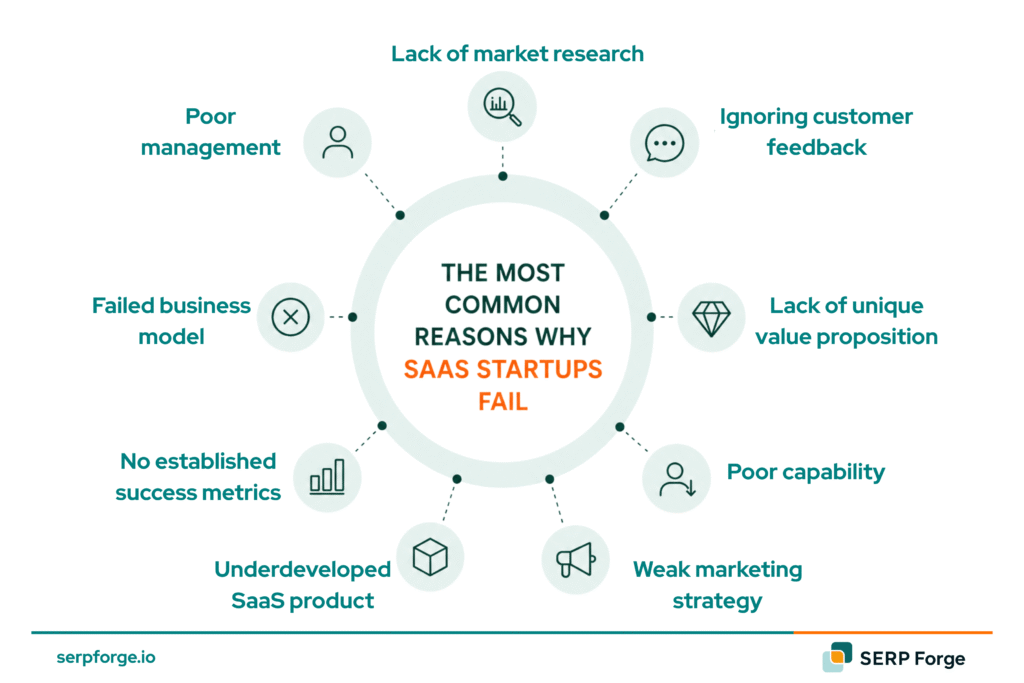
34% of SaaS startups fail due to lack of product-market fit, 22% from ineffective marketing, and 18% from team misalignment making pre-launch validation the single highest-leverage activity.

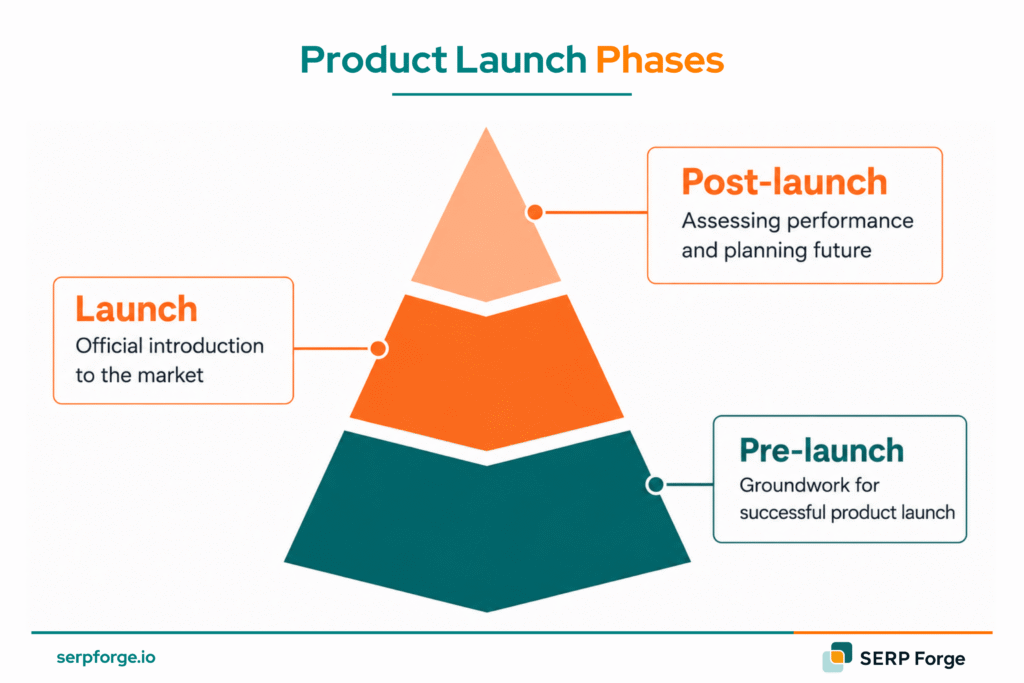
The Three Stages of a Successful SaaS Product Launch
Every successful SaaS launch follows a three-stage arc. Think of it as a runway.
Each stage builds momentum for the next:
1. Pre-Launch Stage
This is the longest and most overlooked stage. It begins the moment you decide to build something and ends the day you go public.
The goal is to arrive at launch day with a validated product, a warm audience, and a functioning marketing and sales infrastructure.
Key pre-launch activities include market research, ICP definition, competitor analysis, and MVP development.
Teams should also focus on beta testing, pricing strategy, waitlist building, content marketing, and sales preparation.
A clear go-to-market strategy helps align positioning, pricing, distribution, and customer acquisition before launch.
2. Launch Stage
The launch stage is typically a defined window, often one to two weeks, during which your product goes from private to public.
This stage is about generating maximum awareness and conversion with the audience you’ve already warmed up.
Key launch activities include Product Hunt submissions, press outreach, and founder-led LinkedIn content.
Teams should also run email campaigns, partner promotions, paid ads, webinars, and community announcements to maximize visibility.
3. Post-Launch Stage
Most SaaS teams underinvest in post-launch. This is when you convert early adopters into advocates, iterate on feedback, refine onboarding, and scale what’s working.
Key post-launch activities include analyzing activation data, improving onboarding, running user interviews, and scaling top acquisition channels.
Teams should also focus on SEO content, case studies, and planning future product updates.
Nearly 45% of SaaS startups fail between months 18 and 24 after launch. This phase is often called the “valley of death” and is usually caused by poor retention rather than weak acquisition.
How to Prepare for a SaaS Product Launch
A great launch is built on a great pre-launch foundation. Here is the step-by-step roadmap to get there.
1. Research the Market
Before writing a single line of code or a single word of marketing copy, invest deeply in market research.
Understand the size of the opportunity, the category dynamics, existing players, and macro trends shaping buyer behavior.
- Use tools like G2, Capterra, and Gartner Peer Insights to map competitive landscapes.
- Analyze search demand using SEO tools to understand what problems customers are actively Googling.
- Study analyst reports, VC investment trends, and job postings in your target segment for signals.
- Join relevant Slack communities, Reddit threads, and LinkedIn groups to observe organic conversations.
2. Identify the Target Customer
Your Ideal Customer Profile (ICP) is not just a demographic; it’s a specific combination of company type, role, problem severity, and buying behavior.
The more precise your ICP, the more targeted (and efficient) your launch will be.
Define: company size, industry, geography, tech stack, team structure, decision-maker roles, budget range, and pain point intensity.
Then build detailed personas for each buying role: the champion, the economic buyer, and the technical evaluator.
3. Validate the Problem
Never assume. Run at least 20 to 30 problem-focused customer interviews before investing in a full build.
The goal is to confirm that the pain you’re solving is real, frequent, urgent, and currently underserved by existing solutions.
- Ask: How do you currently solve this problem? What does it cost you? What would you pay for a better solution?
- Look for patterns in language; the exact words customers use become your marketing copy.
- The PAS copywriting framework helps turn those customer pain points into persuasive marketing messages that drive action.
- Use surveys, landing page experiments, and waitlist sign-up rates as quantitative validation signals.
4. Analyze Competitors
Competitor analysis is not about copying, it’s about finding where existing solutions fall short and positioning your product to fill that gap.
- Audit competitor websites, pricing pages, feature lists, and customer reviews.
- Read negative reviews on G2 and Capterra: these are your positioning opportunities.
- Map the competitive landscape on key dimensions (price, features, ease of use, integrations).
- Identify whitespace, the underserved customer segment or use case you can own.
5. Define the Product Offer
Your product offer includes your pricing model, packaging tiers, free trial or freemium strategy, guarantees, and positioning statement. These decisions should be made before you build, not after.
Key decisions to make: freemium vs. free trial vs. paid-only; flat-rate vs. usage-based vs. seat-based pricing; monthly vs. annual billing; self-serve vs. sales-assisted motion.
6. Build the MVP
The MVP is the smallest, simplest version of your product that delivers the core value proposition to your best-fit customer.
Ruthlessly cut everything that isn’t essential to the primary use case.
- Define the ‘aha moment,’ the single action that makes a user say, ‘I get it, this works.’
- Design your onboarding flow to guide new users to that aha moment as fast as possible.
- Instrument your product with analytics from day one you need data from the first user.
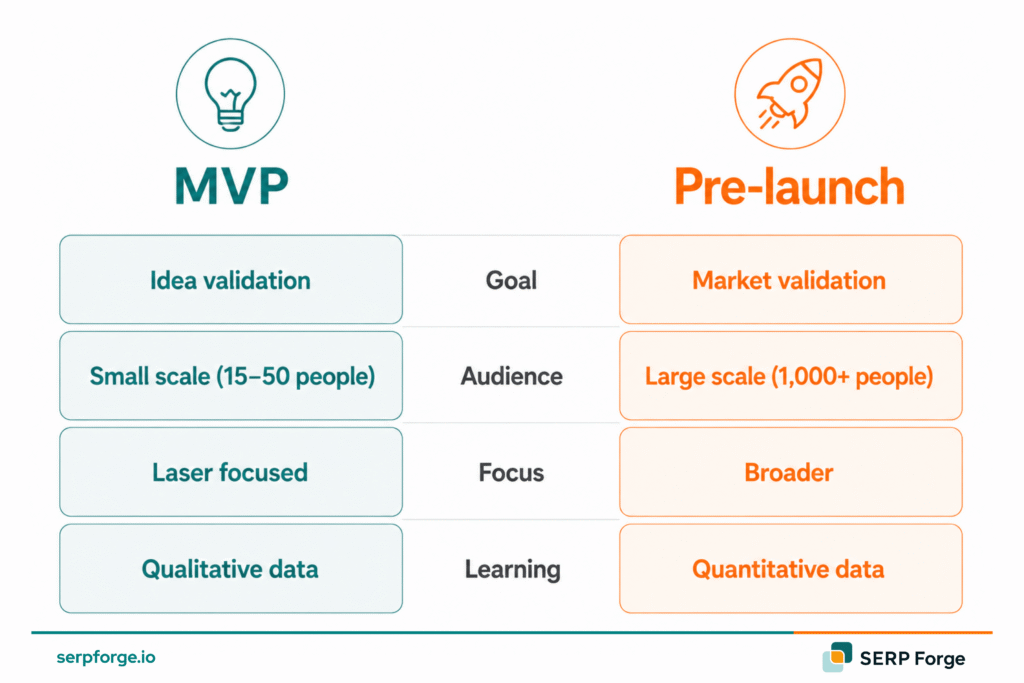
7. Test with Early Users
Run a closed beta or early access program with 20 to 100 hand-selected users from your ICP. The goal is not perfection, it’s learning.
- Recruit beta users from your network, ICP communities, and waitlist.
- Conduct weekly user interviews and watch session recordings to identify friction points.
- Track activation rates and feature usage as leading indicators of retention risk.
- Collect testimonials and case studies from beta users to use as social proof at launch.
8. Set Up Marketing & Sales Systems
Before launch, your full go-to-market infrastructure must be live and tested. This includes:
- Website and landing pages with clear messaging, pricing, and CTAs.
- CRM and lead tracking (HubSpot, Salesforce, or equivalent).
- Email marketing automation for welcome sequences, trial nurture, and onboarding drips.
- Analytics and attribution tracking (Google Analytics 4, Mixpanel, or equivalent).
- Support infrastructure: live chat, help docs, onboarding emails, and escalation paths.
- Sales playbook: talk tracks, objection handling, demo scripts, and proposal templates.
Need help launching your SaaS product?
Explore SERP Forge SaaS SEO to build a stronger growth engine before launch.
9. Launch the Product Publicly
With your product validated, your audience warmed up, and your systems live, you’re ready for the public launch.
Execute across all your priority channels in a coordinated burst ideally within a single launch week to maximize momentum and algorithmic visibility.
10. Measure, Improve, and Scale
The launch is not the finish line. Day one is when the real work begins.
Establish a 90-day post-launch cadence of weekly metric reviews, bi-weekly user interviews, and monthly channel performance audits.
Double down on what works; kill what doesn’t.
Building a SaaS Product Launch Checklist
Use this comprehensive checklist to ensure every team is aligned and ready before, during, and after launch. We recommend converting it into a shared project management document and assigning clear ownership to each task.
Download the SaaS product launch checklist to track product readiness, marketing execution, onboarding, analytics, and post-launch tasks in one place.
SaaS Product Launch Channels That Actually Work
Not all distribution channels are created equal. The best channel depends on your ICP, your ACV, and your team’s strengths. Here are the channels with the highest ROI for SaaS launches in 2025.
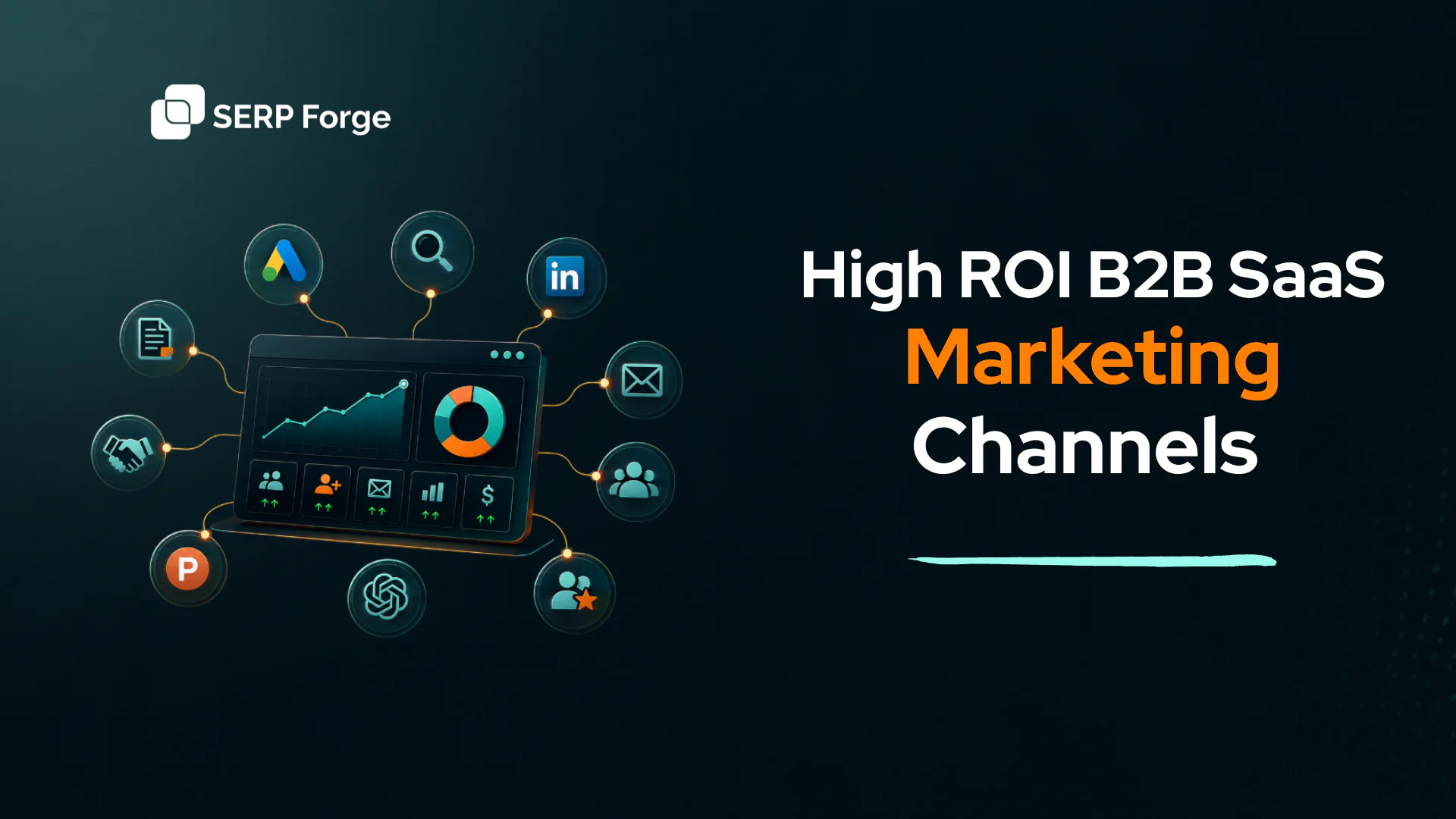
Explore the most effective B2B SaaS marketing channels to identify where your launch efforts will have the greatest impact.
Product Hunt Launches
Product Hunt remains the most efficient way to generate launch-day awareness in the tech and startup ecosystem.
A top-5 ranking on launch day can drive 500 to 2,000+ signups within 24 hours.
- Schedule for a Tuesday, Wednesday, or Thursday launch (highest traffic days).
- Build your hunter network before launch. You need upvotes in the first two hours to gain momentum.
- Respond to every comment on launch day; engagement boosts your ranking.
- Prepare a special offer exclusively for Product Hunt visitors to increase conversion.

LinkedIn Founder-Led Distribution
In 2025, LinkedIn will be the highest-ROI organic channel for B2B SaaS. Founder-led content authentic posts documenting the build journey, sharing lessons, and announcing milestones consistently outperforms branded content.
- Start posting 6 to 8 weeks before launch to build an audience and establish credibility.
- Share the behind-the-scenes story: the problem you’re solving, why you’re building it, and what you’ve learned.
- Use the launch week to post a product story thread that drives traffic to your Product Hunt listing and website.
SEO and Content Marketing
SEO is a long game, but content published pre-launch begins compounding before you go live. Targeting high-intent keywords related to your category, competitor alternatives, and specific pain points can drive consistent, qualified traffic.
- Publish 4 to 6 foundational blog posts before launch targeting primary and secondary keywords.
- Create comparison pages (e.g., ‘Your Product vs. Competitor’) for high-intent searchers.
- Build a free tools or template page to generate backlinks and newsletter subscribers.
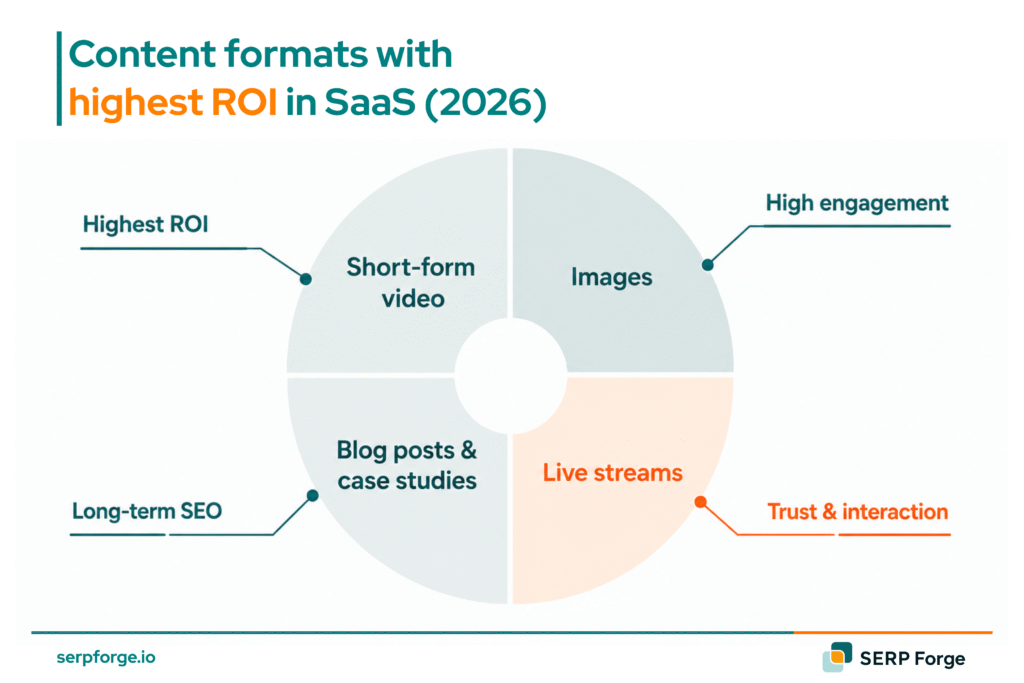
SaaS Communities and Forums
SaaS-specific communities are goldmines for early adopters, feedback, and word-of-mouth. The key is to give before you take a contribution genuinely before promoting your product.
- Relevant communities: Indie Hackers, Hacker News (Show HN), SaaS Growth Hacks on Slack, relevant subreddits (r/SaaS, r/entrepreneur), and niche industry forums.
- Share your launch story as a case study or post-mortem; these consistently attract engagement.
- Offer community members exclusive early access or a discount code for authentic endorsement.
Influencer and Creator Partnerships
B2B SaaS influencer marketing has matured significantly. Partnerships with YouTubers, newsletter operators, podcast hosts, and LinkedIn creators in your niche can deliver highly targeted reach.
- Target micro-influencers (5K to 50K followers) with highly engaged, niche audiences over mega-influencers.
- Offer a revenue share or lifetime deal in exchange for authentic reviews.
- Provide influencers with early access, a clear briefing, and creative freedom.
Paid Ads for SaaS Launches
Paid ads amplify what’s already working; they should not be used to test product-market fit. Use them to scale channels that have proven organic traction.
- Google Search Ads: target high-intent keywords like ‘[competitor] alternative’ or ‘[problem] software’.
- LinkedIn Ads: use for ABM campaigns targeting specific company sizes, industries, or job titles.
- Retargeting: run retargeting campaigns to visitors who didn’t convert during launch week.
Email Marketing Campaigns
Your email list is your most valuable owned channel. A well-built pre-launch waitlist of 500 to 2,000 engaged subscribers can generate significant Day 1 signups and trial activations.
- Build your list using a pre-launch landing page with a clear value offer (early access, discount, exclusive content).
- Send a 3-email launch sequence: teaser (1 week before), launch day (go live), and follow-up (3 days after).
- Segment your list by engagement and send personalized offers to your most engaged subscribers.
Affiliate and Partner Launches
Partner-led distribution can dramatically extend your reach without proportional increase in marketing spend.
Integration partners, agency partners, and affiliate programs create ongoing referral flywheels.
- Identify complementary tools your ICP already uses and propose co-marketing or integration partnerships.
- Launch an affiliate program with a competitive commission structure (20 to 30% recurring is the B2B SaaS standard).
- Working with agencies that serve your ICP they often prefer recommending products that solve client problems.
SaaS Product Launch Timeline
After working with multiple SaaS startups and supporting successful product launches, we created a practical launch timeline checklist based on strategies and workflows that consistently delivered results.
This checklist covers the key stages, tasks, and launch activities teams should focus on before, during, and after launch. To access the complete SaaS Product Launch Checklist PDF, simply fill out the form below.
This timeline provides a practical, week-by-week framework for a well-coordinated launch.
Download the Complete SaaS Product Launch Checklist
Adjust durations based on your product complexity and team size:
Metrics to Track After a SaaS Product Launch
Data without context is noise.
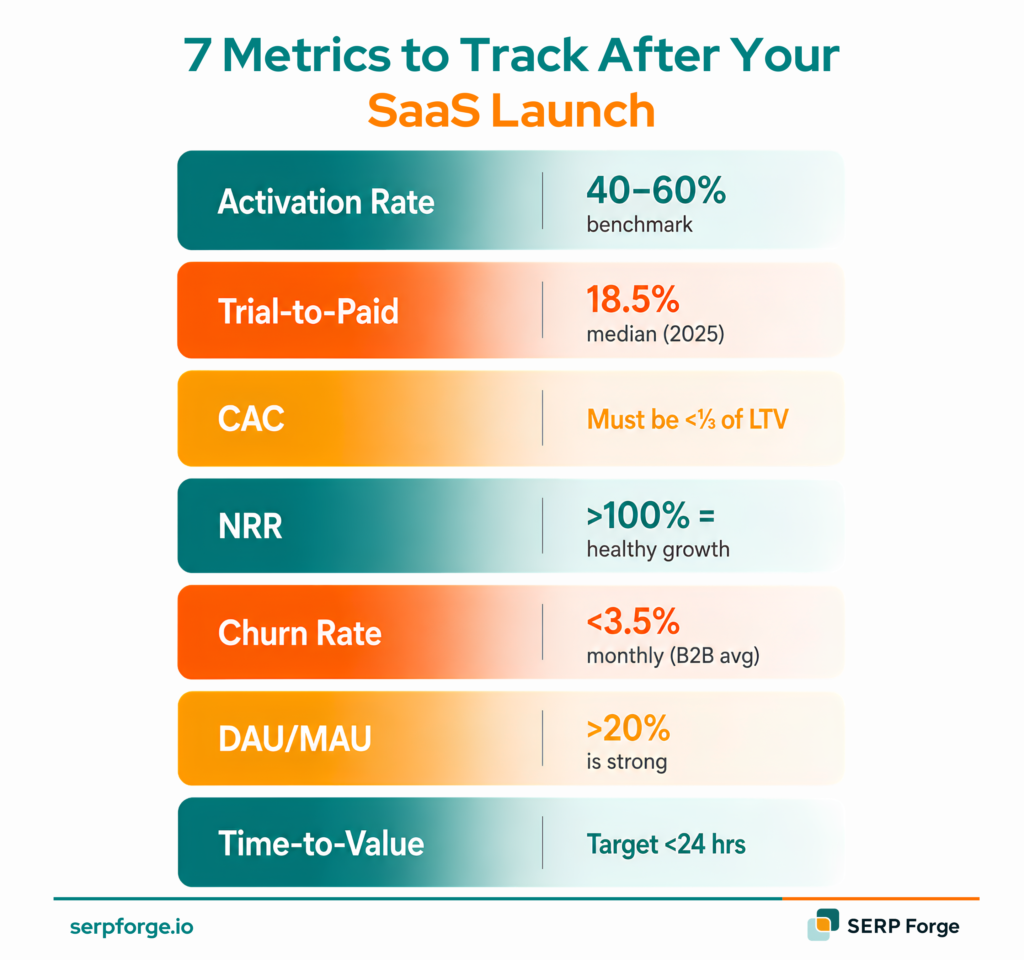
Track these seven metrics obsessively in the 90 days following your launch, and use them to drive every product and marketing decision:
| Metric | What It Measures | Why It Matters | Benchmark |
|---|---|---|---|
| Activation Rate | Percentage of users who complete the core setup or first-value action. | Indicates whether onboarding is successfully helping users reach value. | 40%–60% (varies by product type) |
| Trial-to-Paid Conversion Rate | Percentage of trial users who upgrade to a paid plan. | The most direct post-launch indicator of revenue generation. | 2%–5% (freemium); 15%–25% (opt-in trial) |
| Customer Acquisition Cost (CAC) | Total sales and marketing spend divided by the number of new customers acquired. | Measures the economic efficiency and scalability of acquisition channels. | Should be less than one-third of LTV |
| Net Revenue Retention (NRR) | Revenue retained plus expansion revenue from existing customers. | Shows long-term customer value, retention, and expansion potential. | Above 100% indicates healthy SaaS growth |
| Churn Rate | Percentage of customers who cancel during a specific period. | Provides an early warning signal for product-market fit and retention issues. | Below 2% monthly for B2B SaaS |
| Product Engagement Metrics | DAU/MAU ratio, feature adoption, session depth, and usage frequency. | Reflects whether users continue to find value in the product. | DAU/MAU above 20% is considered strong |
| Time-to-Value (TTV) | Time required for a user to achieve their first meaningful outcome. | Shorter TTV generally leads to higher activation and lower churn. | Less than 24 hours for SMB SaaS products |
What are the Common SaaS Product Launch Mistakes Founders Make?
Most SaaS launch failures are predictable and preventable.
These are the seven mistakes we see most often and how to avoid them:
Launching Without Distribution
Building a great product is not enough. If you haven’t built an audience, cultivated a waitlist, or established relationships with distribution partners before launch day, you’ll be shouting into the void. Distribution must be built in parallel with the product, not after it. SaaS marketing services can help you build that audience and distribution channel before launch day.
The fix: Start your content engine, community presence, and waitlist at least 90 days before launch.
Overbuilding Before Feedback
The temptation to build ‘just one more feature’ before launching is real — and dangerous.
Overbuilding delays feedback, wastes engineering resources on features users may not want, and creates a bloated, confusing product experience for early users.
The fix: Define your MVP ruthlessly. Ship when you can deliver the core value — not when the product feels complete.

Ignoring Onboarding Experience
Your onboarding flow is your most important retention lever. If users can’t reach the aha moment within their first session, they will churn — regardless of how powerful your underlying product is. Most SaaS teams treat onboarding as an afterthought.
The fix: Map the ideal onboarding journey before you write a single line of code. Design onboarding as a core product feature, not a layer added at the end.
Poor Pricing Communication
Vague, confusing, or hidden pricing is one of the most common conversion killers in SaaS. Buyers want to understand exactly what they’re getting and what they’ll pay before they invest time in a trial or demo.
The fix: Publish clear, transparent pricing. Test multiple pricing formats. Make it easy to compare tiers and understand the value of upgrading.
Weak Demo Experience
A slow, buggy, or unimpressive demo whether live or self-serve can undo months of marketing. First impressions in SaaS are deeply tied to demo quality. Buyers equate a poor demo experience with a poor product.
The fix: Invest in a polished, pre-configured demo environment with realistic sample data. Practice live demos until they’re flawless. Create an interactive product tour for self-serve exploration.
No Post-Launch Content Plan
Many SaaS teams exhaust their content budget and energy on launch day and go silent afterward.
This leaves a gap in momentum exactly when you need to sustain it. Post-launch is when your SEO content starts to rank, when case studies build trust, and when ongoing thought leadership drives inbound.
The fix: Plan 90 days of post-launch content before launch day. Assign owners. Build a content calendar and treat it as a product roadmap.
Focusing Only on Acquisition
Acquiring a new user is five to seven times more expensive than retaining an existing one. SaaS teams that pour all their energy into top-of-funnel acquisition while ignoring activation, retention, and expansion leave enormous revenue on the table.
The fix: Balance your growth levers. For every dollar spent on acquisition, invest proportionally in activation (onboarding), retention (customer success), and expansion (upsell programs).
Conclusion
A successful SaaS product launch is not a single event, it’s a carefully orchestrated process that begins months before you go public and continues for months afterward.
The teams that win are the ones that treat launch as a discipline: researching deeply, preparing methodically, executing with focus, and iterating relentlessly.
Use this guide as your master reference. Download the SaaS product launch checklist, build your pre-launch timeline, choose your priority channels, and track the metrics that matter.
The best time to start preparing for your launch was three months ago. The second-best time is today.
FAQs
How do you launch a SaaS product successfully?
Validate product-market fit, build a clear GTM strategy, launch an MVP, and align product, marketing, and sales teams around the same goals.
What is included in a SaaS product launch plan?
A SaaS launch plan includes market research, ICP definition, positioning, MVP planning, GTM execution, onboarding, and analytics tracking.
How long does a SaaS product launch take?
Most SaaS launches take 6–12 months, including planning, launch execution, and post-launch optimization.
What is the best SaaS launch strategy?
The best strategy depends on your audience and pricing model, but common channels include SEO, LinkedIn, Product Hunt, outbound sales, and partnerships.
How much does a SaaS launch cost?
A SaaS launch can cost under $5,000 for bootstrapped startups or over $250,000 for large-scale launches with paid marketing and PR.