


Product-led growth is a go-to-market strategy where the product helps users experience value before they speak to sales. To say in simple words what is product led growth, users sign up, try the product, complete a useful action, invite others and decide whether it is worth paying for.
But PLG needs more than a free trial or SaaS freemium model. It depends on low-friction signup, fast time to value, self-serve onboarding, product-qualified lead signals and upgrade paths that appear when users reach real limits.
For larger accounts, sales enters after product behaviour shows buying intent. That is where PLG becomes a revenue system instead of just a signup engine.
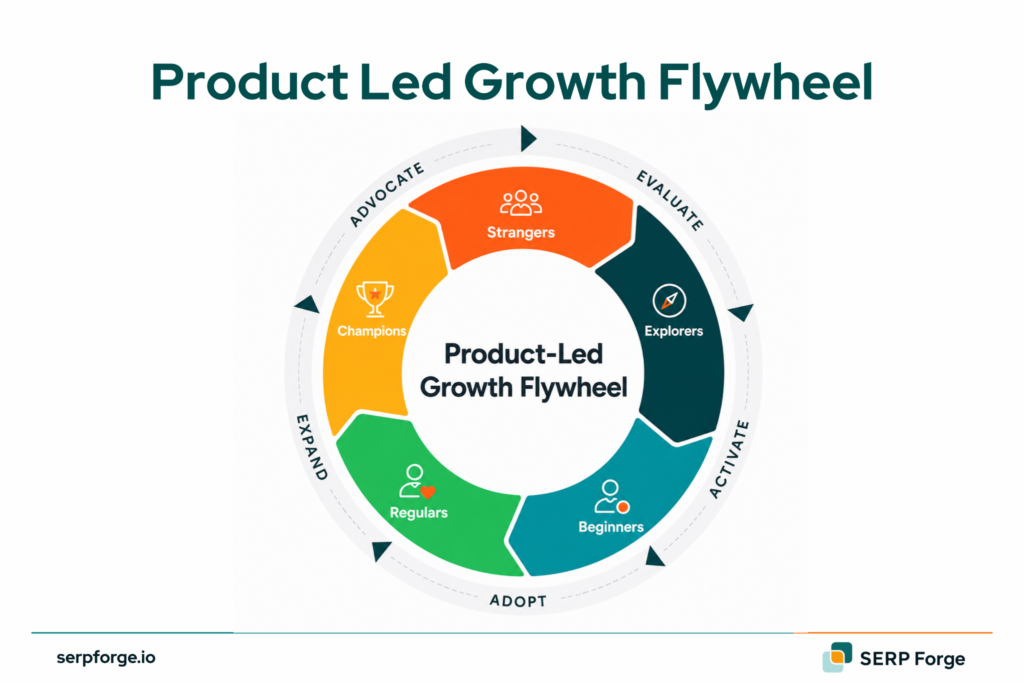
How Does Product-Led Growth Work in SaaS?
Once you understand what product-led growth is, the next question is how product usage turns into revenue.
Product-led growth works by moving users from first access to repeat value.
A useful PLG journey usually follows this path:
Discovery → Signup → Activation → Habit → Upgrade → Expansion
Each stage below needs a product action that moves the user closer to repeat use or payment:
| PLG Stage | What Needs to Happen |
|---|---|
| Discovery | The right users find the product through search, sharing, referrals or product exposure |
| Signup | Users enter without avoidable friction |
| Activation | The first useful outcome happens quickly |
| Habit | Users return and repeat the core workflow |
| Upgrade | Paid value appears at the right limit or need |
| Expansion | More seats, usage, teams or workflows grow the account |
The risk comes after signup. When users create accounts but fail to reach value, PLG creates inflated user numbers instead of revenue. A useful PLG strategy tracks which users activate, which actions predict retention and which limits create upgrade demand.
Product-Led Growth vs Sales-Led Growth
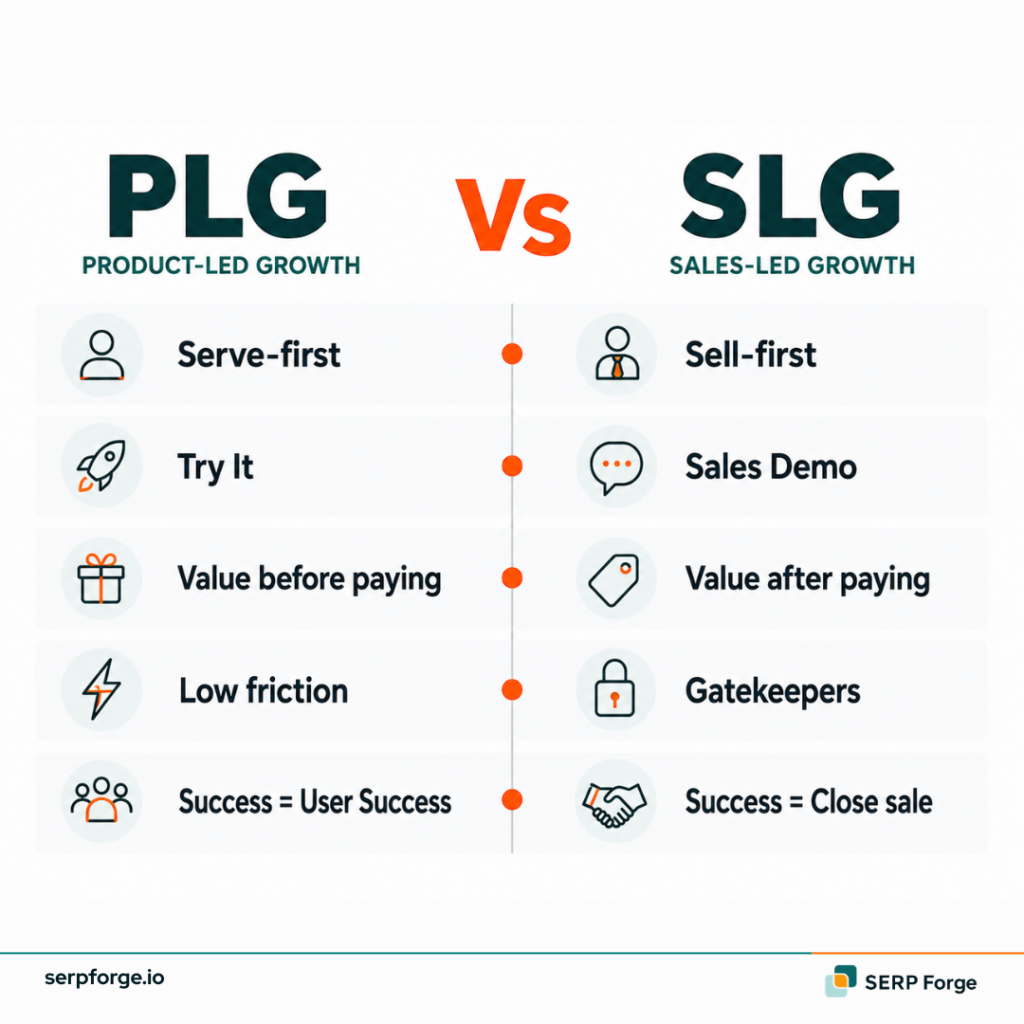
Product-led growth vs sales-led growth comes down to how value is proven and when sales enters the journey.
In PLG, users try the product first. In sales-led growth, buyers usually speak with sales before they experience the product in depth. Here’s the difference:
| Factor | Product-Led Growth | Sales-Led Growth |
|---|---|---|
| First value proof | Product experience | Demo, sales process or proof of concept |
| Buyer entry | Self-serve signup, free plan or trial | Sales conversation or lead qualification |
| Best fit | Fast-value products with repeat use | Complex products with high buying risk |
| Pricing | Transparent, tiered or usage-linked | Custom, negotiated or enterprise-led |
| Sales role | Expansion, procurement and larger accounts | Education, qualification and deal control |
| Main risk | Signups without activation | Long sales cycles and higher CAC |
PLG can reduce acquisition cost when users evaluate the product independently. Sales-led growth helps when the buying process needs education, compliance checks, technical validation or senior approval.
Most serious B2B SaaS teams now blend both models. The product creates early proof, then sales helps accounts that show meaningful usage and commercial potential.
When Does a Product-Led Growth Strategy Make Sense?
A product led growth strategy makes sense when users can reach one useful outcome before they need a demo, custom setup or procurement support.
The product needs one outcome that users can reach quickly. That outcome could be scheduling a meeting, creating a dashboard, editing a design, automating a workflow or inviting a teammate into a shared workspace.
Use these signals to judge whether PLG fits your product:
- Short Time to Value: Users can complete a useful action soon after signing up.
- Repeat Workflow: The product supports a task users need to perform regularly.
- Self-Serve Setup: Users can get started without lengthy implementation or sales support.
- Visible Product Value: The benefit becomes clear through the product experience itself.
- Natural Upgrade Limits: Usage, seats, features or controls create a genuine reason to pay.
- Trackable Product Behaviour: Your team can measure actions at both user and account level.
- Built-In Sharing Loop: Using the product naturally introduces it to teammates or new users.
PLG becomes harder when every account needs custom pricing, heavy implementation, deep procurement or long security review before value appears. In those cases, a hybrid model often fits better.
What Are the Main Product-Led Growth Models?
PLG models decide how users enter the product and when payment begins. The right model depends on how fast users reach value, how often they return and where paid demand appears.
Freemium, free trials, reverse trials, usage-based entry and hybrid PLG reduce buying friction in different ways.
Here is where each model fits best:
Freemium
Users stay on a permanent free plan until they reach a seat, feature, usage or storage limit. It works best for broad markets where the product supports repeat use.
Free Trial
Users receive premium access for a fixed period and pay when the trial ends or after reaching a clear value milestone. This suits products that can prove value quickly.
Reverse Trial
Users start with premium features before moving to a limited free plan. It works well when users need to experience the full product before understanding why they should pay.
Usage-Based Entry
Users begin with free or low-cost consumption and pay as usage or credit needs increase. This model fits API, AI, data and infrastructure products.
Hybrid PLG
Users can enter through a self-serve path, while sales supports larger or more complex opportunities. It is a strong fit for B2B SaaS companies serving a mix of smaller users and enterprise accounts.
What Has Changed in Product-Led Growth in 2026?
PLG in 2026 is shaped by AI-assisted discovery, faster buyer research and more pressure on product experience. HubSpot reports that 65% of startup founders have increased AI investment since 2024, which shows how quickly AI has entered GTM execution across startup teams.
That shift affects PLG directly. SaaS teams can use AI to personalise onboarding, analyse product behaviour and time sales handoffs with more context. The teams that benefit most are the ones using AI to reduce setup time, improve activation paths and identify sales-ready accounts earlier.
These changes show up in four parts of the PLG system:
- Strategic Freemium: Free tiers must deliver enough value to drive adoption while creating a clear reason to upgrade.
- Product-Led Sales: Sales should enter when product usage signals account fit, buying intent or expansion potential.
- AI-Assisted Onboarding: Early user behaviour can shape the setup path, recommended workflows and guidance shown next.
- Real-Time Analytics: Teams need faster visibility into activation, drop-offs and the behaviours linked to conversion.
Forbes reports that 78% of IT leaders faced unexpected charges tied to AI or consumption pricing, while 61% cut planned projects because of unplanned SaaS price increases. That puts more pressure on PLG teams to design free access, credits, usage limits and upgrade paths with clearer economics.
How Do You Find the Aha Moment in PLG?
Find the aha moment by comparing retained users with users who leave.
Look for the first action or sequence that appears often among users who keep returning. That action needs to represent real product value.
Examples:
Scheduling tool → First meeting booked through a shared link
Analytics tool → First dashboard shared with a teammate
Automation tool → First workflow runs successfully
Design tool → First file shared for feedback
Writing tool → First document improved and exported
Project tool → First team workflow completed
Use cohort analysis to test the signal. Users who reach the aha moment retain better than users who skip it. If both groups retain at the same rate, the signal is weak.
Once the aha moment is proven, onboarding guides users toward it with fewer steps and less setup friction.
How Do You Reduce Time to Value?
Reduce time to value by removing every step that delays the first useful outcome.
Start with the path from signup to activation. Then check each screen, field, permission, setup choice and instruction. Keep only what helps the user complete the first meaningful task.
Useful TTV reducers include:
- Social login or SSO
- Sample data
- Templates
- Role-based setup
- AI setup prompts
- Contextual guidance
AI can make onboarding faster when it configures the product around the user’s goal. Instead of asking every user to follow the same checklist, the product can ask what they want to achieve and then prepare the right workspace, template or workflow.
How Does Product-Led Onboarding Work?
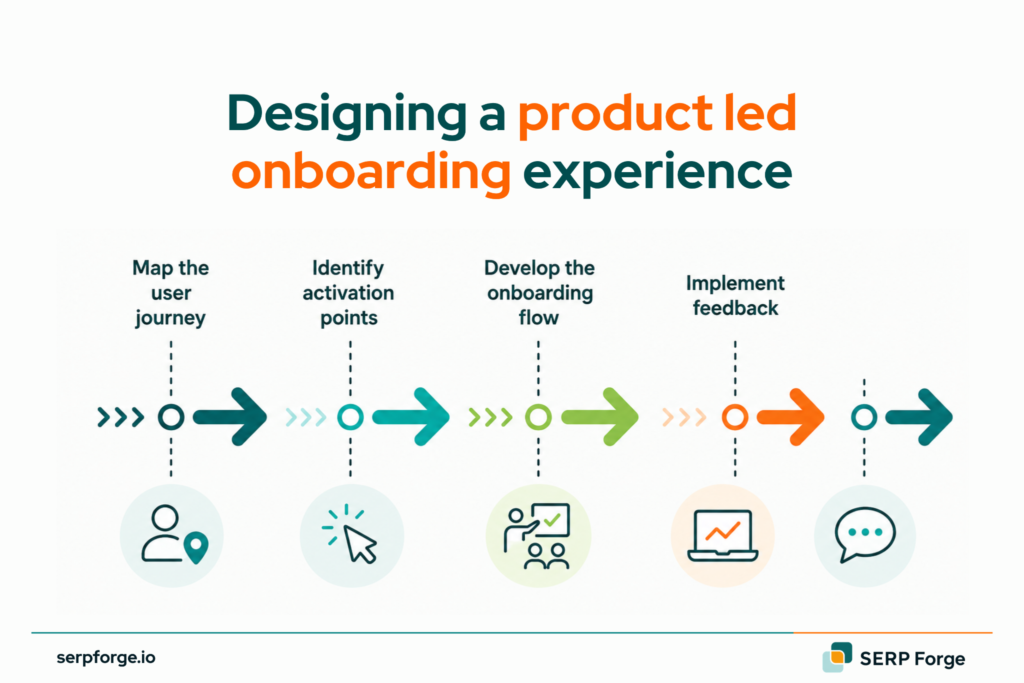
Product-led onboarding guides users toward the action that predicts retention.
AI is changing onboarding from a fixed checklist into a more adaptive product path. HubSpot reports that 86% of founders said AI had a positive impact on their company’s GTM strategy, which supports the shift toward AI-assisted setup, product guidance and sales timing.
In PLG, that means onboarding can respond to role, goal, first action and account behaviour. The product can guide a user toward the right template, workflow or setup path instead of showing every feature at once.
Use onboarding to answer three questions:
- What is the user trying to achieve?
Use role, use case or goal selection to shape the setup path.
- What action proves value?
Guide the user directly towards the product’s aha moment.
- What could stop them getting there?
Add templates, prompts or contextual help at the point of friction.
Good onboarding gives users the first useful result before introducing advanced workflows, integrations or paid features.
What Are Product-Qualified Leads?
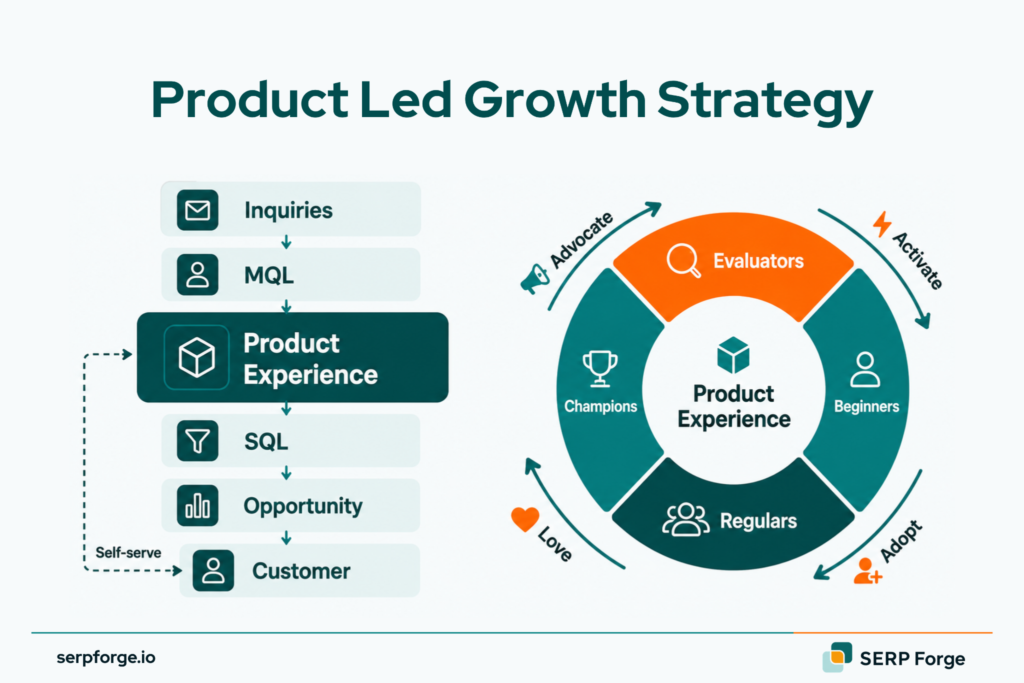
Product-qualified leads are users or accounts that show buying intent through product behaviour.
The best PQL definitions combine fit and usage. A user may be active, but the account still needs budget, company fit and expansion potential. A large company may fit the ICP, but sales outreach will struggle if product usage is shallow.
Use four signal groups:
Comes back: Frequent use shows the product is becoming part of the user’s routine.
Goes deeper: Core features are used in a meaningful way, not just tested once.
Spreads across the account: More teammates or departments begin using the product.
Matches the ICP: The account has the right size, need and commercial potential.
PQL = Frequency + Depth + Breadth + Fit
A good PQL model helps sales prioritise accounts with evidence. Instead of chasing every signup, sales can focus on teams that already experienced value and now need paid scale, governance or procurement support.
How Do You Build Upgrade Paths That Feel Natural?
Build upgrade paths around the moment when paid access helps users continue the job they already care about.
The upgrade prompt appears where the need appears. A team near a seat limit needs a team plan. A heavy API user needs higher credits. An admin reviewing permissions may need governance features.
Common upgrade triggers include:
- Seat limits
- Usage caps
- Storage limits
- Message history
- Advanced reporting
- Premium integrations
- Admin controls
- Security features
- Workflow automation
- Team permissions
- Higher AI credits
Upgrade paths work better when users understand what they gain. The paid plan connects to the next workflow, larger team need or measurable outcome.
How Do You Build a Product-Led Growth Strategy?
A product-led growth strategy connects user value with product behaviour, pricing and revenue.
Use questions to build it.
Which User Can Reach Value Fastest?
Start with the user segment that can complete the core workflow with the least friction.
Review customer interviews, product usage, retention data and support tickets. Choose one priority user group before designing the PLG journey.
What Product Action Predicts Retention?
Find the action that retained users complete early.
This becomes the activation milestone. Build onboarding, prompts and templates around that action instead of sending users through a broad feature tour.
Where Does Signup Friction Delay Value?
Review every step between landing page and first useful outcome.
Remove fields, setup screens and permissions that can wait until after activation. Ask for information when it improves the user journey.
Which Usage Signals Show Buying Intent?
Build the PQL model from frequency, feature depth, team breadth and account fit.
Then test whether those signals predict payment, retention and expansion.
Where Does Sales Enter the Journey?
Sales enters when product usage creates a commercial reason.
Useful triggers include team growth, security interest, heavy usage, admin needs, procurement questions or enterprise account fit.
Which Product Limit Creates Upgrade Demand?
Choose limits that connect paid access with the user’s next stage of value.
Seats, credits, storage, integrations, reporting, admin controls and usage volume can all create upgrade demand when placed at the right moment.
Which Metrics Prove PLG Is Working?
Track activation, time to value, PQLs, free-to-paid conversion, retention, expansion and NRR.
Those metrics show whether product usage is turning into retained revenue.
Which Product-Led Growth Metrics Matter Most?
PLG metrics need to show whether users reach value, return, pay and expand. Signups and page views show entry, while activation, PQLs, free-to-paid conversion, retention and expansion show whether usage is turning into revenue.
Signups and page views show entry, but activation, product-qualified leads, free-to-paid conversion, retention and expansion show whether users reached value and kept using the product.
Use this lifecycle scorecard:
| PLG Stage | Metric | What It Reveals |
|---|---|---|
| Activation | Activation rate | Whether users reach the core value action |
| Speed | Time to value | How fast value appears after signup |
| Qualification | PQLs | Which users or accounts show buying intent |
| Conversion | Free-to-paid rate | Whether product value creates payment |
| Retention | Retention rate | Whether users keep returning |
| Expansion | Expansion revenue and NRR | Whether accounts grow over time |
| Virality | Viral coefficient | Whether users bring in more users |
Activation rate formula:
Activated users ÷ New users × 100
Free-to-paid formula:
New paid customers ÷ Eligible free users × 100
Viral coefficient formula:
Average invitations per user × Invitation conversion rate
NRR formula:
Starting revenue + Expansion – Contraction – Churn ÷ Starting revenue × 100
Read the metrics together. High signup volume means little when activation stays weak. High activation also needs a paid value gap, or users may enjoy the product without upgrading.
What Are the Best Product-Led Growth Examples?
Relevant product led growth examples show how the product creates its own distribution, activation or expansion loop.
Each example below teaches a different PLG mechanic:
- Growth through collaboration: Slack becomes more valuable as teammates join the same workspace. Figma and Miro follow a similar pattern by pulling more roles into shared files, boards and sessions.
- Growth through product sharing: Calendly turns every booking link into distribution. Dropbox uses referrals and extra storage to give users a reason to bring others in.
- Growth through deeper usage: Zapier expands as users connect more tools and build more workflows. Grammarly starts with individual utility, then creates paid demand through advanced writing support.
- Growth through account expansion: Atlassian often enters through one team using Jira or Confluence, then spreads across departments and into larger enterprise plans.
Why Do Product-Led Growth Strategies Fail?
Product-led growth strategies fail when signup volume grows faster than activation, paid conversion and retained usage.
The most common failure pattern starts with easy signup and weak activation. Users enter quickly, but the product asks for too much setup before the first useful result. That creates a large top of funnel with little revenue movement.
Watch for these failure points:
- No precise activation milestone
- Freemium limits with no upgrade logic
- Onboarding built around features instead of outcomes
- PQL scores based on shallow activity
- Sales handoffs without usage context
- Pricing that blocks natural expansion
- Analytics that cannot explain user drop-offs
- Product usage that stays isolated inside one user
A PLG motion needs one measurable value event, one upgrade path and one shared view of product behaviour across product, marketing and sales.
Is Product-Led Growth Right for Your SaaS?
Use PLG when the product can carry part of the buying journey by itself.
The model works best when users can start quickly, understand the workflow and reach value before heavy sales involvement.
Use this readiness check. Look for each statement that is true for your product:
- Users can reach a useful outcome quickly
- The product supports broad demand and repeat use
- Pricing is transparent, with a clear path to expansion
- Users can get started without guided implementation
- Product events are tracked at user and account level
- Sharing or collaboration naturally brings in more users
- Value depends on heavy setup
- The buyer group is very narrow
- Every deal requires custom pricing or negotiation
- Users need hands-on onboarding to make progress
- Usage data is incomplete or unreliable
- Product use stays isolated within one user or team
More checks in the first list usually point to a stronger PLG fit.
A hybrid model often works better for products with high ACV, multiple stakeholders or technical implementation. Users can still enter through the product, while sales supports expansion, security, procurement and enterprise rollout.
Build Product-Led Growth Around Usage That Converts
Product-led growth turns into revenue when users reach value early and keep coming back.
Free access may bring users into the product, but usage alone does not prove commercial intent. The real signal appears when users complete the activation action, invite others, hit a meaningful limit or show behaviour that points to paid need.
If signups are growing but activation, product-qualified leads or upgrades are not improving, the PLG motion needs a closer look. The next step is to find where users slow down, where paid value appears and whether the right accounts have a clear reason to expand.
Frequently Asked Questions
What does PLG mean in SaaS?
PLG means product-led growth.
In SaaS, it means the product helps drive acquisition, activation, retention and expansion through direct user experience.
What is an example of product-led growth?
Calendly is a simple product-led growth example.
A user sends a scheduling link, the recipient books a meeting and that interaction exposes another person to the product.
Is freemium the same as product-led growth?
Freemium is one PLG access model.
Product-led growth is broader because it also includes activation, usage signals, upgrade paths, product-qualified leads, retention and expansion.
What is product-led sales?
Product-led sales uses product behaviour to decide when sales contacts a user or account.
Sales enters after signals such as team adoption, heavy usage, security interest or account-level fit.
What is the difference between PLG and SLG?
PLG lets users experience value through the product before sales enters.
SLG relies more on sales conversations, demos, qualification and relationship-led buying before deep product use.
Which SaaS products are best suited for PLG?
PLG fits SaaS products with short time to value, repeat use, self-serve setup, trackable product behaviour and natural upgrade triggers.
Collaboration, workflow, productivity, developer and automation products often fit this model.
Why do PLG users sign up but never convert?
Users often fail to convert when they never reach the activation milestone or cannot see a valuable reason to upgrade.
Poor-fit acquisition, slow onboarding and weak paid limits can also reduce conversion.