


Link exchange still happens in serious link building teams.
Every serious link builder knows swaps still happen behind guest posts, listicles, resource pages and partner networks. The real question in 2026 is whether the exchange looks like editorial collaboration or a pattern Google can discount.
Hunter says around 80% of its links come from relationships and 66% of replies come from follow-ups. That matches how link exchange works at scale: partner lists, page matching, anchor control, follow-ups and link tracking.
By the end, you should know which swaps are worth doing, which ones to walk away from and how to manage link exchange like a real outreach system.
What Is Link Exchange?
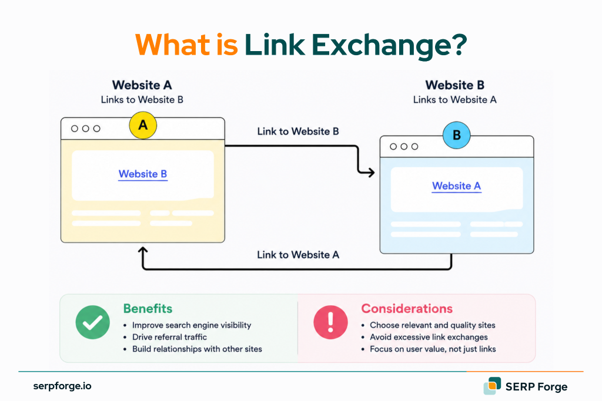
Link exchange is an agreement where two websites place links to each other’s pages.
It is also called link swapping, reciprocal linking or reciprocal link exchange. In SEO, the aim is usually to earn backlinks, referral traffic, search visibility and partner exposure.
A basic exchange looks like this:
- Site A links to Site B
- Site B links back to Site A
That can happen across blog posts, partner pages, guest posts, listicles and resource hubs.
The risk starts when the exchange becomes predictable.
A natural link exchange has a real reason to exist on the page. For example, a CRM tool may link to an email platform it integrates with. The email platform may later mention that CRM inside a sales workflow guide.
A weak link swap usually looks different. The article may feel built around the backlink, with forced anchor text, thin topical connection and the same domains appearing across several swaps.
We believe link exchange is useful only when the link still makes sense without SEO value.
If the only reason for the link is the private deal, the placement is already weak.
What Does Google Say About Link Exchange?
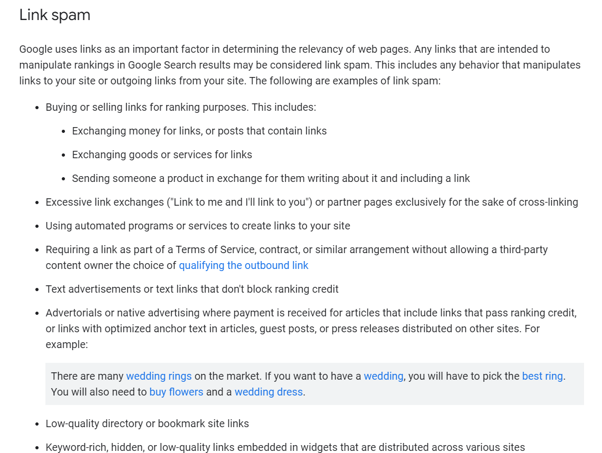
Google’s spam policies mention excessive link exchanges and partner pages made mainly for cross-linking as link spam.
That wording matters. Google is concerned with scale, intent, page context and link patterns.
Natural reciprocal links happen across the web. A brand may reference a partner, a tool may cite an integration and a publisher may link back to a source it later uses.
Risk increases when exchanges are built to influence PageRank.
High-risk patterns include:
- Repeated “link to me and I’ll link to you” deals
- Partner pages created mainly for cross-linking
- Exact-match anchors across many swaps
- Paid access to link exchange groups
Backlinko’s analysis of 11.8 million Google results found that the number one result has 3.8 times more backlinks than positions two to ten. That explains why SEOs still care about links.
That pressure is why link exchange often becomes a shortcut.
The issue is rarely one relevant swap. The problem appears when a site builds a visible exchange footprint across partners, anchors and placement pages.
Before approving a link swap, check four things:
- Reader value
- Topic match
- Anchor fit
- Placement quality
If those checks feel weak, the exchange should stay out of the campaign.
Which Types of Link Exchange Are Safe or Risky?
Link exchange has several formats.
Some look like normal editorial collaboration. Others look like a link network once you inspect the pattern.
Reciprocal Exchange
A reciprocal exchange is the direct version.
Site A links to Site B and Site B links back to Site A.
This can make sense when both brands genuinely connect. A SaaS product may link to an integration partner. The partner may link back from its app marketplace page.
The risk increases when the same two domains swap repeatedly.
Watch for:
- Repeated swaps between two domains
- Commercial anchors on both sides
- Thin articles built around links
- No reason for readers to click
A reciprocal exchange should feel like a natural reference.
If both links look added only to complete a deal, the swap becomes harder to defend.
ABC Exchange
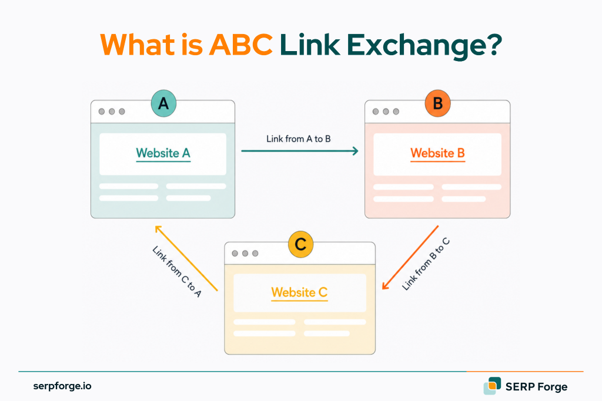
An ABC exchange uses three websites.
Site A links to Site B. Site B links to Site C. Site C links back to Site A.
Many link builders use this structure because it looks less direct than a reciprocal swap.
The setup can be useful when every website is relevant and every page has a real reason to link. It becomes risky when the same middle domains appear across too many exchanges.
Before using an ABC exchange, check:
- The middle site’s traffic trend
- Its outbound link pattern
- Its topic focus
- Its past exchange history
The middle domain should never become the dumping ground for every deal.
That is where ABC exchanges start looking like a network.
Guest Post Swaps
Guest post swaps happen when two partners exchange content placements.
One site publishes your article with a contextual link. You publish their article or place their link inside an existing page.
This can be useful when the content is genuinely helpful.
The article should match the site’s audience. The link should support the section. The anchor should read naturally.
Before agreeing, check:
- Topic fit
- Editorial review
- Anchor context
- Target page quality
A guest post swap should improve the article.
A thin article created only to host a backlink is a weak placement, even when both domains look decent.
Private Influencer Networks
Private influencer networks are groups where SEOs, site owners and link builders trade placements.
These groups often run through Slack, Facebook, LinkedIn or private sheets. Members may share domains, niches, DR, traffic and available link slots.
The appeal is speed.
A link builder can find exchange partners faster than cold outreach.
The risk is shared footprint.
If many members use the same sites, anchors and placement formats, the network becomes easier to spot. A private group can also decline as weaker domains enter over time.
Treat every domain separately.
A poor site still needs manual review, even inside a private group.
Directory and Resource Page Swaps
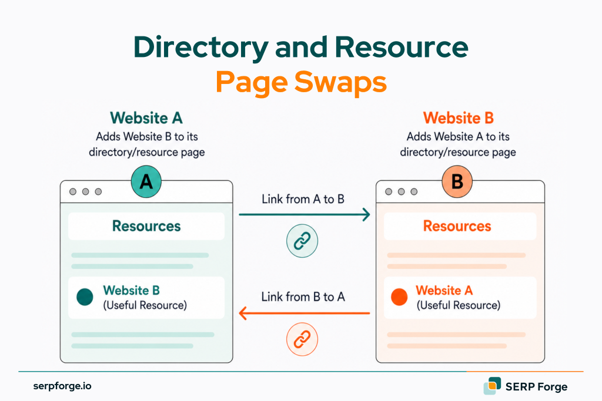
Directory and resource page swaps happen when two sites add each other to lists or resource hubs.
This can make sense when both sites serve the same audience.
For example, a marketing agency may list a CRM tool in a sales stack resource. The CRM may list the agency as an implementation partner.
Risk appears when the page exists mainly to trade links.
Check whether the page has:
- Real editorial purpose
- Useful categories
- Relevant outbound links
- Organic traffic
A resource page with hundreds of unrelated links is a weak exchange target.
How Do You Run Link Exchange Outreach Safely?
Link exchange outreach should start with a partner database.
Active link builders often manage hundreds of partner sites. They track who owes what, which links are live and which placements need review.
Use this process before agreeing to any link swap:
Step 1: Build a Link Exchange Partner Database
Start with a database of possible partners.
Use Ahrefs, Semrush, Google operators, LinkedIn, Slack groups and past outreach replies. The goal is to collect websites that already publish relevant content and understand content partnerships.
Add these columns:
- Domain
- Niche
- DR
- Organic traffic
- Contact name
- Contact role
- Email or LinkedIn
- Past exchange status
Semrush says its backlink index includes over 43 trillion backlinks and 390 million referring domains. That scale shows how quickly link opportunities can become hard to manage once outreach starts.
A partner database should help you separate repeat partners from risky, inactive or overused domains.
Start small if needed. Five reliable partners are better than fifty inactive names in a sheet.
Step 2: Segment Partners by Niche, DR and Traffic
Segment the database before writing emails.
A DR 25 niche blog needs a different pitch from a DR 75 software publication. A SaaS company needs a different offer from an agency or media site.
Use practical segments:
- Same niche
- Adjacent niche
- High DR with real traffic
- Medium DR with relevant audience
- Low DR with niche authority
For each prospect, check:
- Organic traffic trend
- Topic fit
- Referring domains
- Outbound link quality
Use DR and traffic as filters. Then open the page before pitching.
Semrush says pages ranking #1 in Google have over 200 referring domains on average, while pages ranking #10 have fewer than 80. That gap explains why SEOs keep looking for backlink partners.
Still, the partner matters more than the number alone. A moderate DR site with real readers can be better than a high-DR site selling links across every category.
The goal is to avoid spreadsheet decisions.
A link swap should pass both tool checks and human review.
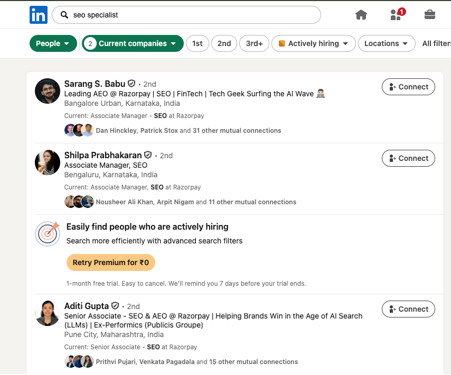
Step 3: Find the Right Contact Person
The right contact is the person who can edit the page.
Start with people closest to content and SEO.
Use this order:
- SEO specialist or SEO manager
- Content manager or editor
- Head of marketing
- Founder
- Generic email
Use Hunter, LinkedIn, author bios and team pages to find the contact.
Then match the message to the role.
For SEO managers, be direct. Mention the page, link fit and exchange option.
For founders, connect the placement to visibility, audience quality or partnership value.
This helps because everyone does not think in backlinks.
An SEO manager may care about anchor context. A founder may care about qualified visitors.
The right person makes the exchange faster and cleaner.
Step 4: Choose What You Can Offer
A good link exchange pitch needs a useful offer before the email is sent.
Decide what you can give before asking for anything.
Options include:
- Mention in a relevant article
- Guest post placement
- Partner page listing
- ABC exchange
- Introduction to another partner
- Inclusion in a resource page
- LinkedIn mention or tool review
The offer should fit the prospect. A SaaS company may care about a partner mention, while a blog may prefer expert input or a future guest post placement.
Avoid sending one fixed offer to every domain.
Prospects see repeated pitches every week. A specific offer feels more serious than a generic swap request.
Good link exchange outreach starts with this question:
What does the other site gain from saying yes?
Step 5: Pitch a Specific Page or Placement
A vague link exchange email usually gets ignored.
Pitch one page, one placement and one reason.
Before emailing, choose:
- Their page where your link fits
- Your page where their link could fit
- Suggested anchor
- Reader reason
- Exchange type
Post pitch outreach and mention outreach usually feel more editorial than direct swap requests.
You can say you are writing a post and want to include them. You can also say you already mentioned them and share the page.
For a direct pitch, keep it short.
Mention the page. Explain the fit. Offer a relevant return placement.
The email should be easy to answer.
A good pitch does not make the prospect search your site, guess the benefit or ask what you mean.
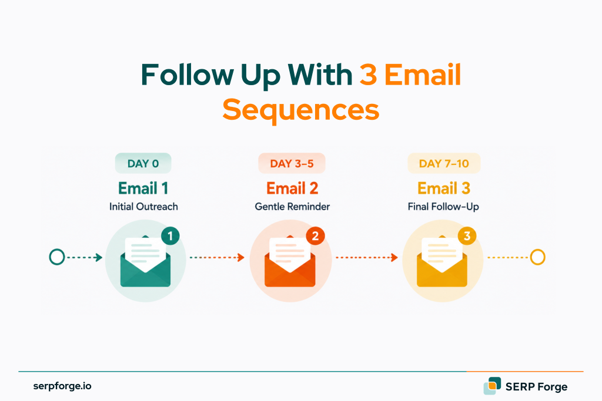
Step 6: Follow Up With a 3-Email Sequence
One email is rarely enough.
Use a three-email sequence:
- Email 1: page-specific pitch
- Follow-up 1: new value angle
- Follow-up 2: polite close
Send the first follow-up after 3 to 5 days.
Send the second follow-up after another 5 to 7 days.
Replace “just checking in” with a new reason to reply.
Use the follow-up to add value.
You can offer:
- A different page fit
- A guest post option
- A partner introduction
- A future placement
Keep every email short.
Under 150 words is enough for most link exchange outreach.
The follow-up should feel like a useful reminder.
Step 7: Confirm the Exchange Details
Confirm the details before any link goes live.
This prevents missing links, weak placements and partner confusion.
Ask both sides to confirm:
- Linking page
- Target URL
- Anchor text
- Placement sentence
- Follow or nofollow status
- Expected publish date
For ABC exchanges, record all domains involved.
This matters because ABC swaps can become messy fast. One missing link can break the whole agreement.
Keep the anchor natural.
A forced exact-match anchor creates more risk than the exchange itself. Branded, partial-match and sentence-based anchors usually fit better.
The confirmation step also protects the relationship.
Everyone knows what is expected before content goes live.
Step 8: Track Requests in a Link Exchange Sheet
Track every request in a shared sheet or CRM.
A practical sheet should separate partner requests, your requests and a balance view. That keeps the exchange from becoming messy once several partners are involved.
Use these columns:
- Partner domain
- Contact person
- Link from
- Link to
- Anchor
- Text edit
- Exchange type
- Status
- Notes
Use simple statuses:
- Check
- Pending
- Live
- Rejected
- Removed
The sheet should show who owes what.
This matters when link exchange runs across many partners. Without tracking, teams lose links, repeat partners too often or forget to verify live placements.
Add a notes column for restrictions.
Some partners may reject casino, crypto, CBD or direct competitor pages. Record that once, so the next request is faster.
Step 9: Recheck Live Links and Balance
A link exchange is not finished when the email thread ends.
Links can go live late, switch to nofollow, break during updates or disappear during site audits.
Check every live link after publishing.
Review:
- Is the URL live?
- Is the link placed correctly?
- Is the anchor correct?
- Is the link follow or nofollow?
- Is the page indexed?
Then recheck links monthly.
Track live, pending, rejected and removed links so exchanges do not fall out of balance over time.
If a partner removes your link, check whether it was a content update or accident.
If the link cannot be restored, ask for a replacement page.
The best partners keep links live and communicate when pages change.
Which Link Exchange Outreach Templates Can You Use?
Use these templates as starting points. Keep them short and edit them for the specific page.
Post Pitch Outreach Template
Subject: Content idea for [site name]
Hi [Name],
I’m working on a post about [topic] and wanted to include [their site/tool] because [specific reason].
There may also be a natural place for [your page] in your article on [their article topic].
Would you be open to swapping relevant mentions if both pages fit?
Best,
[Name]
Mention Outreach Template
Subject: Mentioned [site name]
Hi [Name],
We mentioned [their site] in our article on [topic]: [URL].
It felt like a good fit because [reason].
If you have a relevant article where [your page] would help readers, I’d be happy to send it over.
Best,
[Name]
Direct Outreach Template
Subject: Content collaboration
Hi [Name],
I noticed your article on [topic] covers [specific point].
Our page on [your page topic] could add a useful reference for that section.
We also have a relevant article where [their page] could fit naturally. Want me to send both page options?
Best,
[Name]
How Should You Track and Manage Link Exchanges?
Track link exchanges like a small partnership pipeline.
Use one sheet or CRM for all partners. Every exchange should have a status, owner, page URL, anchor and follow-up date.
Review the tracker every week if exchanges are active.
Check:
- Pending links
- Live links
- Removed links
- Rejected requests
- Balance by partner
Also monitor link health monthly.
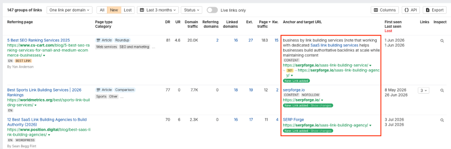
Open the live page, confirm the anchor and check whether the link is still follow. Then check Google Search Console or Ahrefs to see whether the link appears in your backlink data.
Repeated patterns create the main risk.
If the same partners, anchors and pages appear too often, slow down. A healthy exchange system should look like real editorial collaboration across relevant sites.
Need to know which link exchanges are safe?
SERP Forge can review your partners, anchors and placement patterns before they create risk.
Book a link exchange audit today.
Conclusion
Link exchange is still part of modern link building and it needs judgment.
A good swap should feel like a natural editorial reference instead of a favour added to satisfy a deal. Check the site, agree on the anchor, record the exchange and revisit live links before they quietly turn into risk.
The safest link swaps are the ones you can explain without mentioning SEO.
FAQs
Are link exchanges against Google guidelines?
Link exchanges become risky when they are done mainly to manipulate rankings.
Google’s spam policies mention excessive link exchanges as link spam.
How many link exchanges are safe?
There is no fixed safe number for link exchanges.
A few relevant swaps with trusted websites can look natural. Repeated partners, exact-match anchors and unrelated placements create risk.
What is the difference between a link exchange and a link scheme?
A link exchange is a mutual link placement between two websites.
A link scheme is a repeated pattern built to influence rankings through scale, weak partners, forced anchors or poor placement context.
Does a three-way link exchange work in 2026?
A three-way link exchange can still pass value when the websites are relevant and the placements make editorial sense.
It becomes risky when the same middle sites are reused across many exchanges. Track every ABC exchange so the same domains do not appear too often.
How do I know if a site is safe to exchange links with?
Check the site in Ahrefs or Semrush before agreeing to a link swap.
Review organic traffic, traffic value, referring domains, outbound links and recent articles.
Then open the exact placement page. It should have relevant content, a natural reason to link and no obvious paid-link pattern.