
Most SaaS companies publish content consistently. The problem is they rarely stop to ask whether that content is actually working.
Blog posts pile up, landing pages go stale, and organic traffic plateaus, all while the team churns out more new articles instead of fixing what already exists.
A SaaS content audit reviews your content to decide what to update, merge, repurpose, or remove based on performance.
This guide gives you the exact SaaS content audit framework, checklist, and real-world examples used to recover rankings, boost conversions, and build compounding content marketing results.
What is a SaaS Content Audit?
A saas content audit is a structured process of reviewing and evaluating all your existing content to understand how it performs across rankings, traffic, engagement, and conversions.
It goes beyond surface-level SEO checks by analyzing how well each page aligns with search intent, target keywords, user journey stages, and your overall SaaS content strategy.
A strong content audit for saas ensures every page supports your product positioning, addresses your ideal customer profile (ICP), and contributes to the funnel from awareness to conversion while improving organic growth and long-term content ROI.
Why is Content Audit for SaaS Companies Important?
SaaS content decays faster than content in most other industries. Product features change. Competitor positioning shifts.
Here is what a proper content audit for SaaS achieves:
- Recovers lost organic traffic from pages affected by content decay or algorithm updates
- Identifies conversion dead zones, pages getting traffic but generating zero signups or demo requests
- Surfaces keyword cannibalization, where two or more pages compete for the same search intent, splitting ranking authority
- Improves topical authority by filling content gaps and strengthening semantic coverage across your core topics
- Reduces crawl budget waste by removing or redirecting low-value pages that dilute your site’s overall authority
- Strengthens AI citation eligibility by ensuring content is structured with credible, quotable, answer-first sections
According to Ahrefs, publishing more content doesn’t guarantee growth. 96.55% of content gets no traffic from Google, which shows that without regular auditing and optimization, most content simply doesn’t perform.
What to Check Before Starting a SaaS Content Audit
Before you start auditing individual pages, you need to pull the right data. Open Google Search Console, Google Analytics 4, and your SEO platform of choice (Ahrefs, Semrush, or similar).
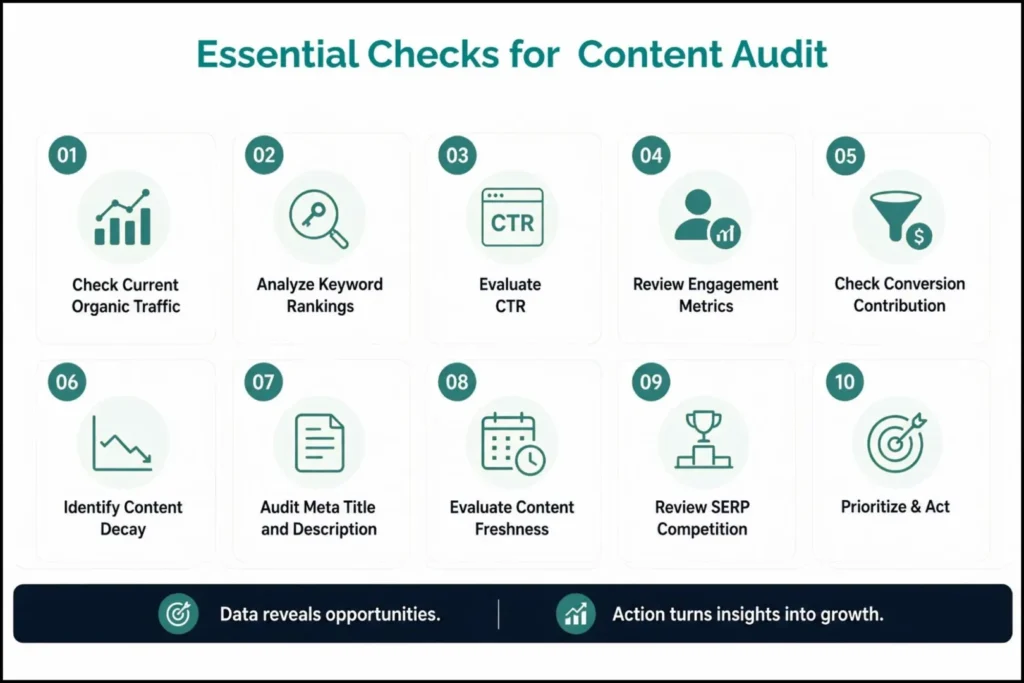
Export a full list of your published URLs and populate a spreadsheet with the following data points for each page:
Check Current Organic Traffic
Pull three to six months of organic sessions per URL from GA4. Filter out branded queries, so you are looking at purely non-brand keyword performance.
Flag any page with fewer than 50 monthly organic sessions as a candidate for review. This threshold can be adjusted based on your site’s overall traffic volume.
Analyze Keyword Rankings
Export keyword position data from Ahrefs or GSC. Identify pages ranking in positions 5–20 for high-value keywords; these are your best optimization opportunities.
Also, flag any page that used to rank in the top 10 but has dropped, as this is a signal of content decay or increased SERP competition.
Evaluate CTR (Click-Through Rate)
A low CTR combined with deep impressions usually means your meta title and description are not compelling enough, or your page is ranking for the wrong query.
In Search Console, filter for pages with more than 1,000 impressions per month but a CTR below 2%; these need title and meta description optimization.
Review Engagement Metrics
In GA4, examine average engagement time, scroll depth, and bounce rate per URL.
A blog post with an average engagement time under 60 seconds suggests the content is not matching user expectations, either the topic is wrong, the intro is not compelling, or the content depth is too shallow.
Check Conversion Contribution
Connect your content data to conversion events in GA4 or your CRM. Identify which blog posts and landing pages are generating trial signups, demo requests, or newsletter subscriptions.
Many SaaS content teams are surprised to find that 20% of their pages drive 80% of their content-attributed conversions.
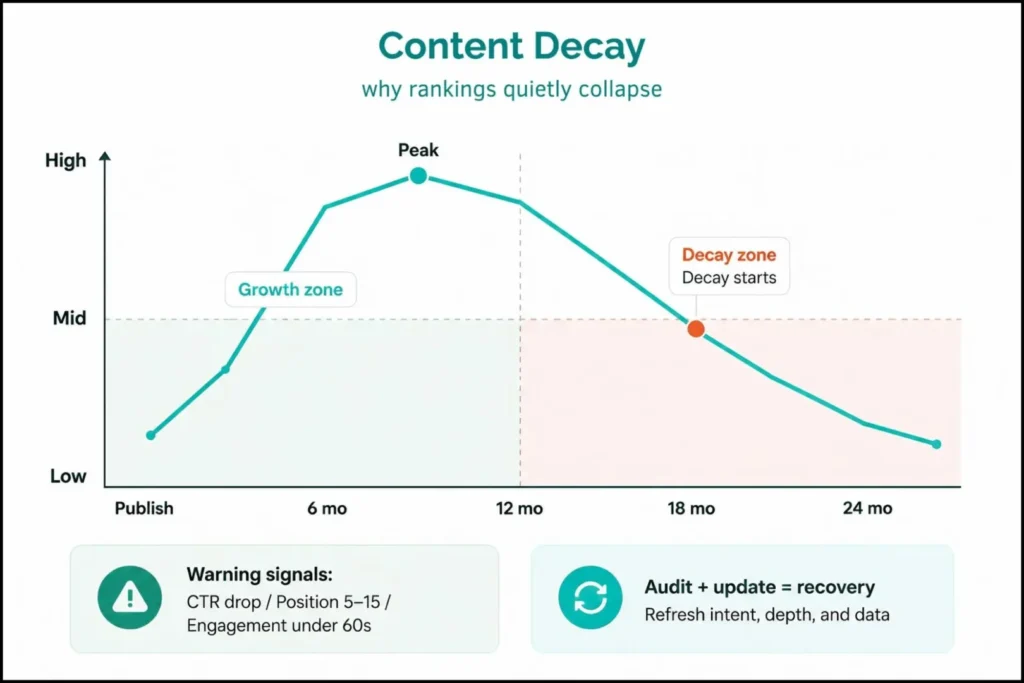
Identify Content Decay
Content decay happens when a page’s rankings and traffic gradually decline over time, typically due to newer, fresher, or more comprehensive content outranking it.
Look for pages that peaked in traffic 12–24 months ago and have been declining since; these are your highest-priority update candidates.
Audit Meta Title and Description
Review every page’s title tag and meta description. Look for titles that are keyword-stuffed, too long (over 60 characters), too vague, or missing the primary keyword.
A well-structured meta title should include the primary keyword, communicate a clear benefit or outcome, and use power words that trigger clicks.
Evaluate Content Freshness
Check the last-modified date for each article. Any piece covering a topic that changes frequently (pricing, integrations, features, market trends) and hasn’t been updated in over 12 months is a freshness risk. Search engines factor in content freshness for time-sensitive queries.
Review SERP Competition
For your target keywords, manually review the current SERP. Has the composition changed? Are there more listicles, more videos, more product pages competing?
Does your content match the dominant format and intent now ranking? This analysis tells you if your update strategy needs to go beyond editing copy and into restructuring the entire page.
SaaS Content Audit Prioritisation Framework
You cannot fix everything at once. The goal of a content prioritisation framework is to identify where your effort will generate the highest return faster.
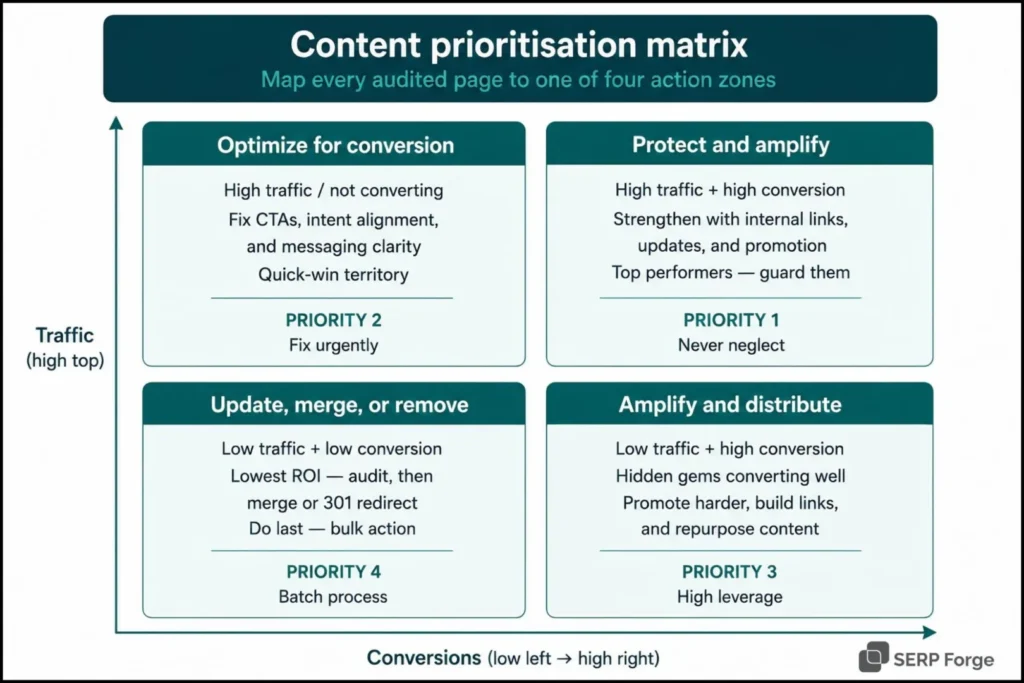
So you can build momentum while systematically working through your full content library:
Identify High-Impact Pages (Traffic vs Conversions)
Create a 2×2 matrix: high traffic / high conversion (protect and amplify), high traffic / low conversion (optimize for conversion), low traffic / high conversion (amplify and distribute), low traffic / low conversion (update, merge, or remove).
This single framework will guide 80% of your audit decisions.
Spot Quick Wins vs Heavy Fix Pages
Quick wins are pages ranking in positions 5–15 for target keywords where a content refresh, internal link addition, or CTA improvement can push them into the top five.
Heavy fix pages are those with fundamental problems, wrong search intent, outdated information, and thin content that require a near-complete rewrite.
Group Pages by Funnel Stage (TOFU, MOFU, BOFU)
Top-of-funnel content (educational blogs, industry guides) should prioritize organic reach and engagement. Middle-of-funnel content (comparison pages, use case articles) should prioritize topical depth and lead capture.
Bottom-of-funnel content (pricing pages, demo landing pages) should prioritize conversion clarity and friction reduction. Each stage has different success metrics; audit them accordingly.
Decide: Update, Merge, Redirect, or Delete
Update: Pages with strong keyword relevance and good historical traffic but declining performance. Fix intent alignment, add depth, refresh data.
Merge: Two or more pages covering the same topic or keyword cluster. Combine into one authoritative piece and 301 redirect the weaker URLs.
Redirect: Pages with no search value, minimal traffic, and no conversion contribution. Redirect to the most topically relevant URL.
Delete: Pages that are truly orphaned, have zero traffic history, and no internal linking value. Remove and return a 404 or 410 response.
SaaS Content Audit Checklist (Step-by-Step Fix Framework)
Below is the full content audit checklist used by SaaS content teams to systematically evaluate and fix underperforming content. Work through each item for every page flagged in your audit.
| # | Audit Item | Priority |
|---|---|---|
| 01 | Check and fix search intent alignment | High |
| 02 | Define and refine target audience (ICP) | High |
| 03 | Add a clear, stage-matched CTA | High |
| 04 | Update outdated information and examples | High |
| 05 | Add original insights or a unique POV | Medium |
| 06 | Expand thin sections with depth and examples | High |
| 07 | Insert practical assets (templates, checklists, frameworks) | Medium |
| 08 | Improve content structure and readability | Medium |
| 09 | Optimize for semantic coverage and LSI keywords | High |
| 10 | Add contextual internal links | Medium |
| 11 | Optimize for featured snippets and PAA boxes | Medium |
| 12 | Rewrite key sections in answer-first format | High |
| 13 | Break content into self-contained sections | Low |
| 14 | Add credible sources and real data | High |
| 15 | Create quotable and citable statements | Medium |
| 16 | Optimize title tag and meta description for CTR | High |
| 17 | Improve above-the-fold clarity | High |
| 18 | Align content with product positioning | High |
| 19 | Optimize for engagement and dwell time | Medium |
1. Check and Fix Search Intent Alignment
Does your content match what users actually want when they search for your primary keyword? Open an incognito browser and Google your target keyword.
Look at the top five results. Are they how-to guides, listicles, comparison pages, or product pages? If your content format doesn’t match, you have an intent misalignment problem.
Restructure your content to match the dominant SERP format. If the top results are step-by-step how-to guides and yours is an opinion piece, convert it. Intent alignment is the single most impactful fix you can make in a SaaS content audit.
2. Define and Refine Target Audience (ICP)
Every piece of content should speak directly to a specific stage of your ideal customer profile. Review the opening paragraphs.
If a reader lands on the page, will they immediately recognize that the content is written for someone like them? Vague content written for ‘marketers’ when your ICP is ‘B2B SaaS CMOs at Series A companies’ will always underperform.
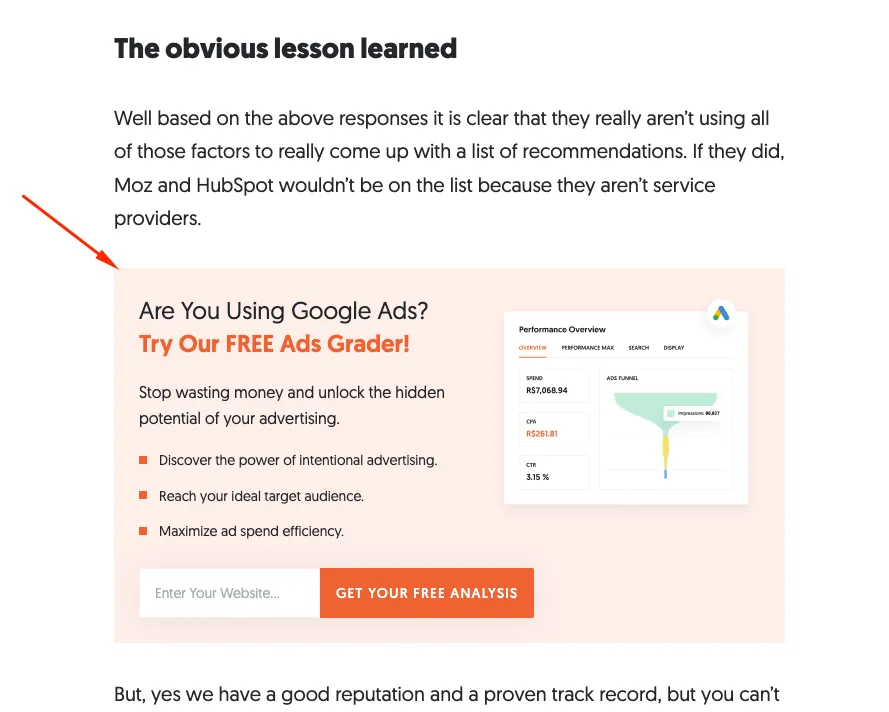
3. Add a Clear, Stage-Matched CTA
Every page needs one primary CTA that matches the reader’s intent and funnel stage. A TOFU blog post should not lead with ‘Start your free trial,’ which creates friction.
Instead, use a content upgrade CTA (download the checklist, get the template). MOFU content should drive to case studies or comparison pages. BOFU content should offer the demo or free trial directly.
4. Update Outdated Information and Examples
Outdated statistics, deprecated tool references, and old screenshots are signals to both users and search engines that content is not being maintained. Replace every data point with a source published in the past 24 months.
Update screenshots, pricing references, and integration lists. Freshness signals matter for content trust and ranking stability.
5. Add Original Insights or Unique POV
Generic content that simply rehashes what competitors have already written will not outrank them. Add proprietary data, original frameworks, expert quotes, or contrarian perspectives that cannot be found elsewhere.
This is what earns backlinks, AI citations, and repeat readership, the three compounding assets of great SaaS content.
6. Expand Thin Sections with Depth and Examples
Identify sections of your content where the explanation is shallow or the guidance is generic. Expand these with specific examples, step-by-step breakdowns, screenshots, or mini case studies.
Thin content articles under 800 words covering complex topics are consistently outranked by more comprehensive coverage on the same subject.
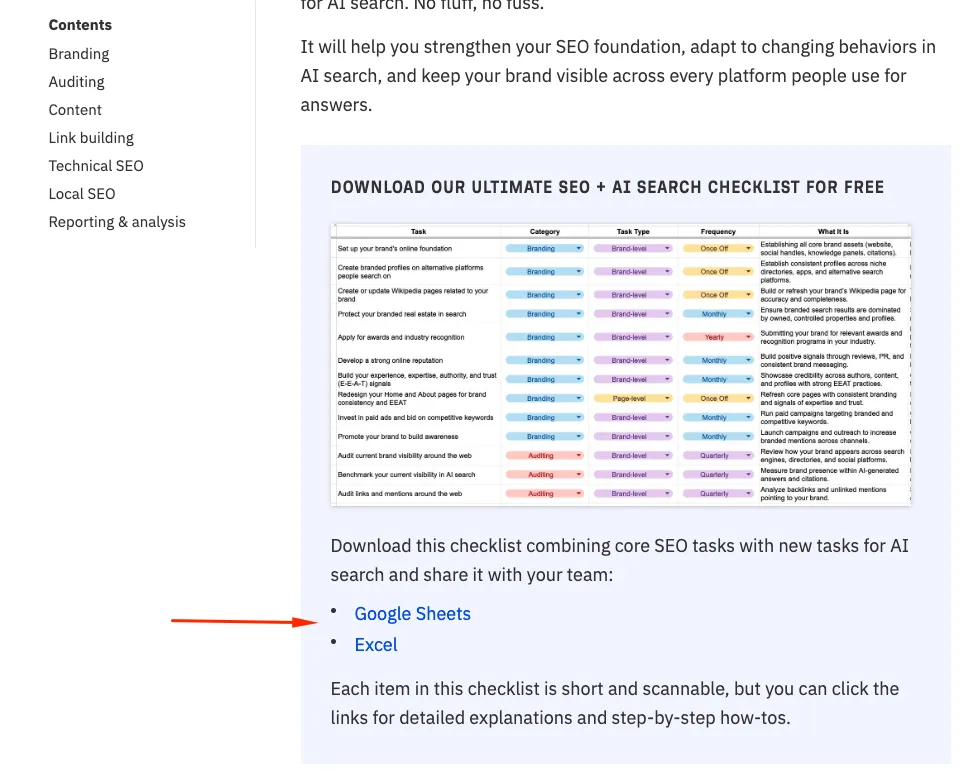
7. Insert Practical Assets (Templates, Checklists, Frameworks)
Embedded practical assets increase time-on-page, boost perceived value, and create natural link magnets.
For a SaaS content audit post, that might mean including a downloadable audit template, a prioritization matrix, or a scoring rubric. These assets also serve as lead magnets when gated behind an email capture form.
8. Improve Content Structure and Readability
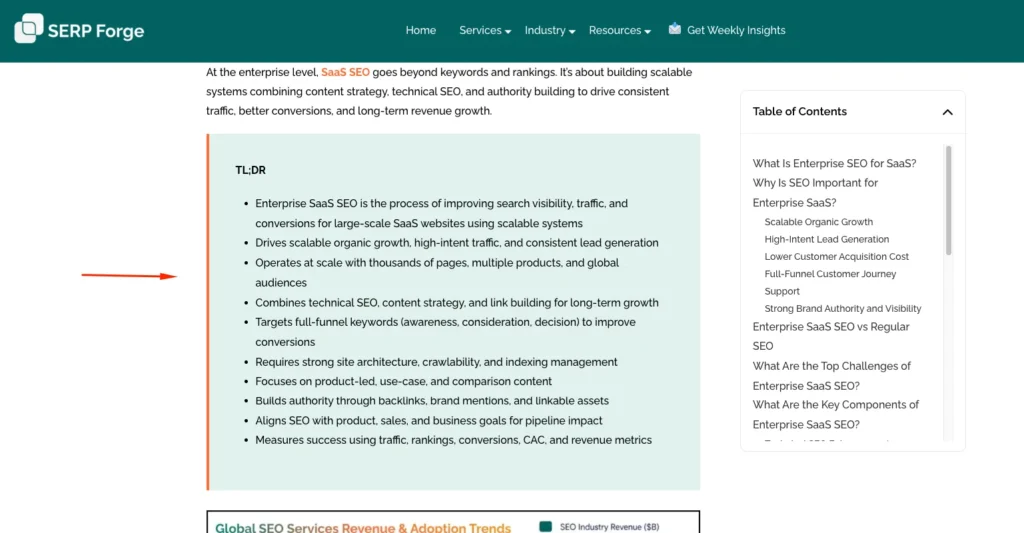
Review your heading hierarchy (H1 → H2 → H3), paragraph length (target three to four sentences maximum), sentence complexity, and use of visual breaks.
Content that is difficult to scan is content that gets abandoned. Use short paragraphs, descriptive subheadings, bold key phrases, and summary callout boxes to improve scanability.
9. Optimize for Semantic Coverage
Semantic SEO means covering a topic comprehensively, including all related subtopics, questions, and entities that users and search engines associate with your primary keyword.
Use SEO tools like Surfer SEO, Clearscope, or Frase to identify missing semantic terms and LSI keywords.
For a SaaS content audit article, semantic coverage includes terms like content performance analysis, organic traffic decay, keyword cannibalization, and content repurposing.
It also covers on-page optimization, SERP intent mapping, content gap analysis, blog post optimization, conversion rate from organic traffic, and content lifecycle management.
10. Add Contextual Internal Links
Internal linking distributes page authority, improves crawlability, and keeps users moving through your content funnel.
Every updated page should include at a minimum three to five contextual internal links to related blog posts, product pages, or resource hubs.
Use descriptive anchor text, not ‘click here’ or ‘learn more’ to signal topical relevance to search engines.
For this article, we can internal links other topic like:
• SaaS content strategy
• Product-led marketing
11. Optimize for Featured Snippets and FAQs
Featured snippets and People Also Ask (PAA) boxes are priority real estate in modern SERPs. To capture them, structure your content with direct, concise answers immediately following the question.
Use proper heading tags for questions, keep definition answers under 50 words, and use numbered or bulleted lists for process-oriented answers.
This structure also improves your chances of being cited by AI search tools like Google AI Overviews and Perplexity.
12. Rewrite Key Sections in Answer-First Format
Answer-first writing (also called the inverted pyramid format) means leading with the most important point, then providing supporting detail.
This structure is preferred by both users skimming for quick answers and search engines identifying passages for featured snippets.
Review every major section of your content and ensure the core insight comes in the first two sentences.
13. Break Content into Self-Contained Sections
Each major section of your content should be able to stand alone as a useful piece of information.
This modular structure makes your content more scannable, improves passage indexing by search engines, and makes it easier to repurpose individual sections into social media posts, email newsletters, or short-form video scripts.
14. Add Credible Sources and Real Data
Unsubstantiated claims erode trust. Back every major assertion with a link to a credible, authoritative source, such as industry research, peer-reviewed studies, government data, or recognized SaaS industry publications.
This signals expertise and trustworthiness to both readers and Google’s quality assessment algorithms.
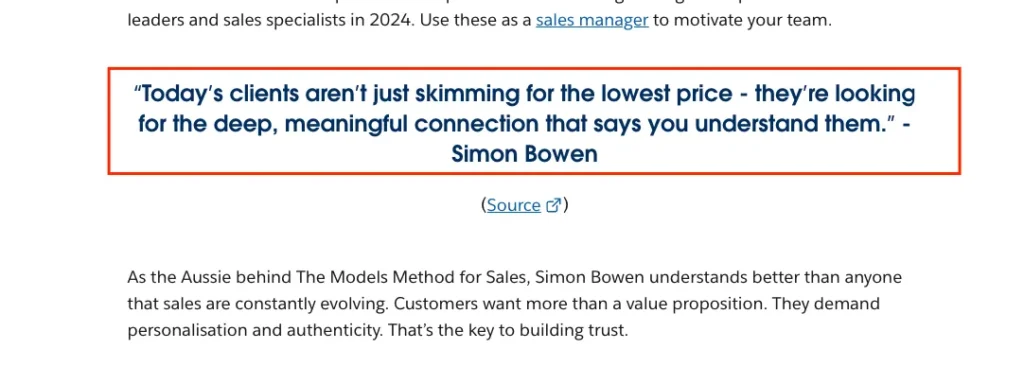
15. Create Quotable, Citable Statements
For AI citations and backlink acquisition, your content needs to contain clear, memorable, quotable statements that other writers and AI models will want to reference.
These are short, confident, specific sentences that crystallize a key insight. Example: ‘A SaaS content audit is not a cleanup exercise — it is a revenue recovery strategy.’
16. Optimize Title Tag and Meta Description for CTR
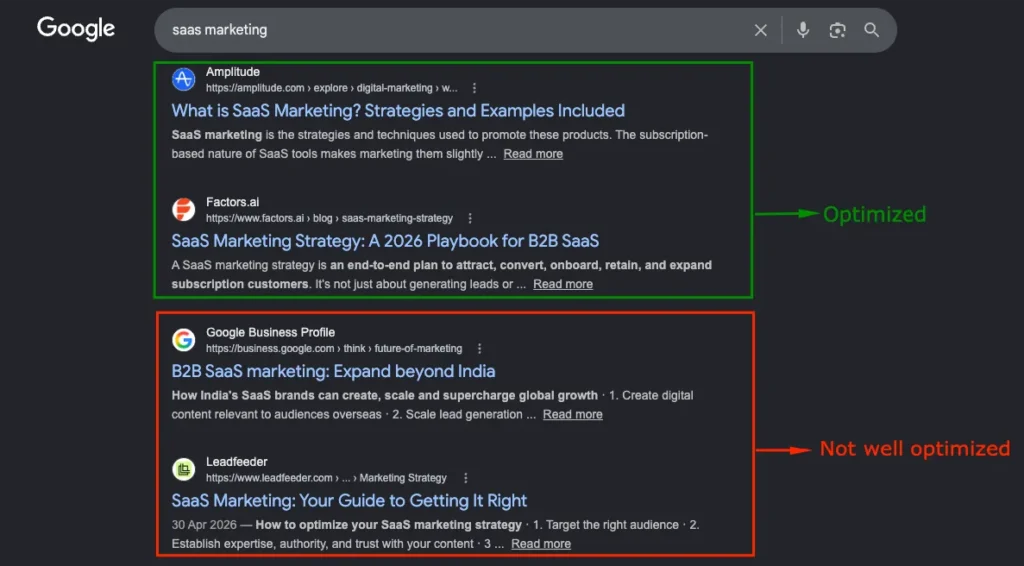
Your title tag is your paid ad headline, except you don’t pay per click. A high-performing SaaS content title includes the primary keyword, a specific outcome or benefit, and a hook that differentiates from competing results.
Your meta description should expand on the title with a secondary benefit and a soft call-to-action. Always stay within 60 characters for the title and 155 characters for the meta description.
17. Improve Above-the-Fold Clarity
The first 100 words of any page determine whether a user stays or bounces. Eliminate any vague introductions, excessive throat-clearing, or generic statements.
Start with the problem your reader is facing, confirm that this article solves it, and set clear expectations for what they will learn. This simple change can reduce bounce rate by 15–25% on educational content.
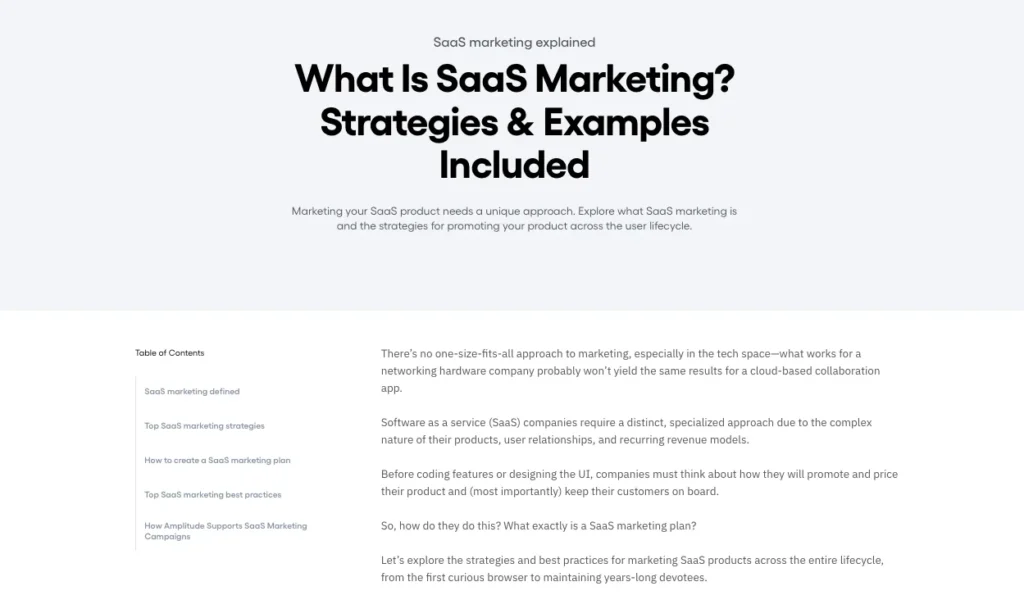
18. Align Content with Product Positioning
SaaS content should consistently reinforce your product’s core value proposition, even in top-of-funnel educational pieces.
A structured SaaS content strategy that defines product positioning from the start makes this easier to maintain.
This doesn’t mean making every blog post a sales pitch; it means ensuring your examples, use cases, and recommended solutions naturally connect to what your product does best. This is the difference between generic SEO content and content that actually moves the revenue needle.
19. Optimize for Engagement and Dwell Time
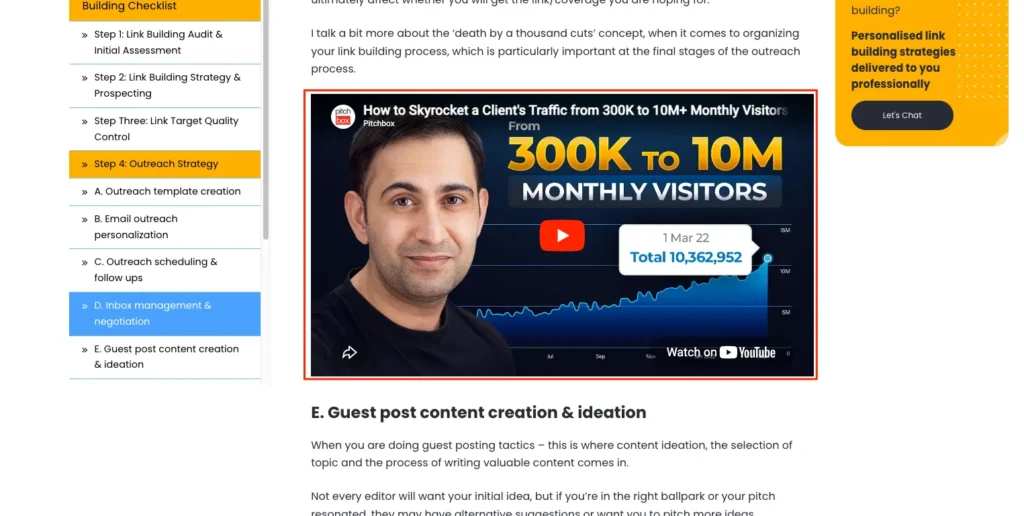
User engagement signals, specifically time on page and scroll depth, influence how search engines assess content quality. Improve dwell time by adding embedded videos, interactive tools, data visualizations, and inline summary boxes.
Break long walls of text with visual elements every 300–400 words. A page that keeps users engaged for three to five minutes will consistently outperform a page that loses them in under a minute.
SaaS Landing Page Content Audit Checklist
Blog content and landing page content require different audit criteria in the context of SEO and SaaS copywriting.
Landing pages are conversion-focused; every element should serve the goal of moving a visitor toward a specific action.
Here is the landing page audit checklist for SaaS teams:
Messaging Clarity and Value Proposition
Can a first-time visitor understand what your product does, who it is for, and why they should care within five seconds of landing?
Test your headline against this standard. If your H1 is product-centric rather than outcome-centric, rewrite it around the transformation your customer experiences.

Feature vs Outcome Communication
Feature lists tell users what your product does. Outcome statements tell them what their life looks like after using it.
Audit every bullet point and section header on your landing pages and convert feature statements into outcome statements wherever possible.
CTA Placement and Friction
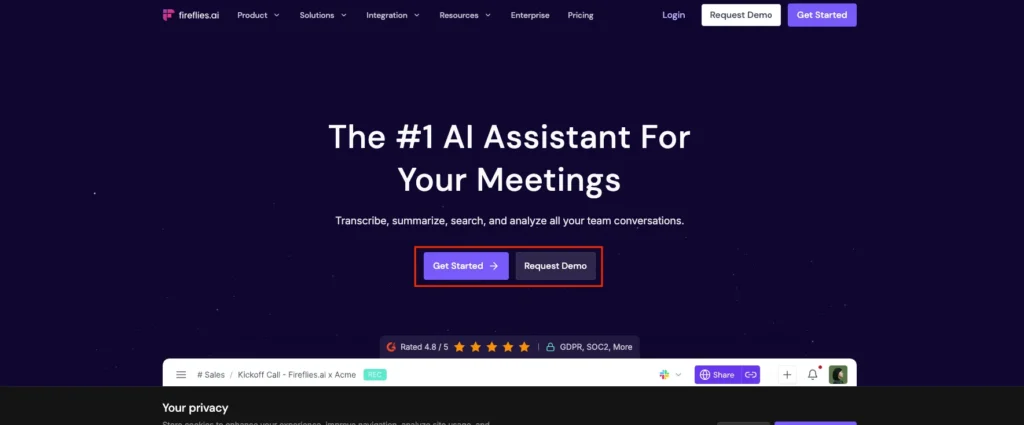
Your primary CTA should appear above the fold, after the first major value section, and in the footer. Review the friction level of each CTA does it require a credit card?
Does it use a weak copy like ‘Submit’? Reduce friction by removing unnecessary form fields, using social proof near CTAs, and using action-oriented copy like ‘Start my free audit’ instead of ‘Get started’.
Social Proof and Trust Signals
Audit the placement and specificity of your social proof elements. Vague testimonials (‘Great tool!’) are less effective than specific, outcome-focused testimonials (‘We increased our organic traffic by 140% in three months using SERP Forge’).
Check that logos, review badges, and customer quotes are visible without scrolling on desktop and mobile.
Content Depth vs Conversion Balance
Long-form landing pages can outperform short ones when the audience is research-oriented (enterprise buyers, technical evaluators).
Short, friction-free pages work better for high-intent bottom-of-funnel traffic from branded keywords. Audit whether your landing page depth matches the intent of the traffic source.
Alignment with Ad or Organic Intent
If the landing page receives paid traffic, does the page messaging directly mirror the ad copy?
Message mismatch between an ad and its landing page is one of the top causes of high-paid traffic bounce rates. For organic traffic, ensure the page ranks for and delivers on the intent of the keywords driving visits.
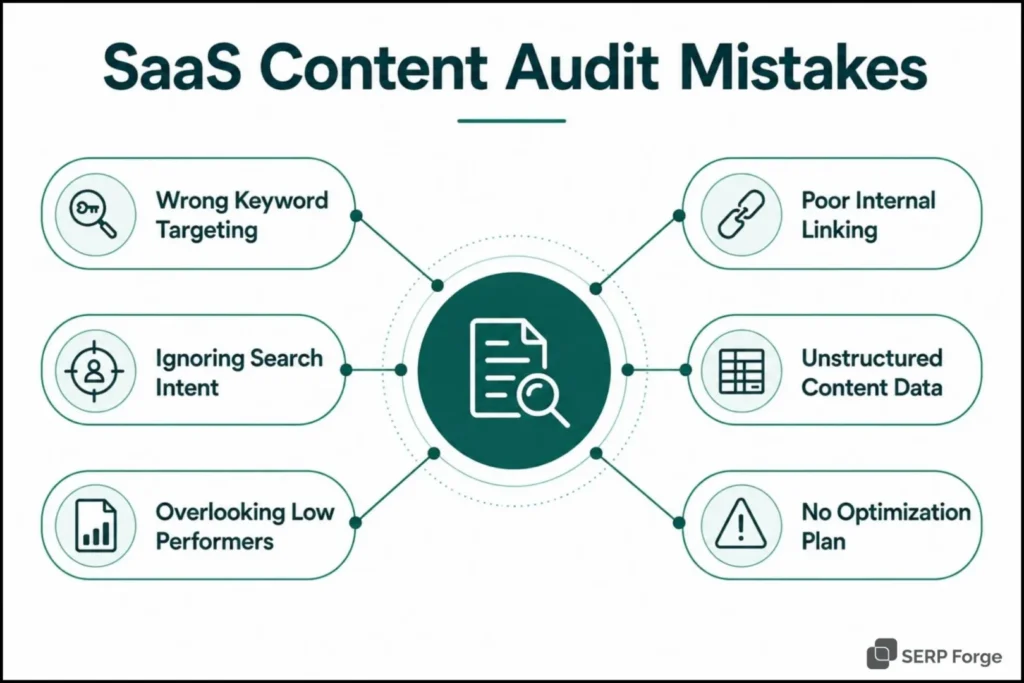
Common Mistakes to Avoid in SaaS Content Audits
A saas content audit often fails not because of a lack of effort, but due to common strategic mistakes.
These include focusing on volume over impact, ignoring conversion data, and treating SEO as separate from product and user intent:
Auditing Everything Instead of Prioritising
Trying to audit 500 pages simultaneously leads to analysis paralysis and zero execution. Start with your top 50 pages by organic traffic potential, then work outward. Focus creates momentum; breadth creates overwhelm.
Ignoring Conversion Data
A page ranking on page one for a high-volume keyword is meaningless if it generates zero conversions. Always pair traffic data with conversion data before making update decisions.
A page with modest traffic and a high conversion rate often deserves more investment than a high-traffic, zero-conversion page.
Over-Optimising for Keywords Only
Keyword stuffing and mechanical optimization produce content that ranks briefly and then declines.
Modern SaaS content must serve real user needs comprehensively. Semantic coverage, content depth, and readability now matter as much as, if not more than, keyword density.
Not Aligning Content with Product
Content that educates without connecting to your product is brand awareness without revenue impact.
Ensure every major content asset includes at least one natural, non-promotional reference to how your product solves the problem being discussed.
Updating Content Without Clear Goals
Before touching any page, define a specific, measurable goal for the update. ‘Improve this article’ is not a goal.
‘Increase organic CTR from 1.4% to 3% by rewriting the title and meta description, and move from position 8 to position 4 by adding 600 words of in-depth examples’ is a goal.
According to HubSpot reports, focusing only on creating new content is a common mistake. After all, the top three results on a search query get 61% of all search clicks, and 75% of users never scroll past the first page—so if your existing content isn’t ranking well, it’s essentially invisible.
SaaS Content Audit Examples (Real Workflow)
Here is how a saas content audit works in practice: real workflows show how data-driven fixes can turn underperforming pages into high-impact growth assets:
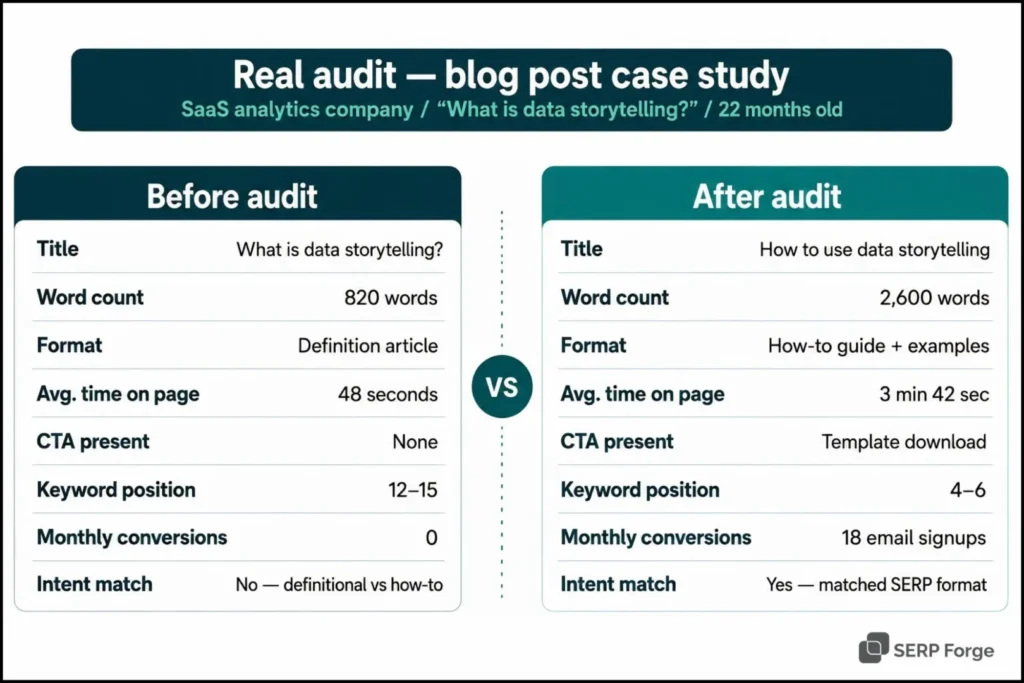
Example: Blog Post Audit Breakdown
Scenario: A SaaS analytics company had a blog post titled ‘What is data storytelling?’ published 22 months ago.
It was ranking in positions 12–15 for its target keyword, had an average time on page of 48 seconds, and was generating zero conversions.
Audit findings:
• Search intent mismatch: The SERP was dominated by how-to guides; the post was definitional
• Thin content: 820 words covering a topic where competitors averaged 2,400 words
• No CTA: The post ended with no next step for the reader
• Zero internal links: No connection to the company’s analytics product or related content
• Outdated examples: All screenshots referenced tools from 2021
Example: Landing Page Audit
Scenario: A project management SaaS had a landing page for ‘team collaboration software’ receiving 800 monthly organic visits but converting at 0.4%, well below the 2–4% benchmark for SaaS landing pages.
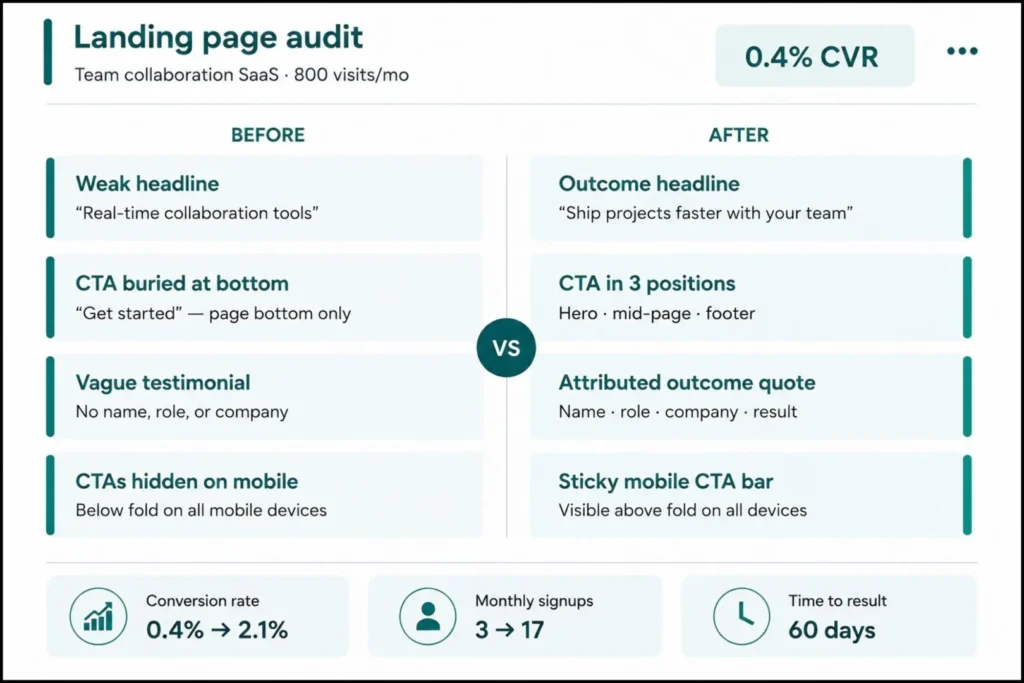
Audit findings:
• The H1 led with a feature (‘Real-time collaboration tools’) instead of an outcome (‘Ship projects faster with your whole team in one place’)
• The primary CTA ‘Get started’ appeared only at the bottom of a long page
• Social proof was limited to a single testimonial with no company name or role attribution
• The page was not mobile-optimized, with key CTAs hidden below the fold on mobile devices
Result after fix: Conversion rate increased from 0.4% to 2.1% within 60 days. Monthly trial signups from this page went from 3 to 17.
SERP Forge SaaS Content Audit Template
Download the free SERP Forge SaaS Content Audit Template to start your audit immediately.
The template includes a URL inventory tracker, performance scoring rubric, prioritization matrix, and step-by-step fix log, everything your content team needs to execute a full audit without starting from scratch.
Ready to Audit Your SaaS Content? Start With the Right Foundation
Your SaaS content library is either compounding for you or working against you.
A structured content audit is the highest-leverage activity a SaaS content team can run, with higher ROI than publishing five new articles and faster than building backlinks.
SERP Forge helps SaaS teams audit, fix, and scale content that actually drives revenue.
Whether you are recovering from a traffic drop, optimizing for AI citations, or rebuilding a content strategy from scratch, start with the audit. Book a free content audit strategy call.
Conclusion
A SaaS content audit is not busywork. It is one of the highest-leverage investments a content team can make, recovering organic traffic, improving conversion rates, and building a content library that compounds in value over time instead of quietly decaying.
The framework in this guide, from the pre-audit data collection checklist to the 19-point fix checklist to the before-and-after examples, is designed to be used repeatedly, not just once.
Run it every six months, assign clear owners to each audit action, and measure results against your defined goals.
SaaS Content Audit FAQs
How often should you do a SaaS content audit?
Every six months is ideal. High-growth teams can review quarterly to catch content decay, ranking drops, and intent shifts before they impact traffic and conversions.
How many pages should you audit at once?
Start with your top 50 pages based on traffic and conversion potential. Expand gradually once your audit process becomes structured and repeatable.
What tools are needed for a SaaS content audit?
Use Google Search Console, Google Analytics 4, Ahrefs, or Semrush, plus a spreadsheet or project tool to track performance, rankings, and audit actions.
How do you measure success after an audit?
Measure improvements in organic traffic, keyword rankings, CTR, engagement time, and conversion rates within 30–90 days after implementing content updates.
Should you delete underperforming content?
Delete only if the content has no traffic, backlinks, or relevance. Otherwise, update, merge, or redirect it to retain value and improve overall site performance.

