




.
What Is Burning Multiple?
Burn multiple is a SaaS financial efficiency metric that measures how much net cash a startup burns to generate one dollar of new annual recurring revenue (ARR).
Burn Multiple = Net Burn ÷ Net New ARR
A SaaS company that burns $2M in a quarter and adds $1M in net new ARR has a burn multiple of 2.0. That means it costs $2 in cash to generate every $1 of new recurring revenue.
The metric gained traction after the SaaS market correction, when investors shifted focus from growth-at-any-cost to capital-efficient growth. Companies that had been burning $5 for every $1 of ARR suddenly couldn’t raise at any valuation.
A lower burn multiple generally indicates better capital allocation and go-to-market efficiency, while a higher burn multiple may signal unsustainable spending.
Why Burn Multiple Matters for SaaS?
Burn multiple is important because it helps:
- Investors evaluate capital efficiency
- Founders benchmark financial health
- CFOs optimize spending decisions
- Operators balance growth vs profitability
- Boards assess fundraising readiness
Consider two Series A SaaS companies, both growing ARR at 3x year-over-year:
| Metrics | Company A | Company B |
|---|---|---|
| Net Burn (Q) | $900K | $3M |
| Net New ARR (Q) | $1M | $1M |
| Burn Multiple | 0.9x | 3.0x |
Same growth rate. Completely different fundraising conversations. Company A is nearly self-funding its growth. Company B needs to raise again within 6 months and will do so from a weaker position.
That gap is why burn multiple has become a standard slide in almost every VC due diligence process.
How to Calculate Your Burn Multiple (Formula + Calculator Walkthrough)
The formula behind the calculator is:
Burn Multiple = Net Burn ÷ Net New ARR
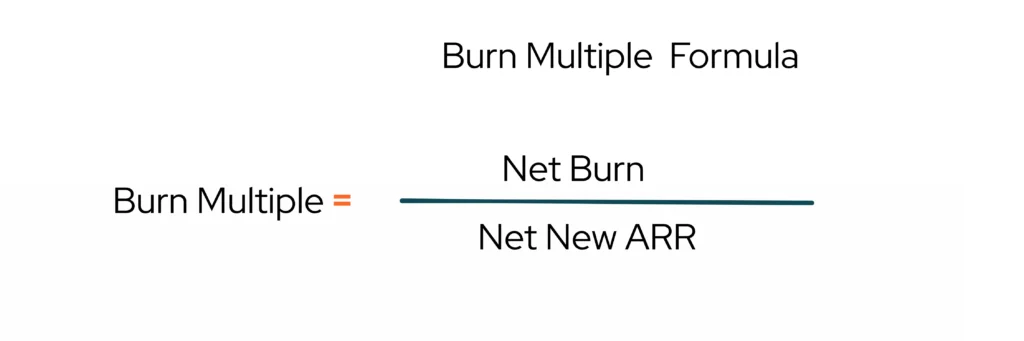
It answers one question: how many dollars is your company spending to generate $1 of new ARR? To get a meaningful result, you need two clean inputs. Here is how to pull them correctly.
Step 1: Find Your Net Burn
Net burn is not your total spending; it is what your company actually loses after revenue offsets expenses.
Net Burn = Gross Burn − Revenue
Take a SaaS company running $2,000,000 in quarterly operating expenses with $800,000 in revenue coming in the door:
| Metrics | Amount |
|---|---|
| Gross Burn | $2,000,000 |
| Revenue | $800,000 |
| Net Burn | $1,200,000 |
This $1,200,000 is the number that goes into the Net Burn field not the $2M headline expense figure. Using gross burn instead of net burn is the most common input mistake and will inflate your score significantly.
Step 2: Find Your Net New ARR
Net new ARR is not just new customer revenue. It is the net movement in your ARR book during the same period, growth minus contraction.
Net New ARR = (New ARR + Expansion ARR) − (Churned ARR + Contraction ARR)
Using the same quarter for that company:
| Component | Amount |
|---|---|
| New customers | +$500,000 |
| Expansion / upsells | +$200,000 |
| Churned customers | −$80,000 |
| Downgrades | −$20,000 |
| Net New ARR | $600,000 |
Enter this $600,000 into the Net New ARR field. One critical check: both inputs must cover the exact same time window. A quarterly net burn figure paired against a monthly ARR figure will produce a number that means nothing.
Step 3: Read Your Result
Hit the Calculate button once both fields are filled.
Using the numbers above:
$1,200,000 ÷ $600,000 = 2.0x
This company spends $2 to generate every $1 of new recurring revenue. Here is how that number maps to what investors actually expect:
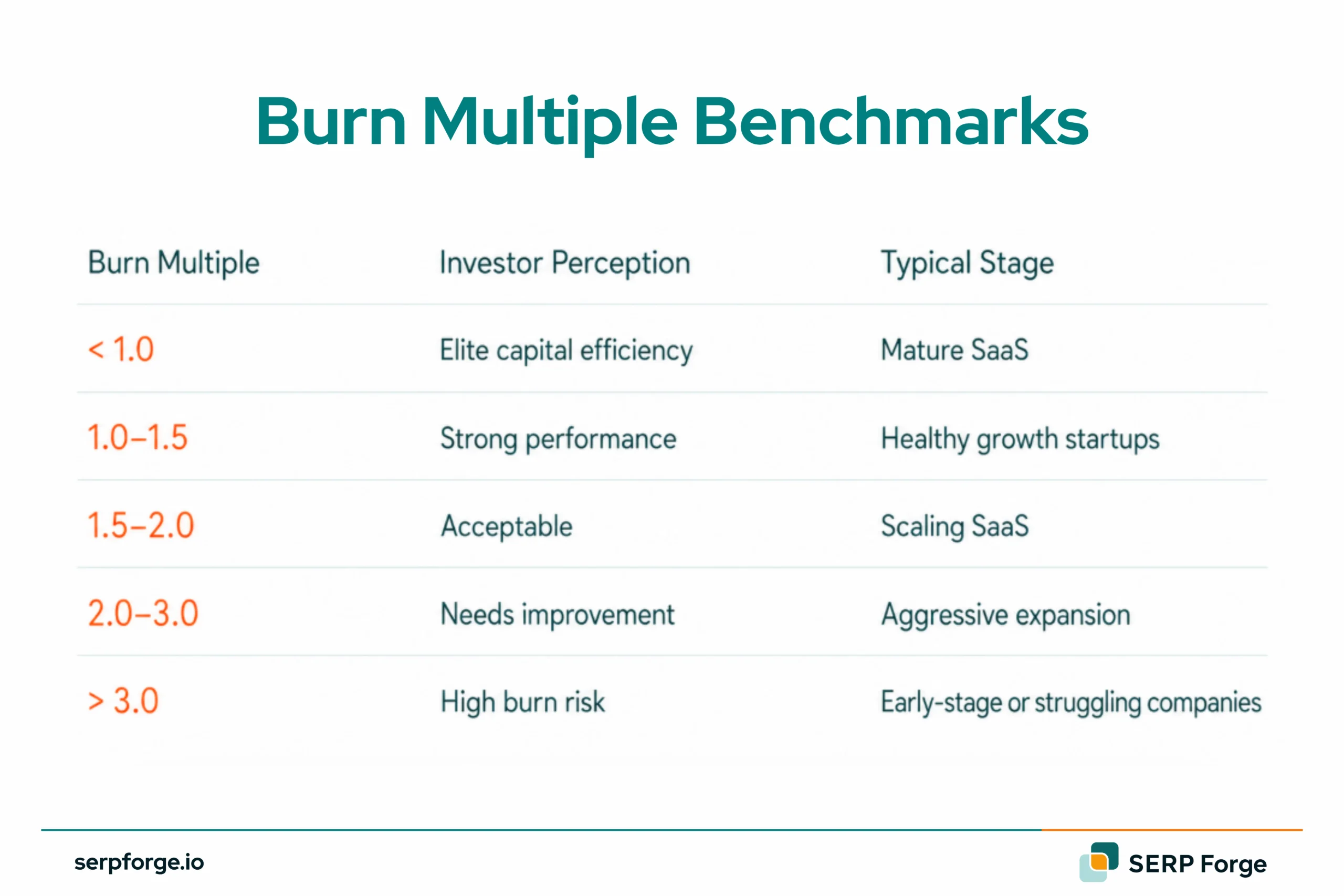
| Burn Multiple | Interpretation | What It Signals |
|---|---|---|
| Below 1.0x | Elite efficiency | Growth is nearly self-funding |
| 1.0x – 1.5x | Strong | Capital-efficient scaling |
| 1.5x – 2.0x | Acceptable | Manageable with strong growth to back it |
| 2.0x – 3.0x | Needs attention | Spending is outpacing ARR growth |
| Above 3.0x | High burn risk | Unsustainable without a correction |
At 2.0x, this company sits exactly at the informal ceiling most VCs apply to growth-stage raises. The business is not disqualified, but burn efficiency will be the first question in every investor conversation until that number moves.
Burn Multiple Benchmarks in 2026
Investor expectations around burn efficiency have tightened significantly over the past few years.
In 2026, efficient growth matters more than pure top-line expansion and overall SaaS unit economics.
Burn Multiple Benchmark Tables
The table below shows general burn multiple benchmarks and how investors typically interpret SaaS growth efficiency at different stages:
What Is a Good Burn Multiple?
A “good” burn multiple depends on:
- Startup stage
- Growth rate
- Market conditions
- Funding environment
- Competitive landscape
However, most VCs today prefer companies operating below 2.0.
Companies below 1.0 are often viewed as highly efficient.
Burn Multiple by SaaS ARR Stage
Burn multiple expectations vary by company maturity.
Earlier-stage startups often spend more aggressively to establish product-market fit and accelerate growth.
The table below highlights typical burn multiple ranges across different SaaS ARR stages and how efficiency expectations change as companies scale:
| ARR Stage | Typical Burn Multiple |
|---|---|
| Pre-seed | 3.0–8.0 |
| Seed | 2.0–5.0 |
| Series A | 1.5–3.0 |
| Series B | 1.0–2.0 |
| Growth Stage | < 1.5 |
Early-stage startups may temporarily tolerate higher burn multiples if they are:
- Expanding rapidly
- Building market share
- Investing heavily in product development
- Entering new markets
But as companies mature, investors expect increasing efficiency.
Why do investors care about the burn multiple?
Burn multiple became especially important after the SaaS market correction shifted investor focus from aggressive growth to sustainable economics.
Investors Use Burn Multiple To Evaluate:
- Fundraising risk
- Cash runway efficiency
- Operational discipline
- Growth sustainability
- Leadership decision-making
Efficient startups generally:
- Raise capital more easily
- Maintain stronger valuations
- Survive downturns better
- Scale with less dilution
Common Burn Multiple Mistakes to Avoid
Many startups calculate burn rate incorrectly.
1. Using Gross Burn Instead of Net Burn
The formula requires net burn, not operating expenses alone.
Ignoring Churn
Net new ARR must account for:
- Customer churn
- Downgrades
- Lost expansion revenue
Ignoring churn artificially improves the metric.
Measuring Too Frequently
Monthly burn multiple calculations can create noisy results.
Quarterly measurements often provide better insights.
Focusing Only on Efficiency
Extremely low burn isn’t always positive.
A company underinvesting in growth may show excellent burn multiple numbers while missing market opportunities.
How to Improve Burn Multiple for Your SaaS?
Improving burn efficiency usually requires increasing ARR growth faster than spending growth.
Ways to Improve Burn Multiple
The strategies below can help SaaS companies improve burn multiple by increasing ARR growth efficiency and reducing unnecessary cash burn:
Increase Net New ARR
Focus on:
- Better sales conversion
- Higher expansion revenue
- Improved retention
- Faster onboarding
- Pricing optimization
Reduce Inefficient Spend
Audit spending across:
- Paid acquisition
- Hiring
- Tool sprawl
- Non-core initiatives
Improve Retention
Retention directly improves net new ARR.
Reducing churn often improves burn multiple times faster than acquiring new customers.
Increase Sales Efficiency
Strong go-to-market efficiency improves burn performance significantly.
Track:
- CAC payback period. Tired of manual marketing tasks? Discover 15 powerful SaaS marketing automation tools that handle lead nurturing, onboarding, and retention on autopilot.
- Magic number
- Pipeline conversion
- Sales productivity
When is a High Burn Multiple Acceptable?
Not every high burn multiple is bad.
There are situations where temporary inefficiency may make strategic sense.
Examples
- Launching a new product category
- Expanding internationally
- Building AI infrastructure
- Capturing market share quickly
- Investing ahead of expected demand
Investors may tolerate higher burn multiples if:
- Growth is exceptional
- The market opportunity is massive
- Retention metrics are strong
- The company has a clear path to efficiency
The key is whether the burn creates long-term enterprise value.
How SERP Forge Helps You?
We help SaaS companies improve growth efficiency through data-driven SEO, content strategy, and scalable organic acquisition.
Our SaaS SEO strategies focus on helping startups reduce inefficient spend by driving qualified organic traffic, improving conversion-focused content, and building long-term visibility across high-intent search queries.
Whether you’re preparing for fundraising, optimizing CAC efficiency, or scaling ARR growth, SERP Forge helps align your growth strategy with sustainable business performance.
FAQs
How do investors use burn multiple?
Investors use burn multiple to evaluate how efficiently a startup converts capital into ARR growth. It helps determine fundraising quality, operational discipline, and long-term sustainability.
What is the next ARR?
Net new ARR is the increase in annual recurring revenue after accounting for new customers, expansions, churn, and downgrades.
Formula: New ARR + Expansion ARR − Churned ARR − Contraction ARR
How is burn multiple different from runway?
Burn multiple measures of growth efficiency, while runway measures how long your company can survive before running out of cash.
Runway focuses on time remaining. Burn multiple focuses on capital efficiency.
Can startups have a high burn multiple temporarily?
Yes. Early-stage startups or companies investing aggressively in expansion may temporarily operate with high burn multiples.
However, investors usually expect efficiency improvements over time.
What burn multiple do VCs prefer?
Most VCs prefer burn multiples below 2.0.
Companies below 1.5 are often viewed as highly capital efficient, especially in modern SaaS markets.