



What is Moz’s Domain Authority?
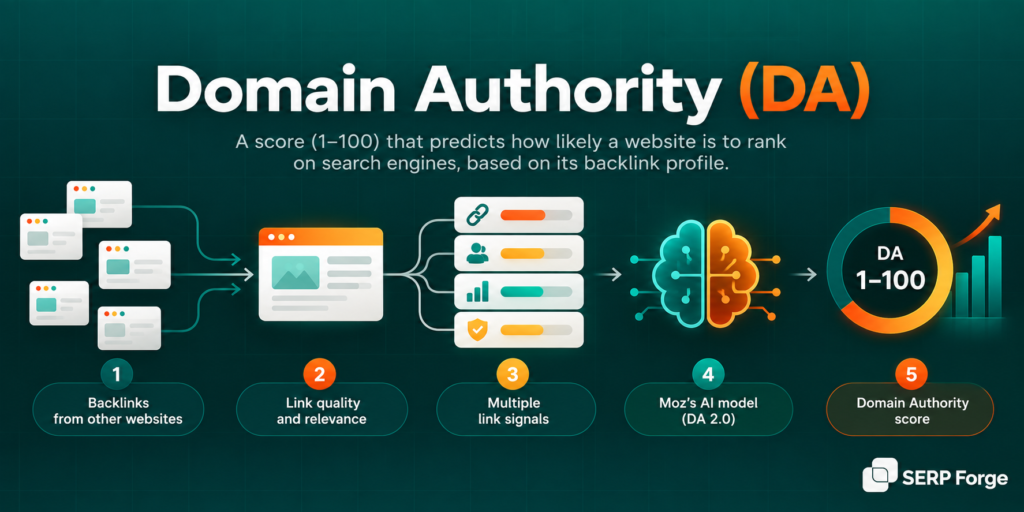
Moz Domain Authority (DA) is a proprietary SEO metric developed by Moz to estimate a domain’s ranking potential relative to other websites. The DA score ranges from 1 to 100, with higher scores indicating stronger predicted ability to rank in search engine result pages (SERPs).
The major upgrade came with DA 2.0 in March 2019, when Moz replaced its earlier linear model with a neural network. At launch, Moz reported that its Link Explorer index contained 35+ trillion links.
DA 2.0 also improved how the model evaluates link profiles by including randomly selected non-ranking pages in training and incorporating Spam Score and link distributions based on quality and traffic.
This allows the model to learn more complex relationships between link profiles and ranking performance, rather than relying mainly on backlink volume.
Key Features of Domain Authority Checker
SEPR Forge’s Moz domain authority checker is built to remove friction between professionals and reliable authority data.
100% Free Access
Use the free version to check DA, evaluate PA, review spam score, and inspect any URL without limitations.
Genuine Moz Metrics
The system retrieves real Moz data, so your DA score, PA, and domain rating reflect authentic authority behaviour.
Authority Clarity
This checker checks the authority to reveal how the quality and quantity of backlinks influence PA, & domain rating
How Our Domain Authority Checker Works?
Our Moz DA Checker uses the official Moz API to retrieve authority metrics directly from Moz’s index. Enter a domain or URL, and the tool sends it to Moz’s URL Metrics API, which returns the available metrics for that target.
The checker displays key metrics such as Domain Authority (DA), Page Authority (PA), Spam Score, and MozRank in an easy-to-read format.
Unlike tools that estimate DA using their own databases or calculations, our checker does not calculate or modify the DA score itself. It fetches the metric generated by Moz and displays the returned value. Moz’s API supports retrieving these metrics for individual URLs.
How is Moz Domain Authority calculated?
Moz calculates Domain Authority (DA) using a proprietary machine-learning system built primarily from its link graph, combining backlink and link-quality signals to predict a domain’s ranking potential.
Link Graph Construction
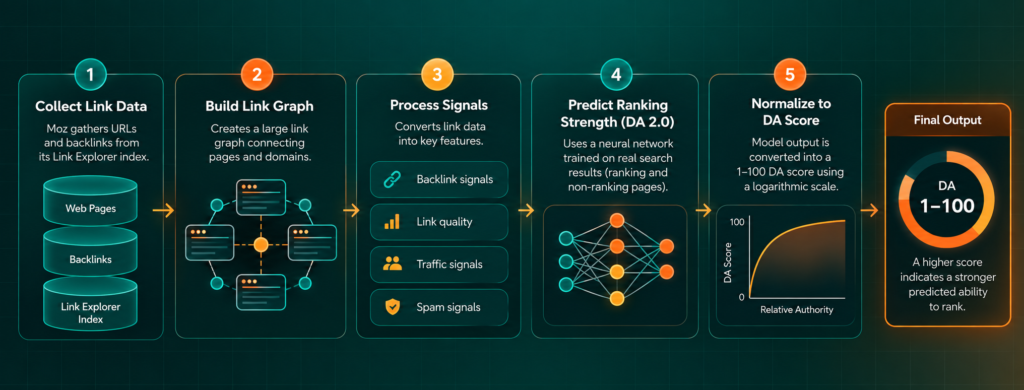
Moz uses data from its Link Explorer index to build a large-scale link graph connecting pages and domains through backlinks.
For each domain, the graph captures signals such as total backlinks, linking root domains, and how links are distributed across domains with different levels of link quality and estimated traffic. Moz also incorporates its proprietary Spam Score and other link-related signals to identify potentially manipulative patterns.
Feature Processing
Moz converts the link graph into numerical features used by its DA model.
These include the quantity of backlinks, number and characteristics of linking domains, distributions of links by quality and traffic, and spam-related patterns. The exact feature set, feature weights, and calculations are proprietary, so Moz does not provide a public formula such as “one backlink = X DA points.”
Importantly, metrics such as domain age, backlink velocity, or PA inheritance should not be presented as confirmed DA inputs, because Moz has not publicly established them as direct components of the DA calculation.
Predictive Modeling
With Domain Authority 2.0, Moz replaced its previous linear model with a neural network.
The model is trained using actual search-result data, while also introducing randomly selected pages that do not rank, allowing the model to distinguish stronger and weaker link profiles more effectively.
Score Normalization
The model’s output is converted into a 1–100 DA score, where a higher score indicates stronger predicted ability to rank.
DA is a comparative, logarithmic metric, not a direct measurement of Google’s ranking algorithm. Therefore, DA 60 is not twice as strong as DA 30, and the amount of authority required to increase the score becomes progressively larger at higher levels.
Is Domain and Page Authority legitimate?
Yes. DA and PA are legitimate third-party SEO metrics because authority and link-based signals show a measurable relationship with search rankings. However, they are predictive metrics, not Google ranking factors.
Semrush analyzed 16,298 keywords and around 300,000 Google results. The study found that domain authority-related signals were associated with better rankings, although correlation does not prove causation.
Ahrefs analyzed 1 million high-volume US keywords. Domain Rating (DR) correlated 0.131 with rankings, while referring domains and backlinks showed stronger correlations of 0.255 and 0.248, respectively. The study found that stronger link profiles generally aligned with higher rankings.
How to Use Our Moz DA Checker?
SEPR Forge designed this DA Checker to help professionals check the domain authority, evaluate competitiveness, and plan ranking strategy with confidence.
Steps to follow:
- Enter your URL into the input box of the checker tool.
- Click the button to check DA instantly.
- Review your DA score, PA, spam score, and domain rating.
- Compare results with competitor domains.
- Analyze which pages show stronger PA signals.
Do’s and Don’ts of Moz DA Checker
Do’s
- Do analyse PA at the URL level to understand page-specific authority impact.
- Track the domain age influence when comparing older and newer competitors.
- Monitor spam score trends to avoid trust erosion.
- Do compare the domain rating with the DA score to detect authority imbalance.
- Do validate link quality before outreach decisions.
Don’ts
- Don’t rely on the DA score alone without PA context.
- Don’t ignore spam score even on high DA domains.
- Don’t assume a higher score guarantees rankings.
- Don’t compare unrelated industries.
- Don’t overlook the quality and quantity balance in backlinks.
Frequently Asked Questions
1. What is the difference between PA and DA?
PA evaluates a single URL, while DA evaluates the entire domain.
2. Can I check the domain authority score for multiple URLs?
Yes. You can test any URL individually using the domain authority tool.
3. Does domain age affect DA?
Yes. Domain age contributes to trust development over time.
4. Why does my PA change faster than DA?
PA responds more quickly to link and content changes.
5. Can spam score reduce rankings?
Yes. A high spam score can weaken trust signals.
6. Is domain rating the same as DA?
No. Domain rating comes from other platforms but reflects similar authority logic.
7. Does DA impact organic traffic directly?
DA does not send traffic but influences ranking probability.
8. Can I use this tool to check competitors?
Yes. The tool supports competitor benchmarking.
9. Why does my site not rank well in search despite high DA?
Weak PA, poor content relevance, or low link quality can block performance.
10. How often should I check domain authority?
Monthly tracking offers reliable trend visibility.
11. Is Moz’s domain authority is ranking factor?
No, domain and page authority are not ranking factors. Google won’t consider it as a ranking signal.