




What Is SEO ROI?
SEO ROI, or search engine optimisation return on investment, measures the net financial gain produced by your organic search activities relative to what you spent to produce them. It is the metric that converts SEO from a brand-building exercise into a quantifiable business investment.
Every dollar spent on agency fees, content production, link acquisition, and SEO tooling is weighed against the revenue generated by the incremental organic traffic, leads, and customers that spending produced.
The result is a percentage that tells you whether your organic search programme is paying for itself and by how much.
How to Calculate SEO ROI
Four formulas drive every projection in this SEO ROI calculator. Each solves for a specific output based on inputs you already have from Google Search Console, your CRM, and your finance team.
The Core SEO ROI Formula
SEO ROI (%) = ((Annual Revenue from SEO − Annual SEO Cost) ÷ Annual SEO Cost) × 100
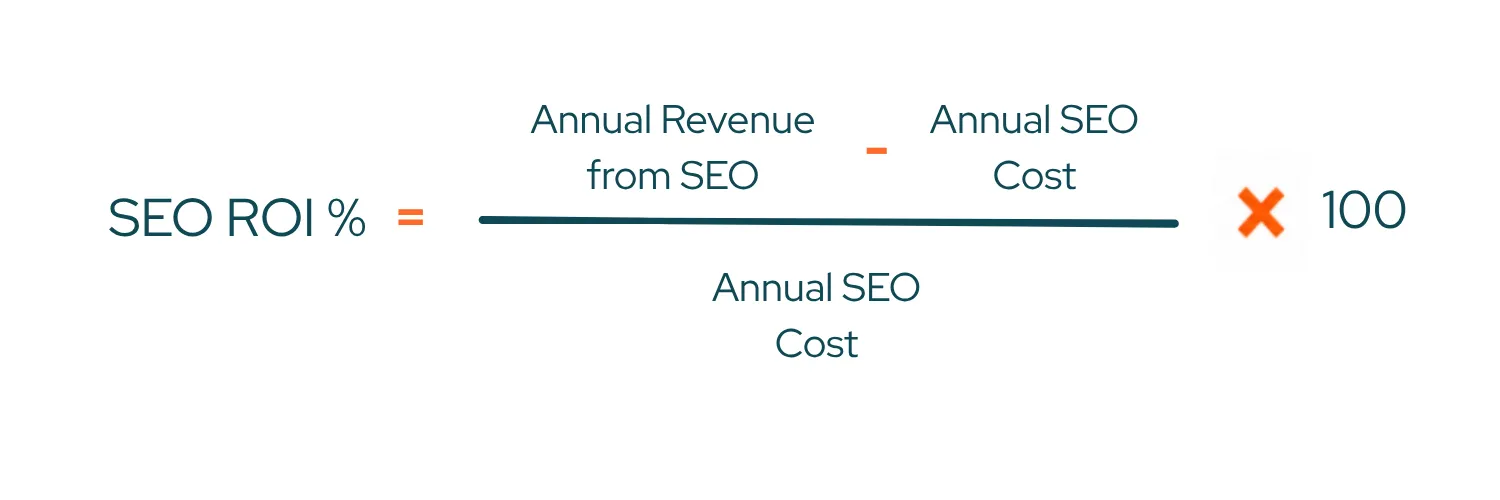
Example: Your SEO programme generates $66,000 in annual revenue against a $20,000 annual investment. Your SEO ROI is 230%.
How to Calculate Additional Organic Clicks
Additional Clicks = Monthly Organic Clicks × Traffic Growth Rate
Example: 10,000 monthly clicks with a 100% growth forecast produces 10,000 additional clicks per month.
How to Calculate Revenue from SEO
Monthly Revenue = (Additional Clicks × Visitor-to-Lead Rate) × Lead-to-Customer Rate × Customer LTV
Example: 10,000 additional clicks at 2% visitor-to-lead and 10% lead-to-customer with a $2,000 LTV generates $40,000 per month.
How to Calculate Payback Period
Payback Period (Months) = Annual SEO Cost ÷ Monthly Revenue
Example: A $24,000 annual SEO investment against $40,000 in monthly revenue returns a 0.6-month payback period.
Use the SEO ROI calculator above to skip the manual calculation entirely.
How to Use the SEO ROI Calculator
Enter all six inputs using data from your analytics platform, CRM, and finance records. The calculator delivers six outputs instantly.
| Input | What to Enter |
|---|---|
| Monthly Organic Clicks | Total monthly clicks from Google Search Console → Performance → Total Clicks |
| Expected Organic Traffic Growth (%) | Projected 12-month organic traffic growth; use 20–50% for conservative estimates, 100%+ for aggressive content or technical SEO campaigns |
| Organic Visitor → Lead Conversion Rate (%) | Percentage of organic visitors who become leads via form fills, demo requests, or free trial sign-ups |
| Lead → Customer Conversion Rate (%) | Percentage of leads who become paying customers; pull this directly from your CRM pipeline data |
| Average Customer Lifetime Value (LTV) | Total net revenue a single customer generates over their full relationship with your business |
| Monthly SEO Investment | All recurring SEO costs: agency retainer, content production, link building, and tooling combined |
Once you click Calculate ROI, the results panel shows six outputs:
- Estimated ROI (%): your projected 12-month return on SEO investment as a percentage
- Total Revenue Generated: gross annual revenue attributable to SEO-driven organic traffic
- Net Profit: total revenue minus annual SEO investment
- Payback Period: months until cumulative SEO revenue recovers your total annual spend
- Additional Customers: net-new customers acquired from incremental organic traffic over 12 months
- Net Profit Margin: net profit expressed as a percentage of total generated revenue
- Insight: a contextual summary of whether your projected ROI is Low, Moderate, or Excellent
All values are used only for calculation and are never stored.
Average SEO ROI by Industry in 2026
Industry benchmarks tell you whether your SEO ROI projection reflects a healthy campaign or a structural gap in your SEO strategy.
CPAs, conversion rates, and customer lifetime values vary dramatically across verticals and they pull SEO ROI in different directions accordingly.
| Industry | Typical SEO ROI Range | Primary Driver |
|---|---|---|
| B2B SaaS / Software | 400%–900% | High LTV ($10K–$50K+) amplifies every converted lead |
| Legal Services | 500%–1,200% | Single retained client can generate $5K–$100K in fees |
| Finance & Insurance | 350%–800% | High CPC equivalents and strong purchase intent keywords |
| Healthcare | 200%–450% | Targeting restrictions limit scale, but conversion intent is high |
| Ecommerce / Retail | 150%–400% | Large addressable audiences offset lower per-customer LTV |
| Real Estate | 300%–700% | High transaction value per closed deal justifies elevated spend |
| Education | 100%–300% | Longer sales cycles compress 12-month ROI windows |
B2B SaaS ROI runs high because a single converted customer often represents $10,000–$50,000 in lifetime revenue.
The same organic click that produces $30 in revenue for an ecommerce brand produces $500–$5,000 for an enterprise SaaS company off identical traffic volume and conversion infrastructure.
Run your numbers through this SEO investment calculator to see where your campaign sits against your vertical benchmark before committing next quarter’s budget.
What Is a Good SEO ROI?
A good SEO ROI exceeds 200%, meaning you earn at least $3 for every $1 invested in organic search. ROI above 500% is considered excellent.
Industry research puts the average 12-month SEO ROI at 275% across all verticals, though high-LTV businesses regularly report returns of 500%–1,000% over multi-year programme horizons.
What a Low SEO ROI Signals
An SEO ROI below 100% means you are recovering less revenue than you are spending. This is normal during the first three to six months of a new campaign before rankings materialise.
If it persists beyond month nine, the issue is almost always one of three things: keyword intent mismatch, a conversion funnel that leaks before checkout, or a customer LTV too low to justify the acquisition cost through organic search.
Check your visitor-to-lead conversion rate before adjusting SEO spend. A 1% improvement in conversion rate at 10,000 monthly clicks produces 100 additional leads per month without spending an extra dollar on SEO.
What a High SEO ROI Signals
An SEO ROI above 500% is the compound effect of good rankings meeting a high-LTV product and a conversion funnel that closes efficiently. It most commonly appears in B2B SaaS, legal, and financial services, where one converted customer generates revenue that dwarfs the cost of the organic content that acquired them.
It can also signal that your current SEO investment is undersized relative to the available opportunity. If your organic search programme is generating a 700% ROI, adding incremental budget is likely your highest-return capital allocation decision.
SEO ROI Calculation Example
Here is a step-by-step walkthrough using realistic inputs for a mid-market B2B SaaS company:
| Input | Value |
|---|---|
| Monthly Organic Clicks | 10,000 |
| Expected Traffic Growth | 100% |
| Visitor → Lead Rate | 2% |
| Lead → Customer Rate | 10% |
| Customer LTV | $2,000 |
| Monthly SEO Investment | $2,000 |
| Step | Calculation | Result |
|---|---|---|
| Additional Clicks/month | 10,000 × 100% | 10,000 |
| Additional Leads/month | 10,000 × 2% | 200 |
| New Customers/month | 200 × 10% | 20 |
| Monthly Revenue | 20 × $2,000 | $40,000 |
| Annual Revenue | $40,000 × 12 | $480,000 |
| Annual SEO Cost | $2,000 × 12 | $24,000 |
| Net Profit | $480,000 − $24,000 | $456,000 |
| SEO ROI | ($456,000 ÷ $24,000) × 100 | 1,900% |
| Payback Period | $24,000 ÷ $40,000 | 0.6 months |
| Net Profit Margin | ($456,000 ÷ $480,000) × 100 | 95% |
This example illustrates why customer LTV is the single most powerful variable in the SEO ROI formula. Double the LTV to $4,000 with identical traffic and conversion rates, and annual revenue doubles to $960,000; ROI jumps to 3,900% without changing a single ranking.
How to Interpret Your SEO ROI Results
| ROI Range | Classification | What It Means |
|---|---|---|
| Below 0% | Negative | SEO spend exceeds revenue generated; review keyword intent and conversion funnel immediately |
| 0%–100% | Low | Campaign is recovering cost but producing minimal profit; likely an early-stage or high-competition scenario |
| 100%–300% | Moderate | Healthy return; scale content production and link acquisition to push toward Excellent |
| 300%–500% | Strong | SEO is outperforming most paid channels; protect rankings and consider increasing investment |
| 500%+ | Excellent | SEO is a dominant growth lever; expand topical authority and increase monthly spend aggressively |
Low ROI: Audit your conversion funnel before adjusting SEO budget. Small conversion rate improvements compound faster than traffic increases, and they cost nothing to implement.
Moderate ROI: Scale the inputs that are working topic clusters converting at above-average rates, landing pages with strong engagement metrics, and content categories generating the highest organic lead volume.
Excellent ROI: Your current SEO budget is almost certainly undersized relative to the available organic demand. This is the time to increase investment, not defend the current spend level.
Factors That Affect SEO ROI
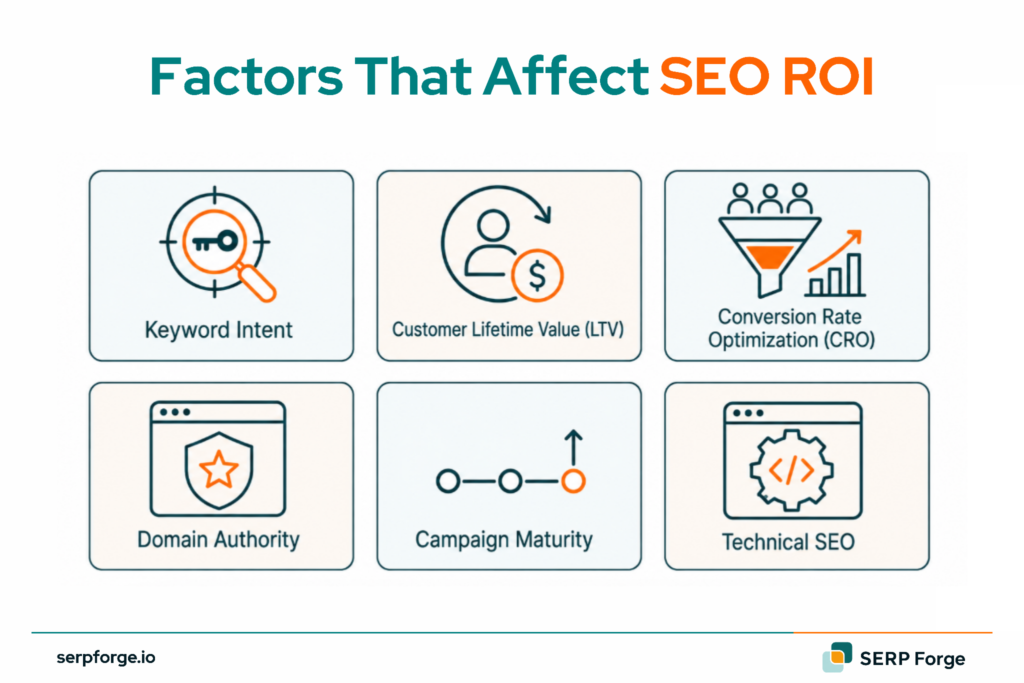
Several factors determine how much return you can generate from your SEO efforts. Here are the key elements that have the biggest impact on SEO ROI:
- Keyword Intent: Bottom-of-funnel keywords drive far more leads and revenue than informational keywords, even with lower search volume.
- Customer Lifetime Value (LTV): Higher LTV significantly increases SEO ROI by generating more revenue from each customer.
- Conversion Rate Optimization (CRO): Even a small improvement in conversions can boost revenue without increasing SEO traffic.
- Domain Authority: Websites with strong authority rank faster, reducing the time needed to see SEO results.
- Campaign Maturity: SEO delivers compounding returns over time, making long-term campaigns more profitable.
- Technical SEO: A technically optimized website improves rankings, visibility, and the ability to convert organic traffic into revenue.
When Is CPM or CPC the Right Model Instead?
This SEO ROI calculator measures the return from organic search investment. It is not the right comparison when your campaign goal requires guaranteed impressions or guaranteed clicks in a specific window.
Use CPM advertising when you need predictable reach and frequency for a product launch, seasonal push, or brand awareness campaign. CPM gives you a fixed cost per thousand impressions before you spend a dollar.
Use CPC when your campaign goal is traffic from users who showed intent by clicking. Comparison pages, demo request pages, and pricing pages all perform better under cost-per-click because you pay only for engaged users.
Use CPA when your conversion tracking is solid and your campaigns carry enough historical data for platform algorithms to optimise toward revenue. CPA eliminates impression and click waste entirely but publishers price the performance guarantee into the rate.
Use SEO when you want the model that generates traffic, leads, and revenue without a per-click or per-impression fee attached to every visitor. The upfront investment in content and authority building is fixed; the traffic it generates is not.
Frequently Asked Questions
What does SEO ROI mean?
SEO ROI measures the net financial return from your organic search investment. Formula: ((Annual SEO Revenue − Annual SEO Cost) ÷ Annual SEO Cost) × 100. A 275% ROI means you earn $3.75 for every $1 spent.
What is a good ROI for SEO?
200% or higher is good. Above 500% is excellent. Industry average sits at 200%–275% across all verticals. High-LTV businesses like B2B SaaS and legal services routinely exceed 500%.
How long does SEO take to show ROI?
Most campaigns show measurable ROI within 4–6 months. Significant returns typically appear between months 6 and 12. Competitive verticals can take 12–18 months. Use the payback period output above for your specific timeline.
Why is my SEO ROI low?
Three causes: keyword intent mismatch, a leaking conversion funnel, or a customer LTV too low to justify acquisition cost. Fix conversion rates first it compounds faster than increasing SEO spend.
How do I calculate SEO ROI without conversion tracking?
Use placeholder rates: 2% visitor-to-lead and 10% lead-to-customer are standard B2B starting points. Set up GA4 goal tracking and CRM source attribution as soon as possible.
Is SEO ROI better than Google Ads ROI?
Usually yes no per-click fee means lower acquisition cost at scale. The trade-off is time. Paid search delivers traffic immediately; SEO takes months. Best programmes run both in parallel.
How do I improve my SEO ROI?
Three levers: improve landing page conversion rates, increase customer LTV through retention or upsells, and target higher-intent commercial keywords. More organic traffic through link building amplifies all three.