




What Is ARR?
Annual Recurring Revenue (ARR) measures the total recurring subscription revenue a SaaS company expects to generate over a year. It focuses only on predictable recurring revenue and excludes one-time payments or non-recurring services.
ARR is commonly used to:
- Measure SaaS growth
- Forecast recurring revenue
- Evaluate customer retention
- Analyze business scalability
- Support investor reporting
SaaS businesses rely on ARR because subscription revenue creates predictable cash flow and long-term revenue visibility.
How to Calculate ARR
ARR is usually calculated by annualizing recurring subscription revenue.
ARR Formula
ARR = MRR \times 12
If your company already tracks yearly subscriptions directly, ARR can also equal total annual recurring subscription revenue.
Example Calculation
Imagine a SaaS company generates:
- $25,000 in Monthly Recurring Revenue (MRR)
Then:
ARR = 25000 \times 12 = 300000
The company’s ARR is $300,000.
This means the business expects to generate $300,000 in recurring subscription revenue annually if customer retention and subscription levels remain stable.
ARR vs MRR
Although ARR and MRR measure recurring subscription revenue, they focus on different reporting periods.
| Metric | Meaning | Timeframe |
|---|---|---|
| ARR | Annual Recurring Revenue | Yearly |
| MRR | Monthly Recurring Revenue | Monthly |
ARR is generally used for:
- Long-term forecasting
- Investor reporting
- SaaS valuation analysis
MRR is commonly used for:
- Monthly performance tracking
- Short-term revenue monitoring
- Operational forecasting
Most SaaS companies track both metrics together to measure recurring revenue growth accurately.
How to Use Our ARR Calculator
ARR is not a single input; it is the sum of four moving parts. The calculator takes each one separately, so your result reflects what your business is actually generating, not a rough estimate based on MRR alone.
The formula the calculator uses:
ARR = (MRR × 12) + ACV + (Expansion MRR × 12) − (Churned MRR × 12)
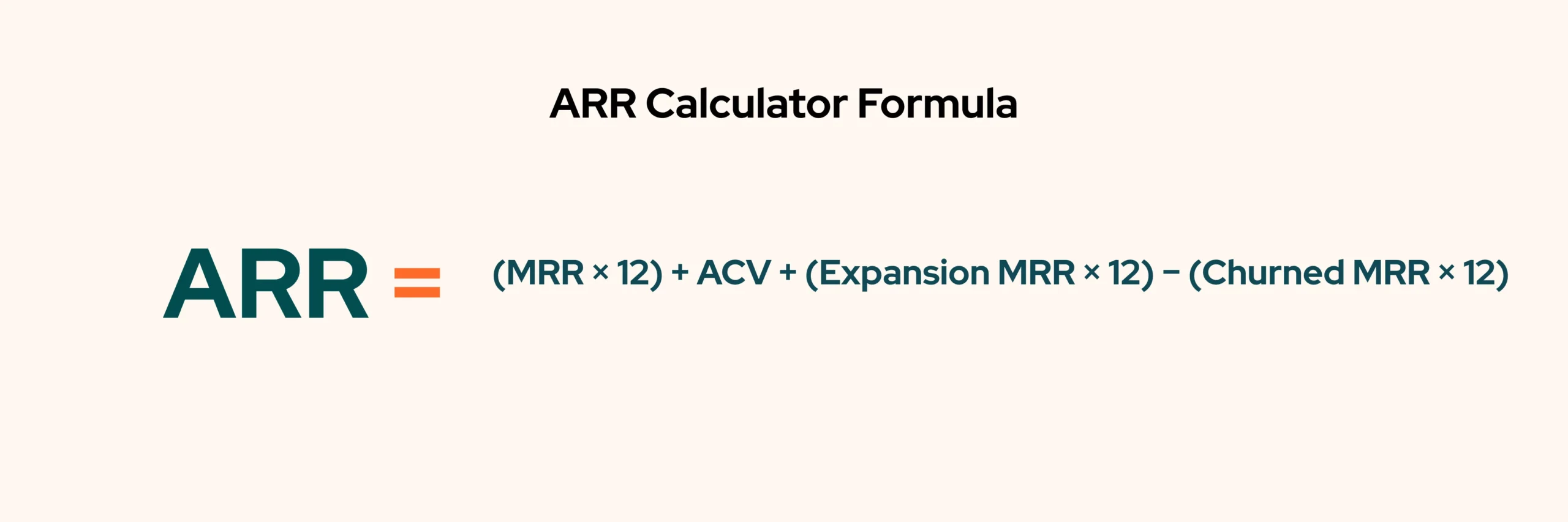
Here is how to fill each field correctly.
Step 1: Enter Your Monthly Subscription Revenue
Enter the recurring revenue your active subscriptions generate each month. This is your MRR, not invoiced amounts, not one-time payments, not revenue from contracts already captured in ACV.
The calculator annualizes this automatically: MRR × 12.
Step 2: Enter Your Annual Contract Value
Enter the total annualized value of your annual contracts. Unlike MRR, ACV inputs are already annualized, so enter the yearly figure directly. Do not multiply it again.
This field captures contract revenue that does not flow through monthly billing.
Step 3: Enter Expansion MRR
Enter the monthly recurring revenue added from upsells, seat expansions, and upgrades within your existing customer base. If a customer upgraded from a $500 to an $800 monthly plan, your expansion MRR from that account is $300.
The calculator annualizes this: Expansion MRR × 12.
Step 4: Enter Churned MRR
Enter the monthly recurring revenue lost from cancellations and downgrades. This is what your ARR number loses each month, and it gets subtracted before your final result is shown.
The calculator annualizes this: Churned MRR × 12.
Step 5: Hit Calculate
Once all four fields are filled, hit the Calculate button. The results panel displays your total ARR alongside a plain-language summary of what that number represents and the formula used to arrive at it.
A business with $50,000 MRR, $200,000 ACV, $5,000 expansion MRR, and $3,000 churned MRR produces:
($50,000 × 12) + $200,000 + ($5,000 × 12) − ($3,000 × 12) = $2,364,000 ARR
Why ARR Matters for SaaS Companies
ARR is one of the most important metrics in subscription-based businesses because it reflects predictable long-term revenue growth.
A strong ARR helps SaaS companies:
- Improve revenue forecasting
- Measure customer retention
- Attract investors
- Benchmark growth performance
- Increase company valuation
Investors frequently analyze ARR because recurring subscription revenue is more stable and predictable than one-time sales revenue.
Growing ARR often indicates:
- Healthy expansion revenue
- Strong product-market fit
- Effective customer retention
- Sustainable SaaS growth
ARR also helps finance teams evaluate:
- Revenue efficiency
- Net revenue retention
- Churn impact
- Customer lifetime value
ARR Benchmarks in 2026
ARR benchmarks vary depending on SaaS business size, growth stage, and customer segment.
| SaaS Stage | Typical ARR |
|---|---|
| Early-Stage SaaS | $10K–$1M |
| Growth-Stage SaaS | $1M–$10M |
| Scale-Up SaaS | $10M–$100M+ |
Early-Stage SaaS
Early-stage SaaS companies usually focus on:
- Customer acquisition
- Product-market fit
- Initial recurring revenue growth
Growth-Stage SaaS
Growth-stage companies often prioritize:
- Expansion revenue
- Customer retention
- Operational scalability
Scale-Up SaaS
Large SaaS businesses typically emphasize:
- Enterprise customer acquisition
- Revenue predictability
- Net revenue retention
- Global expansion
Investors frequently compare ARR growth against:
- Burn multiple
- CAC payback
- Gross margins
- Revenue efficiency metrics
What Counts Toward ARR?
Not all revenue should be included when calculating ARR.
Included in ARR
Recurring subscription revenue that renews consistently should be included.
- Monthly subscriptions annualized
- Annual SaaS contracts
- Recurring add-ons
- Expansion revenue
- Recurring seat upgrades
Excluded from ARR
Non-recurring or one-time revenue should not be included.
- One-time setup fees
- Consulting services
- Implementation charges
- Hardware sales
- Training fees
Excluding non-recurring revenue ensures ARR accurately reflects predictable subscription income.
ARR vs Revenue
ARR and total revenue are related but different financial metrics.
| Metric | Purpose |
|---|---|
| ARR | Measures recurring subscription revenue |
| Revenue | Measures all company income |
Revenue includes:
- Recurring subscriptions
- One-time fees
- Services
- Consulting income
ARR only measures predictable recurring subscription revenue.
This makes ARR more valuable for:
- SaaS forecasting
- Investor analysis
- Subscription growth evaluation
Common ARR Calculation Mistakes
Many SaaS companies incorrectly calculate ARR by including non-recurring revenue or ignoring churn impacts.
Including One-Time Revenue
One-time onboarding or implementation fees should not be counted toward ARR because they are not recurring.
Ignoring Churn
Customer cancellations reduce recurring subscription revenue. Ignoring churn can create inaccurate ARR projections.
Double-Counting Expansion Revenue
Expansion revenue should only be counted once after the recurring subscription officially increases.
Mixing Bookings With ARR
Bookings represent signed contracts, while ARR measures recurring revenue actually expected annually.
Counting Free Users
Free plans or inactive customers should not be included in ARR calculations because they do not generate recurring subscription revenue.
FAQs
Is ARR the same as annual sales?
No. ARR only measures recurring subscription revenue, while annual sales may include one-time purchases, services, or consulting revenue.
Do one-time fees count toward ARR?
No. One-time setup fees, onboarding charges, and consulting services are generally excluded because ARR focuses on predictable recurring revenue.
Why do investors focus on ARR?
Investors use ARR to evaluate revenue predictability, customer retention, and long-term SaaS growth potential. Strong ARR growth often signals sustainable business performance.
How does ARR affect SaaS valuation?
Higher ARR can improve SaaS valuation because recurring subscription revenue is predictable and scalable. Investors often apply valuation multiples directly to ARR performance.
Can ARR decrease?
Yes. ARR can decline due to customer churn, downgrades, lower expansion revenue, or subscription cancellations. Monitoring retention and expansion revenue helps stabilize ARR growth.