


Launching a new product is one of the most challenging stages for any startup. Even with a strong idea or innovative technology, many startups struggle to reach the right audience and generate early traction.
This is where a go-to-market strategy becomes essential. A well-planned GTM strategy helps startups clearly define their target customers, position their product effectively, and choose the right marketing and sales channels to drive growth.
Instead of launching without direction, a structured go-to-market plan ensures that every activity supports a clear goal: bringing the right product to the right customers at the right time.
In this guide, you will learn what a go-to-market strategy is, the key elements it should include, and nine practical steps startups can follow to build a successful GTM strategy.
What Is a Go-To-Market Strategy?
A go-to-market strategy (also known as a market entry or product launch strategy) helps startups reach customers, generate demand, and build a scalable growth engine.
Instead of launching a product without direction, a GTM strategy ensures that every activity supports a clear goal: getting the right product in front of the right customers at the right time.
Recent industry insights from Gartner also highlight how actively companies refine their GTM strategies. According to market research data:
- 47% of organizations plan to make minor adjustments to their go-to-market strategy.
- 11% plan to adopt an entirely new GTM strategy this year.
- 39% say they will continue using their current strategy without major changes.
These numbers show that businesses constantly evaluate and refine their go-to-market approach to stay competitive, respond to market shifts, and improve customer acquisition outcomes.
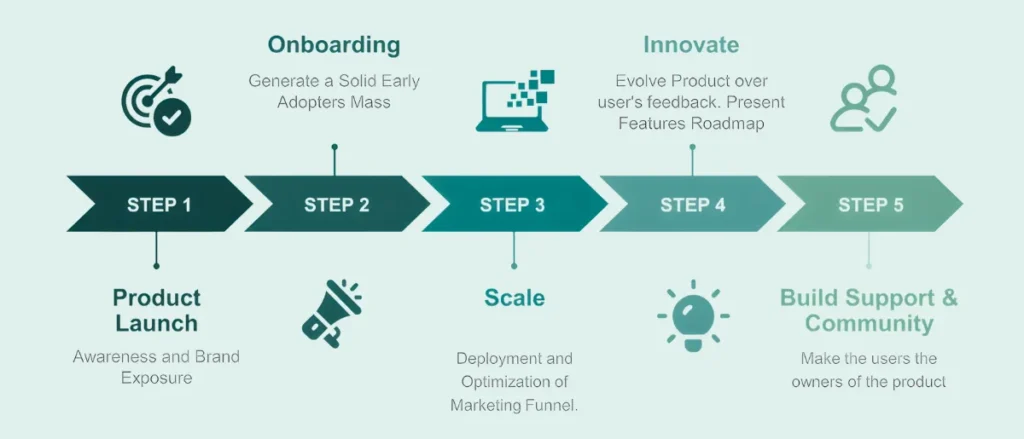
Why Are Go-To-Market Strategies Important for Startups?
A well-planned go-to-market strategy helps them focus their efforts on the most valuable customers, effective marketing channels, and scalable sales processes.
Industry data also highlights why a structured GTM approach is critical for growth. Research shows that:
- 5.4% of companies still don’t have a defined go-to-market strategy, which can make product launches and market entry more challenging.
- 79.5% of organizations believe product launches have a notable or major impact on revenue, showing how important a well-planned launch strategy is for business growth.
A strong go-to-market strategy helps startups:
- Identify the right target customers and build clear ideal customer profiles (ICPs)
- Position the product effectively within a competitive market
- Select the most effective marketing and distribution channels
- Align marketing, sales, and product teams around common growth goals
- Optimize customer acquisition and revenue generation
Most importantly, a GTM strategy helps startups move from product development to real market adoption, ensuring that their solution solves a meaningful problem for the right audience.
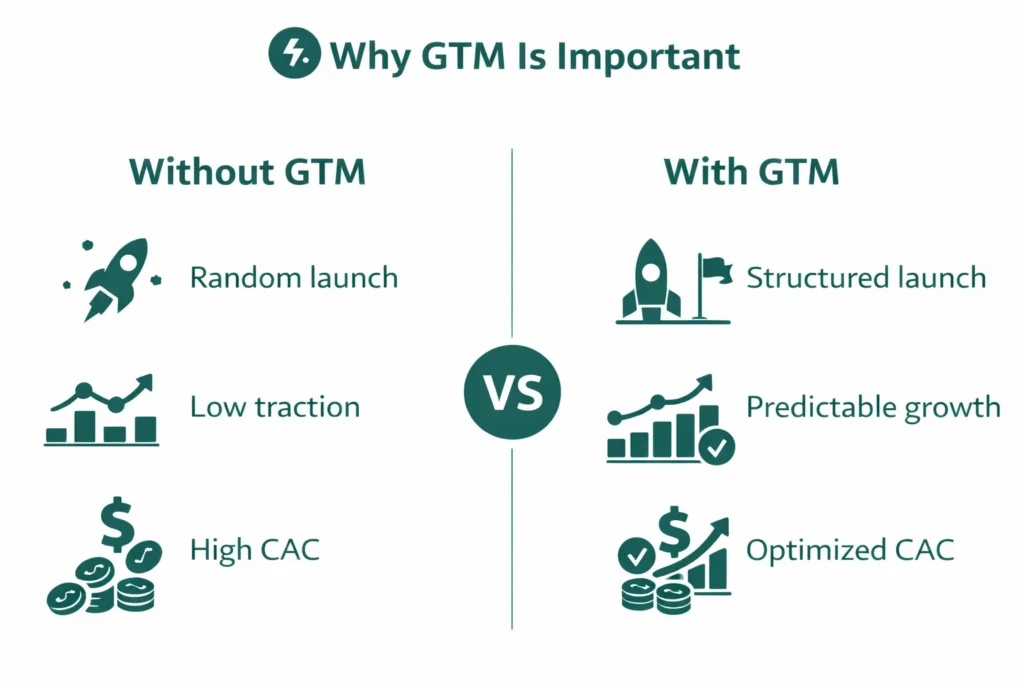
What Are the Key Elements of a Go-To-Market Strategy?
At a high level, every GTM strategy should clearly define the core components that guide how a product enters the market, reaches the right audience, and drives revenue growth.
Core components of a go-to-market strategy include:
1. Market Sizing
Market sizing helps startups estimate the overall market opportunity and identify where to focus their go-to-market efforts.
Instead of targeting the entire market, businesses typically use a tiered approach to narrow down realistic and high-value segments.
A well-structured GTM strategy typically includes the following key components:
- Total Addressable Market (TAM): The total market demand for a product if all potential customers buy it.
- Serviceable Addressable Market (SAM): The portion of TAM that a company can realistically serve based on its product, geography, and target audience.
- Serviceable Obtainable Market (SOM): The share of SAM that a company can capture, considering competition, resources, and market conditions.
- Prioritized Account Market (PAM): The subset of high-fit accounts within the market that show strong buying intent and are most likely to convert.
2. Target Customer Definition
Target customer definition focuses on identifying and segmenting the ideal customer profile (ICP) using demographic, firmographic, psychographic, and behavioral data.
A clear ICP helps startups target the right buyers and improve marketing efficiency.
3. Value Proposition
Value proposition explains the unique benefits and differentiators of the product, clearly showing how it solves specific customer problems.
A strong value proposition aligns with the needs and priorities of the ideal customer segments.
4. Product Positioning
Product positioning defines how a product fits within the competitive landscape and how it should be perceived by the target market.
It highlights the product’s strengths, key differentiators, and the value it delivers to customers.
5. Sales Strategy
Sales strategy outlines the sales process, revenue model, and go-to-market channels used to convert prospects into customers.
This may include direct sales, inside sales teams, partnerships, or self-serve product adoption.
6. Marketing Strategy
Marketing strategy focuses on demand generation and customer acquisition activities, including content marketing, digital campaigns, brand awareness, and lead generation.
These initiatives support the overall GTM plan by attracting and nurturing potential customers.
7. Customer Journey and Experience
Customer journey mapping identifies how buyers move through each stage of the awareness, consideration, and decision process.
Understanding this journey allows businesses to deliver relevant messaging and create a smoother buying experience.
8. Distribution Channels
Distribution channels define how the product will reach customers, whether through online platforms, marketplaces, partner networks, or direct sales.
Choosing the right channels ensures efficient product distribution and better market coverage.
9. Core Metrics and KPIs
Core metrics and key performance indicators help measure the success of the go-to-market strategy.
Common GTM metrics include pipeline growth, conversion rates, customer acquisition cost (CAC), and customer lifetime value (LTV).
10. Launch and Enablement Plans
Launch and enablement plans ensure that internal teams are prepared for product launches and market expansion.
This includes training sales teams, providing marketing resources, and equipping support teams with tools and documentation to assist customers effectively.
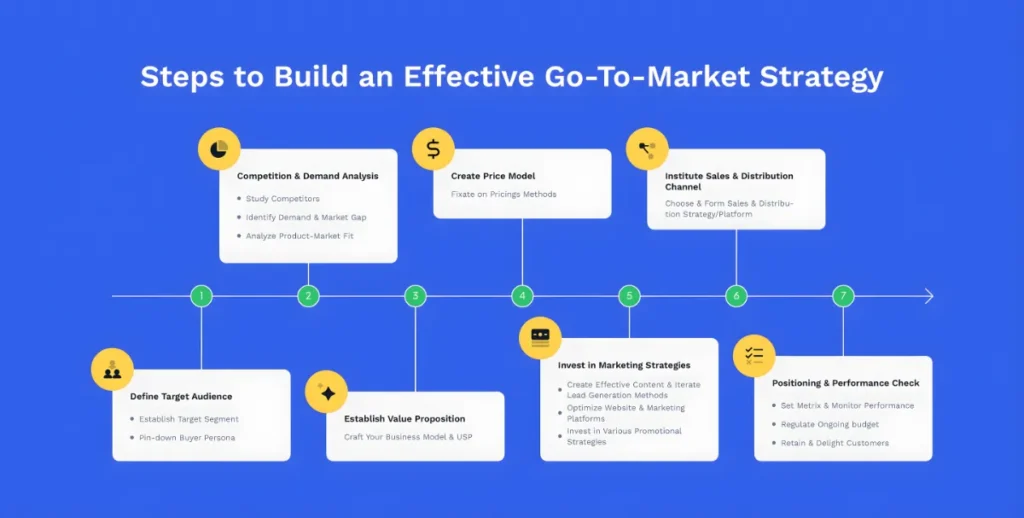
What Are the 4 Ps of a Go-To-Market Strategy?
The 4 Ps framework helps startups structure how a product is introduced to the market.
The 4 Ps of marketing framework typically includes the following elements:
- Product: The solution a company offers to solve a specific customer problem. It includes core features, functionality, and value for the target audience.
- Price: How the product is priced and the pricing model used, such as subscription, freemium, tiered, or usage-based. Choosing the right structure is a critical early decision see our breakdown of SaaS pricing models to compare each option.
- Place: The channels where customers access or buy the product, such as websites, marketplaces, partners, or direct sales.
- Promotion: The activities used to create awareness and demand, including SEO, content marketing, advertising, and social media.
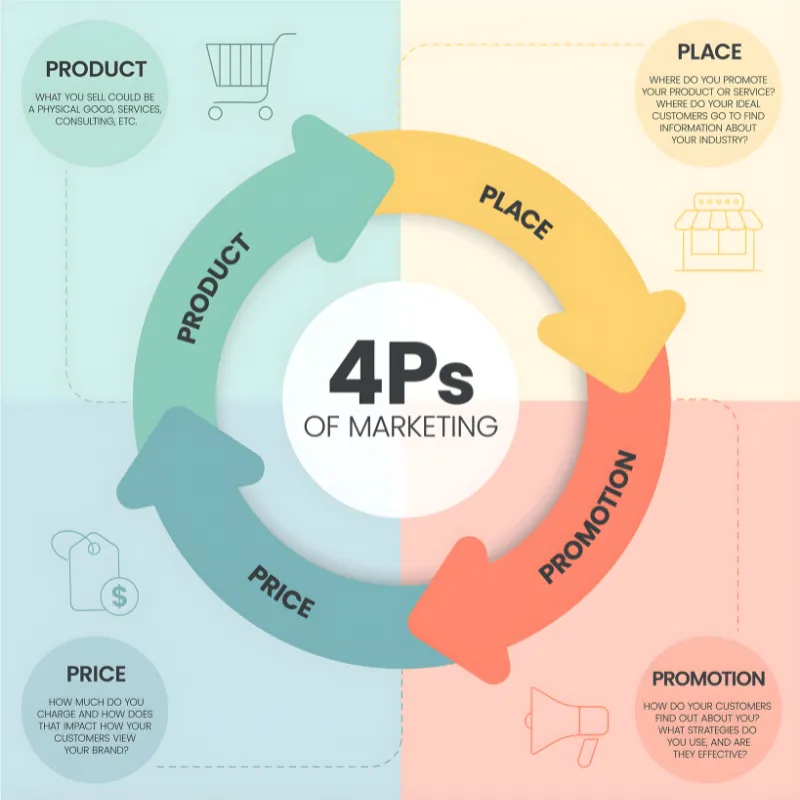
How to Create a Go-To-Market Strategy for Startups?
Building a successful startup launch requires a structured go-to-market plan that defines who you target, how you position your product, and how you acquire customers.
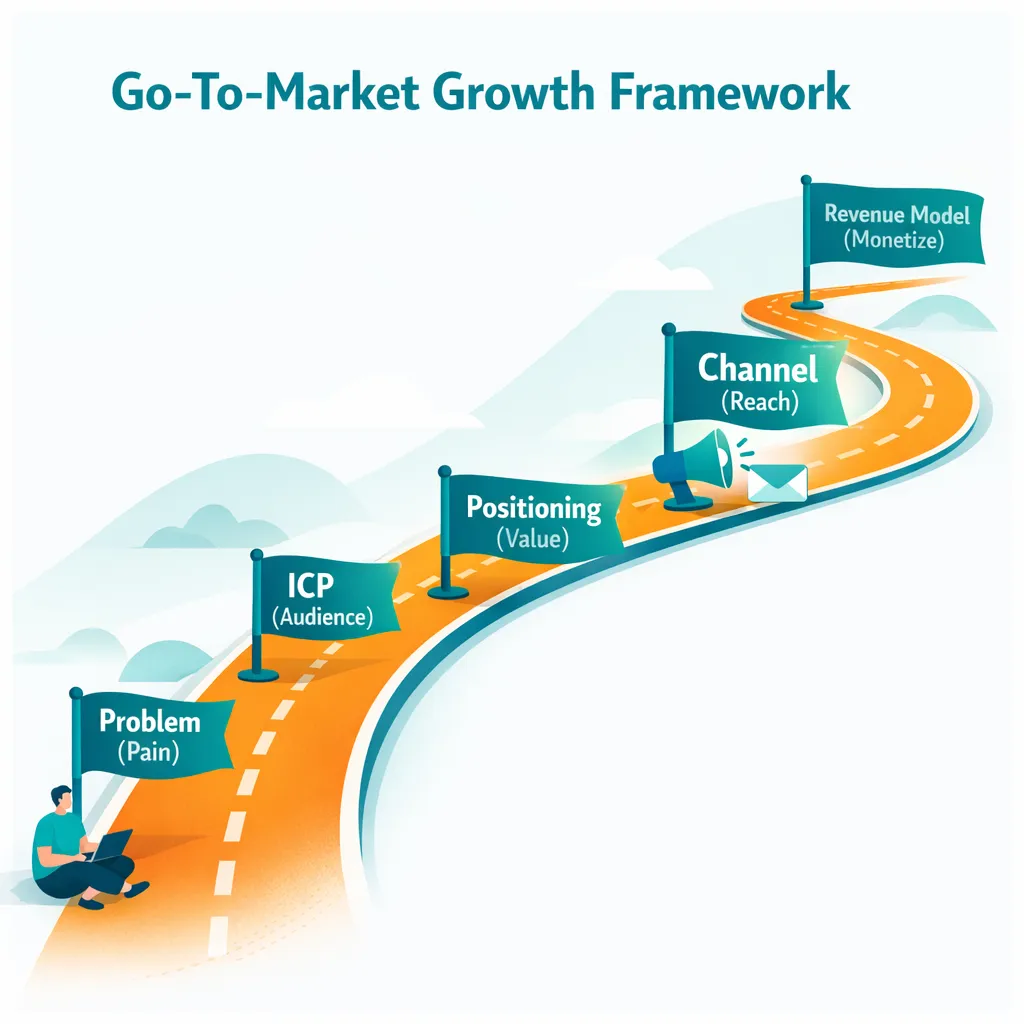
Before diving into the steps, it helps to view your GTM strategy through a simple but powerful model:
Problem → ICP → Positioning → Channel → Revenue Model
This framework ensures every decision you make is aligned with customer needs, market demand, and scalable growth.
Follow these practical steps to create a clear and actionable GTM strategy:
Step 1: Identify the core problem you’re solving
Start by defining the specific problem your product solves within the market:
- What challenge does your product address?
- Who experiences this problem the most?
- How are people currently solving it?
Focus on the real pain point, not just product features. This is the foundation of product-market fit, and it directly influences your positioning, messaging, and demand generation strategy.
A clear problem statement helps guide your product positioning, messaging, and marketing strategy.
Step 2: Define the target audience
Next, determine who your product is built for. Targeting a specific audience improves customer acquisition efficiency and reduces wasted marketing spend.
This step defines your Ideal Customer Profile (ICP) — a critical component of any scalable GTM strategy.
a) Ideal Customer Profile (ICP)
Your Ideal Customer Profile (ICP) describes the type of company or customer most likely to benefit from your product and generate long-term value.
Common ICP factors include:
- Industry
- Company size
- Budget range
- Location
- Business challenges
Defining your ICP helps focus your sales strategy, marketing campaigns, and overall growth strategy.
b) Buyer Personas
Buyer personas represent the decision-makers involved in purchasing your product and moving through your sales funnel.
Key elements of buyer personas include:
- Job role
- Goals and responsibilities
- Challenges or pain points
- Buying motivations
This helps refine your content strategy, sales messaging, and outreach campaigns.
Step 3: Research competition and demand
Analyse the competitive landscape and market demand before launching. This step ensures you are entering a viable market with clear differentiation.
Key areas to analyse in competitive and market research include:
- Direct competitors
- Alternative solutions customers use
- Market gaps you can address
You should also evaluate demand signals, such as search trends, customer feedback, and industry reports.
Competitor research helps you identify opportunities for stronger product differentiation, positioning, and market entry.
Step 4: Define product positioning and messaging
Clear positioning helps customers quickly understand your product and how it compares to alternatives in the market.
This step connects your problem + ICP to value proposition, forming the core of your GTM narrative.
Key elements of product positioning and messaging include:
- What your product does
- Who it is for
- What makes it different
Your messaging should highlight the key value proposition and customer outcomes rather than just product features.
For example, a SaaS tool may position itself as a simpler, faster alternative to complex enterprise solutions to attract startups and SMBs.
Step 5: Map the buyer’s journey
Customers typically move through several stages before making a purchase. Understanding this journey helps you align your marketing funnel and sales funnel.
Common stages of the buyer’s journey include:
- Awareness: The customer identifies a problem and begins researching possible solutions.
- Consideration: The customer evaluates and compares different products or services.
- Decision: The customer selects the most suitable product and moves toward purchase.
Mapping the buyer journey helps align your content marketing, product demos, and sales processes to improve conversion rates.
Step 6: Pick marketing channels
Choose marketing channels where your target audience is most active and where you can generate consistent demand.
This step defines your demand generation and distribution strategy.
Common startup marketing channels include:
- Search engine optimization (SEO)
- Content marketing
- Email marketing
- Social media marketing
- Paid advertising
- Partnerships and referrals
Instead of using too many channels, focus on 1–2 high-performing channels first to maximize ROI and validate your GTM strategy.
Step 7: Create a pricing and sales plan
Your pricing model should align with your product value, customer expectations, and market positioning.
This step defines your revenue model, completing your GTM framework.
Common pricing strategies include:
- Freemium model
- Tiered subscriptions
- Usage-based pricing
- Enterprise pricing
Also, define your sales approach, such as:
- Self-serve (product-led growth)
- Inside sales
- Enterprise saas sales
Choosing the right model directly impacts conversion rates and revenue scalability.
Step 8: Set concrete goals & KPIs
Define measurable metrics to track the success of your GTM strategy and overall growth performance.
Key SaaS and GTM metrics include:
- Customer Acquisition Cost (CAC)
- Customer Lifetime Value (LTV)
- LTV:CAC Ratio
- Monthly Recurring Revenue (MRR)
- Annual Recurring Revenue (ARR)
- Return on Ad Spend (ROAS)
Tracking saas metrics helps evaluate marketing efficiency, optimize your growth strategy, and improve unit economics.
Step 9: Create transparent processes
Establish clear internal processes to support consistent and scalable GTM execution.
Key internal processes required include:
- Lead qualification workflows
- Sales pipeline stages
- Customer onboarding processes
- Performance tracking systems
Clear processes improve team alignment across marketing, sales, and product, leading to better operational efficiency and scalable growth.
What Are the Common Mistakes Startups Make in a Go-To-Market Strategy?
Many startups struggle with growth, not because the product is weak, but because the go-to-market strategy is unclear or poorly executed. Avoiding these common mistakes can help you launch faster and reach the right customers.
Common go-to-market strategy mistakes startups often make include:
- Targeting a broad audience instead of focusing on a clearly defined customer segment.
- Having unclear product positioning makes it difficult for customers to understand the product value.
- Launching without proper market and competitor research.
- Using too many marketing channels instead of focusing on the most effective ones.
- Setting a pricing strategy that does not match customer expectations or product value.
- Poor alignment between marketing and sales teams.
- Not tracking key growth metrics such as CAC, LTV, MRR, and ROAS.
How Can SERP Forge Help Startups Build a Strong Go-To-Market Strategy?
Startups often need a clear plan to reach the right audience, position their product, and generate consistent demand.
SERP Forge, a SaaS marketing agency, supports startups in building and executing effective go-to-market strategies.
Ways SERP Forge helps startups include:
- Conducting market and competitor research to identify opportunities and demand.
- Developing SEO and content marketing strategies to attract qualified traffic.
- Creating clear product positioning and messaging for better market differentiation.
- Building high-quality backlinks and digital PR for stronger search visibility.
- Tracking SEO performance and growth metrics to improve marketing results.
With the right strategy and consistent execution, startups can improve product visibility, attract qualified leads, and build a scalable growth engine.
Conclusion
A strong go-to-market strategy helps startups launch products with clarity and direction. By defining the target audience, positioning the product clearly, selecting the right marketing channels, and tracking key metrics, you can improve customer acquisition and growth.
Following a structured GTM approach also helps reduce risks and ensures your marketing, product, and sales efforts work toward the same goal.
With the right strategy and consistent execution, startups can build visibility, attract the right customers, and scale sustainably.
Go-To-Market Strategy FAQs
1. What Is the Main Goal of a Go-To-Market Strategy for Startups?
The main goal of a go-to-market strategy is to help startups launch their product effectively, reach the right audience, and generate consistent customer demand. It provides a clear plan for positioning, marketing channels, sales approach, and customer acquisition.
2. When Should a Startup Create a Go-To-Market Strategy?
A startup should create a go-to-market strategy before launching a new product or entering a new market. Planning early helps define the target audience, messaging, marketing channels, and pricing approach.
3. What Is the Difference Between a Go-To-Market Strategy and a Product Launch Strategy?
A go-to-market strategy focuses on how a product will reach the market and acquire customers over time. A product launch strategy focuses specifically on the activities planned for the initial product release.
4. How Long Does It Take to Build a Go-To-Market Strategy?
The time required depends on the product, market complexity, and research involved. For many startups, developing a clear go-to-market strategy can take a few weeks to a couple of months.
5. What Metrics Should Startups Track in a Go-To-Market Strategy?
Startups should track metrics that measure growth and marketing performance, such as Customer Acquisition Cost (CAC), Customer Lifetime Value (LTV), Monthly Recurring Revenue (MRR), Annual Recurring Revenue (ARR), and Return on Ad Spend (ROAS).
6. Can Small Startups Create an Effective Go-To-Market Strategy With a Limited Budget?
Yes, small startups can build an effective go-to-market strategy by focusing on a specific target audience, using cost-effective channels like SEO and content marketing, and tracking key performance metrics to optimize results.

