




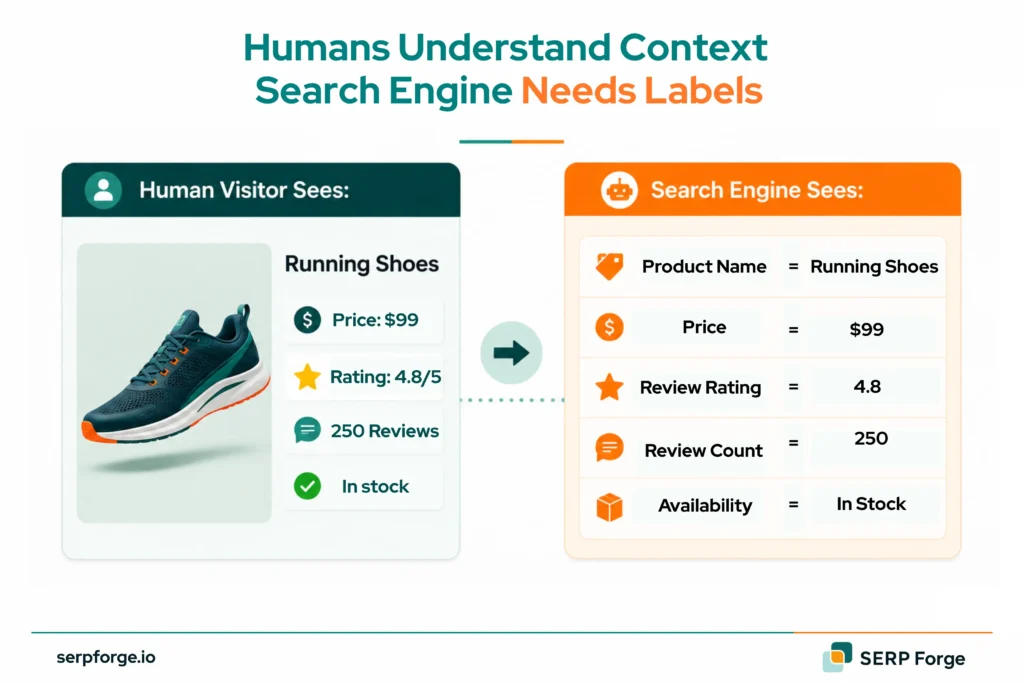
Search engines can read the words on your webpage, but they don’t always understand what those words represent. Is a number a price, a rating, a phone number, or a product ID? Without additional context, they have to interpret the information on their own.
That’s where structured data comes in. By using schema markup, you can clearly label important information such as products, reviews, articles, events, and businesses, helping search engines understand your content more accurately.
This can improve eligibility for rich results, strengthen entity recognition, and enhance your website’s visibility in search.
Why Structured Data Matters for SEO
Search engines have evolved beyond simple keyword matching. They now focus on understanding entities, relationships, and user intent. Structured data helps provide the context needed for that understanding.
1. Enhanced Search Visibility
Structured data helps search engines interpret page content more accurately and display it appropriately in search results.
For example, a recipe page that includes cooking time, calorie information, ingredients, and ratings through schema markup provides far more context than a recipe page containing only plain text.
This additional context helps search engines understand page elements more accurately and determine whether content is eligible for enhanced search features.
2. Rich Results Eligibility
One of the biggest benefits of structured data SEO is eligibility for rich results.
Depending on the schema type used, search results may display:
- Review stars
- Product pricing
- FAQ dropdowns
- Breadcrumb navigation
- Event information
- Recipe details
For example, if two product pages rank side by side and one displays a 4.8-star rating, price, and stock availability while the other shows only a title and description, users are naturally more likely to notice the enhanced listing.
3. Better Entity Understanding
Search engines increasingly rely on entities rather than keywords alone.
For example, structured data can help search engines understand that:
- A specific person authored an article
- An organization published the content
- A product belongs to a particular brand
- A business operates at a specific location
These entity relationships help search engines connect people, brands, products, and topics within their knowledge graphs, improving overall content understanding and relevance.
4. Improved Information Extraction
Without structured data, search engines must infer information from page content.
For example, a page may mention:
“Our office is open Monday through Friday from 9 AM to 6 PM.”
A human immediately understands that these are business hours. Structured data explicitly labels this information so search engines don’t need to guess.
This improves information extraction and reduces ambiguity.
How Structured Data Works
Structured data works by adding machine-readable code to a webpage. Search engines crawl this code alongside visible page content and use it to identify important information.
Schema Vocabulary
Schema.org currently provides hundreds of schema types and properties that help websites describe everything from articles and products to events, organizations, and local businesses.
This vocabulary contains thousands of schema types that describe different content categories, including:
- Articles
- Products
- Organizations
- FAQs
- Events
- Courses
- Local businesses
For example, instead of simply displaying a product price on a webpage, Product Schema identifies that value specifically as a price, helping search engines interpret it correctly.
JSON-LD Format
JSON-LD is the most widely used structured data format and Google’s preferred implementation method.
Google specifically recommends JSON-LD for most structured data implementations because it is easier to maintain and separate from page content.
For example, an eCommerce website with 5,000 product pages can manage structured data far more efficiently using JSON-LD than manually adding markup throughout each page template.
This makes implementation easier and maintenance more scalable.
Entity Relationships
One of the most powerful aspects of structured data is its ability to connect entities.
For example:
- An article is written by an author.
- The author works for an organization.
- The organization publishes content on a website.
- The article discusses a product.
These connections help search engines understand the broader context surrounding content rather than viewing each entity in isolation.
Search Engine Processing
When search engines crawl a page, they:
- Discover the structured data.
- Identify schema types and properties.
- Validate the markup.
- Associate entities and relationships.
- Determine eligibility for rich results.
Search engines may then use this information to generate rich results, knowledge panels, product listings, and other enhanced search features when appropriate.
What Are the Different Types of Structured Data?
Different types of content require different schema implementations.
Article Schema
Article Schema is commonly used for blogs, news websites, and editorial content.
For example, a blog post published on June 1st by a marketing expert can use Article Schema to define:
- Headline
- Author
- Publication date
- Featured image
- Publisher
This helps search engines identify key content details.
FAQ Schema
FAQ Schema is designed for pages containing questions and answers.
For example, a software company may have a support page answering common customer questions. FAQ Schema helps search engines understand that those questions and answers belong together.
Breadcrumb Schema
Breadcrumb Schema helps search engines understand website hierarchy.
For example, a SaaS website might organize content as:
Resources > SEO Guides > Structured Data Guide
This helps search engines understand the relationship between categories and pages.
Organization Schema
Organization Schema provides information about a business or brand.
Typical properties include:
- Company name
- Website URL
- Logo
- Contact details
- Social profiles
This helps search engines better understand brand entities.
Product Schema
Product Schema is one of the most widely used schema types in eCommerce.
For example, a product page may contain:
- Price: $99
- Rating: 4.8 stars
- Reviews: 250
- Availability: In Stock
Product Schema helps search engines understand these details and potentially display them in search results.
Local Business Schema
Local Business Schema helps search engines understand location-specific information.
For example, a dental clinic can provide:
- Business address
- Phone number
- Opening hours
- Service area
- Business category
This information supports local SEO and improves location relevance.
What Is the Difference Between Structured Data and Unstructured Data?
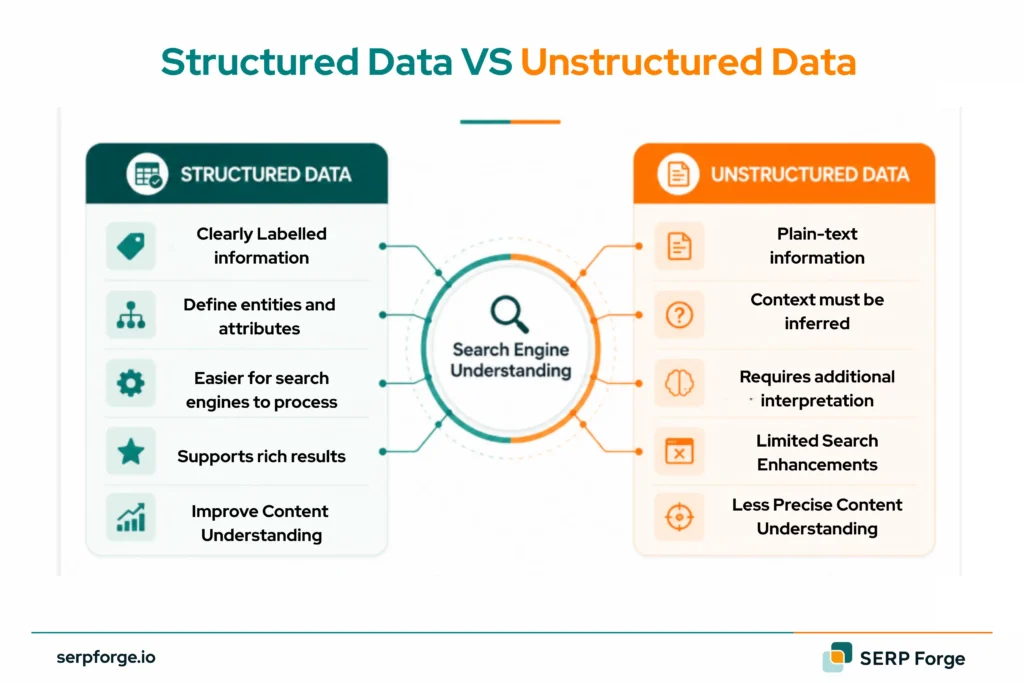
Both structured and unstructured data can contain the same information, but they present that information differently to search engines.
Structured data uses schema markup to clearly define important details, while unstructured data relies on search engines to interpret meaning from surrounding content and context.
The key difference lies in how information is organized and understood by search engines:
What Are the Main Components of Schema Markup?
Structured data relies on several key components:
Entities: Entities are the primary objects being described. For example, an entity could be a person, a product, an organization, an event, or an article being described on a webpage.
Attributes: Attributes provide additional details about an entity. Attributes provide additional details about an entity, such as its name, description, price, address, or publication date.
Properties: Properties define the characteristics associated with a schema type. A product page might use properties such as price, brand, availability, and review ratings to help search engines understand important product information.
Relationships: Relationships connect entities together. For example, an author can be associated with an article they have written, an organization can be identified as the publisher of that article, and a brand can be connected to the products it sells.
Types: Types classify entities according to Schema.org definitions. Examples include Article, Product, FAQPage, LocalBusiness, and Organization.
How to Implement Structured Data
To get the most value from schema markup, it’s important to implement structured data correctly from the start:
Choose the Appropriate Schema Type
Start by selecting the schema type that matches your content.
For example:
- Blog post > Article Schema
- Product page > Product Schema
- Company website > Organization Schema
- Location page > Local Business Schema
Using the correct schema type helps search engines understand page intent.
Add Required Properties
Every schema type includes required and recommended properties.
For example, Product Schema often requires details such as product name, price, availability, and brand information.
The more complete the markup, the more useful it becomes.
Validate Markup
Before publishing, validate your structured data to identify missing fields and implementation errors. Many SEO professionals use tools such as Google’s Rich Results Test and Schema Markup Validator to verify that markup is implemented correctly.
Even small mistakes can prevent search engines from properly processing markup.
Monitor Rich Results
After implementation, monitor search performance and rich result eligibility. Many websites discover errors only after reviewing structured data reports regularly.
What Are the Most Common Structured Data Mistakes?
Even experienced SEO teams can make implementation mistakes:
- Missing Required Properties: Incomplete schema markup often prevents search engines from understanding content correctly.
- Incorrect Entity Types: Using Product Schema on a service page or Article Schema on a product page creates confusion and reduces effectiveness.
- Structured Data Not Matching Page Content: Structured data should always reflect visible page content. Google’s structured data guidelines recommend that schema markup accurately reflect the content visible to users on the page.
For example, adding review ratings within markup when no reviews appear on the page creates inconsistencies.
- Spammy or Misleading Markup: Some websites add FAQ Schema to pages that contain no actual FAQs. Search engines may ignore this markup or remove rich result eligibility.
- Ignoring Validation Errors: Small validation issues can prevent structured data from functioning correctly. Regular audits help identify and fix these problems before they affect performance.
What Are the Best Practices for Structured Data?
Structured data delivers the best results when it accurately reflects your content and is maintained consistently across your website:
- Use Relevant Schema Types: Only implement schema that accurately describes page content.
- Maintain Entity Consistency: Use consistent names, business details, author information, and branding across your website.
- Connect Related Entities: Link related entities wherever possible to strengthen semantic relationships.
- Update Markup Regularly: As content changes, update structured data to ensure accuracy.
For example, product availability, pricing, business hours, and publication dates should always reflect current information.
Final Thoughts
Structured data helps search engines understand website content by providing clear information about entities, attributes, and relationships.
While schema markup is not a direct ranking factor, it can improve content understanding, support rich results, strengthen entity recognition, and contribute to a stronger technical SEO foundation over time. An AI SEO agency can also use structured data to support AI search visibility.
As search engines continue moving toward entity-based search and semantic understanding, structured data remains one of the most effective ways to provide clear, machine-readable information about your content.