


Entity SEO is the process of helping search engines understand the real-world subject behind your content. That subject can be a person, place, product, brand, organization or concept.
Earlier SEO relied more heavily on keyword matching. Entity SEO adds another layer by helping search engines understand meaning, context and relationships.
Here’s an easy example:
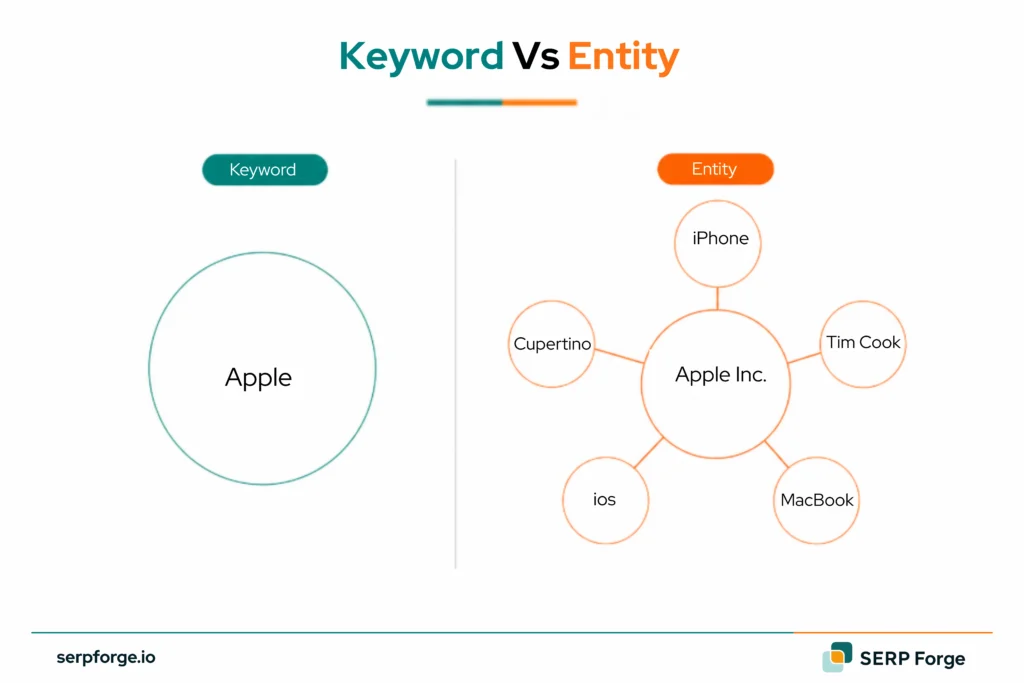
“Apple” can mean a fruit or a technology company. Search engines use related entities like iPhone, Tim Cook, MacBook, iOS and Cupertino to understand that the page is about Apple Inc.
Entity SEO helps Google and AI systems understand what your page is about, which entity it refers to and how that entity connects to other topics.
What Is an Entity in SEO?
An entity in SEO is a uniquely identifiable real-world subject that search engines can recognize.
Common entities in SEO include:
- People: Sundar Pichai, Marie Curie, Elon Musk
- Places: Delhi, Eiffel Tower, Silicon Valley
- Organizations: Google, Salesforce, OpenAI
- Products: iPhone, Adobe Photoshop, ChatGPT
- Concepts: machine learning, semantic SEO, digital marketing
- Creative works: books, films, research papers, software frameworks
Think of it this way:
A keyword is a string of text. An entity is the meaning behind that text.
“CRM software” is a keyword. “Salesforce” is an entity. It has products, features, competitors, categories and relationships attached to it.
Pro tip:
Treat every important entity like a profile. Give it a clear name, category, attributes, related concepts and internal links so search engines can place it correctly.
This is why entity based SEO is different from basic keyword placement. You are building a subject map that machines can read.
What Are Entity Catalogs?
An entity catalog is a database that stores known entities and their details.
Think of it like a machine-readable directory.
Each entity may include a name, type, description, alternate names, related entities, attributes, source references and a unique ID.
Common entity catalogs include:
| Entity Catalog | What It Helps Search Engines Understand |
| Google Knowledge Graph | People, places, brands, products and concepts |
| Wikipedia | Public descriptions and related topics |
| Wikidata | Structured facts about entities |
| Schema.org | Website-level structured vocabulary |
Here’s where this becomes practical:
“Jaguar” can mean an animal, car brand, sports team or software version. An entity catalog gives each meaning a separate identity.
Pro tip:
Keep the entity name, category and description consistent across your website, schema, social profiles and third-party mentions. Mixed naming creates weak entity signals.
How Does Google Use Entities to Rank Content?
Google uses entities to understand meaning, context and search intent.
It looks at:
- The main entity of the page
- Related entities around it
- The relationship between those entities
- Schema markup and structured data
- Trusted third-party references
For example:
A page about entity SEO should naturally include Knowledge Graph, schema markup, semantic SEO, NLP, structured data, entity linking, sameAs, topical authority and entity disambiguation.
One practical way to check entity clarity is Google’s Natural Language API. It can identify entities, classify their type and show entity salience, which means how central each entity is to the text. For SEOs, this helps spot whether the page is focused on the right subject or sending mixed signals.
The Knowledge Graph
The Knowledge Graph is Google’s database of real-world entities and their relationships.
It helps Google understand that Barack Obama is a person, was President of the United States and is connected to public office, books, elections and speeches.
That is the shift:
Search moves from text matching to relationship mapping.
For SEO, your page should explain the entity, its attributes and its related concepts in a structured way.
Things Not Strings
“Things, not strings” means Google tries to understand real-world subjects instead of only matching text.
A string is a keyword. A thing is an entity.
For example, “Java” can mean coffee, a programming language or an island.
The surrounding entities do the work:
If the page mentions JVM, Spring Boot, Oracle and object-oriented programming, the entity is likely Java the programming language.
If it mentions beans, roasting, caffeine and espresso, the entity is coffee.
Pro tip:
When a term has multiple meanings, add related entities early. It helps search engines resolve the correct meaning faster.
Entities vs Keywords
Keywords and entities work together, but they are not the same.
Use this table to see the difference:
| Point of Difference | Keywords | Entities |
| Meaning | Words users search | Real-world subjects search engines understand |
| Example | “best CRM software” | Salesforce, HubSpot, Zoho CRM |
| SEO role | Matches user language | Builds context and meaning |
| Measurement | Search volume, rankings, clicks | Relevance, relationships, topical coverage |
| Content use | Shows demand | Shows subject depth |
Old SEO asked:
“How many times should we use this keyword?”
Entity SEO asks:
“Have we explained the subject well enough for search engines to understand it?”
Use both together:
- Use keywords to match search demand
- Use entities to define meaning
- Use schema to confirm identity
- Use internal links to connect related topics
How Do Entity Linking and Disambiguation Work?
Entity linking connects a word or phrase in your content to a known entity in a knowledge base.
Entity disambiguation chooses the correct meaning when one word can refer to different things.
Here’s a simple example:
“Washington spoke at the event.”
This could refer to George Washington, Washington, D.C., Washington State or a person with the surname Washington.
Now add context:
“Washington spoke at the White House after meeting Congress.”
The political context helps the system understand the entity.
Pro tip:
Use full names, related terms, definitions and structured context when introducing important entities.
For content, this means:
- Define the main entity early
- Use related entities near it
- Avoid vague references
- Add schema where useful
- Link to supporting pages with descriptive anchor text
How to Use Wikipedia as Your Entity SEO Framework
Wikipedia is useful because it shows how entities are organized.
You do not need to copy Wikipedia. Use it as a structure map.
Study the Lead Section
Wikipedia usually starts with a direct definition.
Glossary pages should do the same.
Your first paragraph should answer:
“What is this thing?”
Review the Table of Contents
The table of contents shows the major sub-entities around a topic.
For example, a page on search engine optimization may include crawling, indexing, ranking, link building, on-page SEO and technical SEO.
That gives you a content map.
Check Internal Links
Wikipedia links related entities to build context.
Your page should do the same with descriptive anchors.
Use anchors like schema markup, semantic SEO, Knowledge Graph, structured data and topical authority.
Pro tip:
Wikipedia’s internal links show which nearby concepts support the main entity. Use them to spot missing subtopics.
Review Categories
Wikipedia categories show how a subject is grouped.
Use those categories to plan your breadcrumbs, tags, glossary categories and internal linking.
How to Optimise for Entity SEO
Entity SEO works when your page, schema, internal links and external mentions all support the same meaning.
Start with this process:
Identify Your Page’s Main Entity
Every page needs one main entity.
For this page, the main entity is entity SEO.
Supporting entities include:
- Knowledge Graph
- schema markup
- entity linking
- semantic SEO
- structured data
- NLP
- Wikidata
- sameAs property
- topical authority
Before writing, ask:
“What should Google understand this page is mainly about?”
Then build the opening section around that answer.
Use Schema Markup
Schema markup is structured data that helps search engines read your page more accurately.
For a glossary page, DefinedTerm schema is a good fit. Breadcrumb schema also helps because it shows where the page sits on your site.
Schema can define the term, description, page URL, subject, related references and breadcrumb position.
Pro tip:
Use schema to confirm the main entity. If the visible content says one thing and the markup says another, the page sends mixed signals.
Add the sameAs Property
The sameAs property connects your entity to trusted URLs that describe the same subject.
For a brand, sameAs may point to LinkedIn, Crunchbase, Wikidata, Wikipedia, official social profiles or Google Business Profile.
Use sameAs only when the URL clearly identifies the same entity.
Pro tip:
Add sameAs only for trusted profiles that clearly describe the same entity. Weak or mismatched URLs can create more confusion than clarity.
Use Semantically Related Terms
Semantic SEO entities help search engines understand the full topic.
For entity SEO, related terms include semantic search, knowledge graph, structured data, entity catalog, entity recognition, entity disambiguation, entity linking, natural language processing, topical authority, schema markup, linked data, search intent, content clusters and co-occurrence.
Use them naturally inside explanations. The goal is coverage.
Build Topical Depth Across Your Site
A single glossary page can define a term. A connected content cluster builds authority.
For entity based SEO, supporting pages may include semantic SEO, schema markup, knowledge graphs, topical authority, structured data and entity linking.
Think of your website like a knowledge base. Each page explains one idea. Internal links show how those ideas connect.
Build Co-occurrence on Third-Party Sites
Co-occurrence means your entity appears near related entities on trusted websites.
For example:
If your brand is often mentioned near technical SEO, AI search, schema markup and content strategy, search engines may connect your brand with those topics. AI SEO Optimization builds on these entity signals to help AI search systems understand your brand.
This can happen through guest articles, podcast bios, PR mentions, directory listings, partner pages, founder profiles and industry reports.
Pro tip:
Keep names, categories, founder details and product descriptions consistent across these surfaces. One mismatch may look small to humans but can create entity confusion for machines.
Conclusion
Publishing more pages will not fix weak visibility if search engines cannot understand how those pages connect. Entity SEO helps turn loose content into a search ecosystem, where each page has a defined subject, supporting entities, schema and internal links. If your glossary, blog or landing pages are live but still not earning the visibility they should, it may be time to look beyond writing and fix the SEO content structure behind them. SERP Forge SaaS SEO helps software brands build that structure.