



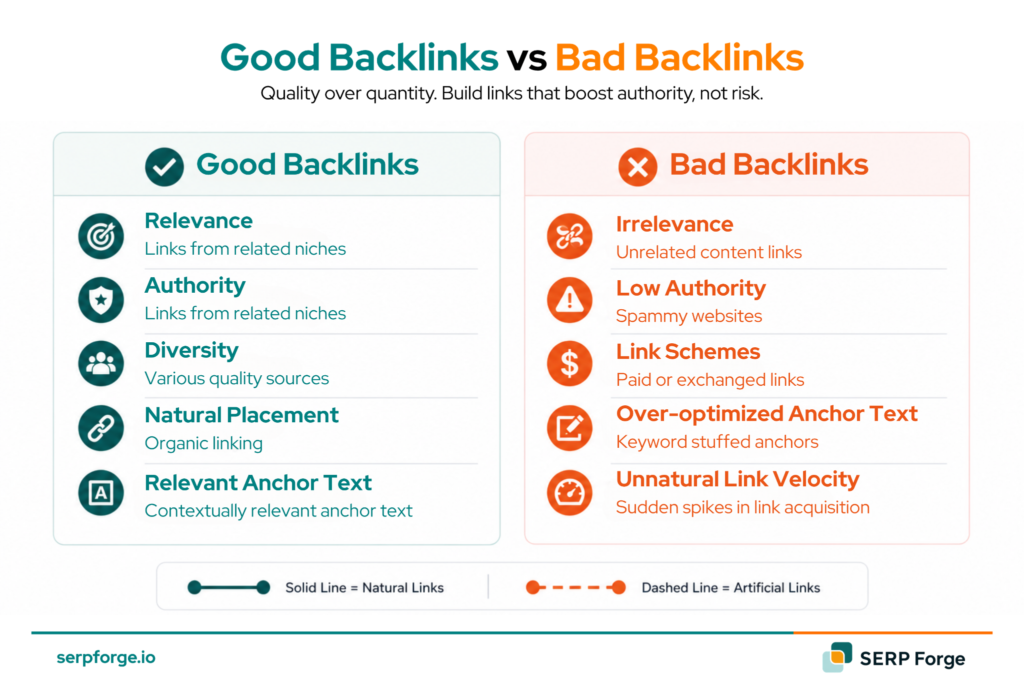
Not all backlinks provide the same value. Search engines look beyond the number of links and evaluate where they come from, how they’re earned, and how diverse your backlink profile is.
Backlink diversity measures the variety of links pointing to your website across different domains, anchor texts, content formats, and industries. Building a diverse backlink profile helps strengthen your site’s authority, reduces spam signals, and supports sustainable SEO growth.
Why Backlink Diversity Matters for SEO
Backlink diversity plays a major role in helping search engines evaluate whether a website has earned authority naturally across the web.
A strong backlink diversity strategy helps SEO in several ways:
- Creates a more natural-looking link profile
- Reduces the risk of algorithmic spam signals
- Strengthens topical relevance and authority
- Improves ranking consistency during algorithm updates
- Expands visibility across different audiences and platforms
- Builds broader trust through unique referring domains
- Supports healthier anchor text distribution
- Prevents over-reliance on one link acquisition method
If a website receives hundreds of links with identical anchors or from similar low-quality sources, the pattern can appear manipulative.
Industry research shows that 93.8% of link builders prioritize link quality over quantity. Instead of focusing on volume, they achieve better long-term SEO results by earning relevant, authoritative backlinks from diverse sources.
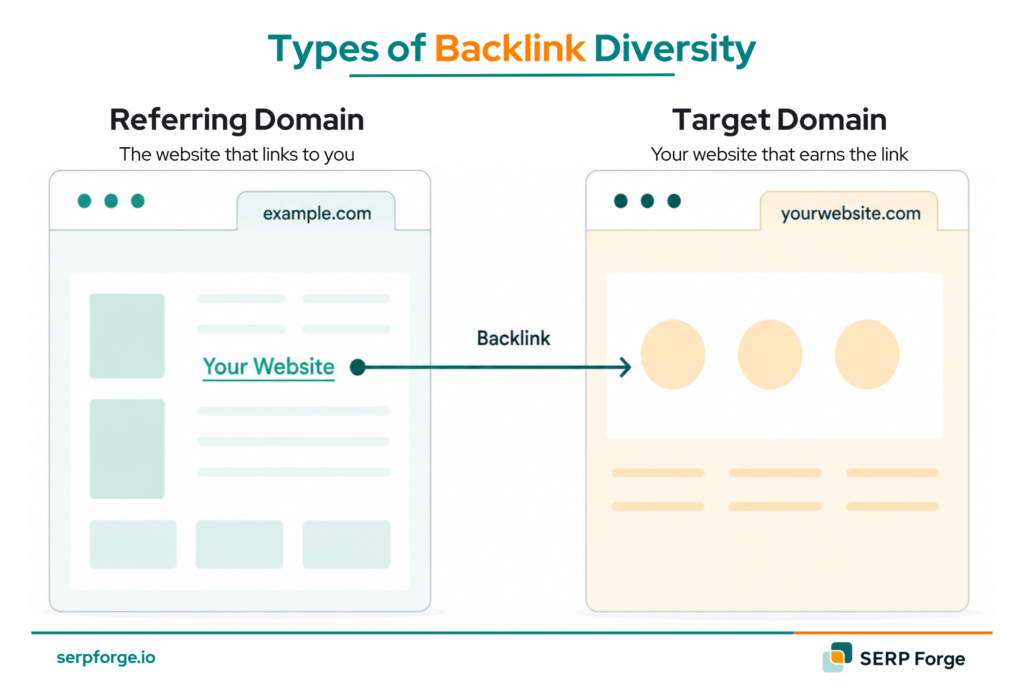
Types of Backlink Diversity
Backlink diversity is not a single thing; it is made up of several overlapping dimensions.
To build a healthier and more natural backlink profile, you need to focus on the following types of diversity:
Referring Domain Diversity
The most fundamental type of diversity is the number of unique domains linking to your website. Ten links from ten different domains are almost always more valuable than ten links from the same domain.
Referring domain diversity reflects how widely your website is recognized across the internet.
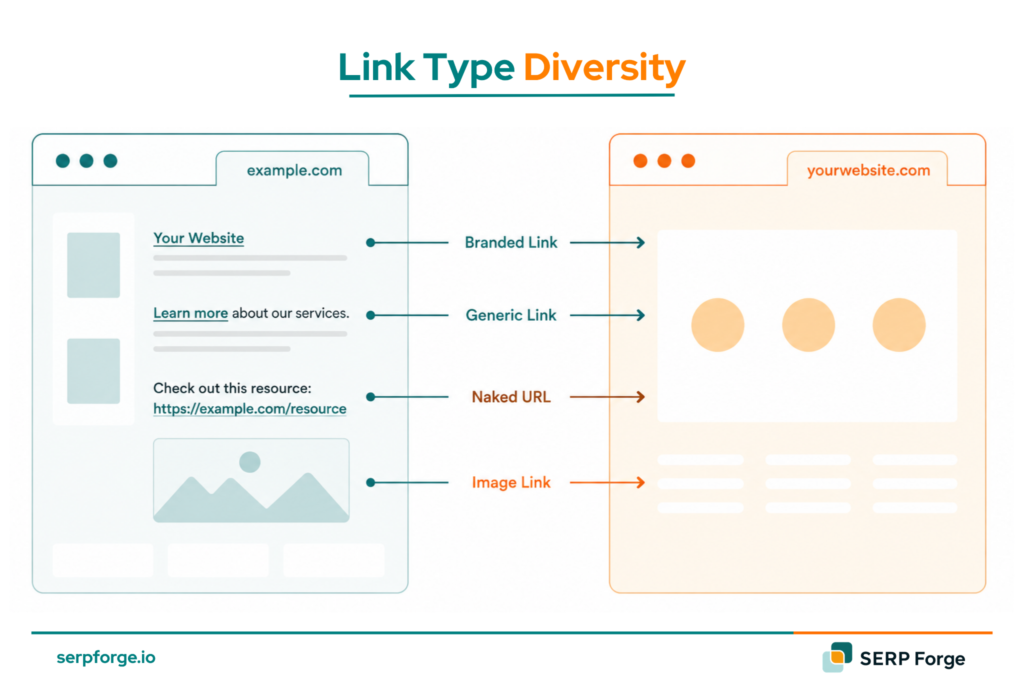
Anchor Text Diversity
Anchor text diversity means the clickable text used in your inbound links varies a mix of branded terms naturally (your company name), generic phrases (“click here,” “learn more”), partial-match keywords, exact-match keywords, and naked URLs.
A healthy anchor text profile typically has branded and generic anchors as the majority, with keyword-rich anchors as a smaller minority.
Link Type Diversity
Links come in many forms: editorial links embedded in articles, directory submissions, forum signatures, blog comments, social media mentions, resource page citations, and press coverage.
A diverse link profile includes a range of these types. Over-reliance on any single link type, especially lower-quality types like blog comments or directory submissions, dilutes your profile’s credibility.
Content Format Diversity
The formats of content that link to you also matter. Links may come from written articles, video descriptions, podcast show notes, infographics, research studies, or tools and calculators.
Diversity in content formats signals that your site is recognized as a resource across different media, not just in one content channel.
TLD Diversity
TLD (top-level domain) diversity refers to having links from a range of domain extensions .com, .org, .edu, .gov, .net, and country-specific TLDs like .co.uk or .de.
Links from .edu and .gov domains carry particular trust signals because they are harder to obtain and come from authoritative institutions.
Geographic Link Diversity
If your business serves multiple regions or countries, geographic link diversity becomes important.
Having links from websites based in different countries not only diversifies your profile but can also improve your visibility in local and international search results.
How Google Evaluates Backlink Diversity
Google does not assess backlinks in isolation.
It evaluates your entire link profile as a system, looking at patterns, context, and history to determine whether your links reflect genuine authority or artificial manipulation.
Search engines do not look at backlinks individually; they assess multiple signals across your entire backlink profile, including:
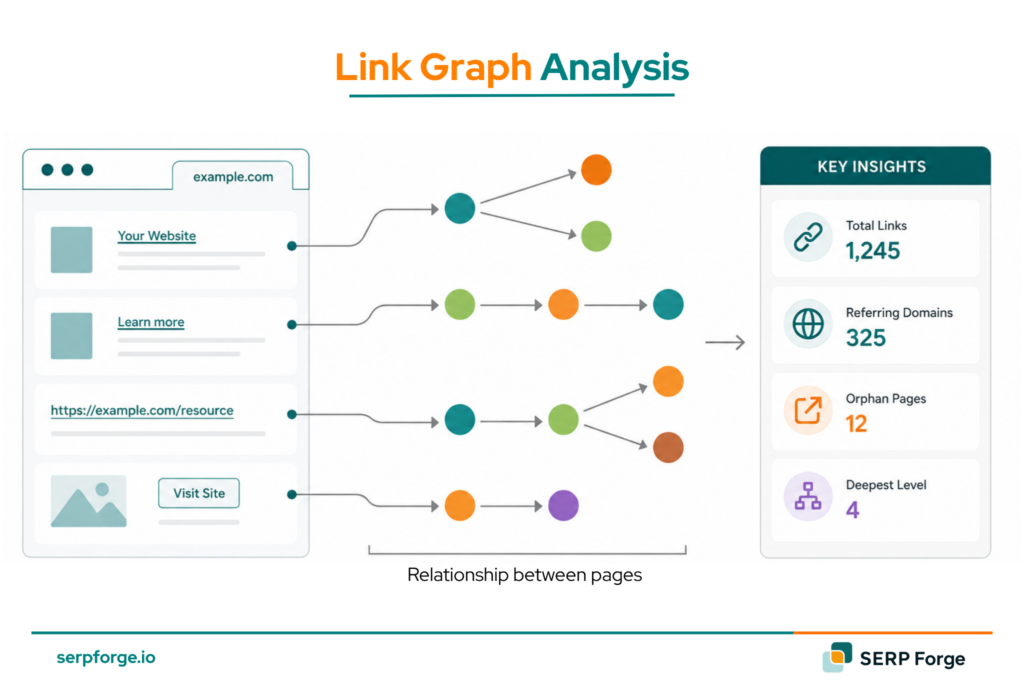
Link Graph Analysis
Google maps the relationships between websites through what is known as the link graph, a vast network showing which sites link to which. When it analyzes your profile, it looks at clustering patterns.
If many links to your site come from a small cluster of interlinked domains (known as a link network or PBN), that cluster stands out as anomalous compared to the more distributed pattern of a naturally-acquired link profile.
Relevance and Contextual Signals
Google pays close attention to the relevance of the sites linking to you. A backlink from a website in your industry or one covering a closely related topic carries significantly more weight than a link from an unrelated niche.
Equally, the contextual placement of the link (where on the page and surrounded by what kind of content) influences how Google interprets its signal.
Anchor Text Pattern Recognition
Anchor text distribution is one of the clearest fingerprints of manipulative link building. When Google sees an unusual concentration of exact-match keyword anchors pointing to a page, it raises a flag.
The algorithm has been trained to recognize the difference between the anchor text profile of a site that earns links naturally, where most anchors are branded or generic and one that has been artificially optimized.
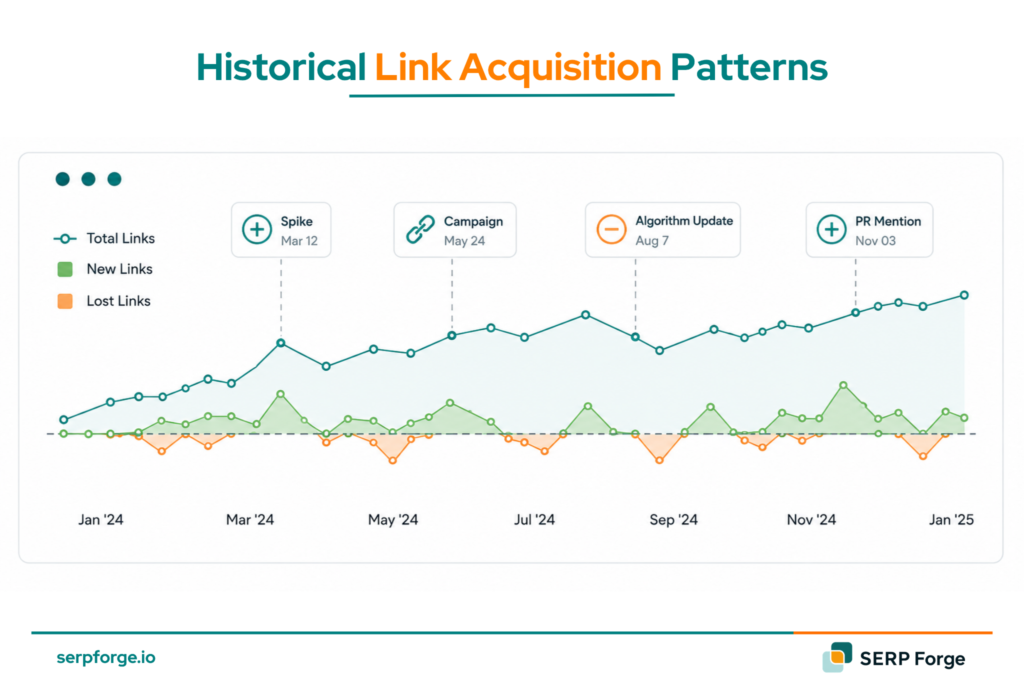
Historical Link Acquisition Patterns
The rate and pattern at which you acquire links also matter. A sudden spike of dozens of identical links in a short window looks unnatural.
Google considers historical velocity, how links have accumulated over time, as part of its evaluation.
How to Build Backlink Diversity
Building a genuinely diverse backlink profile requires deliberate strategy and a commitment to multiple link-building methods running in parallel.
Below are the most effective approaches. For a broader overview of tactics, see our guide on link-building techniques.
A naturally diverse backlink profile is created through multiple SEO and outreach strategies working together, such as:
Create Linkable Assets
The most durable way to earn diverse links is to create content and resources so valuable that multiple different types of websites want to reference them.
Linkable assets include:
• Original research, surveys, or industry data
• Comprehensive how-to guides and tutorials
• Free tools, calculators, or templates
• Infographics and visual explainers
• Glossary pages and definitional content
When your asset is genuinely useful, it will attract links from a variety of sources, such as news sites citing your data, bloggers embedding your infographic, and educators referencing your guide, creating diversity automatically.
Use Multiple Link Building Strategies
Relying on a single tactic produces a uniform link profile. Instead, run several strategies simultaneously. Manual link building through outreach, digital PR, HARO responses, podcast appearances, broken link building, and resource page outreach each attract links from different types of domains and formats.
The goal is not to do everything at once, but to ensure that over time, your link profile reflects a range of acquisition methods rather than a single repeated pattern.
Diversify Anchor Text Naturally
Never specify anchor text when doing outreach unless the natural phrasing of the content calls for it.
Let the linking site choose how to describe the link. Over time, this creates a natural spread of anchor text.
When you do influence anchor text, for instance, in guest posts, vary it deliberately across branded terms, partial-match phrases, and generic language.
Earn Links From Relevant Niches
Seek link opportunities beyond top industry publications.
Focus on niche blogs, local news sites, industry associations, educational institutions, complementary businesses, and community forums.
Each different type of referring domain adds a new dimension to your diversity profile.
Build Links to Multiple Pages
Many link-building campaigns focus exclusively on the homepage or a few top-priority pages. This creates an unnatural concentration of inbound links to just one or two URLs.
This reflects how a site naturally attracts attention and strengthens your overall domain authority, not just a handful of pages.
In fact, 41% of SEO professionals consider link building the most difficult part of search engine optimisation, mainly because earning high-quality and naturally varied backlinks requires long-term outreach, content quality, and relationship building.
How to Analyze Backlink Diversity
Building a diverse link profile is only half the job; regularly auditing it ensures you catch imbalances before they become liabilities.
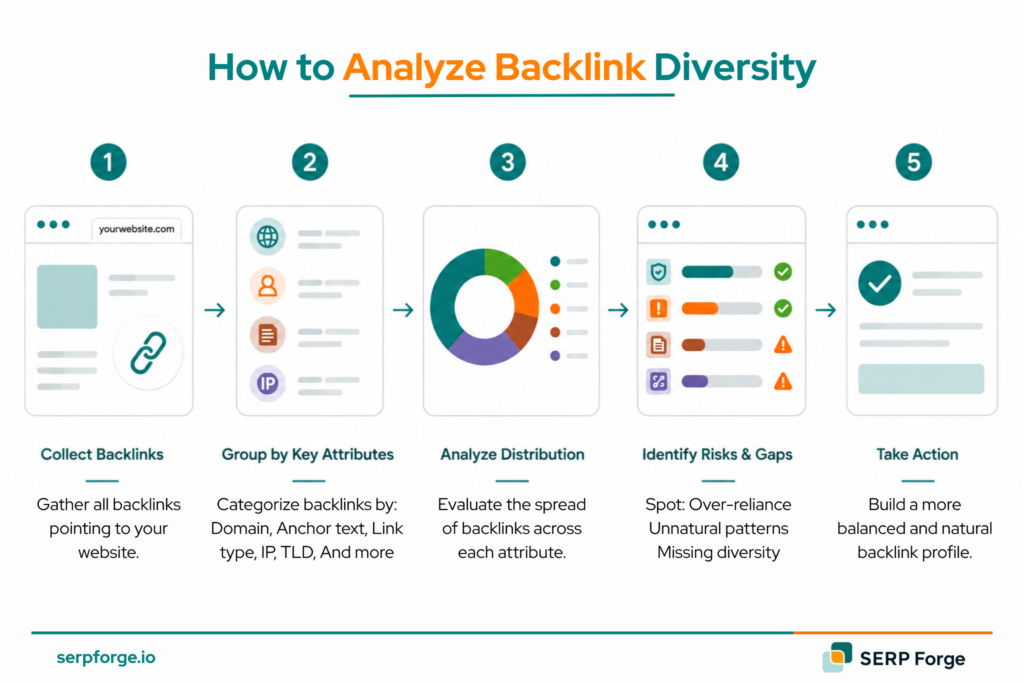
A proper backlink diversity analysis helps uncover patterns, strengths, and potential risks within your link profile, including:
Metrics to Monitor
When reviewing your backlink profile, track the following key metrics:
- Number of unique referring domains (vs. total backlinks)
- Ratio of do-follow to no-follow links
- Distribution of anchor text types (branded, generic, exact-match, partial-match, URL)
- Domain authority range of linking sites
- Geographic distribution of linking domains
- Percentage of links from relevant vs. unrelated niches
- Link acquisition velocity over time
Tools for Backlink Analysis
Several tools provide the data you need to assess your backlink diversity:
- Ahrefs: Referring domains report, anchor text distribution, and link velocity graphs
- Semrush: Backlink audit tool with toxicity scores and link attribute breakdowns
- Moz Link Explorer: Domain authority metrics and spam score assessment
- Google Search Console: Free overview of your top linking domains
- Majestic: Trust Flow and Citation Flow metrics for link quality assessment
How to Audit Anchor Text Diversity
Export your complete backlink list using your preferred SEO tool. Then, group the anchor texts into five categories: branded, exact-match keywords, partial-match keywords, generic anchors (such as “read more” or “click here”), and naked URLs.
A natural anchor text profile for most sites will look roughly like this:
• Branded anchors: 40–60%
• Generic anchors: 20–30%
• Partial-match keyword anchors: 10–20%
• Exact-match keyword anchors: 1–5%
• Naked URLs: 5–15%
If your exact-match percentage is significantly higher than 5–10%, it is worth diversifying by pursuing more branded and generic link opportunities and, where appropriate, disavowing aggressively over-optimized links.
Competitor Link Diversity Analysis
One of the fastest ways to identify gaps in your own link profile is to benchmark against your top-ranking competitors.
Pull their backlink profiles and compare referring domain diversity, anchor text distribution, and link type breakdown against your own.
Conclusion
Backlink diversity is not a tactic; it is the natural result of a well-rounded link-building strategy executed over time.
Instead, build links in ways that naturally produce diversity by creating assets worth linking to, by using multiple acquisition methods, and by distributing link-building efforts across your full site. The diverse profile is the byproduct.