


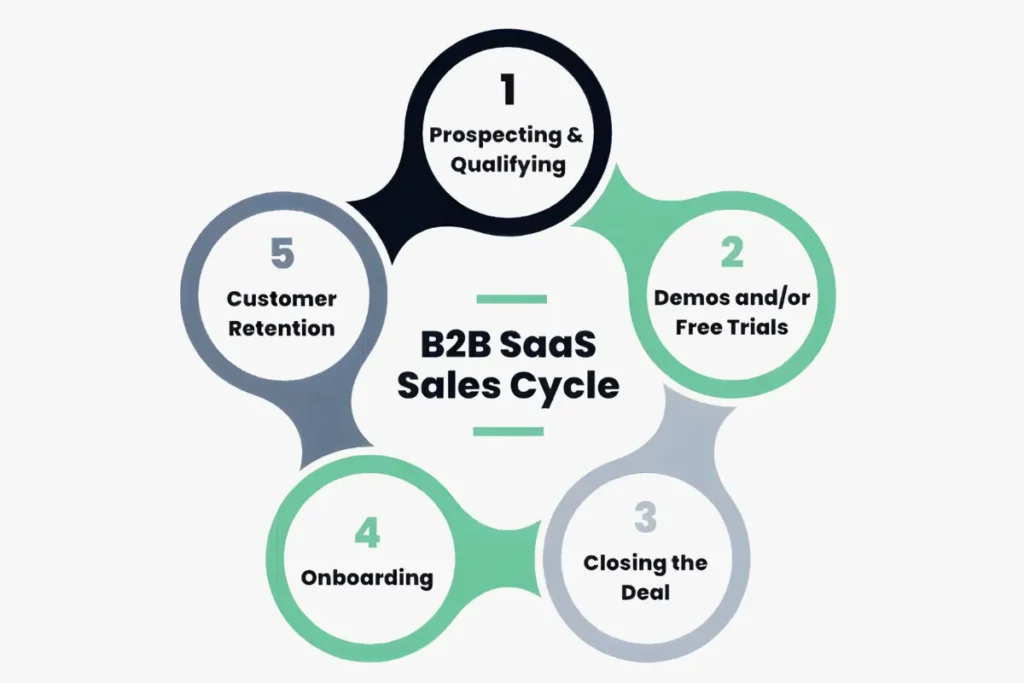
The B2B SaaS sales process is a structured framework that helps companies convert prospects into long-term customers through stages like prospecting, demos, onboarding, and expansion.
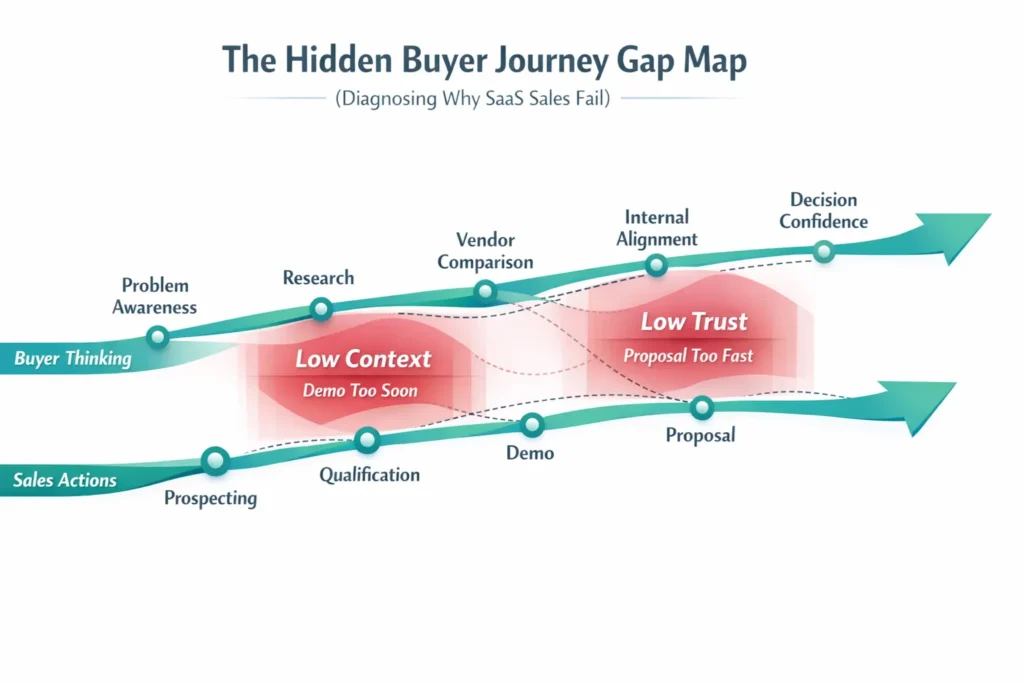
Success depends on guiding the right buyers through a clear, consistent journey, not just having a great product.
Many SaaS companies struggle because their sales process doesn’t align with how modern buyers evaluate software.
In this guide, you’ll learn the 8-step B2B SaaS sales process, along with key sales models, metrics, and common challenges.
TL;DR
|
What Is B2B SaaS Sales?
B2B SaaS sales is the process of selling cloud-based software to businesses through recurring subscriptions (monthly or annual).
Sales teams attract and qualify leads, demonstrate product value through demos or trials, close subscription deals, and drive ongoing adoption, retention, and expansion to grow recurring revenue.
Insights:
Improving customer retention by just 5% can increase profits by 25–95%, highlighting the importance of long-term customer value in SaaS.
How Is B2B SaaS Sales Different From Traditional Software Sales?
B2B SaaS sales differ from traditional software sales by focusing on recurring revenue through subscriptions instead of one-time licensing fees.
The comparison below highlights the key differences between B2B SaaS sales and traditional sales models:
| Factor | B2B SaaS Sales | Traditional Software Sales |
|---|---|---|
| Revenue Model | Subscription-based (monthly or annual) | One-time purchase or licensing |
| Customer Relationship | Ongoing focus on retention, usage, and expansion | Mostly ends after purchase |
| Growth Strategy | Revenue grows through renewals, upsells, and expansion | Growth depends on new customer acquisition |
| Product Delivery | Cloud-based, continuously updated | Installed software or physical delivery |
What Are the Different B2B SaaS Sales Models?
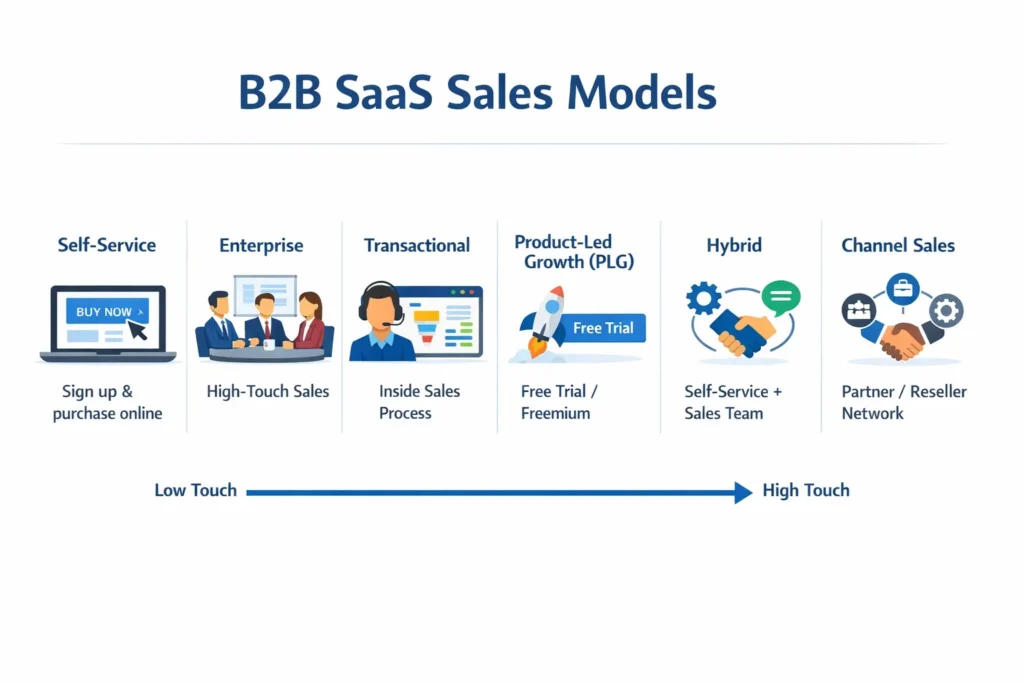
B2B SaaS companies use different sales models depending on product complexity, pricing structure, and target customers; selecting the right model helps streamline customer acquisition, improve product adoption, and scale recurring revenue.
Here are some of the most common B2B SaaS sales models used by modern software companies:
1. Self-Service Model
Self-service model is a SaaS sales approach where customers sign up, explore the platform, and purchase subscriptions without interacting with a sales representative; the entire buying process is automated through the product interface.
This model relies heavily on product-led onboarding, in-app guidance, automated billing, and frictionless signup flows; SaaS companies often integrate tools like Stripe to manage subscription payments and automated plan upgrades.
2. Enterprise Model
The enterprise sales model is designed for large organizations that require customized solutions, advanced integrations, and dedicated account management; the sales cycle typically involves multiple stakeholders, procurement reviews, and contract negotiations.
This model focuses on consultative selling, pricing structures, security compliance, and long-term contracts; enterprise sales teams often manage complex deal pipelines using CRM platforms such as Salesforce.
3. Transactional Model
The transactional sales model focuses on relatively fast deal closures with moderate human interaction; sales representatives assist prospects during product evaluation, but the process remains structured and efficient.
This model works well for mid-market SaaS products with predictable pricing tiers, standardized demos, and shorter decision cycles; teams often use CRM and pipeline management tools to manage leads and track conversions.
4. Product-Led Growth Model
The product-led growth (PLG) model is a SaaS growth strategy where the product itself drives user acquisition, activation, and conversions; users experience the product value through free trials, freemium access, or usage-based plans.
This model prioritizes user experience, self-guided onboarding, product analytics, and viral adoption within teams; companies such as Slack have scaled rapidly by allowing users to adopt the product before interacting with sales teams.
For example, companies like Slack and Notion allow users to explore the product before speaking with sales teams, accelerating adoption through product experience.
5. Hybrid Model
The hybrid sales model combines product-led growth with traditional sales support; users can start with self-service onboarding while sales teams engage when accounts expand or require advanced features.
This approach helps SaaS companies target both SMB and enterprise segments, enabling scalable customer acquisition while supporting complex deals; many hybrid SaaS sales teams coordinate marketing, product usage data, and CRM systems to identify high-value leads.
6. Channel Sales Model
The channel sales model is a distribution strategy where SaaS companies sell their software through external partners such as resellers, consultants, system integrators, and technology partners.
This model helps expand market reach and accelerate adoption through partner ecosystems, affiliate programs, reseller agreements, and integration marketplaces; large SaaS ecosystems such as Salesforce rely heavily on partner networks for distribution.
7. Freemium Model
Freemium model is a pricing and growth strategy where SaaS companies offer a free version of the software with limited features while charging for premium functionality, higher usage limits, or advanced support.
This approach supports rapid user acquisition, product-led adoption, and upgrade-driven revenue growth; platforms like Dropbox successfully used freemium access to attract millions of users and convert them into paid subscribers.
How Do You Identify Your Ideal Customer (ICP) in a B2B SaaS Sales Process?
An Ideal Customer Profile (ICP) defines the companies most likely to convert, retain, and generate high lifetime value.
To identify your ICP, evaluate:
- Industry fit: Where your product solves a clear problem
- Company size: Revenue, employees, and growth stage
- Tech stack: Compatibility with existing tools
- Pain points: Core business challenges your product solves
- Decision-makers: Key stakeholders (e.g. founders, IT, operations)
Sales teams use CRM platforms like HubSpot to analyze customer data, segment accounts, and continuously refine ICP based on conversion, retention, and expansion signals.
How to Create an Effective B2B SaaS Sales Process?
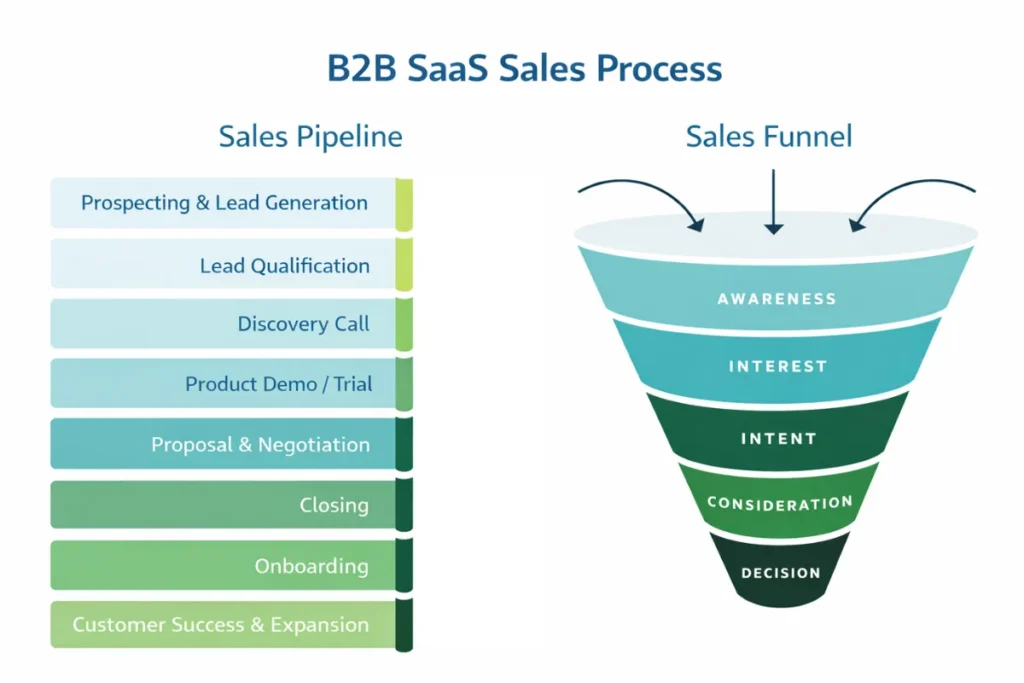
The B2B SaaS sales process is not just a funnel. It is a revenue system that drives acquisition, conversion, and long-term customer value.
Here are the key stages of an effective B2B SaaS sales process:
1. Prospecting & Lead Generation
Prospecting and lead generation focus on building a high-intent, revenue-qualified pipeline, not just increasing lead volume.
Top SaaS teams prioritize:
- SEO-driven content targeting bottom-of-funnel keywords (e.g., comparison, alternatives)
- LinkedIn outbound and account-based outreach (ABM)
- Paid acquisition with retargeting and intent signals
- Webinars, communities, and partner ecosystems
Marketing automation and CRM platforms like HubSpot help capture, segment, and nurture leads based on behavioral and firmographic data.
At this stage, teams track Marketing Qualified Leads (MQLs), Cost per Lead (CPL), and total pipeline generated to evaluate lead quality and acquisition efficiency.
High-growth SaaS companies prioritize buyer intent signals over traffic volume.
2. Lead Qualification
Lead qualification ensures your sales team focuses only on accounts with real revenue potential.
Beyond basic ICP matching, modern teams evaluate:
- Buying intent (demo requests, product usage)
- Stakeholder involvement (multi-threading)
- Business urgency and ROI potential
Frameworks like BANT and MEDDIC are commonly used, while CRMs help score leads dynamically based on engagement.
Sales teams monitor Sales Qualified Leads (SQLs) and the lead-to-opportunity conversion rate to measure how effectively qualified leads move into the pipeline.
Combining product data + CRM insights significantly improves qualification accuracy.
3. Discovery Call
The discovery call is where you uncover business pain and quantify its impact, not just gather information.
Effective discovery focuses on:
- Operational bottlenecks and inefficiencies
- Existing tools and workflow gaps
- Measurable outcomes (time saved, revenue impact)
Top-performing reps connect pain points directly to business KPIs and ROI outcomes, setting the foundation for a strong demo.
The primary metric here is the discovery-to-demo conversion rate, which indicates how effectively sales conversations progress to the next stage.
Strong discovery shortens sales cycles and increases close rates.
4. Product Demo / Trial
Product demos and trials should deliver a personalized value experience, not a generic feature walkthrough.
Best practices include:
- Role-based demos tailored to decision-makers
- Use-case storytelling instead of feature listing
- Interactive trials and guided onboarding flows
For product-led growth (PLG) companies, free trials and freemium models act as self-qualification mechanisms.
Teams typically track demo-to-opportunity conversion rates and product activation rates to measure how well the demo experience drives engagement and intent.
The most effective demos clearly answer: “How does this improve your business outcomes?”
5. Proposal & Negotiation
This stage aligns your solution with the customer’s financial, operational, and strategic expectations.
Key elements include:
- Value-based pricing tied to ROI
- Custom plans, SLAs, and compliance requirements
- Risk reduction (security, implementation clarity)
Sales teams manage deal progression through CRM platforms like Salesforce and CPQ systems.
Proposal acceptance rate and Average Contract Value (ACV) are critical indicators of pricing alignment and deal quality.
In SaaS, deals are often won by reducing perceived risk—not lowering price.
6. Closing
Closing converts opportunities into revenue by ensuring a frictionless transition from decision to activation.
This stage includes:
- Contract signing and approvals
- Subscription setup and billing activation
- Internal handoff to onboarding teams
Optimizing this stage improves pipeline velocity and win rates.
Teams evaluate win rate and sales cycle length to understand closing efficiency and deal velocity.
The smoother your closing process, the faster your revenue realization.
7. Onboarding
Onboarding is critical for achieving Time-to-Value (TTV) and driving early product adoption.
Effective onboarding includes:
- Guided setup and integrations
- Training sessions and documentation
- Milestone-based activation (first success moment)
A strong onboarding experience directly impacts retention and churn reduction.
Product activation rate is the primary indicator of onboarding success and early customer engagement.
Faster activation leads to higher retention and long-term customer value.
8. Customer Success & Expansion
Customer success ensures customers continue to realize value, driving renewals and expansion revenue.
Key focus areas:
- Product usage and health scoring
- Proactive engagement and support
- Upselling, cross-selling, and seat expansion
This stage is essential for improving Net Revenue Retention (NRR) and reducing churn.
Teams monitor churn rate, expansion revenue, and Net Revenue Retention (NRR) to evaluate long-term growth and customer value.
The most successful SaaS companies grow primarily through existing customers, not new acquisition.
What Key Metrics Should You Track in a B2B SaaS Sales Process?
B2B SaaS metrics show where your revenue is growing, where it’s leaking, and how efficiently you convert pipeline into recurring revenue.
Here are the most important metrics SaaS companies track to evaluate sales performance:
- Customer Acquisition Cost (CAC): How much you spend to acquire a customer. If CAC is too high, your growth becomes expensive and unsustainable.
- Customer Lifetime Value (LTV): The total revenue a customer generates. Higher LTV means stronger retention and better product-market fit.
- LTV:CAC Ratio: Tells you if your growth is healthy. If customers generate far more value than they cost, your model scales.
- Sales Cycle Length: How fast deals close. Shorter cycles mean faster revenue and better pipeline efficiency.
- Lead-to-Customer Conversion Rate: Shows how well you turn interest into revenue. Low conversion signals poor targeting or weak positioning.
- Monthly Recurring Revenue (MRR): Your predictable revenue baseline. This is the core metric that reflects real SaaS growth.
- Churn Rate: How many customers you lose. High churn cancels out new sales and slows growth.
- Expansion Revenue: Revenue from existing customers through upgrades or add-ons. This is often the fastest way to grow, with expansion strategies increasing revenue by 20–30%.
Key Stat: Research from McKinsey & Company shows that companies that leverage customer analytics extensively are 23 times more likely to acquire customers and 6 times more likely to retain them, highlighting the importance of tracking the right SaaS metrics.
What Are the Common Challenges in B2B SaaS Sales?
B2B SaaS sales challenges often arise from long sales cycles, complex decision-making processes, and the need to continuously demonstrate product value.
Sales teams must balance lead generation, product education, and customer retention to maintain steady subscription revenue growth.
Some of the most common challenges in B2B SaaS sales include:
- Long sales cycles and enterprise deals often require multiple approvals and stakeholder discussions.
- Poor Ideal Customer Profile (ICP) targeting can reduce lead quality and conversion rates.
- Product demos and education complex SaaS features often require clear demonstrations and onboarding.
- Customer Acquisition Cost (CAC) can be high due to increased marketing and sales spending.
- Customer churn and subscription cancellations can reduce recurring revenue and long-term growth.
Addressing these challenges requires strong sales processes, customer success strategies, and data-driven pipeline management to improve conversions and long-term customer retention.
How Can SERP Forge Help Improve Your B2B SaaS Sales Pipeline?
SERP Forge helps B2B SaaS companies grow their sales pipeline through targeted SEO, high-quality content, and strategic link building.
Many clients see an average 20–40% increase in qualified pipeline opportunities by improving organic visibility and attracting high-intent prospects.
The team focuses on B2B SaaS SEO strategy, demand generation, organic lead acquisition, and revenue-focused content marketing.
By aligning SEO with the sales funnel, SERP Forge helps SaaS companies generate qualified leads, improve inbound pipeline growth, and support long-term recurring revenue.
Final Thoughts
A clear and structured sales framework helps SaaS companies move prospects smoothly from first interaction to long-term adoption.
When teams understand their target customers, choose the right sales model, and follow defined stages, it becomes easier to guide buyers through demos, evaluations, and final decisions.
Focusing on strong lead qualification, clear product value, and ongoing customer success also supports better retention and expansion.
By continuously monitoring key performance indicators and refining the sales funnel, SaaS teams can improve conversion rates, strengthen customer relationships, and build steady recurring revenue.
B2B SaaS Sales FAQ’s
1. How do you build a strong B2B SaaS sales pipeline?
Start with a clear Ideal Customer Profile (ICP) and attract qualified leads through SEO, outbound outreach, webinars, and referrals to maintain a consistent pipeline.
2. What skills are important for a successful B2B SaaS sales team?
Strong communication, product knowledge, consultative selling, and the ability to identify pain points and demonstrate clear business value.
3. How does product-led growth influence B2B SaaS sales?
PLG lets users experience the product through free trials or freemium plans, building trust, improving adoption, and shortening the sales cycle.
4. What role does customer onboarding play in SaaS sales success?
Onboarding drives early product adoption, reduces churn, and helps customers achieve value quickly, supporting long-term retention.
5. How can SaaS companies reduce churn after closing a sale?
Focus on customer success, monitor usage, provide ongoing support, and deliver continuous value to keep customers engaged and retained.


