


Launching and scaling a SaaS product requires more than strong technology. A well-planned GTM framework connects multiple growth components, including market research, competitive analysis, value proposition, distribution channels, pricing strategy, and sales enablement.
It also helps SaaS teams focus on the right growth levers such as product-led growth (PLG), inbound marketing, demand generation, organic search, partnerships, and account-based sales.
When SaaS companies build a structured go-to-market strategy, they can improve customer acquisition efficiency, reduce customer acquisition cost (CAC), increase product activation, and drive predictable recurring revenue such as MRR and ARR.
This guide explains the 10 key steps to build a successful B2B SaaS go-to-market strategy, covering audience research, messaging, acquisition channels, onboarding, and growth metrics that help SaaS companies scale sustainably.
What Is a B2B Go-To-Market Strategy in SaaS?
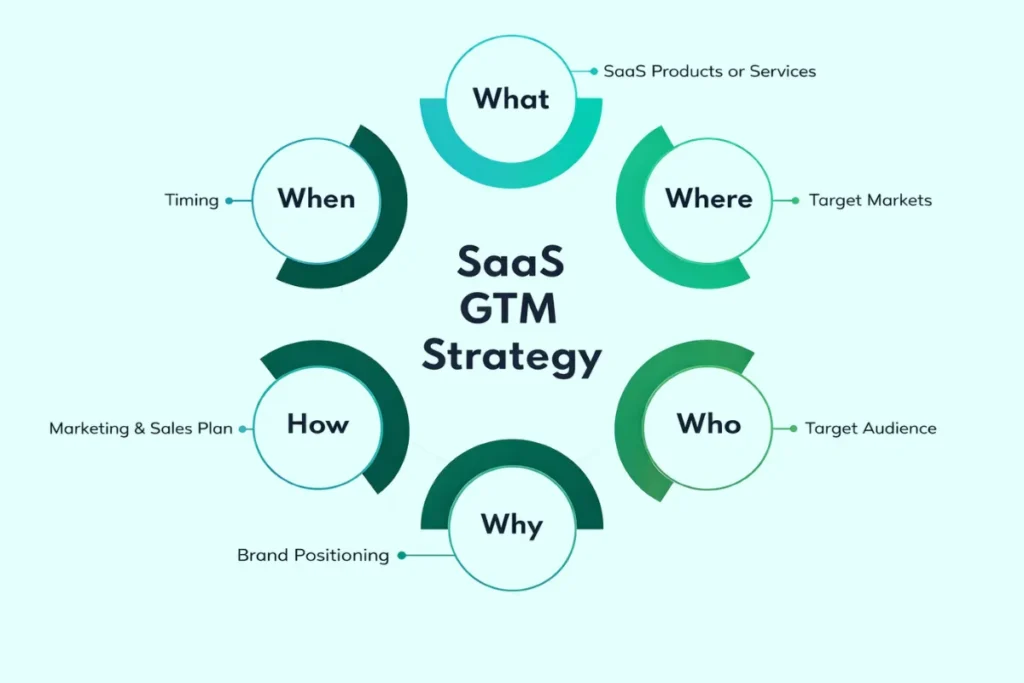
A B2B SaaS go-to-market (GTM) strategy is a structured plan that explains how a software company introduces its product to the market, reaches the right business customers, and turns them into paying users.
A SaaS GTM strategy defines target customers, the problem solved, and how the product is marketed and sold. It aligns teams to deliver the right product to the right companies through the right channels for predictable growth.
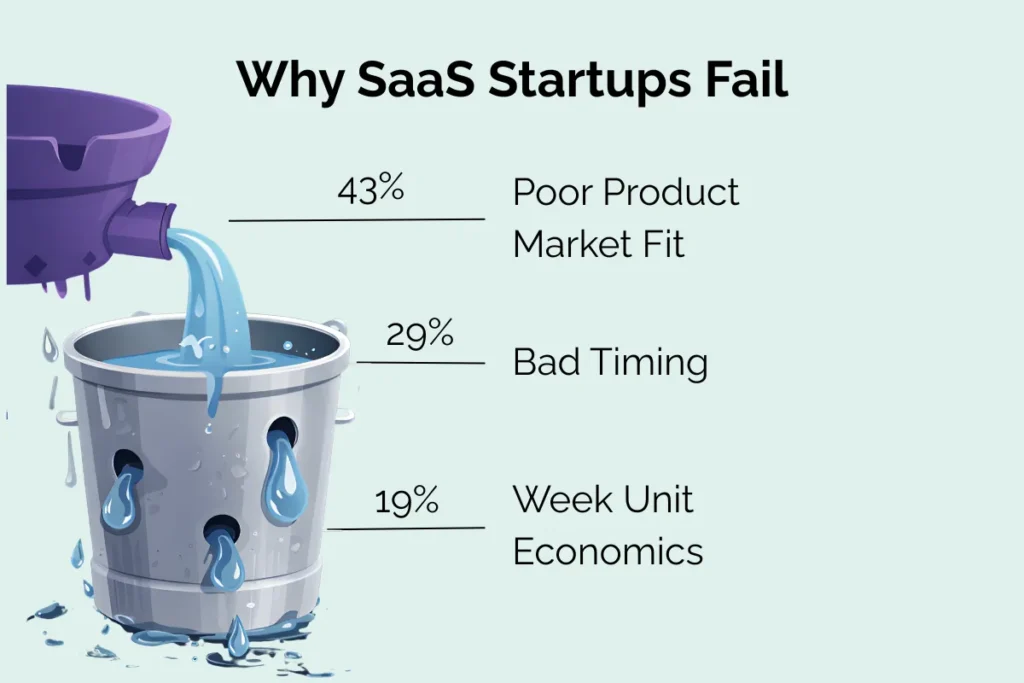
Startup failures often happen due to weak market alignment; research highlights the most common causes:
- 43% of failures happen due to poor product-market fit
- 29% occur because of bad timing, or entering the market too early or late
- 19% result from unsustainable unit economics
These numbers highlight the need for a clear B2B SaaS GTM strategy, validated demand, and strong product–market fit before scaling.
GTM Strategy vs Marketing Strategy: What’s the Difference?
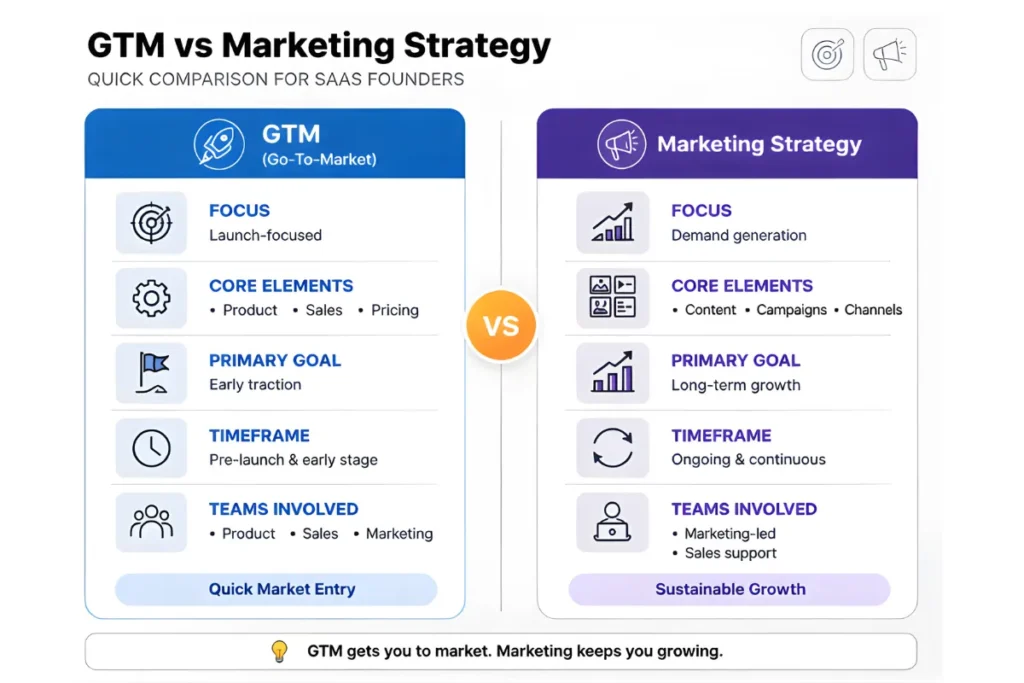
A go-to-market (GTM) strategy focuses on how a product enters the market and reaches its first customers; it defines the target audience, positioning, pricing, and sales approach.
A marketing strategy focuses on promoting the product and generating demand over time through channels like content, campaigns, and brand building.
Here is a quick comparison:
| Aspect | Go-To-Market (GTM) Strategy | Marketing Strategy |
|---|---|---|
| Purpose | Focuses on how a company launches a product and enters the market successfully. | Focuses on promoting the product and building demand over time. |
| Primary Goal | To introduce a product to the right audience and generate early traction. | To create awareness, attract leads, and support long-term growth. |
| Scope | Covers product positioning, pricing, target audience, sales approach, and distribution channels. | Covers branding, campaigns, content marketing, advertising, and lead generation activities. |
| When It’s Used | Mostly used during product launches or when entering a new market. | Used continuously to support ongoing growth and customer engagement. |
| Teams Involved | Involves product, sales, marketing, and leadership teams working together. | Mainly handled by the marketing team with support from sales. |
| Example | Companies like Slack used a strong GTM approach with product-led adoption and team-based onboarding. | Companies like HubSpot rely heavily on content marketing and inbound strategies to attract users. |
Why SaaS Go-To-Market Strategies Are Different
SaaS go-to-market strategies are different from traditional product launches because they focus on recurring revenue, continuous product improvement, and long-term customer relationships.
Key factors that make SaaS growth strategies unique include:
- Subscription revenue model based on monthly or annual recurring payments rather than one-time software sales
- Continuous product iteration through frequent updates, feature releases, and product improvements
- Customer retention and expansion focus, including upgrades, additional seats, and premium plans
- Data-driven growth supported by product analytics, customer behavior insights, and performance metrics
What Are the Benefits of a Well-Defined SaaS Go-To-Market Strategy?
A well-defined SaaS go-to-market strategy helps software companies launch products effectively, reach the right business audience, and build predictable growth.
In the SaaS industry, a clear GTM plan ensures better product positioning, customer acquisition, demand generation, and revenue growth, helping companies scale more efficiently in competitive markets.
Key benefits of a well-defined SaaS go-to-market strategy include:
1. Provides a Clear Product Launch Roadmap
A strong SaaS go-to-market strategy creates a clear roadmap for launching a SaaS product.
It defines the target audience, distribution channels, pricing strategy, and messaging, allowing product, marketing, and sales teams to coordinate their efforts and execute the launch smoothly.
2. Aligns the Product With Real Customer Needs
A well-planned GTM strategy ensures that the product solves real customer problems.
By conducting market research, customer interviews, and competitive analysis, SaaS companies can refine their product positioning and deliver solutions that match business needs.
3. Supports Scalable and Predictable Growth
With a structured GTM approach, SaaS businesses can track customer acquisition cost (CAC), conversion rates, product adoption, and revenue performance.
These insights help companies refine their strategy over time and scale growth in a more predictable way.
How to Create a Successful Go-To-Market Strategy for a SaaS Company
A successful SaaS go-to-market strategy requires a structured approach that connects product positioning, customer acquisition, and revenue growth.
Many leading SaaS companies have scaled by building a clear SaaS GTM playbook that combines market research, value positioning, distribution channels, and sales strategy.
Core steps to build a successful SaaS go-to-market strategy include:
1. Research and Identify Your Audience
Start by defining your ideal customer profile (ICP) and target market segments. Analyze industry needs, company size, job roles, and purchasing behavior to understand who benefits most from your product.
This helps SaaS companies focus on the right buyers instead of marketing to a broad audience.
2. Spend Time on Your Value Proposition and Branding
Your value proposition should answer:
- What problem does your product solve?
- Who is it for?
- Why is it better than alternatives?
Combine this with clear brand positioning so customers instantly understand:
- Your category
- Your differentiation
- Your credibility
3. Define Value-Based Messaging
Create messaging that highlights specific business outcomes, such as improving productivity, reducing operational costs, or simplifying workflows.
Clear messaging helps communicate the product’s value across landing pages, sales materials, and marketing campaigns.
4. Think About Sales and Pricing
Choose a pricing and sales model that fits your target market. SaaS companies typically use subscription pricing, tiered plans, freemium models, or usage-based pricing depending on product complexity and customer needs.
Also, decide your sales motion like:
- Product-led (self-serve)
- Sales-led (high-touch)
- Hybrid
5. Consider How to Market and Distribute Your Product
Identify how users will discover your product:
- Content marketing & SEO
- Paid ads (Google, LinkedIn, etc.)
- Partnerships & integrations
- Product-led growth (PLG)
- Outbound sales
Focus on channels where your ICP is already active.
6. Develop a Customer Acquisition Strategy
Customer acquisition should combine multiple growth channels such as organic search, referral programs, email marketing, and targeted campaigns.
SaaS companies often track acquisition metrics like customer acquisition cost (CAC) and conversion rates to improve efficiency.
7. Design a Clear Onboarding Process
An effective onboarding experience helps new users quickly understand the product and achieve their first success.
Key elements should focus on:
- Guided product tours
- Clear first-use actions
- Quick wins for users
A clear onboarding flow improves activation rates, product adoption, and early customer satisfaction.
8. Manage Feedback Loops
Collect customer feedback through product analytics, support tickets, and surveys to identify improvement opportunities. Continuous feedback helps SaaS companies refine product features, messaging, and user experience.
9. Align All Teams Behind Your Strategy
A successful SaaS go to market strategy requires alignment between product, marketing, customer success, and sales teams.
When teams work toward shared goals, SaaS companies can improve product adoption, customer retention, and revenue growth.
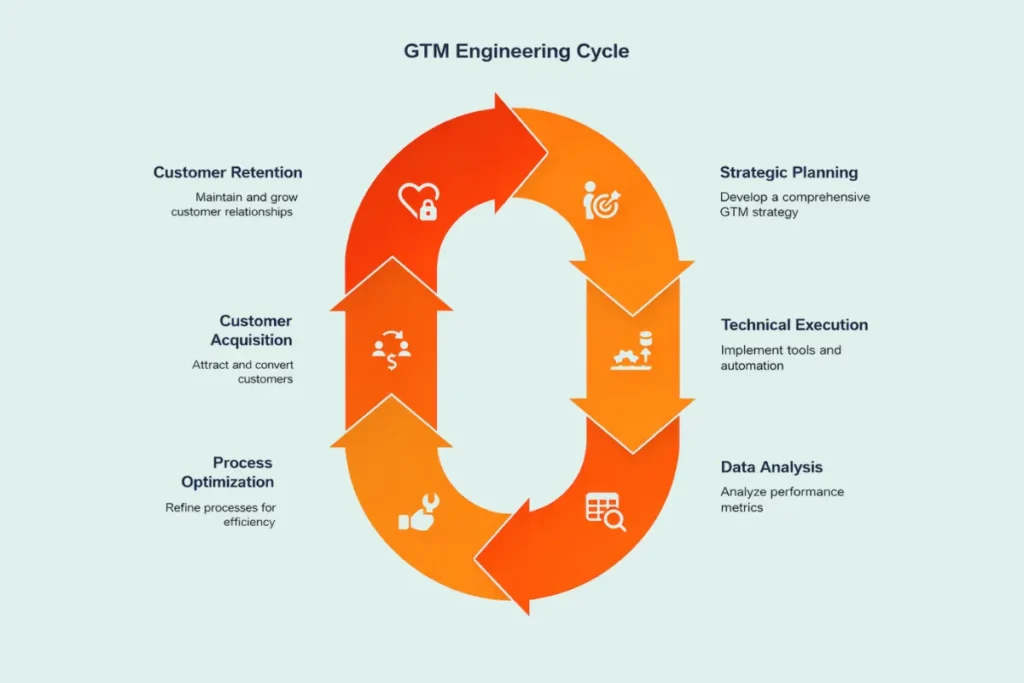
Real SaaS Go-To-Market Strategy Examples That Drive Growth
Go-to-market strategy plays a major role in how SaaS companies acquire customers, position their products, and scale revenue.
Many successful SaaS companies use different GTM models depending on their product complexity, pricing structure, and target market.
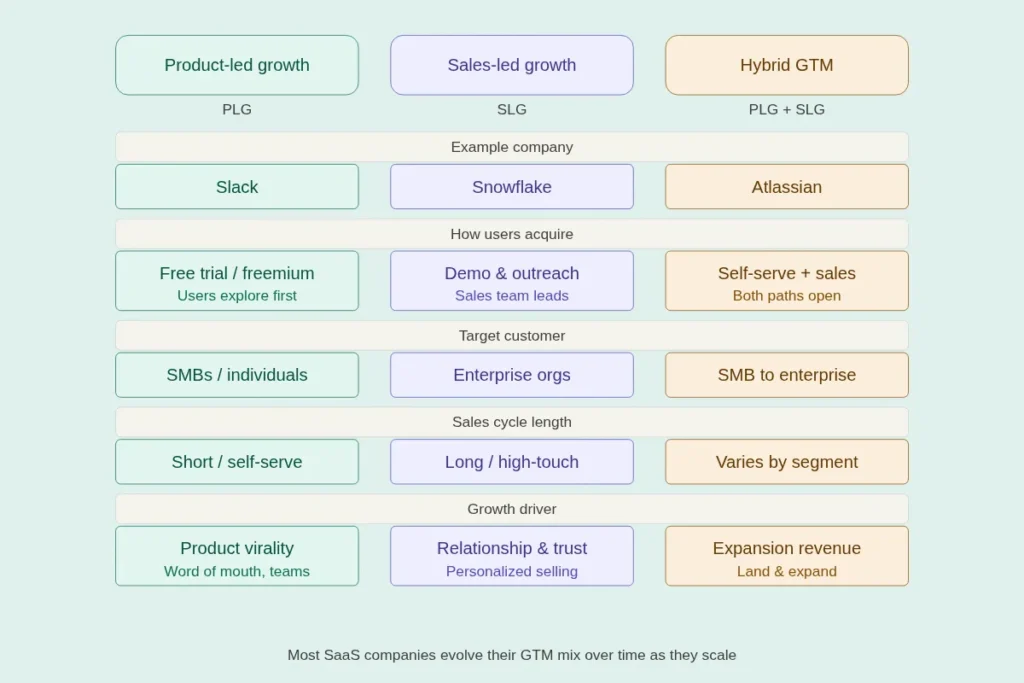
The three most common approaches include product-led growth (PLG), sales-led growth, and hybrid models:
- Product-Led Growth (PLG): Companies like Slack focus on letting users experience the product before purchasing. Free plans, trials, and easy onboarding allow users to explore the product independently, which drives organic adoption and team-based expansion.
- Sales-Led Growth: Enterprise SaaS platforms such as Snowflake rely heavily on dedicated sales teams. These companies target larger organizations, provide personalized demos, and guide buyers through longer decision-making processes.
- Hybrid GTM Model: Some SaaS companies combine product-led and sales-led strategies. Atlassian uses a self-serve product model for smaller teams while also supporting enterprise sales for larger organizations that require customized solutions.
Each model works differently, but successful SaaS companies usually refine their GTM strategy over time by analyzing customer acquisition channels, product adoption data, and revenue performance.
How to Measure the Success of Your SaaS GTM Strategy
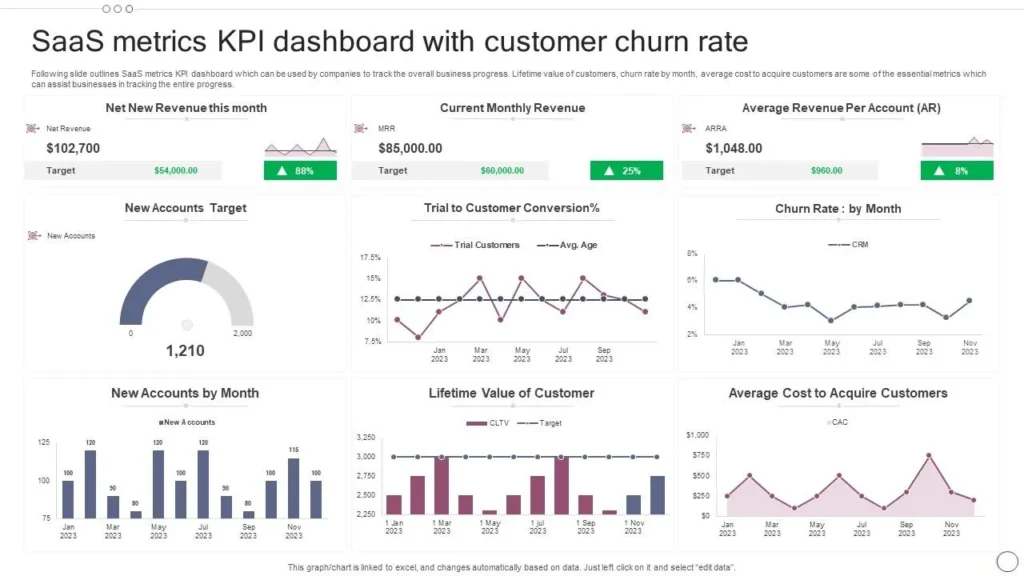
Monitoring the right SaaS metrics helps teams identify what is working, improve marketing efficiency, and scale growth more effectively.
Key metrics to track the success of saas GTM strategy include:
- Customer Acquisition Cost (CAC) measures the total cost required to acquire a new customer through marketing and sales efforts.
- Customer Lifetime Value (LTV) estimates the total revenue a business expects to earn from a customer over the entire relationship.
- Activation Rate shows how many new users complete key onboarding actions and start actively using the product.
- Conversion Rate tracks the percentage of visitors or trial users who become paying customers.
- Sales Cycle Length measures the average time required to convert a qualified lead into a customer.
- Revenue Growth tracks increases in recurring revenue, such as monthly recurring revenue (MRR) or annual recurring revenue (ARR).
Common Mistakes to Avoid in a SaaS Go-To-Market Strategy
Many SaaS companies struggle with growth because of common strategic mistakes that affect product adoption, customer acquisition, and long-term retention.
Common GTM mistakes SaaS companies should avoid:
1. Not Clearly Defining Your Target Audience
A SaaS product cannot effectively serve everyone. Failing to define an ideal customer profile (ICP) and buyer personas often leads to weak positioning and inefficient marketing efforts.
Clear audience segmentation based on industry, company size, and use cases helps SaaS companies attract the right customers.
2. Ignoring Market Research and Customer Insights
Skipping market research can lead to poor product positioning and messaging. SaaS companies need to analyze customer pain points, competitor offerings, and industry demand to ensure their solution addresses real business problems.
3. Making the Strategy Too Complex
Some companies create overly complicated go-to-market plans with too many channels, tools, and campaigns.
A focused strategy that prioritizes core acquisition channels, product positioning, and measurable growth metrics is often more effective.
4. Neglecting Customer Onboarding and Retention
Acquiring new users is only part of SaaS growth. Without a strong onboarding experience and customer success strategy, users may abandon the product before realizing its value.
Effective onboarding improves activation rates, product adoption, and long-term retention.
5. Underinvesting in Marketing and Distribution
Even a well-built SaaS product needs strong distribution. Companies that invest too little in SEO, content marketing, partnerships, and demand generation may struggle to reach their target audience and generate consistent leads.
Improve Your SaaS Go-To-Market Strategy With SERP Forge
SERP Forge helps SaaS companies improve their go-to-market strategy through focused SEO, content, and link building.
A strong GTM strategy needs clear positioning, the right distribution channels, and ongoing optimization based on performance data.
We support SaaS growth by focusing on:
- Search-driven demand generation: Capture high-intent traffic during the research stage
- Strategic content marketing: Highlight use cases, features, and business value
- Authority link building: Build high-quality backlinks to improve rankings
By aligning SEO, content, and performance tracking, SERP Forge helps attract qualified traffic and generate consistent leads.
Final Thoughts
Go-to-market strategy plays a critical role in how SaaS companies introduce products, reach the right audience, and generate sustainable revenue.
A well-structured strategy connects product positioning, target audience research, distribution channels, pricing models, and customer acquisition efforts into a clear growth framework.
When SaaS companies focus on customer needs, product value, onboarding experience, and performance metrics, they can refine their strategy and improve product adoption over time.
A clear and focused GTM approach helps businesses attract qualified users, strengthen retention, and build predictable recurring revenue in competitive SaaS markets.
B2B SaaS Go-to-Market Strategy FAQ’s
1. How long does it take to validate a B2B SaaS GTM strategy?
Go-to-market strategy validation usually takes 3 to 6 months for most early-stage SaaS companies. During this period, teams test messaging, target segments, pricing models, and acquisition channels to see what generates consistent leads and product adoption. The goal is to confirm that the product solves a real problem and that customers are willing to pay for it.
2. How many customers validate a SaaS GTM strategy?
Product-market fit is often indicated when a SaaS company acquires 10 to 50 active paying customers within a specific target segment. At this stage, founders can observe patterns in customer behavior, usage, and feedback to confirm that their positioning and value proposition resonate with the market.
3. When should founders hire their first sales rep?
Sales-led growth becomes relevant once founders have validated their messaging and can consistently generate qualified leads. Most SaaS companies hire their first sales representative when they have a repeatable sales process and a clear pricing structure.
4. Should early SaaS focus on inbound or outbound GTM?
Inbound marketing and outbound sales both play important roles in early SaaS growth. Inbound strategies like SEO, content marketing, and product-led adoption attract organic demand, while outbound outreach helps companies reach specific high-value accounts and accelerate early customer acquisition.
5. How do you know your SaaS GTM strategy is ready to scale?
Customer acquisition cost stability, improving conversion rates, and growing monthly recurring revenue (MRR) often indicate that a GTM strategy is ready to scale. When customer acquisition becomes predictable and retention remains strong, SaaS companies can confidently invest more in marketing, sales, and distribution channels.


