


SaaS marketing is judged by what happens after acquisition. Trials and demos matter, but sustainable growth depends on whether users activate, reach value, renew and expand.
A campaign can look efficient at the top of the funnel and still hurt revenue if customers churn before acquisition costs are recovered. That is why marketing a SaaS product needs a connected system that links discovery to conversion, onboarding, product adoption and retention.
This guide explains how marketing for SaaS works, which strategies support recurring revenue and how to build a plan around customer value at every growth stage.
What is SaaS marketing?
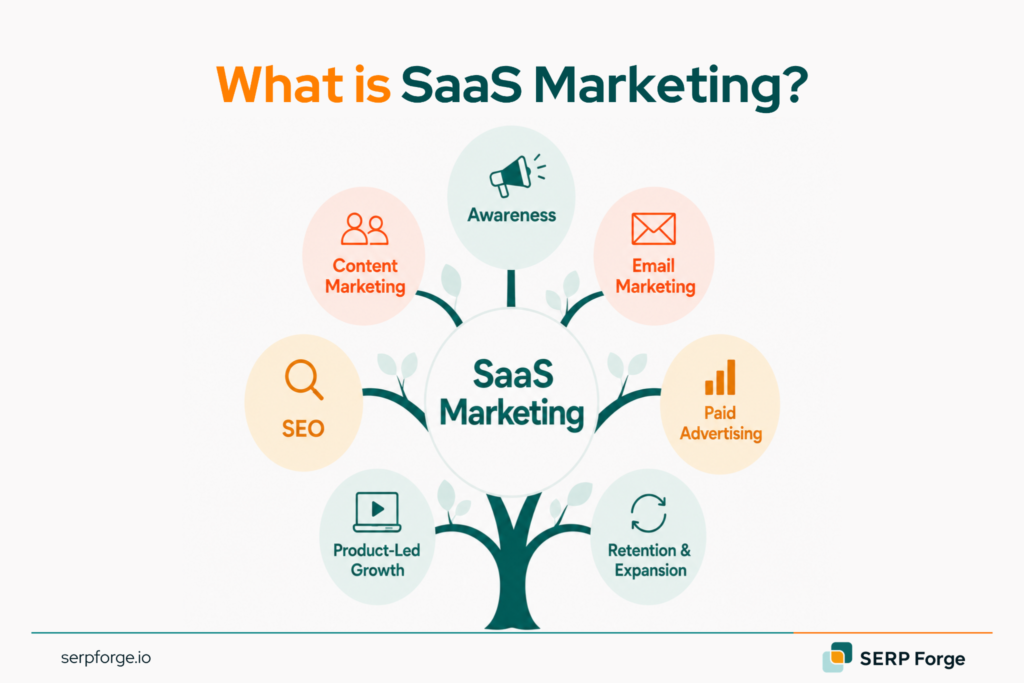
SaaS marketing is the process of attracting, converting, activating, retaining and expanding customers for subscription-based software.
The work continues after the first signup or payment because revenue depends on whether users reach value, continue using the product, renew their subscription and expand their account.
That gives marketing five commercial responsibilities:
- Create demand among suitable accounts
- Convert interest into trials, demos or purchases
- Help new users reach product value
- Protect recurring revenue through retention
- Increase account revenue through expansion
A channel deserves more budget when the customers it acquires activate, retain and produce enough gross-margin contribution to recover acquisition cost within the company’s target period.
Lead volume and campaign clicks may show activity, but they do not reveal whether marketing is creating durable growth.
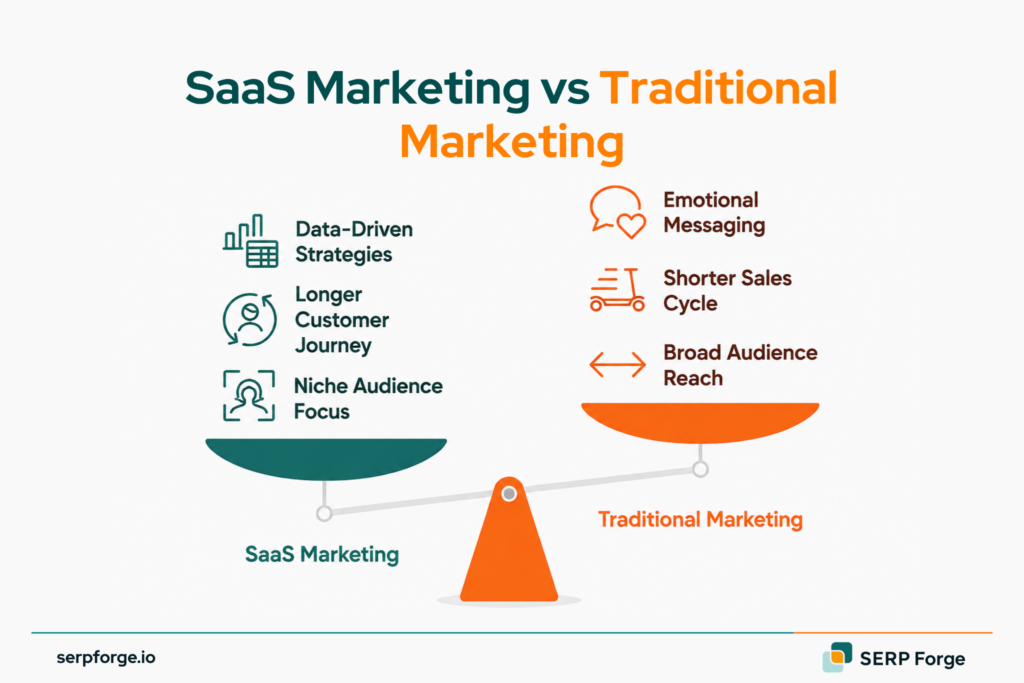
How is marketing for SaaS different from traditional marketing?
SaaS revenue develops across the customer relationship. While a purchase may complete a traditional transaction, in SaaS it begins onboarding and adoption.
The differences become most visible across revenue, conversion, data, economics and measurement:
| Area | Traditional Marketing | SaaS Marketing |
|---|---|---|
| Revenue | Often linked to one transaction | Accumulates through recurring payments |
| Conversion | Purchase may complete the journey | Purchase begins onboarding and adoption |
| Data | Campaign and transaction data | Campaign, CRM, billing and product data |
| Economics | Revenue may cover acquisition immediately | CAC is recovered over future months |
| Core measures | Orders and campaign revenue | CAC, activation, MRR, ARR, churn and NRR |
Consider two campaigns:
- Campaign A acquires 100 customers at a low CAC. Half leave within three months.
- Campaign B acquires 60 customers at a higher CAC. Most activate, renew and add seats.
Campaign B can produce more lifetime revenue despite generating fewer initial customers.
That is why SaaS teams judge marketing by customer quality. A channel is valuable when it brings users who activate, stay and expand at a cost the business can recover.
How Do the Marketing Funnel for SaaS and Customer Journey Work Together?
The SaaS marketing funnel tracks movement towards revenue, while the SaaS customer journey maps what buyers and users experience across research, purchase, adoption and renewal.
Together, they show both where accounts drop and which unanswered question or product experience caused the drop.
Map each funnel stage to the buyer’s question, the required marketing response and one primary measure:
| Stage | Buyer or user question | Marketing response | Primary measure |
|---|---|---|---|
| Awareness | Is this problem worth solving? | Education, research and category visibility | Qualified reach |
| Consideration | Which approach fits us? | Comparisons, proof and product information | Engaged accounts |
| Conversion | Can we trust this product and vendor? | Trial, demo, pricing and risk reduction | Trial or opportunity rate |
| Activation | Can the product deliver value quickly? | Onboarding, templates and guidance | Activation rate |
| Retention and expansion | Does the product keep creating value? | Adoption, renewal and expansion programmes | GRR and NRR |
Use each stage to identify the next question marketing needs to answer:
1. Awareness
Build awareness around the business problem and its commercial impact.
Prioritise:
- Problem-led search content
- Original research
- Industry events and communities
- Calculators and templates
For example, a workforce-planning platform can publish a labour-cost benchmark instead of another general productivity article.
2. Consideration
Give buyers enough evidence to assess fit, risk and expected return without depending on a sales call.
Create:
- Comparison and use-case pages
- Integration and implementation information
- Security and privacy evidence
- Pricing guidance
- Customer results
AI products need another evidence layer. Explain the task performed, data used, human controls, security safeguards and pricing model.
A broad “AI-powered” claim leaves the buyer’s commercial and technical questions unanswered.
3. Conversion
Match the conversion route to product complexity and buying risk:
- Self-service trial or freemium for simple, low-cost products
- Trial with optional sales assistance for moderate complexity
- Guided demo and technical validation for enterprise or regulated software
- Consultation and proof of concept for new or high-risk categories
Match each conversion point with evidence that reduces the buyer’s immediate risk.
Place a security case study near an enterprise demo CTA. Use a short product walkthrough near a self-service trial. Explain pricing expectations before the buyer enters a sales process.
4. Activation and Adoption
Define the product action that proves the user has reached value.
Examples include:
- Connecting a data source
- Completing the first workflow
- Inviting teammates
- Producing the first result
Set one activation event for each major use case.
Then track:
- Activation rate
- Time to value
- Setup completion
- Retention among activated users
A login confirms access. Product completion data shows whether the user experienced the promised outcome.
5. Retention and Expansion
Use product and account signals to decide the next retention or expansion action:
- Falling activity triggers adoption support
- Unused features trigger education
- Usage limits trigger an upgrade route
- Renewal dates trigger outcome reviews
Segment these signals by customer type, plan and lifecycle stage.
For larger SaaS businesses, expansion can become a major source of new ARR. Marketing, product and customer success therefore need one shared view of usage, renewal risk and account-growth potential.
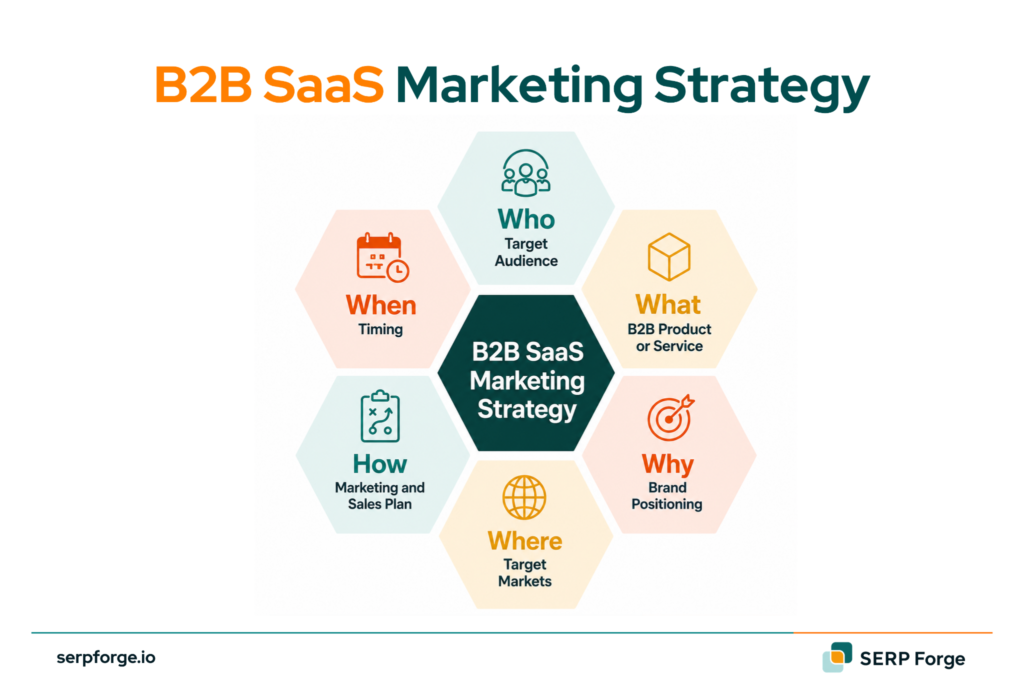
How Should a SaaS Company Build Its Marketing Strategy?
Build SaaS marketing strategies around the point where recurring revenue is breaking down.
High retention with weak pipeline points to an acquisition problem, while heavy trial volume with low activation points to onboarding. However, when churn is high, retention work should come before more media spending.
A useful operating sequence is: Revenue Constraint → ICP → Positioning → Goal → Channels → Budget → Measurement
Each stage answers a different strategic question:
1. Define the Ideal Customer Profile and Buying Problem
Start with the customers who can get the most value from the product and stay long enough to make acquisition worthwhile.
Look at CRM data, customer interviews, product analytics, support tickets and churn feedback to filter your ideal accounts by business size, tech environment, buying triggers, contract value and renewal likelihood.
Once you know which segment has the best potential, map the full buying group so the message addresses every person involved in the decision:
- User: Wants an easier, optimized daily workflow.
- Champion: Wants to solve internal friction and look good to leadership.
- Economic Buyer/Finance: Wants measurable financial returns and strict budget alignment.
- Technical/Security Reviewer: Wants reliable integration, compliance and strict data control.
- Procurement: Wants to minimize legal and commercial risk.
That is why the buying problem needs to sound specific and real.
Too broad:
Reporting takes too long.
More useful:
Finance spends three days closing each month because revenue data sits across six systems.
The second version gives marketing a real problem, a clear audience and an outcome the product can prove.
2. Set Positioning and SaaS Branding
Once the ICP and buying problem are clear, positioning becomes much easier. Start by answering five questions:
- Who gets the most value from the product?
- Which costly problem creates urgency?
- What does the buyer use today?
- How does the product create a better result?
- What proof supports that promise?
Then turn those answers into one core message:
For [specific audience] dealing with [costly problem], [product] delivers [measurable outcome] through [specific mechanism], supported by [proof].
Example: For multi-location healthcare groups managing disconnected scheduling systems, the platform reduces unfilled shifts through demand forecasting and automated staff matching.
This message gives every campaign the same foundation. Carry it across the homepage, product pages, search results, reviews, social content and sales material to build cohesive SaaS branding.
3. Choose Acquisition, Retention and Expansion Goals
Identify where revenue is getting stuck before selecting the target metric.
Every goal needs a baseline and a target. It also needs one owner and one trusted reporting source.
“Grow pipeline” is not a usable goal.
“Increase qualified pipeline from mid-market accounts by 20% by Q4” gives the team a measurable outcome.
Use goals tied to the revenue constraint:
- Acquisition: qualified pipeline or new ARR
- Activation: activation rate and time to value
- Retention: GRR, logo churn, or renewal rate
- Expansion: NRR or expansion ARR
4. Set a Marketing Budget for SaaS
The goals then provide the basis for the company’s budget decisions.
A SaaS marketing budget should reflect the company’s growth priority and customer economics.
Use two views:
- A top-down view based on ARR and available investment
- A bottom-up view based on programme, tool and production costs
The top-down view prevents overspending relative to revenue, while the bottom-up view shows whether the planned programmes can realistically produce the target.
Split the budget across:
- Proven programmes
- Channel experiments
- Analytics infrastructure
- Creative production
- Customer evidence
- Brand investment
Review spending against payback and retention by cohort.
However, blended CAC can hide a channel that looks efficient only because another channel is producing higher-quality customers.
Brand investment and demand creation should not be evaluated on the same time horizon as paid search. Short-term attribution understates channels that influence research and vendor preference before direct conversion.
How Should You Market a SaaS Product?
Learning how to market a SaaS product starts with confirming that the product solves a problem buyers will fund and users will continue paying to solve.
Marketing should carry the buyer from initial interest to a product experience that delivers the promised outcome.
Validate Demand Before Scaling Acquisition
Look for five signals before increasing spend:
- The problem occurs often
- It creates measurable cost
- Buyers actively seek a solution
- Users return after trying the product
- Pricing supports the acquisition model
Use customer interviews, design partners, landing-page tests and early product data.
A waitlist shows interest. Paid usage, repeat activity and retention show real demand.
Build the Product Positioning and Core Message
Use customer research to connect each feature with a valuable outcome.
For example:
- “AI workflow automation” becomes “Complete approvals with fewer manual handoffs”
- “Real-time analytics” becomes “Spot revenue changes before the monthly review”
- “Document extraction” becomes “Process supplier documents without repetitive data entry”
Lead with the outcome that matters most to the ICP. Use product features as proof of how the result happens.
Plan a Product Launch for SaaS
Run the SaaS product launch across three stages:
- Before launch: validate the audience, test onboarding and collect early feedback
- During launch: align the website, email, demos, partners and sales material
- After launch: review activation, objections, conversion and retention
Use the findings to improve the product, onboarding and campaign message.
The same process works for features, integrations, pricing plans and new market launches.
Convert Trial Users Into Active Customers
Guide trial users towards the actions linked with retention.
Define:
- The activation event
- Required setup
- Time-to-value target
- Behavioural messages
- Sales-assistance trigger
- Upgrade signal
Suppose users retain longer after connecting two data sources and sharing one dashboard. Build the trial around those actions and trigger help when progress stalls.
Adapt the Strategy for Different SaaS Verticals
Vertical SaaS needs messaging and proof that match the buyer’s workflow, regulations and implementation concerns.
A marketing strategy for fintech startups needs to address growth and trust together.
Cover:
- Fees and eligibility
- Data protection
- Regulatory responsibilities
- Risk controls
- Integrations
- Audit trails
- Support
- Financial outcomes
A treasury platform needs evidence around controls, implementation and reporting accuracy. Those details help finance, compliance and IT approve the purchase.
Which Channels for B2B SaaS Marketing Fit Your Growth Model?
B2B SaaS marketing channels depend on contract value, buyer behaviour, product complexity and market maturity.
Use the product’s growth model to narrow the initial channel mix:
| Growth Model | Priority Channels |
|---|---|
| Self-service PLG | SEO, free tools, product-led content, lifecycle email and referrals |
| Mid-market hybrid | SEO, paid search, webinars, product trials and sales assistance |
| Enterprise sales-led | ABM, events, executive content, outbound and partner marketing |
| Developer-focused | Technical content, documentation, communities and integrations |
| Vertical SaaS | Industry media, associations, events, partnerships and case studies |
Each of the following channels supports a different part of the buyer and customer journey:
Build Organic Discovery
Inbound marketing for SaaS helps buyers find the company while researching a problem, product category or vendor.
Prioritise content connected with purchase decisions:
- Problem and use-case pages
- Category explainers
- Alternative and comparison pages
- Integration pages
- Migration guides
- Pricing and implementation content
- Templates and calculators
- Customer results
Buyers also use AI tools to compare vendors and summarise product information.
Make the content easy to assess through direct answers, original data, named experts, product screenshots, customer evidence and consistent product details.
Measure engaged ICP accounts, assisted pipeline and customer quality. Traffic alone does not show whether inbound reaches commercially relevant buyers.
Reach Selected Accounts
An outbound marketing strategy for B2B works when the account has a timely reason to engage.
Useful triggers include:
- Funding
- Hiring
- New leadership
- Market expansion
- Regulatory deadlines
- Technology migration
- Product launches
- Contract-renewal windows
Connect the trigger with one account-level problem.
“Congratulations on the funding” adds little. “Your expansion into three regulated markets creates new audit requirements” gives the outreach a business reason.
An outbound versus inbound marketing strategy works best when inbound builds discovery and proof, while outbound brings that evidence to selected accounts.
Guide the Next Action
SaaS email marketing shifts buyers and customers towards the next relevant action.
For example:
- Content engagement triggers use-case education
- A demo request triggers meeting preparation
- A trial signup triggers activation guidance
- Incomplete setup triggers help with the unfinished step
- High-value feature use introduces the next workflow
- Falling activity triggers adoption support
- A renewal date triggers an outcome review
- Repeated usage limits introduce an upgrade route
Build these messages around customer behaviour. A fixed promotional calendar cannot respond to product progress, account risk or expansion potential.
Capture and Create Demand
Paid search captures active demand from buyers already researching a problem, category, competitor or product.
Paid social creates familiarity earlier and reaches different members of the buying group across a longer sales cycle.
Use paid media for:
- High-intent search terms
- Competitor and alternative queries
- Account retargeting
- Customer evidence
- Research reports
- Product launches
- Event promotion
Track qualified account rate, opportunities, activation, CAC, payback and retention by campaign cohort.
Extend Trusted Reach
Partnerships, communities and review platforms introduce the product through sources buyers already value.
Useful routes include:
- Technology and integration partners
- Consultants and implementation firms
- Industry associations
- SaaS marketplaces
- Customer communities
- Review platforms
- Referral programmes
- Co-hosted research and events
Measure partner-sourced revenue, assisted opportunities, influenced accounts and changes in sales-cycle length.
These channels often support conversion without receiving the final click, so evaluate their contribution across the full account journey.
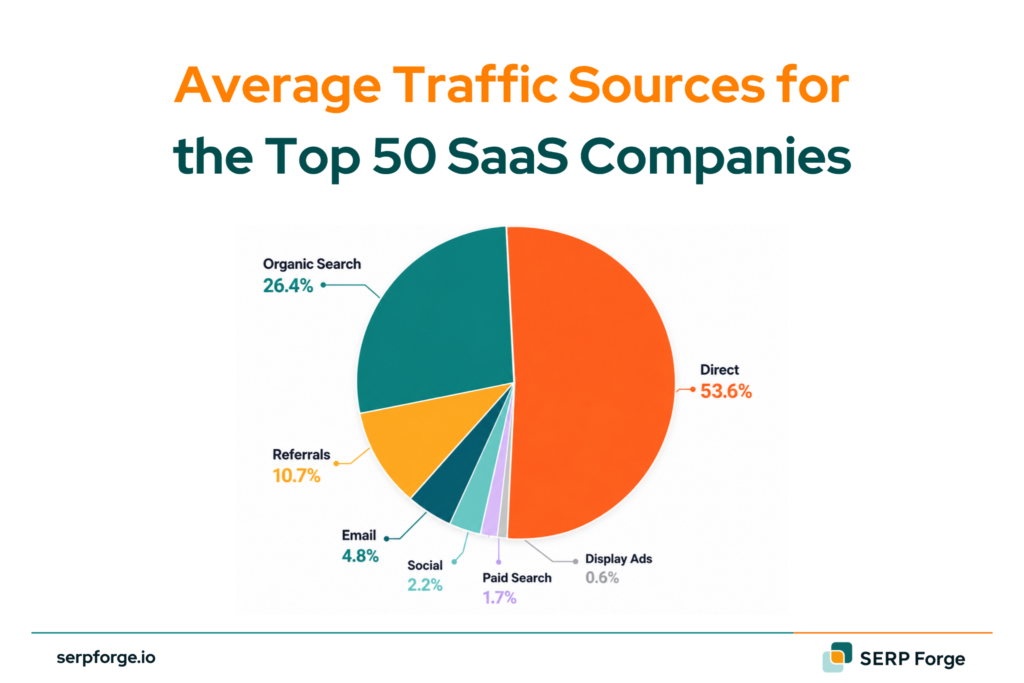
How Do SaaS Demand Generation and Lead Generation Work Together?
SaaS demand generation builds awareness before buyers enter an active evaluation.
B2B SaaS lead generation captures identifiable interest once intent appears.
ABM for SaaS concentrates both efforts on selected accounts with high revenue potential.
The three motions differ in timing, execution and commercial purpose:
| Motion | Primary Role | When to Use It | Core Activities | Main Measures |
|---|---|---|---|---|
| SaaS demand generation | Builds awareness, trust and category preference before buyers actively evaluate vendors | Use it when the market needs education, the sales cycle is long or buyers form preferences before contacting sales | Original research, expert content, events, communities, customer evidence, ungated resources and AI-search visibility | Target-account reach, branded search, direct traffic, engaged accounts and influenced pipeline |
| B2B SaaS lead generation | Captures identifiable interest and moves suitable prospects towards a trial, demo or sales conversation | Use it when buyers show active intent through product research, event participation, tool usage or conversion-page visits | Demo forms, trials, webinars, calculators, comparison pages, retargeting and intent-based outreach | ICP fit, activation, sales acceptance, opportunities, conversion rate and sourced revenue |
| ABM for SaaS | Coordinates marketing and sales around selected accounts with high revenue potential | Use it when the target account list is identifiable and contract value supports account-level research and personalisation | Buying-group mapping, account-specific content, targeted advertising, executive outreach, events and coordinated sales follow-up | Account engagement, buying-group coverage, opportunities, deal velocity, win rate and account revenue |
A SaaS company can run all three motions together.
For example, original research can build market interest, a related calculator can capture active buyers and ABM can use both assets across selected accounts.
The motions should share one account view because separate reporting creates duplicate outreach and hides how several interactions contribute to the same opportunity.
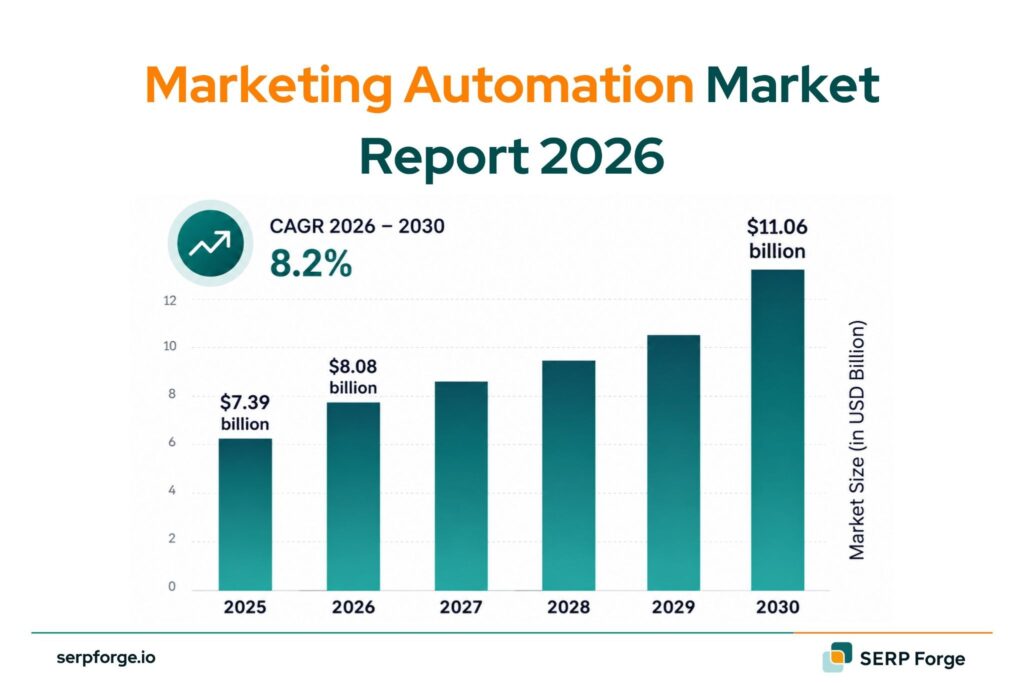
How Should a SaaS Company Use Marketing Automation?
Use SaaS marketing automation when a customer signal needs an immediate and consistent response.
Build every workflow around the same operating logic: Event → customer context → decision rule → action → measured outcome
For example, a trial signup can trigger account enrichment. The workflow checks company size, industry and account ownership before routing the lead.
The same model supports the rest of the customer lifecycle:
- Incomplete setup triggers guidance for the unfinished step
- High-value feature use alerts the account owner
- Falling activity starts an adoption campaign
- A qualified account crossing an engagement threshold receives sales follow-up
- Approaching a usage limit introduces an upgrade route
- A failed payment begins a recovery sequence
Automation removes delays and repetitive work. It still depends on accurate data, sensible rules and one defined outcome for every workflow.
Which Tools for SaaS Marketing Does a Growing Company Need?
SaaS marketing tools should be selected around the decisions the team needs to make.
Adding software before defining the workflow creates fragmented data and overlapping functionality.
A practical stack covers six connected capabilities:
CRM and Marketing Automation
HubSpot CRM and Marketing Hub for managing contacts, pipelines and automated routing. For product-led lifecycle messaging, Customer.io triggers emails and in-app communications based on live user behavior.
Product and Subscription Analytics
Mixpanel helps teams analyze product events, funnels and activation. ChartMogul connects billing data directly with metrics like MRR, ARR, churn and NRR.
Website Publishing and Experimentation
Webflow serves as a reliable SaaS website builder for reusable components, CMS publishing, localization and landing-page optimization tests.
Heatmaps and Session Analysis
Hotjar and Mixpanel help teams review clicks, scrolling, session behaviour and conversion friction. Use heatmap tools to identify where users struggle.
SEO and AI Visibility
Ahrefs and Semrush support traditional keyword research, backlink monitoring, technical SEO and tracking brand visibility across AI-generated search answers.
Which Marketing Metrics for SaaS Reveal Growth Quality?
SaaS marketing metrics reveal whether acquisition spending produces customers who activate, retain and expand.
Use these SaaS metrics as the operating dashboard:
| Metric | Formula or definition | Decision |
|---|---|---|
| CAC | Acquisition Spend ÷ New Customers | Can this segment be acquired efficiently? |
| CAC payback | CAC ÷ Monthly Gross-Margin Contribution | How quickly does acquisition cash return? |
| LTV | Expected gross profit across the relationship | How much can acquisition support? |
| Activation | (Users Reaching Value ÷ Signups) × 100 | Does the product deliver its promise? |
| GRR | Revenue Retained Before Expansion | How much existing revenue remains? |
| NRR | Revenue Retained After Expansion | Does the customer base grow itself? |
| Trial-to-paid | (Paid Trial Users ÷ Trial Users) × 100 | Does product experience convert? |
| Lead-to-customer | (Customers ÷ Qualified Leads) × 100 | Does captured demand become revenue? |
The Golden Rule of SaaS Metrics: Never view these metrics in a silo. Segment them by channel, ICP and cohort against an established SaaS CAC benchmark.
Efficient acquisition (a low CAC or fast payback period) is functionally meaningless if your activation rate is broken, your cash becomes tied up too long or your NRR drops below 100%.
Look at the source of your MRR/ARR blocks (New, Expansion, Contraction, Reactivation and Churn) to see the real health of your growth engine.
Review these metrics together. Efficient acquisition can still produce poor growth when activation or retention is weak.
Which Trends of SaaS Marketing Matter in 2026?
The major SaaS marketing trends of 2026 centre on independent buyer research, AI-assisted discovery, capital efficiency and post-sale growth.
These shifts change both channel strategy and measurement:
1. Product-Led and Hybrid Growth
SaaS companies are combining self-service evaluation with sales support.
They use the product to provide early proof, then bring in sales for security, procurement and complex implementation.
2. AI-Assisted Research and Marketing
Teams are optimizing content for buyers who use AI engines to compare vendors, summarize categories and analyze product documentation.
3. Buying-Group and Account-Level Marketing
Enterprise SaaS companies track the full buying group at an account level instead of treating every individual contact as a separate lead.
4. First-Party Data and Customer Expansion
SaaS companies are connecting CRM, billing and product usage records to spot adoption gaps and act earlier on expansion opportunities.
SaaS Industry Benchmarks and Statistics
Selected SaaS industry statistics provide useful 2026 context:
- Four out of five LinkedIn members influence business decisions. — LinkedIn Advertising
- 89% of B2B marketers use LinkedIn for lead generation and 62% say it generates leads effectively. — Sprout Social
- 91% of businesses use video as a marketing tool, while 93% consider it an important part of their strategy. — Wyzowl
- SaaS Capital’s 2026 bootstrapped benchmark for companies with $3 million to $20 million ARR reported a median NRR of 103% and median annual growth of 15%. — SaaS Capital
How Should a SaaS Company Turn Strategy Into a Marketing Plan?
A SaaS marketing plan template should turn strategic choices into operating commitments.
It should show what the company will fund, which audience it will target and how each programme will be judged.
Build the plan through six connected decisions:
1. Audit the Current Funnel and Customer Journey
Find the largest revenue leak. Review demand, conversion, activation, retention and expansion by cohort. Segment the analysis by ICP, channel and plan.
2. Select the Right Strategies and Channels
Choose channels that fit buyer behaviour and customer economics. Give each channel one commercial purpose.
3. Assign the Budget
Separate core programmes, experiments, infrastructure and brand evidence. Define the performance level that releases additional investment.
4. Choose Tools and Automation Workflows
Map the workflow first. Then select the tools required to execute and measure it.
5. Set Metrics and Benchmarks
Give every metric a baseline, target, source, reporting frequency and owner.
6. Review and Optimise
End every review with decisions:
- Increase investment
- Fix a funnel gap
- Run an experiment
- Change the message
- Remove an activity
- Reassign ownership
Build a SaaS Marketing System Around Recurring Revenue
SaaS marketing has a simple commercial test:
Do customers reach value fast enough to renew and expand?
When that happens, acquisition becomes easier to justify, payback improves and each customer cohort contributes more revenue over time.
That is the outcome the entire playbook is built around.
Frequently asked questions
What is the difference between SaaS marketing and product marketing?
SaaS marketing creates demand and supports acquisition, retention and expansion. Product marketing owns positioning, launches, adoption, competitive insight and sales enablement around the product.
How is marketing for SaaS different from traditional software marketing?
Traditional software can rely on licences or one-time purchases. SaaS marketing supports subscriptions, onboarding, recurring product use, renewals and expansion revenue.
What are the key differences between B2B and B2C marketing for SaaS?
B2B SaaS usually involves several stakeholders, longer evaluations and higher contract values. B2C SaaS generally relies on individual users, faster decisions and self-service conversion.
When does a SaaS company need a marketing agency?
An agency adds value when the product has a defined market and the company needs specialist expertise or execution capacity faster than it can build internally.
How does customer success support SaaS retention?
Customer success helps users reach outcomes, adopt more of the product and resolve risk before renewal. Its insights also improve onboarding, messaging and expansion campaigns.
How do pricing and packaging affect SaaS marketing?
Pricing determines purchase friction and acquisition economics. Packaging shapes the trial experience, plan comparisons, upgrade triggers and expansion potential.
How does lead qualification work in the SaaS sales process?
Lead qualification combines account fit, business need, buying-group activity, urgency and product behaviour. The result determines the next action across marketing, sales or product-led nurture.