




Increasing customer retention by just 5% can significantly boost profits, making Customer Lifetime Value (CLV) one of the most important metrics for sustainable business growth.
Our Customer Lifetime Value Calculator helps you estimate the total revenue each customer generates over their relationship with your business.
Whether you run a SaaS company, ecommerce store, subscription business, agency, or online service, this free CLV calculator lets you measure long-term customer value, evaluate growth efficiency, and understand how retention, churn, and pricing impact your business performance.
What Is Customer Lifetime Value?
Customer Lifetime Value (CLV) is the total revenue or profit a business expects to earn from a customer throughout the entire relationship.
Instead of focusing only on the first purchase, CLV helps businesses understand the long-term value generated by each customer over months or years.
For example:
- A SaaS customer paying $100/month for 24 months generates significantly more value than a customer who cancels after three months.
- An ecommerce customer making repeat purchases every quarter contributes more value than a one-time buyer.
- Subscription businesses rely heavily on CLV to determine how much they can spend acquiring new customers profitably.
Because CLV measures long-term revenue potential, it is one of the most important growth metrics for modern businesses.
Businesses That Commonly Use CLV:
- SaaS companies
- Ecommerce stores
- Subscription services
- Membership businesses
- Online marketplaces
- Agencies and service providers
- Mobile applications
By calculating customer lifetime value regularly, businesses can improve customer retention, increase profitability, and make more informed marketing decisions.
How to Calculate Customer Lifetime Value
Customer lifetime value calculations combine revenue, profitability, retention, churn, and time value of money to estimate the total economic value of a customer.
Customer Lifetime Value Formula
Our calculator uses the following advanced customer lifetime value formula:
CLV=(ARPA\times Gross\ Margin)\times\left(\frac{1-(1+r)^{-n}}{r+d}\right)
Where:
| Variable | Meaning |
|---|---|
| ARPA | Average Revenue Per Account |
| Gross Margin | Percentage profit retained after delivery costs |
| r | Monthly Churn Rate |
| d | Monthly Discount Rate |
| n | Customer Lifespan (Months) |
Average Revenue Per Account (ARPA)
ARPA measures how much revenue an average customer generates each month.
Formula:
ARPA = Total Monthly Revenue ÷ Number of Active Customers
Example:
- Monthly Revenue = $50,000
- Active Customers = 500
ARPA = $50,000 ÷ 500 = $100
Gross Margin
Gross margin represents the percentage of revenue remaining after direct costs associated with delivering your product or service.
Formula:
Gross Margin = ((Revenue − Cost of Goods Sold) ÷ Revenue) × 100)
Example:
- Revenue = $100
- Service Cost = $20
Gross Margin = 80%
Monthly Churn Rate
Churn measures the percentage of customers who cancel or stop purchasing during a given period.
Formula:
Monthly Churn Rate = Lost Customers ÷ Total Customers × 100
Example:
- Starting Customers = 1,000
- Lost Customers = 30
Monthly Churn = 3%
Lower churn generally leads to a higher CLV.
Discount Rate
The discount rate adjusts future revenue to reflect its present value.
Many businesses leave this field blank for basic calculations. However, finance teams often include discount rates to improve forecasting accuracy.
Customer Lifetime Value Calculation Example
Let’s calculate CLV for a SaaS company.
Inputs
- ARPA = $100
- Gross Margin = 80%
- Customer Lifespan = 36 Months
- Monthly Churn = 3%
- Discount Rate = 1%
Calculation
Monthly Gross Profit:
$100 × 80% = $80
Applying the CLV formula:
Estimated Customer Lifetime Value ≈ $2,400
Interpretation
This means the average customer contributes approximately $2,400 in profit-adjusted revenue throughout their relationship with the company.
If customer acquisition costs remain below this value, the business can grow profitably.
Use the Customer Lifetime Value Calculator Step by Step
Calculating customer lifetime value becomes much easier when you break the process into simple inputs.
Follow the steps below to estimate how much revenue or profit an average customer generates throughout their relationship with your business.
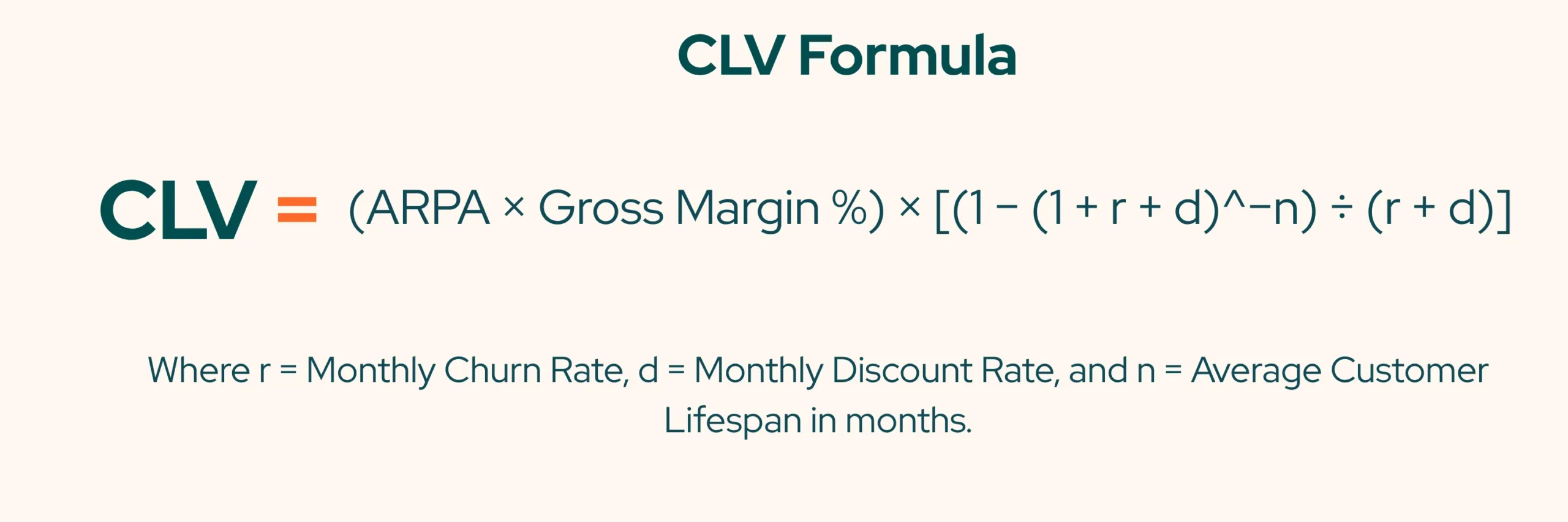
The formula the calculator uses:
CLV = (ARPA × Gross Margin %) × [(1 − (1 + r + d)^−n) ÷ (r + d)]
Where r = Monthly Churn Rate, d = Monthly Discount Rate, and n = Average Customer Lifespan in months.
Here is how to fill each field correctly.
Step 1: Enter Your Average Revenue Per Account (ARPA)
Enter the average monthly revenue a single customer generates. If your platform produces $20,000 in MRR across 200 active customers, your ARPA is $100.
Enter the per-account monthly figure not total MRR, not annual revenue.
The calculator uses ARPA as the base revenue input before applying margin and lifespan adjustments.
Step 2: Enter Your Gross Margin
Enter the percentage of revenue retained after covering the direct costs of delivering your product. If each customer pays $100 per month and service delivery costs $20, your gross margin is 80%.
Gross Margin = ((Revenue − Cost) ÷ Revenue) × 10
This field must be between 1% and 100%. Leaving it blank or entering 0% will return a validation error because a zero-margin business produces zero CLV regardless of revenue.
Step 3: Enter Average Customer Lifespan
Enter how long customers typically stay with your business in months. A 24-month average lifespan means your customers churn after roughly two years on average.
This becomes the n variable in the formula, the number of periods over which the calculator compounds recurring revenue and applies churn and discount adjustments.
Step 4: Enter Your Monthly Churn Rate
Enter the percentage of customers who cancel each month. If you start the month with 500 customers and lose 5, your monthly churn rate is 1%.
Monthly Churn Rate = (Customers Lost ÷ Customers at Start of Month) × 100
This is the r variable in the formula. If you leave this field blank, the calculator assumes 0% churn and uses a simplified lifespan-based CLV instead.
Step 5: Enter a Discount Rate (Optional)
Enter a monthly discount rate if you want CLV adjusted for the time value of money. Most businesses use between 0.5% and 1% monthly. This becomes the d variable in the formula.
If you leave this field blank, the calculator assumes 0% meaning no discounting is applied and future revenue is treated at face value.
Step 6: Hit Calculate CLV
Once your inputs are filled, hit the Calculate CLV button.
Using the example values from the calculator $1,000 ARPA, 80% gross margin, 24-month lifespan, 1% churn, and 10% discount rate the result is $2,400 total value per account.
The results panel also displays the full formula used and the variable values that produced your result, so you can verify the calculation or adjust individual inputs to model different retention or pricing scenarios.
What Does This Result Mean?
A CLV of $2,400 means each average customer contributes $2,400 in profit-adjusted revenue over their entire relationship with your business after accounting for gross margin, churn, and the time value of future payments.
Use this number to:
- Set a rational ceiling on what you can spend to acquire a customer
- Evaluate whether paid channels and sales costs are justified
- Identify how much churn is costing you in lost lifetime value
- Forecast revenue based on acquisition volume
- Benchmark your CLV: CAC ratio against growth targets
If your CAC is $600 and your CLV is $2,400, your CLV: CAC ratio is 4:1, the widely accepted benchmark for sustainable SaaS growth. Below 3:1, your acquisition economics need attention. Above 5:1, you may be underinvesting in growth.
What Is a Good Customer Lifetime Value?
There is no universal CLV benchmark because values vary across industries.
Low CLV
Characteristics:
- High churn
- Low repeat purchases
- Limited retention
Example:
- CLV below $200 for a subscription business may indicate retention issues.
Average CLV
Characteristics:
- Stable customer retention
- Moderate recurring revenue
- Predictable growth
Example:
- SaaS businesses often see CLV values between $1,000 and $5,000.
High CLV
Characteristics:
- Strong retention
- Premium pricing
- High customer loyalty
Example:
- Enterprise SaaS companies frequently exceed $10,000–$50,000 CLV per customer.
The key is improving CLV over time rather than comparing your business directly to others.
Why Customer Lifetime Value Matters
Customer lifetime value is more than a reporting metric. It influences nearly every growth decision.
Predict Future Revenue
CLV helps estimate future revenue based on current customer behavior.
Businesses can forecast growth more accurately and make better budgeting decisions.
Improve Customer Retention
Understanding customer value highlights the importance of retention programs.
Retaining existing customers is often more cost-effective than acquiring new ones.
Increase Marketing Efficiency
Knowing CLV allows businesses to determine how much they can spend on acquisition while remaining profitable.
This improves advertising ROI and budget allocation.
Optimize Pricing Strategies
CLV reveals whether pricing changes improve long-term profitability.
Businesses can test:
- Subscription upgrades
- Premium plans
- Bundled offers
- Loyalty discounts
Forecast Business Growth
Investors, founders, and finance teams frequently use CLV when evaluating company performance and future growth potential.
Higher CLV generally indicates a healthier business model.
Customer Lifetime Value vs Customer Acquisition Cost (CAC)
CLV and CAC are closely connected metrics.
| Metric | Definition |
|---|---|
| CLV | Total value generated by a customer |
| CAC | Cost required to acquire a customer |
Example
- CLV = $2,400
- CAC = $600
CLV:CAC Ratio = 4:1
This means every dollar spent acquiring customers generates four dollars in lifetime value.
Ideal CLV:CAC Ratios
| Ratio | Meaning |
|---|---|
| Below 1:1 | Unprofitable |
| 2:1 | Acceptable |
| 3:1 | Healthy |
| 4:1+ | Strong growth potential |
Businesses should evaluate CLV and CAC together rather than separately.
How to Increase Customer Lifetime Value
Improving CLV often produces better results than simply increasing customer acquisition.
Improve Customer Retention
Retention directly affects customer lifespan.
Strategies include:
- Onboarding improvements
- Customer education
- Regular engagement campaigns
- Loyalty incentives
Reduce Churn
Even a small reduction in churn can significantly increase customer lifetime value.
Methods include:
- Exit surveys
- Renewal reminders
- Product improvements
- Proactive support
Strengthen Customer Support
Customers who receive excellent support are more likely to remain loyal.
Focus on:
- Faster response times
- Self-service resources
- Personalized assistance
Increase Product Adoption
Customers who use more features often stay longer.
Examples:
- Product walkthroughs
- Training sessions
- Feature announcements
- Usage recommendations
Increase Average Order Value
Encourage customers to spend more per transaction.
Techniques include:
Upselling
Offer premium versions of existing products.
Example:
Basic Plan → Pro Plan
Cross-Selling
Recommend complementary products.
Example:
Laptop → Extended Warranty
Bundling
Combine multiple products into one discounted package.
Example:
Software + Training + Support
Improve Customer Experience
A seamless customer experience encourages repeat purchases and longer relationships.
Focus on:
- Easy navigation
- Fast checkout
- Clear communication
- Consistent service quality
Build Loyalty Programs
Reward repeat customers with:
- Points systems
- Exclusive discounts
- VIP memberships
- Early access benefits
Personalize Customer Journeys
Personalized experiences often increase retention and revenue.
Examples include:
- Product recommendations
- Behavior-based emails
- Custom offers
- Personalized onboarding
FAQ’s
What is the difference between CLV and LTV?
CLV (Customer Lifetime Value) and LTV (Lifetime Value) are often used interchangeably. CLV specifically focuses on the value generated by individual customers throughout their relationship with a business.
What is a good CLV: CAC ratio?
Most businesses aim for a CLV: CAC ratio of at least 3:1. Ratios above 4:1 generally indicate strong customer profitability and efficient growth.
How does churn affect customer lifetime value?
Higher churn reduces customer lifespan, which lowers lifetime value. Reducing churn is one of the fastest ways to improve CLV.
Can ecommerce businesses calculate CLV?
Yes. Ecommerce brands frequently use an ecommerce CLV calculator to estimate repeat-purchase value, customer retention performance, and long-term profitability.
How often should CLV be measured?
Most businesses review customer lifetime value monthly or quarterly. Fast-growing SaaS and subscription businesses often monitor CLV alongside CAC, retention, and churn metrics on an ongoing basis.