


Many SaaS companies struggle with the same pattern: traffic grows, signups increase, demos get booked, but revenue doesn’t scale proportionally. Marketing pushes harder. Salespeople work longer. The product ships with more features. Still, growth feels inconsistent.
The real issue often isn’t traffic or product quality. It’s a misalignment.
Teams apply growth tactics without deciding how they want to grow. Should the product drive acquisition and expansion on its own? Or should sales guide prospects through a structured buying process?
This guide breaks down Product-Led Growth (PLG) and Sales-Led Growth (SLG) clearly, using real SaaS examples and practical evaluation criteria. By the end, you’ll know which model fits your SaaS and why.
What is product-led growth (PLG)?
Product-Led Growth is not just a go-to-market strategy; it’s an operating model where the product replaces parts of marketing and sales.
In PLG, acquisition, activation, and expansion are embedded inside the product experience itself. Research from OpenView’s SaaS benchmarks shows PLG adoption rising steadily over the past few years, reflecting a broader behavioral shift: buyers prefer self-education and hands-on evaluation before committing to vendors.
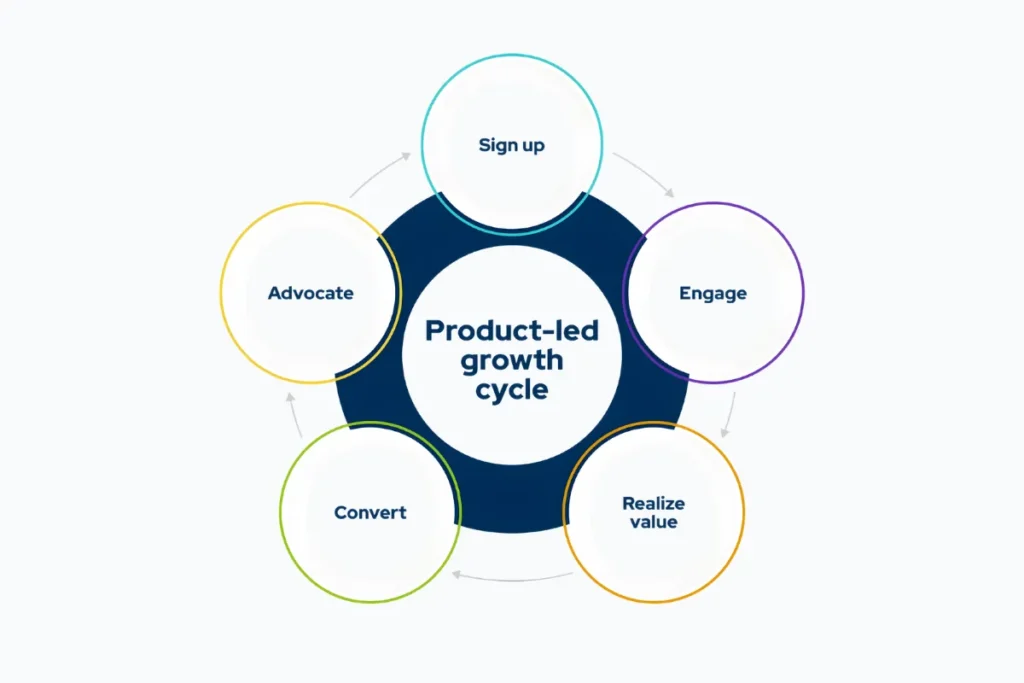
But what makes PLG truly different isn’t free trials, it’s product-qualified signals. Mature PLG companies track product-qualified leads (PQLs), usage thresholds, feature adoption depth, and activation speed. Revenue growth depends less on lead volume and more on how efficiently users reach their “aha moment.”
Unique insight:
PLG fails not because of traffic gaps, but because of activation friction. If users cannot reach the core value quickly, no amount of acquisition will fix growth.
If you’re structuring SEO around product-driven growth, our guide on topic-based keyword research explains how to build keyword clusters that directly support activation and trial signups.
According to research, PLG adoption increased from 45% in 2019 to 55% between 2022 and 2024, meaning more than half of SaaS companies now use product-led growth as their primary or co-primary go-to-market strategy.
This steady rise reflects how modern buyers prefer trying software before committing to a sales conversation.
Companies like Slack and Zoom scaled rapidly because users could start using the product instantly, experience value quickly, and upgrade when usage expanded.
Key attributes of product-led growth
- Free trial or freemium entry point
- Self-serve onboarding
- Short time-to-value (TTV)
- Usage-based or tiered pricing
- Strong in-product expansion loops
Key benefits of PLG
- Lower Customer Acquisition Cost (CAC) over time against industry CAC benchmarks.
- Scalable acquisition through organic channels and referrals
- Faster product feedback loops
- Expansion revenue driven by usage
PLG works best when users can understand and experience value independently, without heavy sales guidance.
What is sales-led growth (SLG)?
Sales-Led Growth is a model where revenue is driven primarily by a sales team that guides prospects through demos, negotiations, and custom implementations.
Unique insight:
SLG struggles not because of high CAC, but because of poor qualification discipline. When deal size doesn’t justify sales cost, the model collapses.
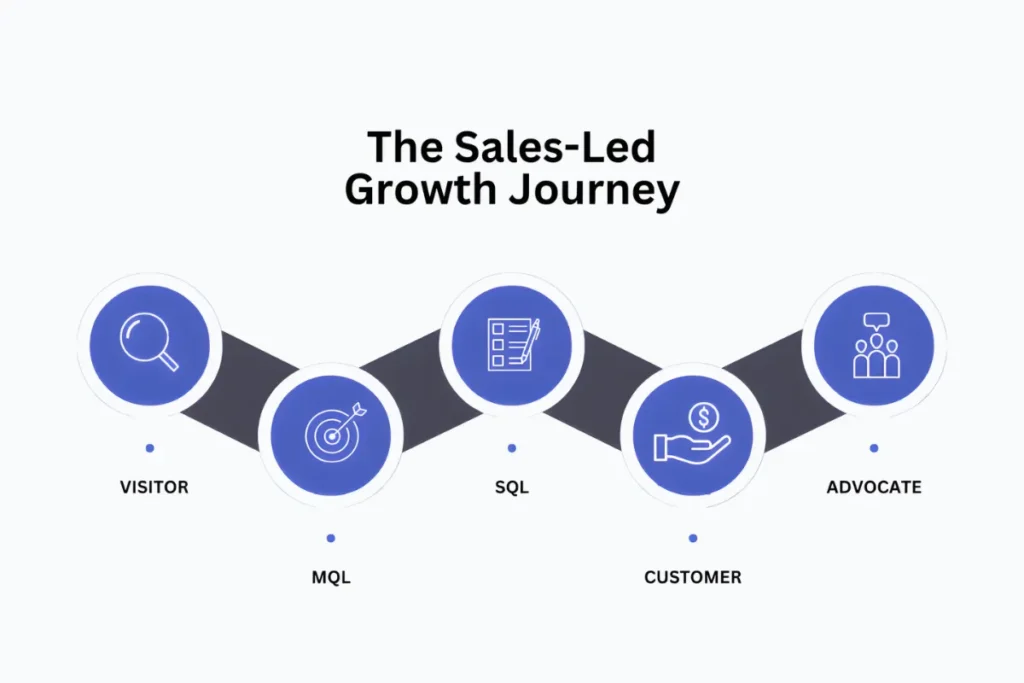
Here, marketing generates qualified leads, but sales closes deals. The buying process often involves multiple stakeholders, budget approvals, and longer decision cycles.
HubSpot reports that the average sales close rate was 29%, while the average win rate was 21%. These numbers show that structured qualification, follow-ups, and strong closing processes remain critical in a sales-led model.
Companies like Salesforce and Oracle rely heavily on structured sales motions, especially for enterprise contracts.
Key attributes of sales-led growth
- Demo-first or consultation-driven acquisition
- Longer sales cycles (30–180+ days)
- High-touch onboarding
- Higher Average Contract Value (ACV)
- Enterprise-focused targeting
Key benefits of sales-led growth
- Higher deal sizes
- Predictable revenue pipelines
- Ability to sell complex solutions
- Strong account control and negotiation
SLG works when the product requires explanation, customization, organizational buy-in, and structured enterprise SaaS sales processes.
The deeper difference
PLG optimizes for speed and scalability.
SLG optimizes for control and contract value.
The real decision isn’t tactical, it’s structural. It depends on how your customers buy, not how you want to sell.
Product-led growth vs Sales-led growth (side-by-side comparison)
A structured comparison across buyer behavior, pricing, scalability, and revenue dynamics to help you identify which growth model fits your SaaS.
| Comparison Factor | Product-Led Growth (PLG) | Sales-Led Growth (SLG) | What It Indicates |
|---|---|---|---|
| Buyer Intent and Decision Process | Buyers search independently, test tools themselves, and upgrade after experiencing value. | Buyers represent organizations, compare vendors, request proposals, and involve procurement or leadership teams. | Individual decision-making → PLG Committee-based buying → SLG |
| Time to Value (TTV) and Onboarding Friction | Requires fast activation. Users should experience value within minutes or a few days. | Can tolerate longer onboarding if the deal size justifies implementation time and training. | TTV < 7 days → PLG Requires setup/training → SLG |
| Pricing Model and Average Contract Value (ACV) | Works best for lower ACVs ($5,000–$10,000 annually) with higher volume. | More efficient for higher ACVs ($15,000–$20,000+ annually). | Low ACV + high volume → PLG High ACV + lower volume → SLG |
| Customer Acquisition Cost (CAC) and Scalability | Relies less on sales teams. Growth driven by marketing, product optimization, and user expansion. | Scales by expanding sales teams, territories, and pipeline systems. | Scales via product optimization → PLG Scales via sales hiring/process → SLG |
| Role of Marketing, Product, and Sales | Product drives activation. Marketing drives traffic. Sales supports expansion. | Marketing generates leads. Sales drives conversion. Product supports implementation. | Product-centered motion → PLG Sales-centered motion → SLG |
| Revenue Predictability and Expansion Potential | Strong expansion revenue when usage increases and retention is high. | Predictable revenue through structured pipeline forecasting and contracts. | Strong retention & usage expansion → PLG Need pipeline control & forecast stability → SLG |
4 Successful SaaS examples of PLG and SLG models
Let’s look at real SaaS companies that demonstrate how product-led and sales-led growth models work in practice.
Notion
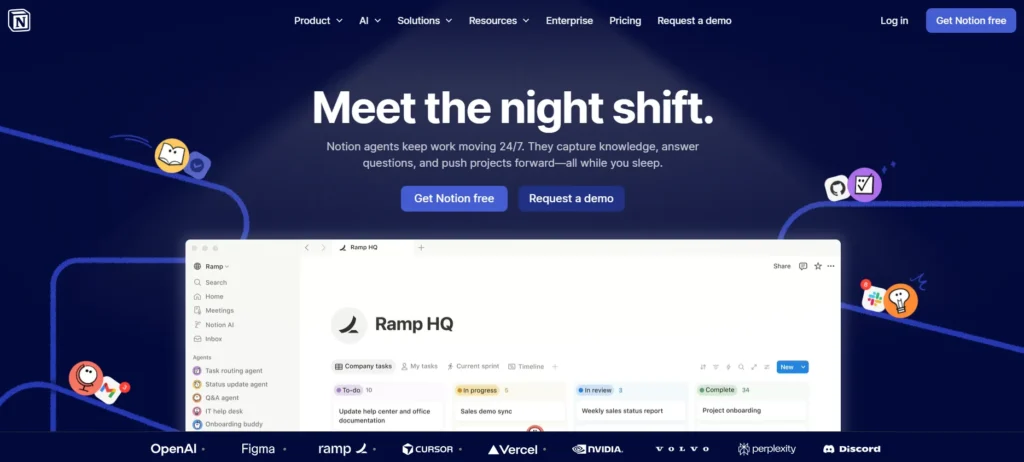
Notion focused on frictionless self-serve onboarding. Users could sign up for free, duplicate templates, and immediately start building documents or workflows. The product encouraged collaboration by making sharing simple, inviting teammates unlocked more value naturally.
What they achieved:
This created organic, bottom-up adoption inside teams. As more members joined, workspace usage increased, driving paid upgrades and expansion without heavy sales involvement.
ver 4 million became paying customers, achieving a 13% freemium conversion rate that’s 4x the industry average for productivity tools. Revenue hit $400 million in 2024 (60% YoY growth), with workspace expansions driving upgrades without heavy sales.
Dropbox
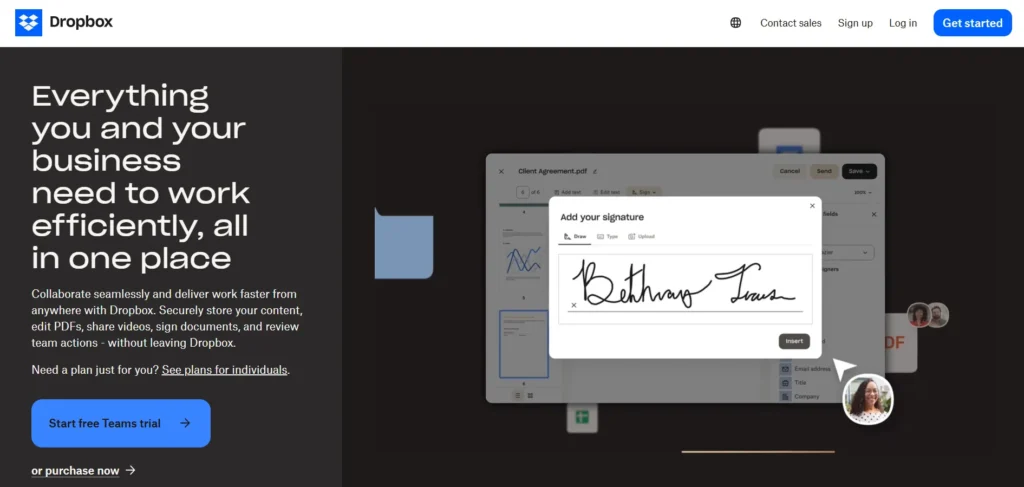
Dropbox simplified onboarding to a single core outcome: store and share files instantly. They embedded referral incentives directly into the product users earned additional storage for inviting others.
What they achieved:
This built a viral growth loop where acquisition and expansion happened simultaneously. User referrals significantly reduced CAC while increasing adoption speed.
Dropbox’s referral programme helped grow its user base from 100,000 to 4 million in just 15 months, a remarkable 3,900% increase. This rapid expansion showed how a well-designed referral loop can turn existing users into a powerful acquisition engine.
HubSpot
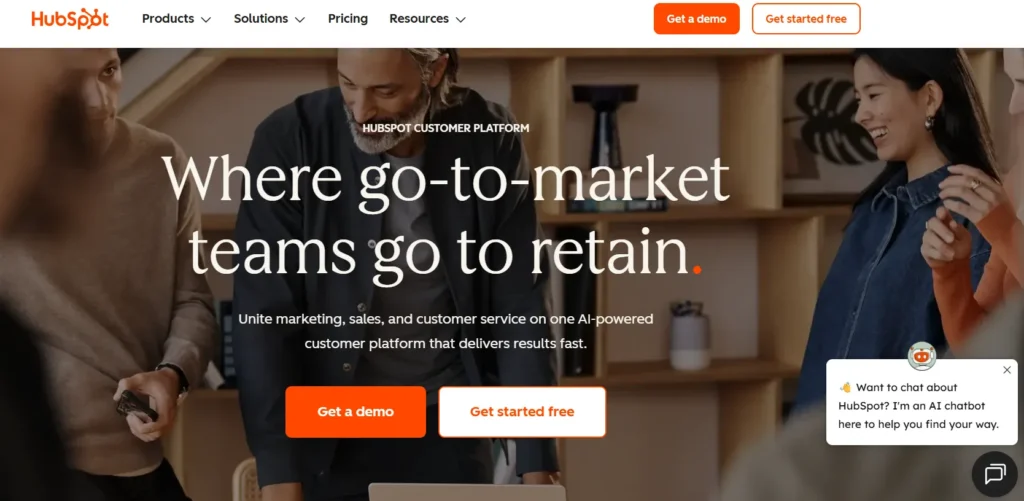
HubSpot attracted users with free CRM and marketing tools (PLG motion). As customers grew and required automation, integrations, and advanced features, sales teams stepped in to offer consultations and structured upgrades.
What they achieved:
They combined scalable inbound acquisition with higher ACV enterprise deals, increasing revenue per account while maintaining strong top-of-funnel growth.
HubSpot generated $3.13 billion in total revenue, marking a 19% increase on a reported basis and 18% growth in constant currency compared to 2024.
Workday
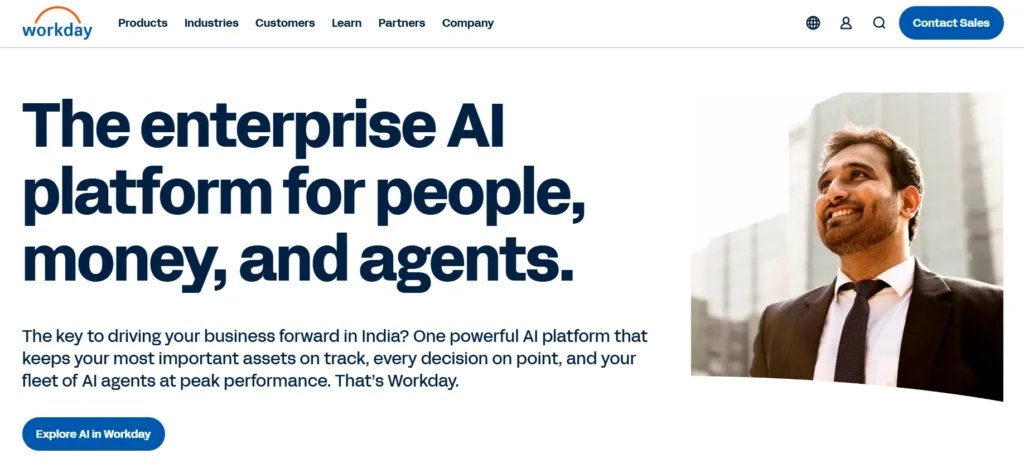
Workday targeted HR and finance leaders with a consultative sales approach. Deals involved demos, ROI discussions, executive approvals, and structured implementation planning.
What they achieved:
This enabled large, multi-year enterprise contracts with predictable revenue and high retention, despite longer sales cycles.
Workday reported $2.211 billion in total revenue, reflecting a 15% increase compared to the fourth quarter of fiscal 2024.
Which growth model is right for your SaaS? (ask these questions)
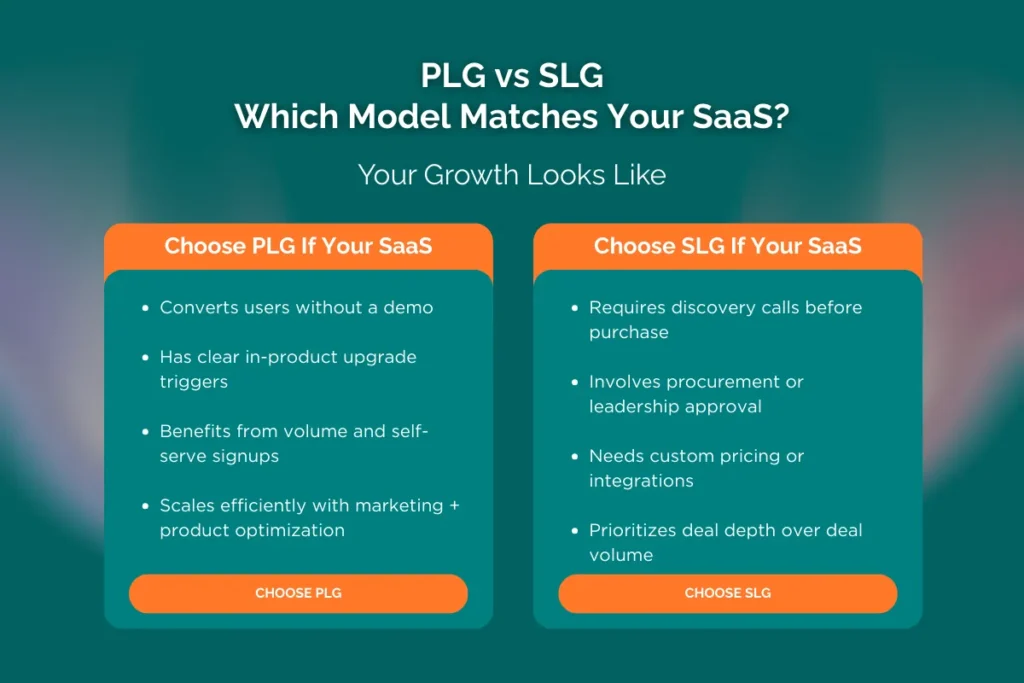
Choosing between product-led and sales-led growth isn’t about trends; it’s about how your category and buyers operate.
If you sell a simple, horizontal tool where users can activate value quickly and upgrade without demos, PLG fits. Look for signals like fast time-to-value, high self-serve conversions, and low sales involvement.
If your product requires multiple stakeholders, integrations, or higher ACVs, SLG makes more sense.
Longer sales cycles, frequent demo requests, and enterprise procurement processes are clear indicators. Many SaaS companies adopt a hybrid model when self-serve drives adoption, but larger accounts need sales support to expand.
What problem does your product solve and how quickly do users see value?
If users can achieve a meaningful outcome within 1–3 sessions → PLG
Metric to check:
- Activation rate > 30%
- Time-to-value under 7 days
If value requires configuration, data migration, or training → SLG
Who is the buyer and how complex is the buying decision?
If the buyer is an individual contributor → PLG
If 3+ stakeholders are involved → SLG
Metric:
- Sales cycle length
- Number of decision-makers
What is your pricing model and ACV?
If you use transparent, self-serve pricing (monthly subscriptions, usage-based tiers, credit models) and your ACV is below $5,000, PLG often works because users can decide independently without negotiation.
If your pricing is custom, contract-based, or quote-driven and ACV exceeds $20,000, SLG performs better since buyers expect demos, proposals, and procurement alignment.
Check:
- CAC payback period
- Deal size vs sales cost
- % of customers purchasing without a demo
How much sales involvement does your product actually require?
If support tickets replace sales calls → PLG
If demos and proposals are necessary → SLG
Metric:
- % deals closed without sales interaction
What growth constraints are you facing today (cost, speed, scale)?
If CAC is too high → consider shifting toward PLG
If the deal size is too small to justify sales cost → PLG
If growth is slow due to limited volume → SLG might unlock higher ACV
Why most SaaS companies go with a hybrid growth model?
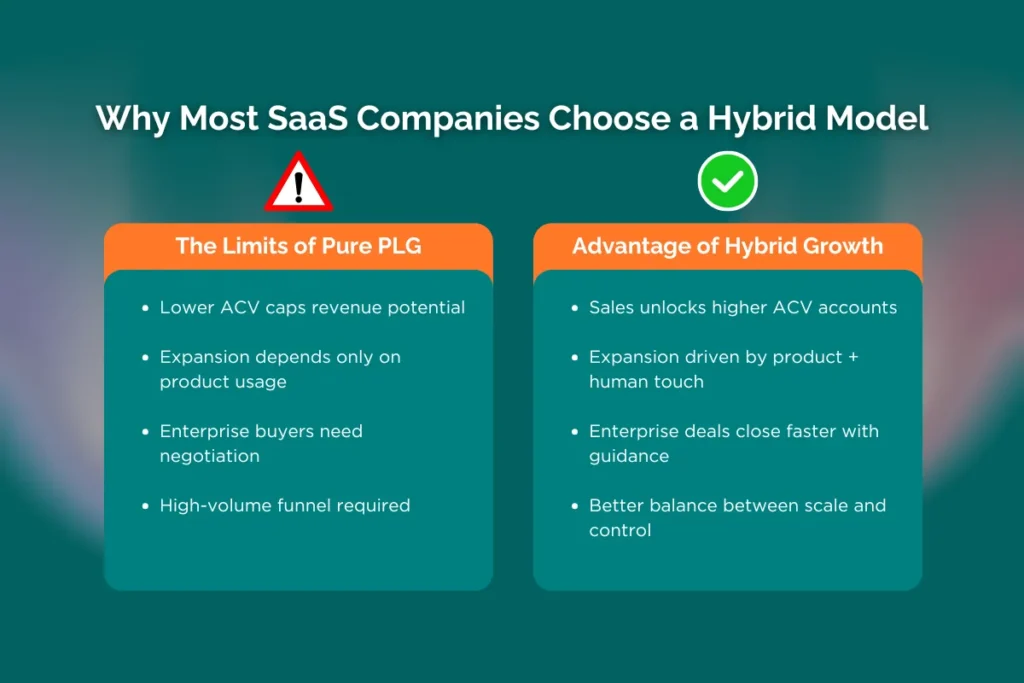
Most successful SaaS companies blend both, but at the right stage.
Start with PLG when you’re early-stage, validating product-market fit, and selling to SMBs with lower ACVs. Introduce sales when you move upmarket, deal sizes increase, or enterprise buyers require demos, security reviews, and negotiation.
For example, Atlassian grew primarily through a product-led model offering free trials and transparent pricing that allowed teams to adopt tools like Jira without talking to sales.
As adoption expanded into large enterprises, Atlassian introduced enterprise sales teams to support complex deployments, compliance requirements, and multi-year contracts. This hybrid approach helped them maintain scalable acquisition while significantly increasing enterprise revenue.
Hybrid models work when:
- Free users convert independently
- High-usage accounts trigger sales outreach
- Enterprise deals require negotiation
The key is clearly defining when and why sales enter the journey.
How SERP Forge helps SaaS teams align growth model with execution
Choosing a growth model is only step one. Execution determines success.
We help SaaS companies align SEO, content, and funnel design with their growth motion. If you’re building a product-led motion, understanding how product-led SEO works specifically for SaaS becomes critical.
Without developing the proper strategy & funnel, your entire SEO engine might be useless. That’s why we highly encourage you to book a free strategy call with us and you will walk away with an execution ready product-led SEO plan for your SaaS, even if you never hire us.
For PLG SaaS, we focus on product-led and activation-focused content writing services.
For SLG SaaS, we design content and SEO strategies that attract high-intent high-value buyers that supply consistent inbound leads.
Growth works when the acquisition strategy matches the revenue motion. So, book your free strategy call with us today.
Final thoughts
Product-Led Growth and Sales-Led Growth are not competitors. They are different revenue engines. PLG works when the value is immediate and buyers can decide independently.
SLG works when complexity, customization, or high ACV requires guided selling. The biggest mistake SaaS companies make is adopting tactics without choosing a model.
Before investing more in SEO, ads, or hiring sales reps, ask: Is our product designed to sell itself, or does it need a salesperson? That clarity determines how you structure onboarding, pricing, content, sales involvement, and forecasting.
If you’re unsure which growth model fits your SaaS or if you’re seeing traffic without revenue, it may be time to realign your strategy. Contact us to evaluate your growth motion and build a revenue engine that scales predictably.
FAQ’s about Product-led growth vs Sales-led growth
1. Can a product be product-led if it still has a sales team?
Yes. Many PLG companies use sales for expansion or enterprise deals.
2. Why does Product-Led Growth fail even when the product is good?
Onboarding friction, unclear value, or weak activation metrics prevent users from experiencing outcomes quickly.
3. When does Sales-Led Growth become unsustainable?
When CAC exceeds lifetime value, or when deal sizes are too small to justify sales costs.
4. How do you know when it’s time to add sales to a PLG motion?
When high-usage accounts require custom pricing, integration help, or negotiation.
5. Is PLG only suitable for low-priced or SMB-focused SaaS?
No. PLG can scale to mid-market if product value is clear and usage-driven expansion exists.
6. How does the growth model affect SEO and content strategy?
PLG SEO focuses on problem-aware, high-volume keywords that drive trial signups. SLG SEO targets high-intent, comparison, and enterprise-driven searches.
7. What metrics matter most for PLG vs SLG?
PLG: Activation rate, product-qualified leads (PQLs), and expansion revenue.
SLG: Sales cycle length, pipeline velocity, and win rate.
8. Why do many hybrid models fail in SaaS?
Because teams don’t clearly define when users shift from self-serve to sales. This creates ownership confusion, friction, and weak execution across both motions.
9. Should early-stage SaaS choose PLG or SLG first?
Choose based on product complexity and ACV. Fast value + low pricing → PLG. Complex product + high ACV → SLG.
10. Does switching growth models mean rebuilding everything?
No. Usually, it requires changes in onboarding, pricing, and funnel ownership, not a full product rebuild.

