


Cold outreach has a conversion problem that SEO teams underestimate.
Cold emails sent specifically for link building yield a backlink only 8.5% of the time. The average cold email response rate across all outreach has dropped from 8.5% in 2019 to 3.43% in 2026.
The volume required to hit link targets through cold outreach alone keeps rising. Link building communities change that equation by replacing cold introductions with relationships built over time.
By the time you pitch inside a backlinks community, publishers already recognize your name. That recognition is what turns a request into an editorial backlink, placed because the content earned it rather than because a transaction happened.
This guide covers 12 active link building communities worth joining in 2026, with cost, access details and who each one is built for.
What is a Link Building Community?
A link building community is an online group where SEOs, publishers, and content marketers share backlink opportunities, guest post openings and collaboration requests.
Members share content, find guest post openings and collaborate on digital PR. Relationships built here form a publisher network that replaces the need to introduce yourself from scratch on every outreach attempt.
The top-ranking page on Google has 3.8 times more backlinks than pages ranked two through ten. Yet 95% of all pages on the internet have zero backlinks. Communities are one of the fastest ways to close that gap without scaling outreach volume.
What Types of Link Building Communities Exist?
Here is how the main community formats differ and who each one suits:
- Public Slack Communities: Broad niche access where quality depends on moderation and structured channels for guest posts, niche edits, digital PR, and resource links. Best suited for freelancers and beginner SEOs building their first publisher network.
- Private Invite-Only Slack Communities: Entry barriers improve member quality and enforce stricter editorial standards that reject weak or thin placements. Best suited for agencies and in-house SEOs prioritizing placement quality over volume.
- Paid Slack Communities: Subscription fees create cleaner link networks, with pricing typically ranging from under $50/month for general SEO groups to $150–$300+/month for vetted publishers and high-DR opportunities. Best suited for teams needing scalable, consistent, high-quality placements.
- LinkedIn & Facebook Groups: Better for visibility and relationship warming than active link exchanges, though networking moves slower than Slack communities. Best suited for building trust with editors and publishers before direct outreach campaigns.
- Online Forums & Platforms: Reddit and Discord help identify trending link strategies, discover guest post opportunities, and test outreach angles before scaling campaigns. Best suited for research and niche discovery before building an established publisher network.
Which Link Building Slack Communities Are Worth Joining in 2026?
Below are 12 communities that working SEOs still rely on in 2026.
For each, you will see how to join, what it costs and when it makes sense to invest time there.
1. SERP Forge
| Category | Details |
|---|---|
| Access | Open |
| Cost | Free |
| Best For | SEOs, agency teams, and niche site owners |
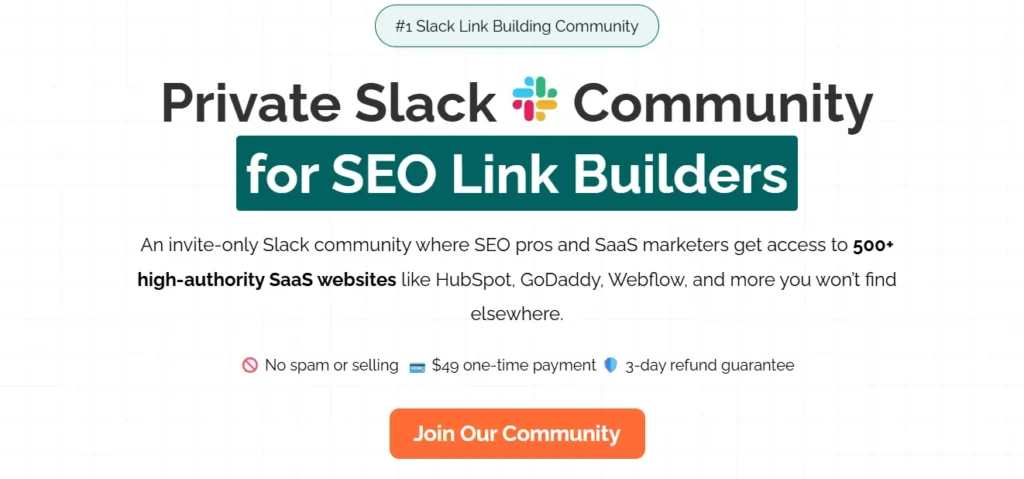
SERP Forge is built around SEO and link building only. That focus keeps conversations tight and removes general marketing noise from the feed.
Channels cover guest post swaps, paid link deals, niche-specific link threads and general SEO questions. Members include founders, agency teams, in-house marketers and niche site owners.
Moderation: Active moderation. Channels are split by link type. Off-topic posts are removed quickly.
For many link builders, SERP Forge functions as a daily home base for learning, testing ideas and landing links in one place.
Verdict: If you want one focused SEO and link building room first, SERP Forge is a practical starting point.
Best for: SEOs at any stage who want a focused, spam-free link building room.
2. Backlink Masterminds
| Category | Details |
|---|---|
| Access | Invite-only |
| Cost | Free |
| Best For | SaaS and B2B link builders |
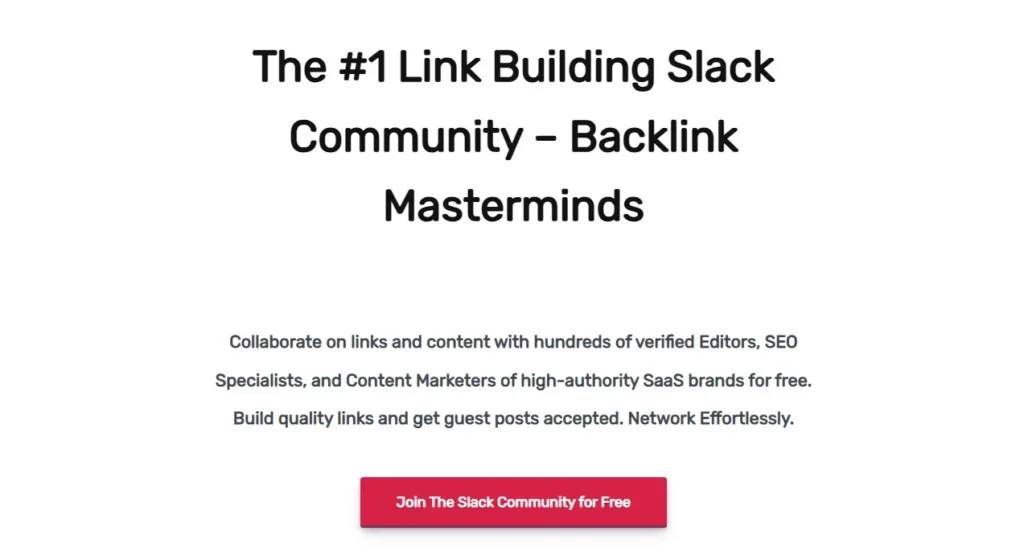
Backlink Masterminds was started by Vikas Kalwani and built specifically for SaaS companies doing collaborative link building. The community has around 300+ active members from brands like HubSpot, Monday and Cloudways.
Inside, members use the group to:
- Find partners for multi-site link exchanges
- Trade links to pages that cold outreach rarely reaches
- Turn guest posts on big sites into additional backlinks
To join, fill out a form describing your role, sites and goals. The team reviews it and sends an invite if you fit.
Moderation: Small member base kept tight by manual approval. Low spam risk by design.
Verdict: The highest signal-to-noise ratio of any free Slack community for SaaS link building.
Best for: SaaS and B2B teams pitching similar publications and working with high-authority properties.
3. GetProLinks
| Category | Details |
|---|---|
| Access | Invite-only via work email |
| Cost | Free |
| Best For | Agencies managing multiple clients |
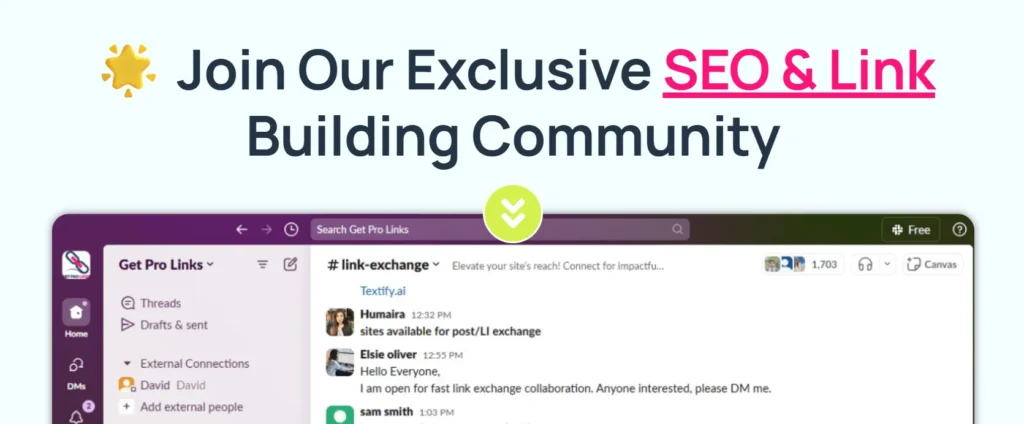
GetProLinks calls itself the fastest-growing community for crowdsourced link building. You join, list the domains you control and see relevant collaboration offers from brands already open to link deals.
This works well when:
- You manage multiple clients and need consistent deal flow
- You want DR ranges and niches listed clearly upfront
- You prefer structured offers over open-ended swap posts
Moderation: Invite-only model keeps quality high. Structured offer format reduces vague swap requests.
Verdict: Underused by most agencies, which keeps the deal quality higher than its size suggests.
Best for: Agencies managing multiple client domains who need steady, structured deal flow.
4. Marketing Lad
| Category | Details |
|---|---|
| Access | Open |
| Cost | One-time fee with a 24-hour refund policy available |
| Best For | SaaS content marketers |
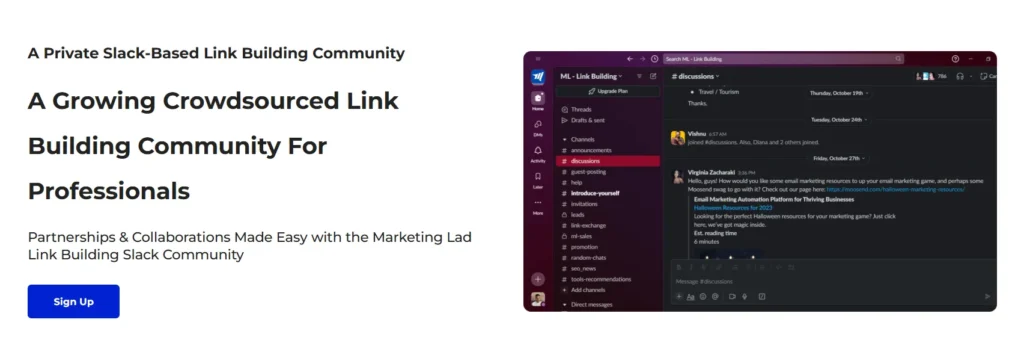
Marketing Lad started as an SEO blog and grew its Slack community into a core product. The one-time fee filters out members who are not serious about outreach or collaboration.
Inside, members can:
- Pitch content ideas directly to brands
- Promote link bait and blog posts to relevant audiences
- Join ongoing collaboration threads
The community is trusted by over 700 brands including Wordable and uSERP.
Moderation: One-time fee filters casual members. Admins enforce contribution standards.
Verdict: Worth the one-time fee if you run content for SaaS clients and need warm outreach partners.
Best for: Content marketers running link building for SaaS or startup clients.
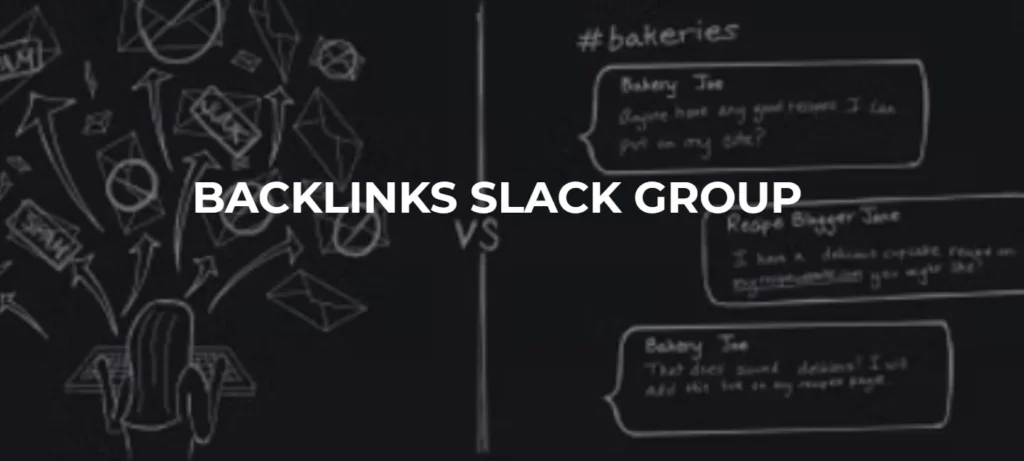
5. Backlinks Slack Group by Brainspin
| Category | Details |
|---|---|
| Access | Open via website |
| Cost | Free |
| Best For | SEOs who also manage broader marketing initiatives |
The Backlinks Slack Group is run by Brainspin, a digital marketing studio. It is free to join and covers both SEO and general marketing topics.
Brainspin sets up focused channels and lets members control notifications per channel. You can subscribe only to link-related rooms and ignore everything else.
Moderation: Lightly moderated. Subscribe only to link channels to avoid noise from general marketing threads.
Verdict: Free and useful, but treat it as a secondary room rather than your main link building base.
Best for: Marketers wearing multiple hats who want a free, lightly structured space for link building and broader SEO discussion.
6. Traffic Think Tank

| Category | Details |
|---|---|
| Access | Application-based |
| Cost | $119/month with 20% annual discount available |
| Best For | SEOs investing in long-term skill development |
Traffic Think Tank costs $119 per month. You get access to a Slack community, private events, live Q&A and monthly webinars. Annual members get a 20% discount and their rate stays locked in permanently.
Membership includes:
- Over 200 hours of recorded training filterable by topic and skill level
- Monthly live Q&A with founders Matt Howells-Barby, Nick Eubanks and Ian Howells
- 3+ expert-led webinars per month
- Exclusive tool and service discounts via the perks page
Link building discussions go beyond swap posts. Members share campaign breakdowns, digital PR tactics and content-led link strategies with verified results.
Moderation: Heavily moderated. Founders are active inside. One of the cleanest paid communities available.
Verdict: The only paid community where the training alone justifies the monthly fee.
Best for: SEOs who want structured learning alongside community access.
7. BigSEO
| Category | Details |
|---|---|
| Access | Invite-only or manual approval |
| Cost | Free |
| Best For | Experienced SEOs seeking advanced strategy discussions |
BigSEO started as a subreddit and grew into a Slack group. By 2022 it had over 8,000 members and has continued growing since.
Channels cover technical SEO, local SEO, site reviews, must-reads and jobs. Link building appears in strategy threads where members debate what is safe, what carries risk and how to adjust when algorithms shift.
Moderation: Large group with active admins. Link spam is flagged but can appear during busy periods.
Verdict: Best if you want peer collaboration that challenges your approach rather than validates it.
Best for: Experienced SEOs who want peers challenging their approach.
8. Online Geniuses

| Category | Details |
|---|---|
| Access | Open with manual vetting |
| Cost | Free |
| Best For | Marketers working across multiple verticals |
Online Geniuses has over 53,000 members across channels covering SEO, PPC, email, analytics and social media. Every applicant is manually vetted before joining.
For link building specifically, the relevant channels include:
- Guest posting
- Blogger outreach
- Curated link resources
- PR outreach
The size of the community means you will find someone who understands almost any industry vertical.
Moderation: Manual vetting before entry. One of the better-moderated large communities at this size.
Verdict: The best large community for finding contacts in unusual niches you cannot reach elsewhere.
Best for: Marketers who need links across diverse industries and want a vetted, large member base.
9. Superpath
| Category | Details |
|---|---|
| Access | Open |
| Cost | Free |
| Best For | Content-led link builders at B2B and SaaS companies |
Superpath is a content-first community. Most members are content managers, editors and heads of content at B2B and SaaS companies.
Link opportunities here come from content collaboration rather than direct swaps:
- Pitching guest posts to people who control editorial calendars
- Offering expert quotes for upcoming articles
- Finding writers for your own content gaps
Because these are editorial decisions, the links earned are contextual backlinks sitting inside relevant body content written by real editors for real audiences. These carry more ranking weight than sidebar or footer placements at the same DR.
Moderation: Content-first culture keeps self-promotional spam low. Members are editors and managers.
Verdict: Slow for link volume but unmatched for earning editorial placements that hold long-term.
Best for: Content marketers who prioritise placement quality and topical relevance over speed.
10. CRO Growth Hacks
| Category | Details |
|---|---|
| Access | Open |
| Cost | Free |
| Best For | Link builders who need to demonstrate ROI to stakeholders |
CRO Growth Hacks focuses on conversion rate optimization and growth experiments. Link building surfaces when members share how domain authority improvements translated into measurable ranking and revenue changes.
Link builders have just three to six months to show the value of their efforts. This community gives you the experiment frameworks and reporting formats to make that case faster.
Moderation: Loosely moderated. Useful for frameworks but not a core link exchange hub.
Verdict: Skip it if placements are your primary goal. Join only if you need to prove link ROI to stakeholders.
Best for: SEOs who need to connect link building output to revenue.
11. Growth Partners
| Category | Details |
|---|---|
| Access | Application-based |
| Cost | Free |
| Best For | B2B SaaS teams running co-marketing programs |
Growth Partners is built for B2B SaaS growth teams operating inside broader partnership ecosystems. Channels span co-marketing, demand generation and content strategy.
Link building here is tied to co-marketing activity rather than direct exchanges:
- Co-creating research reports with complementary SaaS tools
- Running joint webinars that produce natural backlinks
- Publishing integration case studies with partner brands
This motion suits teams selling into mid-market or enterprise, where co-branded assets carry more credibility than traditional outreach.
Moderation: Application-based entry. Co-marketing focus keeps direct link spam minimal.
Verdict: Strong for co-marketing link programs. Weak for direct guest post or niche edit exchanges.
Best for: B2B SaaS teams building pipeline through partnerships.
12. Digital Olympus
| Category | Details |
|---|---|
| Access | Application-based |
| Cost | Free |
| Best For | Teams running full digital PR campaigns |
Digital Olympus focuses on advanced link building and digital PR, and has become one of the most active HARO alternatives for teams that need consistent journalist and publisher access.
Members share:
- Campaign ideas built around original data and research
- Systems for tracking newsroom and journalist outreach
- Real examples of coverage earned from major publications
Digital PR is now the most popular link building method, used by 67.3% of marketers
Moderation: Campaign-level members only. High editorial standards across posts and contributions.
Verdict: Best community if your link strategy is built around digital PR and media placements.
Best for: SEOs and PR teams running campaigns at publication scale.
How to Choose the Right Link Building Community
Joining the wrong community wastes weeks of time you cannot recover. Use a simple framework to decide where to invest your time.
The FACT framework
Score each community across four factors:
- Fit: Do members match your niche and role.
- Activity: Are link channels busy each week.
- Control: Do admins enforce rules and remove spam.
- Transaction quality: Check whether the site’s topic matches yours.
Topical relevance matters as much as DR.
If a backlinks community fails two or more of these, it is rarely worth your attention.
Here is what to check before committing.
Check Access and Quality Control
Open communities grow fast but attract spam if moderation is weak.
Check whether admins remove low‑quality posts and vet new members.
A community with a few hundred vetted members often produces more value than one with tens of thousands and no oversight.
Pinned rules, clean channels and visible admin activity are all good signs.
Verify Activity Level Before Joining
A backlinks community that was thriving two years ago may be quiet today.
Ask existing members or skim recent posts before paying or applying.
Healthy signs include:
- New posts appearing in link channels every few days
- Questions receiving replies within hours
- Link opportunities being claimed
If link threads are full of unanswered posts from weeks ago, keep looking.
Match the Community to Your Role
Different roles need different rooms.
Think about your day‑to‑day work first.
Use this simple mapping:
| Role | Best Community Type |
|---|---|
| Freelancer | Large public communities with varied niches and networking opportunities |
| Agency SEO | Invite-only or paid communities with consistent deal flow and partnership opportunities |
| In-house SaaS SEO | SaaS-focused communities and co-marketing collaboration hubs |
| Content Marketer | Content-first communities such as Superpath and similar networks |
| Digital PR Specialist | Campaign-focused groups like Digital Olympus and PR collaboration communities |
Match to your workflow instead of chasing the biggest member count.
Look for Dedicated Link Building Channels
General SEO channels are not enough.
Good communities have dedicated collaboration channels for each link type:
- Guest posting
- Niche edits
- Digital PR opportunities
- Resource and partner links
Before joining, confirm that at least one dedicated link channel exists.
Then check how often new opportunities appear there.
How to Get the Most Out of a Link Building Community
Getting into the right community is the first step. Consistent link opportunities come from how you show up inside it.
Lead With Value Before Asking for Links
Members who arrive with requests and nothing else get ignored within days. Communities run on reciprocity, and that pattern is visible to everyone watching the channels.
Spend your first two weeks answering questions, sharing a case study, or flagging a useful resource. That activity builds name recognition. When you post a link request after that, people already know who you are.
Use Channels Correctly
Posting a guest post request in a general SEO channel is a fast way to get ignored. Every community has channel rules, and ignoring them signals you did not bother reading them.
Before posting anything:
- Read the channel description and pinned messages
- Check recent posts to see what format members use
- Match your post to what is already working in that channel
Track Opportunities in a Shared Doc
Build a simple tracking system and update it daily:
| Field | What to Record |
|---|---|
| Community Name | Record the community or platform where the opportunity was shared. |
| Site URL and DR | Capture the website URL and domain rating for quality evaluation before responding. |
| Contact Name | Note the name of the person who posted or manages the opportunity. |
| Date Posted | Track when the opportunity was posted to verify if it is still active. |
| Status | Update the progress status such as pitched, accepted, published, or passed. |
A shared doc keeps your pipeline visible and stops you from chasing opportunities that already closed.
Build Relationships Before Pitching
A direct pitch to someone you have never interacted with inside a community is still a cold message. The platform changes but the dynamic stays the same.
Engage with a member’s posts before reaching out directly. Comment on their questions, respond to their shared content and make your name familiar before a link conversation starts.
Members who treat community participation as SEO networking rather than link prospecting consistently get faster responses and higher-quality placements
Link Building Communities vs Cold Outreach: Which Works Better?
Communities and cold outreach serve different functions. Here is where each one fits:
| Factor | Cold Outreach | Link Building Communities |
|---|---|---|
| Speed to First Link | Typically takes 2 to 6 weeks on average | Usually achieved within days to 2 weeks through existing relationships |
| Outreach-to-Placement Ratio | Around 8.5% success rate with cold outreach campaigns | Approximately 30%–50% success rate with warm community-based pitches |
| Scalability | Highly scalable with outreach automation and prospecting tools | Limited by the depth and quality of relationships within the community |
| Link Quality Control | You have full control over site selection and qualification | Depends on the standards and quality of community members |
| Cost | $100–$400/month in tools plus approximately 5–10 hours per week | Ranges from free to $150+/month depending on membership fees |
| Relationship Value | Often transactional and campaign-specific | Builds long-term relationships that compound over time |
| Best Use Case | Effective for entering new niches and targeting cold prospects | Best for recurring placements and trusted long-term partnerships |
Cold outreach, scaled through outreach automation, expands your reach into new sites and niches where you have no existing connections. Communities build the recurring relationships that produce placements without starting from zero every time.
The programs that consistently outperform rely on both, with community-led growth compounding the relationships that cold outreach opens. Cold outreach fills the top of the pipeline. Communities turn the best contacts from that pipeline into long-term link partners.
Conclusion
Link building is still one of the hardest parts of SEO. Doing it alone with only cold email is even harder.
The right Slack communities give you:
- Faster access to people who actually control links
- Space to test ideas and get feedback
- Partners for co‑marketing
Start simple:
pick two or three communities that match your role and niche.
Learn the rules, contribute for a few weeks, then introduce focused offers backed by good content.
Over the next few months, you should see something shift. More warm intros, more natural links and less time wasted sending cold pitches to people who never reply.
Ready to move from cold inboxes to warm rooms?
Shortlist your top three communities, join one this week and commit to ten genuine contributions before your first link request.
Frequently Asked Questions
What is the best free link building Slack community?
SERP Forge is the best starting point if you want a community focused only on SEO and link building.
Are paid link building communities worth it?
They are worth it only when member quality and active link exchanges clearly justify the fee.
Many SEOs start with a free community like SERP Forge and upgrade only after hitting clear limits.
How do Slack link building communities help with SEO?
Slack communities put you directly in front of people who can approve or place links.
You are not another cold email in a crowded inbox.
When members already recognize your name from helpful posts, your outreach feels warm and wins more replies.
What is the difference between a public and invite‑only community?
Public communities are open to anyone and give broad niche access.
Invite‑only communities screen members more tightly, so opportunities tend to be more curated and higher quality.
Can beginners join link building communities?
Yes, beginners can join most communities if they follow the rules, contribute first and ask for links later.
Spaces like SERP Forge, Online Geniuses and BigSEO are all accessible from day one.
Invite‑only groups like Backlink Masterminds usually expect some real placements or experience before accepting you.

