


Pricing your SaaS product correctly is one of the most critical decisions for growth, yet many businesses still rely on cost-based or competitor-based pricing.
While these methods are simple, they often fail to capture the true value your product delivers, leading to missed revenue opportunities and weak positioning.
If you’re still deciding which approach fits your business, it helps to first understand the full range of SaaS pricing models available before committing to one strategy.
This is where value-based pricing changes the approach. Instead of focusing on internal costs or market averages, it aligns pricing with customer- perceived value, measurable outcomes, and willingness to pay.
When done right, it helps you maximize revenue while ensuring customers feel the price reflects the impact they receive.
In this guide, you’ll learn how value-based pricing works in SaaS, the key factors that influence it, and a step-by-step process to implement it effectively.
What is Value-Based Pricing?
Value-based pricing is a pricing strategy where you set the price of your SaaS product based on the perceived value to the customer, rather than production costs or competitor benchmarks.
It focuses on how much value your product delivers in terms of ROI, cost savings, efficiency gains, and business outcomes.
In SaaS, this means pricing is aligned with customer outcomes, not just features. The more impact your product creates, such as increasing revenue, reducing churn, or saving time, the higher the willingness to pay (WTP).
Not sure if your SaaS pricing is leaving money on the table?
Get a Free Pricing Audit →
According to PwC research, customers are willing to pay up to 16% more for a better customer experience, and 73% say a positive experience directly influences brand loyalty. This highlights why pricing based on perceived value and outcomes is more effective than cost-based models.
At its core, value-based pricing connects pricing strategy, product positioning, and customer success, ensuring that what customers pay reflects the measurable value they receive.

What are Value-Based Pricing Strategies for SaaS?
A strong value-based pricing strategy focuses on aligning your pricing with the actual value your product delivers to different customer segments.
It focuses on how customers perceive value, measure results, and decide what they’re willing to pay, not just features or internal costs.
Here are the core elements that shape a strong value-based pricing strategy:
1. Scarcity
Scarcity increases willingness to pay by creating urgency and exclusivity, which directly improves conversion rates and short-term revenue.
Limited-time offers, capped plans, or early-access pricing push users to act faster and accept higher price points because the opportunity feels finite.
For example, a “founder’s pricing” tier drives faster adoption while anchoring future pricing higher, lifting both initial revenue and long-term pricing benchmarks.
2. Differentiation
Differentiation increases pricing power and reduces price sensitivity, allowing you to charge more without losing conversions.
When your product clearly ties features to outcomes like saving hours, reducing costs, or increasing revenue, customers justify higher spend based on measurable impact.
For example, positioning your tool as a way to cut operational costs by 30% shifts the conversation from price to ROI, increasing both deal size and willingness to pay.
3. Segmentation
Segmentation captures maximum revenue from each customer segment by aligning pricing with their perceived value and budget capacity.
Different users assign different values to your product, so tiered pricing ensures you don’t undercharge high-value customers or overprice entry-level users.
This is where ABM for SaaS becomes critical it helps you focus your efforts on the highest-value accounts that justify premium pricing.
For example, offering scalable enterprise plans with advanced features and support increases average revenue per account (ARPA), while lower tiers expand acquisition together, improving overall revenue and customer lifetime value (CLV).
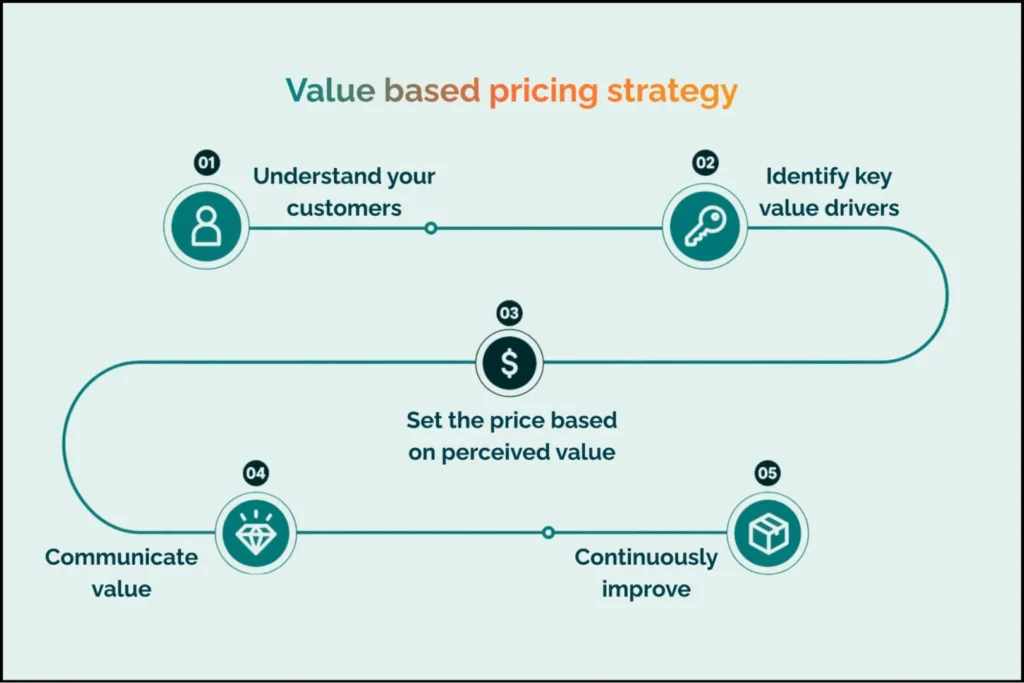
Key Factors That Influence Value-Based Pricing in SaaS
Here are the key factors that directly impact how you set and optimize value-based pricing:
Customer Willingness to Pay
Customer willingness to pay (WTP) defines the maximum price a customer is ready to pay based on the perceived value, expected ROI, and business impact of your SaaS product. It is influenced by factors like pain point severity, urgency, alternative solutions, and budget constraints.
In SaaS, WTP varies across segments, startups, SMBs, and enterprises, all of which assign different value to the same product. Understanding this helps you set price tiers, packaging, and monetization models that capture maximum value.
Key inputs to measure WTP:
- Customer interviews and surveys
- Pricing experiments (A/B testing)
- Usage data and feature adoption
- Conversion rates across pricing tiers
Market Research and Feedback
Market research validates your pricing by combining competitive analysis, customer insights, and demand signals.
It ensures your pricing aligns with market expectations, category benchmarks, and perceived differentiation.
Customer feedback helps identify what users truly value: features, outcomes, support, or scalability. This allows you to refine pricing models, feature packaging, and value metrics over time.
Key research methods include:
- Competitor pricing analysis
- Win/loss analysis
- Customer feedback loops (NPS, surveys, reviews)
- Behavioral data (trial-to-paid conversion, churn reasons)
Brand Positioning
Brand positioning and your SaaS pricing page shape how customers perceive your product’s value in the market.
A strong positioning increases pricing power, reduces price sensitivity, and supports premium pricing strategies.
If your SaaS is positioned as a high-performance or specialized solution, customers are more likely to associate it with higher value and better outcomes. Weak positioning, on the other hand, pushes you toward price-based competition.
Elements that influence pricing through positioning:
- Clear value proposition and messaging
- Niche focus or specialization
- Trust signals (case studies, reviews, authority)
- Consistency across product, pricing, and marketing
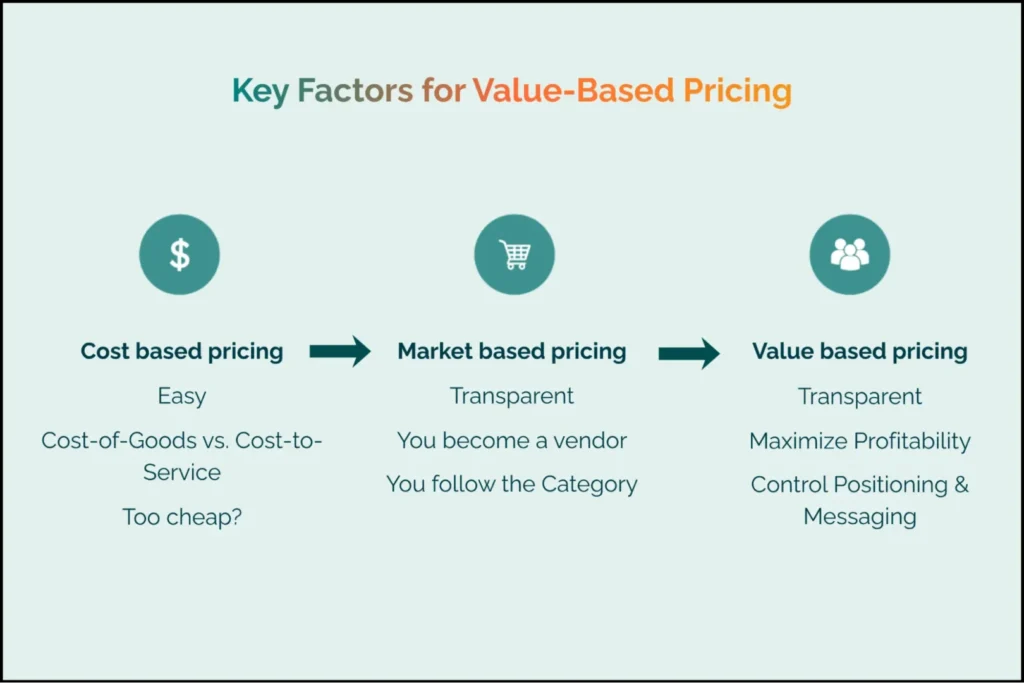
Examples of Value-Based Pricing
Value-based pricing sets prices based on the perceived value to the customer, rather than cost-plus calculations.
It focuses on benefits like prestige, convenience, time saved, and overall experience, which allows businesses to charge significantly higher than production costs.
Here are specific examples of value-based pricing across different industries:
Technology & SaaS (Apple / Adobe)
Companies like Apple price products such as iPhones much higher than their production costs because customers pay for brand value, ecosystem, design, and user experience.
Similarly, Adobe uses a subscription-based model where pricing reflects the ongoing value its tools deliver (design efficiency, productivity), not the cost of distribution.
Retail & Luxury (Gucci / Starbucks)
Luxury brands like Gucci set premium prices to signal status, exclusivity, and brand identity.
Starbucks also follows value-based pricing by charging more for coffee, not because of ingredient costs, but due to brand experience, ambiance, and convenience.
B2B / SaaS Efficiency (Time-Savings Model)
In SaaS, pricing is often tied to time savings and operational efficiency.
For example, if a tool costs $100 to maintain but helps a business save 20 hours monthly (worth $500), it can be priced at $300. The price reflects the value created, not the internal cost.
Unique Intellectual Property (Film Merchandise)
Products tied to popular intellectual property (like movie merchandise) can command higher prices because of emotional value, exclusivity, and brand attachment. Customers are willing to pay more for something unique and meaningful.
Convenience & Immediate Need (Airports / Gas Stations)
Products like snacks or bottled water at airports are priced higher due to convenience and urgency. Customers are not paying for the product itself, but for instant availability and accessibility.
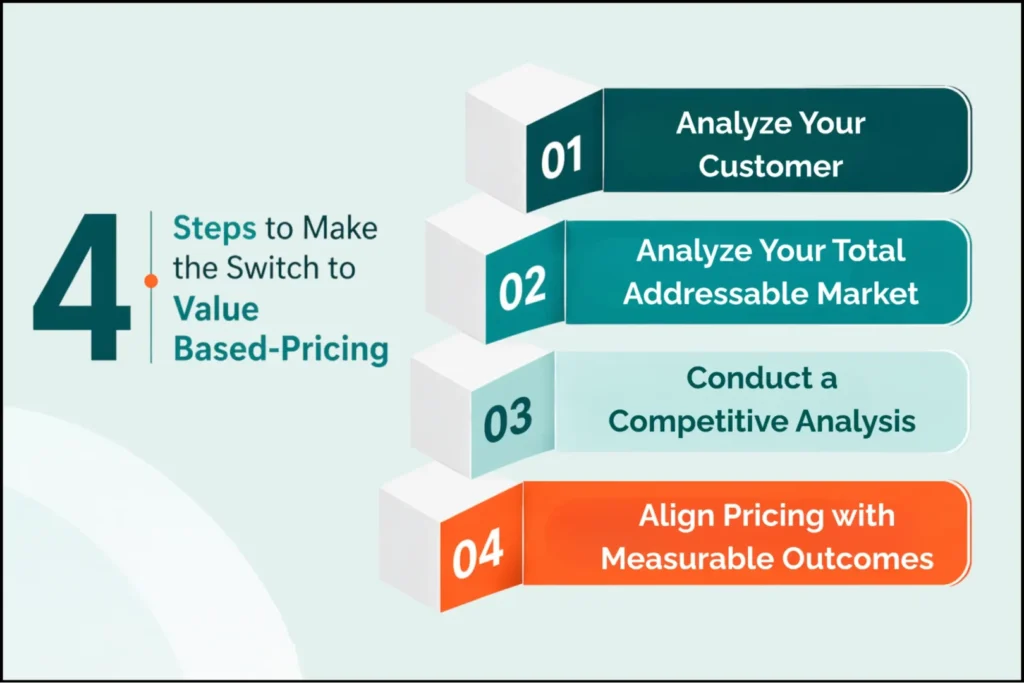
Four Steps to Set Your Value-Based Price in SaaS
Value-based pricing works when you quantify the value you create and price it as a share of that value.
These steps build on each other to get there:
1. Analyze Your Customer
Start by identifying your ideal customer profile (ICP), pain points, use cases, and expected outcomes. Value-based pricing depends on how strongly your product solves a problem and the impact it creates.
Understanding how customers move through your SaaS sales funnel helps you identify which pain points matter most at each stage.
Focus on:
- Revenue generated or influenced
- Costs reduced
- Time saved or productivity gained
This step answers one key question: “What is this worth in ₹ terms to the customer?”
That number becomes the foundation for willingness to pay and revenue potential per customer.
2. Analyze Your Total Addressable Market
Evaluate your total addressable market (TAM), serviceable market (SAM), and target segments to understand how value varies across different customer groups.
Look at:
- How much revenue impact each segment sees
- How critical the problem is (nice-to-have vs must-have)
- Budget capacity vs value received
Higher-impact segments will accept higher pricing because the ROI is larger and more visible this is where you capture maximum revenue per account.
3. Conduct a Competitive Analysis
Study competitor pricing models to understand market benchmarks, pricing structures, and positioning gaps. This is not about copying prices but identifying where you can differentiate and justify premium pricing.
Instead of matching prices, compare:
- Value delivered vs price charged
- Gaps where competitors underdeliver
- Areas where your outcome is stronger (faster, cheaper, higher ROI)
This helps you justify a higher price by showing better return, not just different features, increasing pricing power and deal size.
4. Align Pricing with Measurable Outcomes
The final step is to connect pricing directly to quantifiable value metrics such as revenue impact, cost savings, productivity gains, or efficiency improvements.
Instead of pricing based on features alone, link it to:
- ROI generated
- Time saved
- Output or performance improvement
- Usage or scale (API calls, users, data volume)
A simple rule: price at a fraction of the value created, so customers clearly see the upside.
For example, if your product generates ₹1,00,000 in monthly value, pricing it at ₹10,000–₹20,000 makes the decision easy, high ROI for the customer, strong revenue capture for you.
Advantages and Disadvantages of Value-Based Pricing
Here’s a clear comparison of the pros and cons of value-based pricing in SaaS:
| Pros | Cons |
|---|---|
| Aligns pricing with customer-perceived value and ROI | Difficult to accurately measure perceived value and willingness to pay (WTP) |
| Increases revenue potential and profit margins compared to cost-based pricing | Requires deep customer research and continuous validation |
| Supports premium positioning and brand differentiation | Can be complex to implement without clear value metrics |
| Reduces price sensitivity by focusing on outcomes, not cost | Risk of mispricing if the value is overestimated or unclear |
| Enables better segmentation and tiered pricing strategies | Needs ongoing pricing optimization and experimentation |
| Strengthens customer satisfaction when price matches delivered value | May not work well in highly commoditized or price-driven markets |
Is Value-Based Pricing Right for Your Business?
Value-based pricing works best when your SaaS product delivers clear, measurable outcomes and solves a high-impact problem for a defined customer segment.
It is not just a pricing model; it depends on strong product-market fit, positioning, and value communication.
When it works well
- Your product delivers quantifiable ROI (revenue growth, cost savings, productivity gains)
- You understand your ideal customer profile (ICP) and their willingness to pay
- Your product has clear differentiation in a competitive market
- You can track value metrics like usage, outcomes, or performance
- You have strong customer insights, feedback loops, and data
When it may not be the best fit
- Your product is highly commoditized with little differentiation
- You lack clarity on customer value or use cases
- Your target market is extremely price-sensitive
- You don’t have enough data to define pricing tiers or segments
- Your product is still early-stage without clear, validated outcomes
Conclusion
Value-based pricing in SaaS is about aligning your price with the real value customers receive, not just your costs or competitor benchmarks. When done right, it helps you capture more revenue, improve positioning, and create a stronger connection between your product and customer outcomes.
By focusing on customer willingness to pay, segmentation, value metrics, and measurable ROI, you can build a pricing model that grows with your users and reflects the impact your product delivers.
The key is simple: understand your customer deeply, quantify the value you create, and continuously refine your pricing based on data and feedback.
FAQ on Value-Based Pricing in SaaS
1. How do you measure customer value in SaaS pricing?
Customer value is measured using value metrics and business outcomes such as revenue impact, cost savings, time saved, and efficiency gains. You can validate this through customer interviews, usage data, feature adoption, and ROI analysis. The goal is to quantify how your product improves the customer’s business.
2. Is value-based pricing suitable for early-stage SaaS startups?
It can work for early-stage startups if they have a clear problem-solution fit and defined use cases. However, limited data on customer behavior and willingness to pay can make pricing harder to validate. Many startups start with simplified pricing and refine it as they gather more insights.
3. What metrics matter most in value-based pricing for SaaS?
The most important metrics in value-based pricing include customer willingness to pay (WTP), customer lifetime value (CLV), average revenue per user (ARPU), churn rate, retention, and usage-based metrics such as number of users, API calls, or data volume.
4. How do you communicate value to justify higher pricing?
Focus on outcomes, not features. Highlight measurable benefits like increased revenue, reduced costs, or improved efficiency. Use case studies, testimonials, benchmarks, and ROI examples to show real impact. Clear value messaging reduces price objections and builds trust.
5. Can value-based pricing work with tiered pricing models?
Yes, value-based pricing works effectively with tiered pricing. Each tier can represent a different level of value based on features, usage, or customer segment. This allows you to capture value across different user groups while aligning pricing with their needs and willingness to pay.

