
Link building has been declared “dead” many times over the years.
And yet, in 2025, it continues to sit quietly at the core of strong organic strategies.
As search becomes more crowded, AI summaries take over screen space, and content volume explodes, one thing remains consistent: trusted signals still win.
This is especially true for international SEO, where multilingual link building helps establish trust and authority within country-specific search markets.
To understand why link building hasn’t lost its relevance, we gathered insights directly from in-house leaders, CMOs, founders, and growth teams across industries. These aren’t agencies or consultants, they’re operators who rely on organic visibility for real business outcomes.
Below are their unfiltered perspectives on why link building still matters, how it’s evolved, and what actually works now.
Why is link building still important today?
Link building in 2026 is no longer about volume or shortcuts. It plays a central role in how brands earn trust, visibility, and credibility across search experiences.
Instead of chasing numbers, successful link building focuses on being referenced in the right places, attracting the right audience, and building authority that lasts.
| Aspect | Importance |
|---|---|
| Trust signals | Links act as third-party validation, showing your content is trusted beyond your own website |
| Audience relevance | Mentions on sites your audience already follows drive higher engagement and conversions |
| Search visibility | Quality links help content appear consistently during research and decision-making |
| Content credibility | Links reinforce expertise that content alone cannot self-declare |
| Referral traffic | Visitors from trusted sources arrive more informed and ready to act |
| Long-term value | Strong links continue delivering results long after they are earned |
Expert Insights on link building
Below are insights from in-house leaders explaining why link building still plays a critical role in organic growth and visibility in 2026.
1. Link building works best as a referral engine
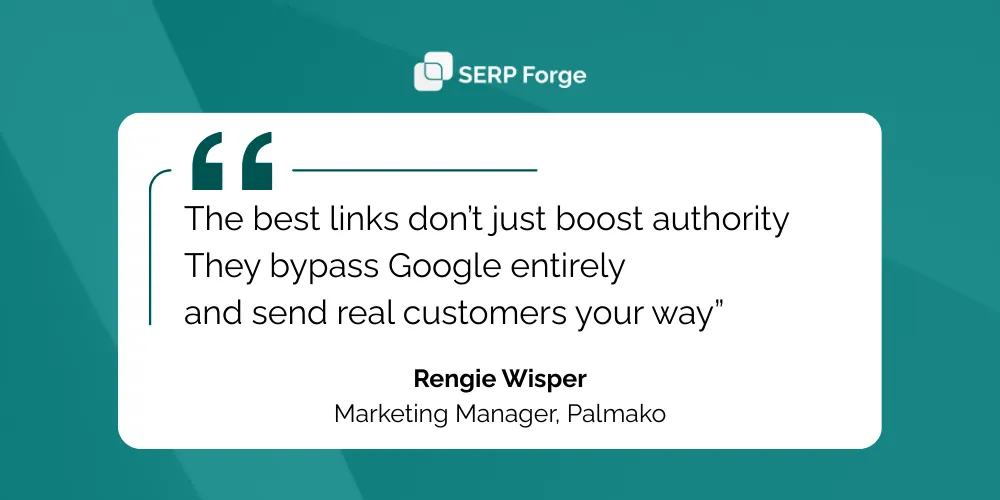
I treat link building differently from most SEO pros. I don’t look at it as just a way to manipulate a search algorithm. I view it as a referral engine.
Search results in 2026 are crowded. AI overviews take up a lot of screen real estate, which makes traditional rankings volatile. But a link on a high-traffic industry blog is stable. It is a direct line to your customers that bypasses the search engine entirely.
This is why link building fits into my organic strategy as a form of content distribution. When I publish a new piece of content, I don’t just wait for Google to find it. I reach out to newsletters, bloggers, and resource hubs that cover that specific topic. I ask them to share it with their audience.
If they link to me, I get the SEO benefit of higher authority. But more importantly, I get real human traffic. If you get a link on a site your audience actually reads, you win regardless of where you rank on Google.
Don’t obsess over arbitrary metrics like Domain Authority scores. Focus on relevance. Ask yourself if the people reading that other site are the people you want to sell to. If the answer is yes, that is a link worth building.
Rengie Wisper, Marketing Manager, Palmako
2. Links as digital trust signals in a noisy web
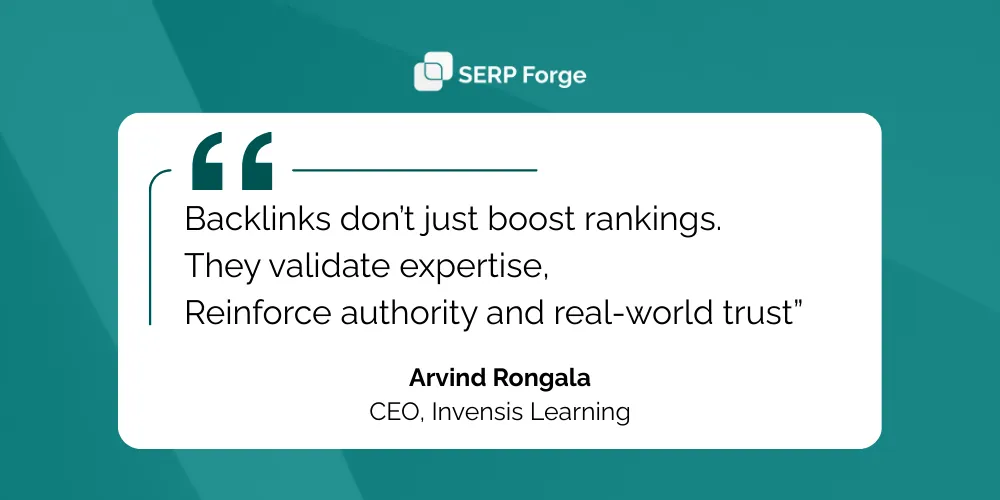
Link building in 2026 remains a core signal of digital trust, especially as search algorithms lean more heavily on credibility metrics to counter the explosion of AI-generated noise.
Independent studies continue to show that high-quality backlinks act as validation from authoritative sources, essentially a reputation layer that the algorithm still struggles to replicate through on-page signals alone.
Research from Backlinko found that pages with strong backlink profiles consistently outrank those without, even when content quality is comparable.
At Invensis Learning, link equity plays a strategic role in strengthening topical authority across key learning domains such as project management, agile, and cybersecurity, helping search engines distinguish truly reliable educational resources from generic content.
In an environment where authenticity and expertise matter more than ever, earned links continue to function as one of the few durable indicators of real-world relevance and trust.
Arvind Rongala, CEO, Invensis Learning
3. Quality backlinks separate real brands from AI noise
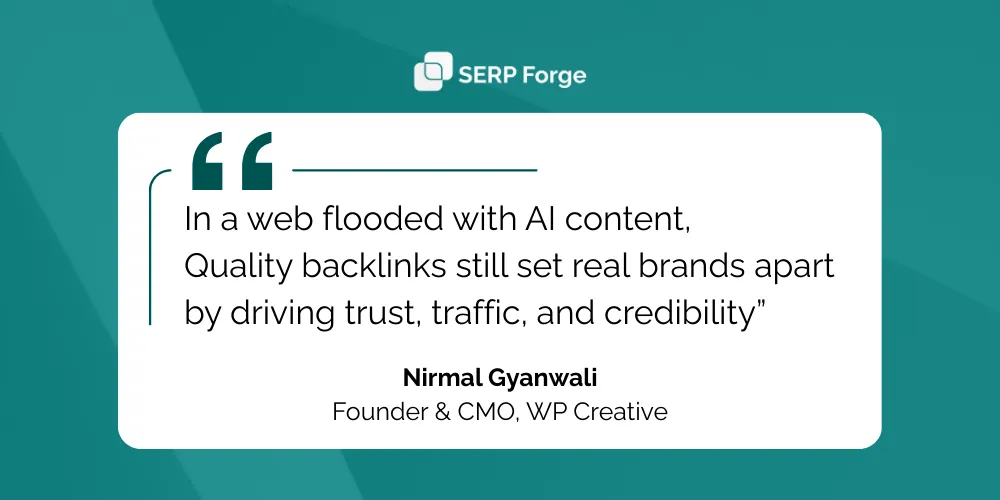
Honestly, link building in 2026 is still super important, and I can’t stress that enough. It’s not just about the links themselves; it’s the connections and credibility that come with them.
With all that AI content flooding the internet, a good quality backlink makes all the difference in setting us apart from the pack as the real deal.
For instance, we just got a big mention on one of the biggest sites in our industry after I contributed a really useful guest post. That one little link sent us a load of traffic, and we saw a serious bump in credibility.
We’re big fans of platforms like HARO for earning genuine links, and it’s a win-win. Not only does it help with SEO, but it also helps us build a following and some real community around our brand. So yeah, link building is still a key part of what we do, and it really does pay off over time.
Nirmal Gyanwali, Founder & CMO, WP Creative
4. AI search still relies on links to judge credibility
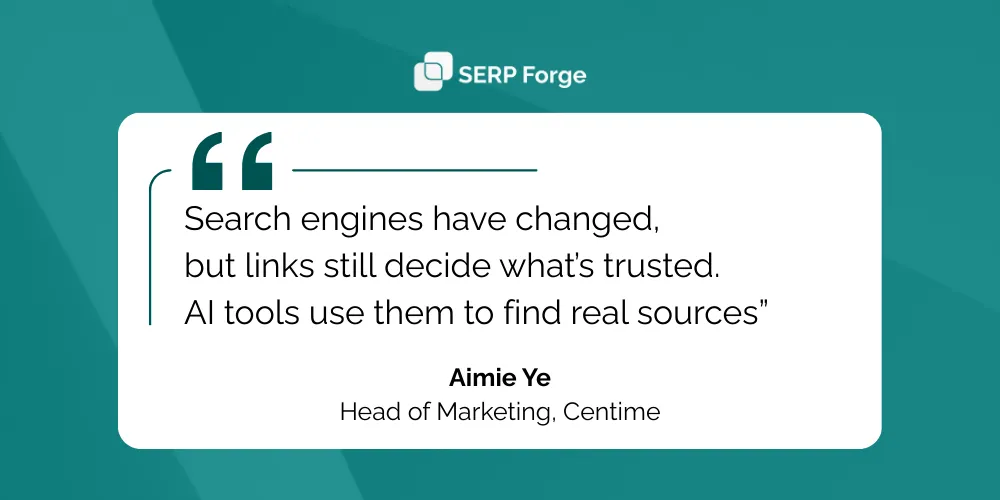
Link building still matters because the engines powering search have changed, but they haven’t stopped relying on links. ChatGPT, Claude, Perplexity, and other AI-powered search tools still use links to understand what’s credible and what’s noise.
They’re crawling the web, following citations, and using link patterns to determine which sources deserve to be referenced in their answers. So while we’re not optimizing for PageRank the way we were 10 years ago, we’re now optimizing for answer engines and generative search results, and links are still the primary signal these systems use to evaluate authority. At Centime, this shift has changed how we think about link building.
We’re not chasing hundreds of low-quality directory links anymore. Instead, we’re focused on earning placements in publications and platforms that AI engines actually reference when answering finance-related queries.
When we get linked from a respected source like CFO.com or a well-cited industry analysis, it increases the likelihood that our insights show up when someone asks Claude or Perplexity about cash flow management or AP automation.
The goal isn’t just traditional SERP rankings anymore; it’s making sure we’re part of the knowledge base these AI tools pull from when finance leaders are researching solutions. Links are still the bridge between being mentioned and being trusted, and in a world where AI is mediating discovery, that credibility signal matters more than ever.
Aimie Ye, Head of Marketing, Centime
5. Backlinks prove authority beyond your own website
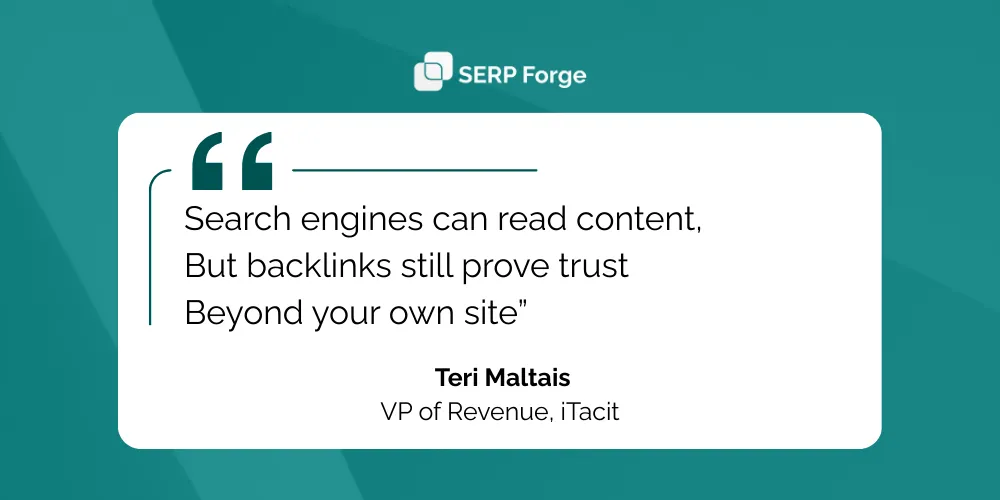
What I’ve found is that link building still matters in 2026 because trust signals matter. Search engines are getting better at reading content quality, but they still look to credible backlinks as proof that your expertise is recognized outside your own walls. For us, it supports the topics we lead on, like frontline communication, digital workflows, and mobile learning.
When reputable sites link to those insights, our educational content performs better and reaches the teams we’re trying to help.
We treat link building as part of a bigger strategy. Share useful knowledge, earn authority, and make it easier for people to find solutions that work.
Teri Maltais, VP of Revenue, iTacit
6. Link building is now an AI visibility strategy
Link building continues to be one of the most underused yet highest-impact levers in SaaS going into 2026.
With AI now acting as a major discovery engine, the visibility landscape has shifted far beyond traditional Google rankings. Large Language Models increasingly rely on authoritative sources and citations when surfacing recommendations, so if your brand isn’t present on those “source” URLs, you simply don’t show up in ChatGPT or other LLM responses.
This is exactly why link building still matters. In our experience at Simplam, top-tier links remain critical for strengthening both search visibility and AI visibility.
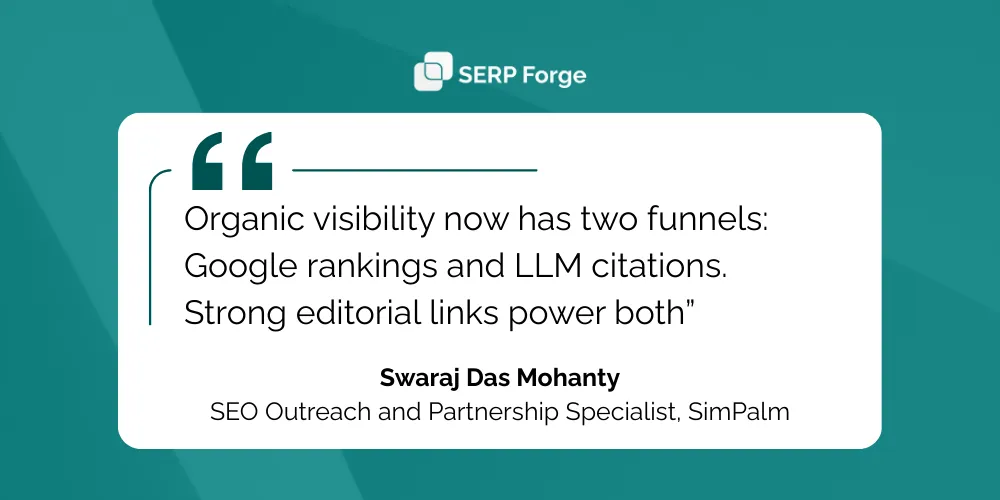
You cannot outrank or outshine competitors in LLM share of voice without strong editorial links. In 2025 and now in 2026, we’re seeing that organic visibility is split between two funnels: Google rankings and LLM citations. Winning both requires consistent link velocity and smart link-targeting.
Our strategy focuses heavily on securing editorial links in relevant content, earning links on URLs that LLMs frequently pull from, and investing in podcast placements and quote outreach.
These efforts compound over time to better rankings, stronger domain trust, and dramatically improved AI inclusion. We’ve already seen the impact internally, with a noticeable increase in qualified leads coming directly from ChatGPT-driven queries.
For us, link building isn’t just an SEO routine anymore; it’s a core component of our overall organic strategy and a major driver of brand visibility in the AI-first era.
Swaraj Das Mohanty, SEO Outreach and Partnership Specialist, SimPalm
7. Relevance matters more than volume

The value of link building persists in 2026 because search engines still use links as key indicators to verify online authority, which directly impacts user trust in brands.
Our link acquisition strategy focuses on reputable women’s health outlets, scientific blogs, and educational websites that align with our actual areas of investment, like vaginal microbiome studies, clean ingredient sourcing, and supplement transparency.
The emphasis now is less on quantity and more on earning relevant links that establish authentic authority. We manage link building internally because our team works closely with researchers, medical experts, and media organizations to produce content that meets high editorial standards.
Ethical, strategic link building brings dual value by boosting search visibility while reinforcing trust with both users and search algorithms.
Hans Graubard, COO & Cofounder, Happy V
8. Links validate real-world expertise
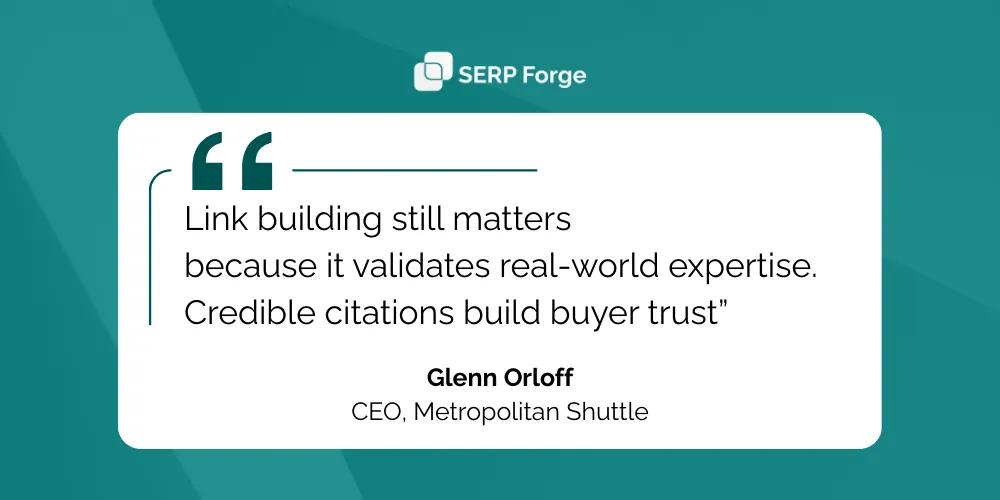
With more than twenty years of running a nationwide shuttle company, I’ve seen that link building still matters because it validates real-world expertise. Search engines look for signals that a company is credible.
For us, that comes from journalists citing safety practices, fleet management workflows, and commuter program results. When reputable domains link to those resources, it strengthens trust and lifts the pages that buyers use early in procurement.
What works best is pairing operational data with content hubs, then letting earned coverage point back to them. It keeps long-lead corporate buyers finding us.
Glenn Orloff, CEO, Metropolitan Shuttle
9. Backlinks close competitive gaps
Link building still matters because search engines rely heavily on authority measurement. Backlinks act as endorsements that confirm your reliability across important subject areas.
Strong links help close competitive gaps when content alone cannot progress effectively. We see consistent gains when clients invest in meaningful link acquisition over time.
Backlinks support our broader strategy by reinforcing pillars driving organic authority development. They help engines identify which pieces deserve ranking strength for commercial keywords. We earn links through thought leadership, community partnerships, and evidence-based resources that customers appreciate. This ensures our link building aligns directly with measurable performance goals.
Marc Bishop, Director, Wytlabs
10. Genuine relationships create long-term authority
Link building continues to be a cornerstone of organic strategy because it creates authority, trust, and visibility in a progressively competitive digital environment.
From my standpoint as a Business Development Director at CheapForex, collaborations and focused outreach are vital for ensuring high-quality link acquisition. Genuine relationships with pertinent industry websites do more than just build links; they cultivate credibility in the view of potential customers and search engines.
Developing content that addresses specific industry inquiries or resolves niche challenges has been a transformative move, attracting natural backlinks while reinforcing brand authority.
These initiatives not only align with SEO objectives but also support long-term business expansion and sustainable traffic generation.
Corina Tham, Sales, Marketing, and Business Development Director, CheapForexVPS
11. Shareable experiences earn natural links

Link building in 2026 is about creating shareable moments that people want to talk about. These moments generate organic backlinks because they are genuinely interesting and newsworthy.
Many businesses find it hard to get noticed online. They feel like they’re just shouting into the void, with no one paying attention.
By creating a unique event or experience, you give journalists and bloggers a compelling reason to write about you, solving the problem of being invisible.
At my company, we do this by creating unique photo experiences. Imagine we set up a “zero-gravity” photo booth at a major city festival.
I would then reach out to local event and lifestyle bloggers with a simple message: “We’re launching a zero-gravity photo booth at the festival this weekend and thought your readers might find it interesting. Would you like a behind-the-scenes look?” This creates a story that is easy for them to cover.
This strategy shifts the focus from asking for links to creating content that naturally earns them. It is a more organic and effective way to build your site’s authority.
Gaetano Isidori, Founder & CEO, PhotoboothTO
12. Community context matters again
Link building is still one of the strongest external signals of authority, and that will stay true in 2026. In 2025, we saw something interesting happening. Old-school tactics came back.
Forums, Reddit, Quora. Places many people wrote off years ago are becoming part of the regular SEO toolkit again. Search engines are paying more attention to real conversations happening in real communities, and that shift is easy to notice.
You can also explore relevant Link Building Slack Communities to connect with SEO professionals and discover link opportunities.
At TRALERT(r), working in a niche market like vehicle lighting, every credible mention matters. Backlinks, comments, brand references, niche discussions. They all help search engines and AI systems understand that our guidance and technical knowledge come from real expertise. With AI overviews and LLM answers taking up so much space at the top of search results, off-site signals are no longer just about ranking. They help us cut through the noise and stay visible where decisions are made.
For us, the focus is not on do-follow or nofollow. The context is what counts. If a mention is relevant and placed in a trusted environment, it adds value. Every one of these signals strengthens our presence as an entity in search.
That is what helps our content show up in both traditional results and the AI summaries people rely on today.
Kevin Van Mierlo, Online Marketer, Tralert®
13. Consumer trust depends on link credibility
In 2026, Link Building will become a key component in building consumer trust and credibility through a brand’s perception by consumers. Consumers are relying on credible sources when searching for products or services online amid the proliferation of misinformation.
A link profile built to convey a positive message and demonstrate credibility will signal to potential customers that LINQ Kitchen is a legitimate, trustworthy option. Consumer trust is critical in the home improvement space, as investment levels can be high.
So, establishing and maintaining a high-quality link profile is essential for demonstrating a commitment to excellence and professionalism in all we do.
Josh Qian, COO and Co-Founder, LINQ Kitchen
14. LLMs still use backlinks as core signals
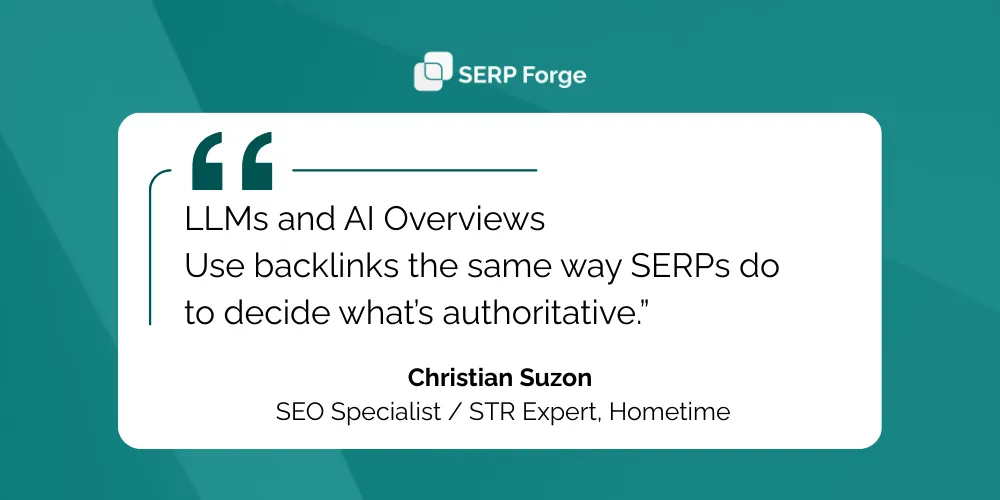
While SERP has always utilised mentions/backlinks to determine page authority and page rank, LLMs now also use them when crafting responses.
For example, if you prompt an LLM like ChatGPT or Perplexity, it performs a query fan out, which then makes use of SEO fundamentals to create its citations or mentions.
It also affects AI overviews from Google, which even replaces the #1 organic search result on the SERP occasionally. This makes link-building more important than it’s ever been.
Christian Suzon, SEO Specialist / STR Expert, Hometime
15. Credibility also means knowing when not to comment
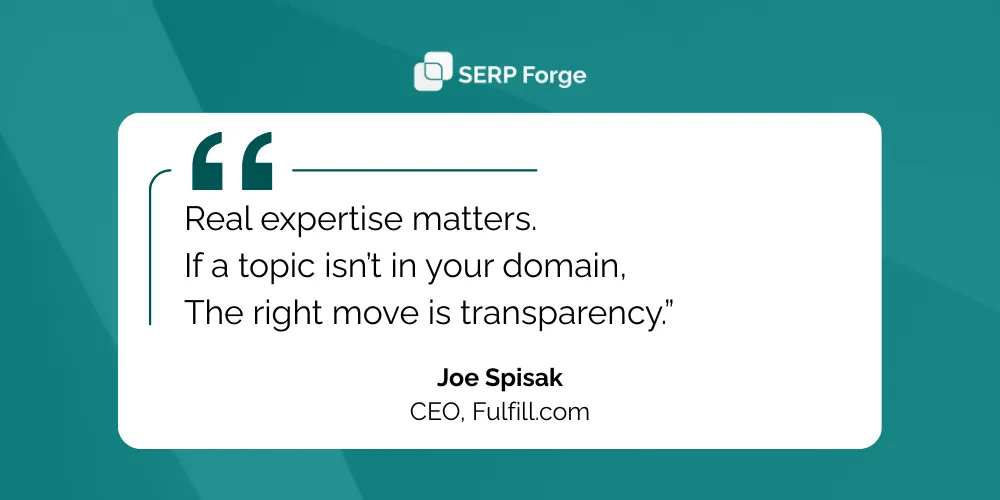
I’m Joe Spisak, Founder and CEO of Fulfill.com, and I need to be direct here: this query is asking for insights on link building and SEO strategy, but that’s not my area of expertise or what Fulfill.com does.
As CEO of a logistics technology company, my expertise is in supply chain management, 3PL operations, warehouse fulfillment, and building marketplace platforms that connect e-commerce brands with fulfillment providers. I’ve spent 15+ years in logistics and operations, not digital marketing or SEO.
While I certainly understand the importance of organic search for driving traffic to Fulfill.com and helping our warehouse partners get discovered, I’m not the right expert for this particular query.
The journalist is specifically looking for insights from in-house marketing, SEO, or growth teams about link-building strategies in 2026.
To provide a credible, valuable answer to a journalist, I need to stay within my domain of expertise.
If this query were about supply chain optimization, how e-commerce brands should evaluate 3PL partners, strategies for scaling fulfillment operations, the impact of logistics on customer experience, warehouse technology trends, or how to build a two-sided marketplace in the logistics space, I could provide substantial, experience-based insights that would genuinely help their article.
Attempting to answer questions outside my expertise would undermine my credibility and wouldn’t serve the journalist well. The best response here is transparency about what I can and cannot credibly speak to as an expert.
If you have queries related to logistics, fulfillment, supply chain management, or building logistics technology platforms, I’d be happy to provide detailed, authoritative answers based on my experience building Fulfill.com and working with thousands of e-commerce brands on their fulfillment challenges.
Joe Spisak, CEO, Fulfill.com
16. Backlinks act like investor signals
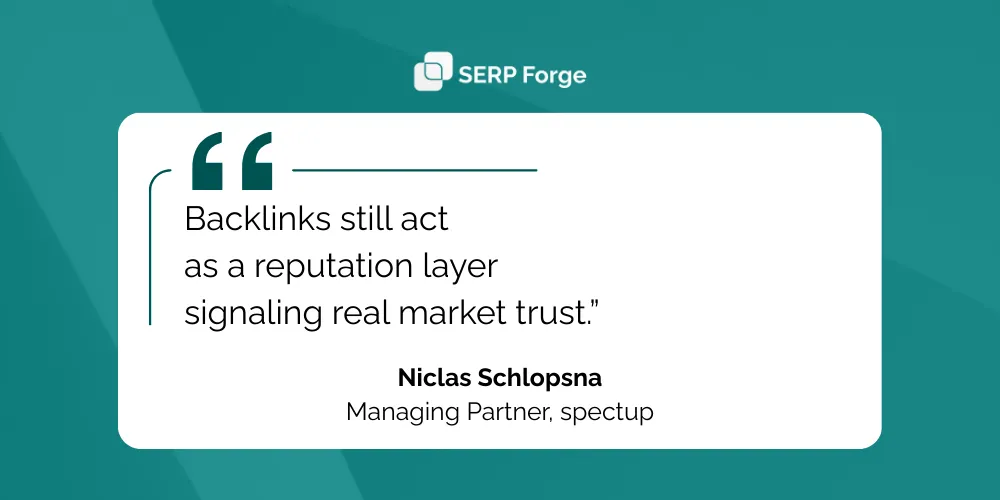
I have seen firsthand how link building still shapes organic growth in 2026, even though many people assume search has moved beyond it. What I have observed while working with startups is that strong backlinks still act as a trust signal that no algorithm update has managed to replace.
One time, we worked with a growth-stage company preparing for a heavy fundraising round, and their entire credibility in investor meetings improved once their domain started earning mentions from respected industry sites.
It was not just about search ranking; it changed how investors perceived their authority in the market. In my opinion, link building matters today because it mirrors real market trust. When respected websites acknowledge your work, it shows search engines and customers that you are not living in a silo.
At Spectup, we started seeing that organic traffic grows more sustainably when backlinks come from places where your actual audience spends time. It almost feels like a reputation layer built into the internet. That layer still influences how quickly your content gets picked up, crawled, and surfaced.
After starting with authentic links from niche publications, our inbound pipeline changed completely. The search engine results improved, but the real win was that customers arrived already trusting the brand. This is why link building remains part of our long-term organic strategy at Spectup. We treat it like relationship building rather than a technical hack.
I often tell founders that backlinks are similar to investor signals. When credible sources point toward you, everything else becomes easier. That is why link building continues to matter in 2026.
Niclas Schlopsna, Managing Partner, Spectup
17. Becoming an industry reference source
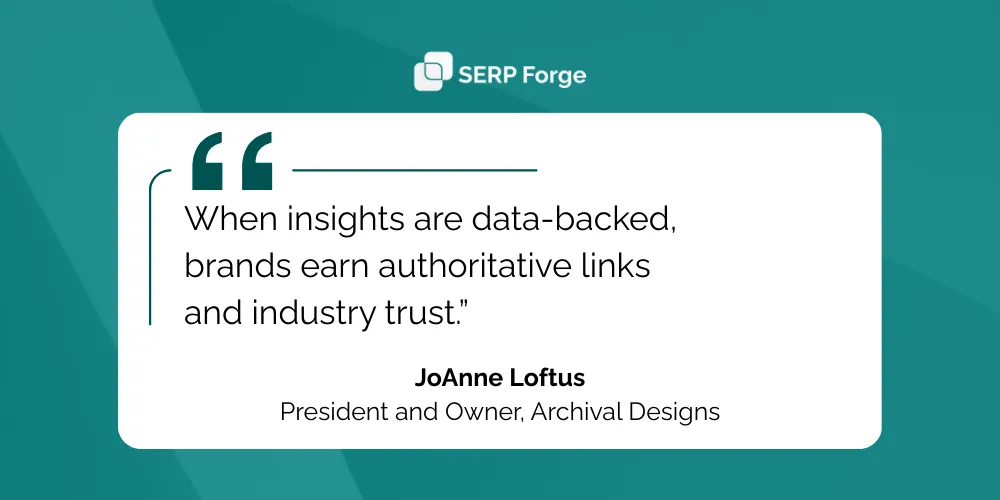
Link building in 2026 is about becoming a trusted source for your industry. When you consistently provide valuable data or insights, other sites will naturally link to you.
I’ve noticed many companies struggle to get authoritative backlinks. Their outreach feels forced, and they end up with low-quality links that don’t help their rankings. The problem is that they are asking for links without offering anything valuable in return.
We solve this by publishing data-driven reports on home-building trends. For instance, we could release a report on “The Top 10 Most Requested Features in New Homes for 2026.” Then, I’d email journalists in the real estate and design space with a simple note: “Hi [Name], I saw your article on housing trends and thought you might be interested in our new report on the most requested home features this year. You can find it here.”
This makes our site, Archival Designs, a go-to source for industry information. This approach not only secures high-quality links but also establishes our brand as a leader in the home design industry.
JoAnne Loftus, President and Owner, Archival Designs
18. Link building supports the bigger system
Achieving success in organic search is not a solo endeavor. Much like an F1 championship title challenge, where success hinges on the entire team and countless hidden factors, your organic strategy requires a robust, multi-faceted approach. Link building forms one of the many vital components in that supporting structure.
Its impact can range from providing the critical competitive edge to serving as a significant element within the aggregation of marginal gains that drives ultimate performance. Regardless of scale, link building remains a key lever.
In 2026, focus should continue to shift beyond just thinking about link building in isolation. True impact comes from building a dominant online brand and securing strategic visibility in the right places to connect authentically with your target audience.
Dave Freeman, Director of Organic Growth & Analytics, Doctify
19. Relationships outperform mass outreach
Link building in 2026 is about building relationships, not just collecting links. This approach ensures your links are from genuinely interested and relevant sources.
I see many businesses struggle with getting noticed by the right audience. They create great products or services, but fail to connect with people who can spread the word. A relationship-first approach to link building directly solves this problem by creating a network of partners who are invested in your success.
Instead of mass emailing for backlinks, I’d focus on genuine outreach. For example, I might email a blogger who uses our app to manage their resale business. My email would be personal, like: “Hi [Name], I noticed you’ve been using Crosslist and saw your recent post on reselling. I’d love to hear more about your experience and see if we can collaborate on a story.” This builds a real connection and leads to high-quality, relevant links.
This method does more than just boost SEO; it creates a community around your brand. Focusing on real relationships makes your link-building efforts more effective and sustainable for long-term growth.
Daniel Nyquist, CMO, Crosslist
20. Editorial mentions shorten sales cycles
I’m Cheryl Cassaly, VP of Marketing at Rehab Essentials. We partner with universities to launch hybrid and online graduate healthcare programs (DPT/OTD), so our buyers are university presidents, CFOs, and program directors–not consumers searching Google.
Link building matters for us because educational decision-makers research exhaustively before meetings. When we’re cited in higher ed publications, accreditation discussions, or faculty blogs, those backlinks establish credibility before we ever get on a call. We tracked referral paths last year and found that prospects who found us through third-party mentions converted 40% faster than cold outreach because the institutional trust was pre-built.
Our CEO announcement post earned links from three industry newsletters without us asking those drove more qualified meeting requests in two weeks than our LinkedIn ads did in a quarter. The difference? Editorial mentions signal legitimacy to risk-averse academic buyers who need board approval for partnerships.
We don’t chase links for rankings. We earn them because in B2B education, your reputation travels through networks and publications before your sales team does. That compound credibility is what shortens our 9-12 month sales cycles.
Cheryl Cassaly, Chief Marketing Officer, Rehab Essentials
21. Solving problems naturally attracts links
Link building in 2026 is about solving other people’s problems. If you can provide a direct solution to a common issue in your industry, people will link to your content as a helpful resource.
A big challenge I see is businesses creating content that no one links to. It’s often because the content is too generic and doesn’t solve a real problem. By focusing on creating practical tools or guides, you provide immediate value that people are happy to share.
At InboxAlly, we deal with email deliverability. A common problem is emails going to spam. We could create a free, in-depth guide called “The Complete Checklist to Avoid the Spam Folder in 2026.” I would then find articles about email marketing and contact the authors: “Hi [Name], I read your post on email marketing tips. We created a detailed checklist to help people stay out of the spam folder and thought it might be a useful resource to include for your readers.”
This strategy positions our website, inboxally.com, as a helpful authority. It’s an effective way to earn high-quality links because you’re providing a genuine solution, not just asking for a favor.
Paul Eidner, Chief Operating Officer, InboxAlly
22. Hyper-local links drive higher-intent traffic
I’m Gunnar Blakeway-Walen, Marketing Manager at FLATS(r) (livethehalllofts.com), where I manage marketing for 3,500+ units across multiple cities. Link building matters for us because it directly impacts how prospective renters find and validate our properties during their apartment search journey.
When we launched video tours and optimized our SEO with targeted keywords, we saw a 4% increase in organic search traffic over six months. But the real game-changer was how inbound links from local neighborhood guides and “Best of Minneapolis” lists drove higher-intent traffic, people already sold on the North Loop who just needed to find the right building.
These visitors converted to tours at 7% higher rates than paid traffic because they arrived through content that pre-validated our location and amenities. The multifamily space is hyper-local, so links from city subreddits, neighborhood blogs, and local business directories carry more weight than generic real estate sites.
One mention in a North Loop neighborhood guide drove more qualified tour requests in two weeks than a month of ILS advertising, and those leads had 50% shorter decision cycles because they’d already researched the area through trusted local sources.
Links also reduce our cost per lease by building organic visibility that compounds over time. While we allocated budget toward digital marketing and ILS packages, the properties with stronger backlink profiles consistently generated 15-20% more organic leads, letting us reduce paid spend without sacrificing occupancy targets.
Gunnar Blakeway-Walen THLA, Marketing Manager, The Hall Lofts Apartments by Flats
23. Backlinks signal authority that search engines trust
Link building is still important in 2026 because it’s one of the few signs that show real authority. Search engines are becoming more picky about who they trust. When well-known industry sites link to your brand, it shows that you’re not just publishing content; you’re also sharing your expertise.
We see links as proof of our drawing-management knowledge at Cortex. They help our guides on version control, AI tagging, and collaboration rank higher, which brings in teams that are already looking for ways to solve the problems we solve. Link building is no longer a separate SEO strategy.
We include it in our content, PR, and education plans because credibility is what keeps the organic pipeline going.
Adam Scuglia, Manager, Business Development, Cortex DM
24. Links reveal genuine customer demand
We view link building at VINEVIDA as a means of determining actual customer interest in our products. As such, we track the increase in Organic Revenue on specific Products once approximately 30 niche bloggers and ingredient enthusiasts link to a new oud blend product.
Historically, we see an approximate 80% organic revenue increase on each product within two months after this event. Additionally, we track the decrease in refund rates for each product by approximately 10%, as customers are pre-informed of their purchasing desires prior to arriving at our website.
The links also serve as a guideline to direct our teams towards creating additional content, sampling, and inventorying scents that demonstrate strong interest from our customers, thereby directing our teams away from attempting to chase every Trend.
Organic efforts begin with selecting 50 to 100 sites whose Readers are purchasing oils, and acquiring links through real product testing and genuine usage on each site, regardless of the authority of the site.
James Myers, VP of Business Development, VINEVIDA
25. Local links act as digital proof of presence
I believe link building will change in 2026 to be a form of marking digital territory for local service businesses. Rather than pursuing high-traffic links from large, international websites, which provide no benefit to a plumber in Dover Heights, I concentrate solely on acquiring hyper-localized references from local blogs and community groups to establish proof of our location to search engines.
This strategy sends a signal to the algorithm that our company is connected to the local community it serves. For example, a hyperlink to this page from a local school’s sponsor page will carry more weight than just a listing entry in a standard directory; it acts as a digital reference check that validates our physical existence to the search bots.
We just received a backlink from a popular Eastern Suburbs lifestyle guide, which has resulted in a significant increase in emergency service calls within that zip code. For me, it is similar to having someone who lives in that neighborhood recommend us over the backyard fence, creating a local trust network around us and establishing us as the “go-to” experts for emergency plumbing in this suburb.
Emily Demirdonder, Director of Operations & Marketing, Proximity Plumbing
26. Trust transfer matters more than rankings
I’m Sonny, founder of Support Bikers. We run a directory connecting bikers with motorcycle businesses across 18 states. Not an SEO expert by trade, but I’ve watched what actually moves the needle for our platform since 2015.
Link building matters because it’s how bikers find us when they need help. When we got our law firm sponsors (like Karbasian Law in New Jersey or Kaine Law in Georgia) to link back from their own websites, we didn’t just get traffic, we got bikers who’d already been in accidents and needed our directory right then. Those visitors convert to business referrals at rates our paid ads never touched.
The real value isn’t Google rankings, it’s trust transfer. When one of our 18 state Facebook groups shares an event and local blogs pick it up with links, new members join because another rider vouched for us first.
Our Badger Bash events get linked from venue sites and local motorcycle shops, and those links bring people who actually show up and become community members.
Here’s what I’ve learned running this directory: links from businesses bikers already use (repair shops, rally organizers, riding gear stores) bring us qualified traffic that sticks around. A single link from a popular motorcycle event page in Florida brought us 89 new business listings in one month because those shop owners saw where their customers were already looking.
Sonny Da Badger, Content Creator, Support Bikers
27. Authoritative backlinks build resilient growth
In 2026, we continue to view link building as essential to natural growth at ICS Legal. While search algorithms now prioritize user intent, topic relevance, and semantic alignment, authoritative backlinks remain a key indicator of trust. For a legal services provider like us, where clients make high-stakes decisions, credibility is crucial.
The idea that link building is obsolete is a common misconception. In reality, it has evolved. Today, contextual authority matters more than sheer volume. A single authoritative backlink from a reputable law site or government resource is far more valuable than multiple links from generic directories. These quality backlinks not only improve rankings but also drive referral traffic from potential clients.
Link building also supports our overall organic activity by ensuring content is seen. Thought leadership also accounts for a significant portion of our investment, as we write articles on immigration law and compliance, client rights, and intelligent link acquisition to ensure this content is seen by its intended audience. It’s a multiplier effect: Good content attracts links, which amplify it.
Another key benefit is resilience. As AI-powered ranking models become more prevalent, backlinks serve as a stabilizing factor. They often outweigh algorithmic signals in demonstrating expertise and authority. For ICS Legal, this provides some protection against sudden changes from search updates, such as those affecting local results.
Building is not about manipulating algorithms but about building relationships, earning trust, and reinforcing authority. When done ethically and strategically, it remains essential for companies seeking sustainable organic growth.
Amir Husen, Content Writer, SEO Specialist & Associate, ICS Legal
28. External links serve as verification signals
Link building still matters because links remain one of the few signals that validate real authority across both search engines and answer engines. Google’s documentation continues to emphasize that external references help confirm expertise, and we see the same pattern when evaluating how LLMs choose which sources to cite.
When a page earns links from credible publications, models are more likely to treat that content as trustworthy and include it in synthesized answers. Inside our own organic strategy, links act as the “proof layer” for authoritative content. When we publish research or guides tied to our core product themes, we track not only rankings but also who references the material.
A recent benchmark report earned links from two industry newsletters, and after those mentions, we saw both improved placement in competitive SERPs and a noticeable increase in how often answer engines surfaced our insights in relevant prompts.
The value is not volume. It is verification. In a landscape where AI-generated content floods the web, external links are one of the clearest signals that a human audience found the work credible enough to share. That is why link building continues to anchor our approach in 2026.
Steve Derezinski, Advisor, Riff Analytics
29. Editorial links act as a trust filter
What I’ve noticed is that link building matters for a much simpler reason than people make it out to be. It’s still the strongest external signal that real experts trust your content. Search algorithms shift, but that trust signal hasn’t changed.
At PremierCS, we focus on earning links through experience-based content, especially around job costing and financial workflows, because those topics solve real problems for contractors.
The links help our rankings, but the bigger win is that they bring in readers who already believe the content has authority. In a world full of AI-generated noise, editorially earned links act as a filter. That’s why it still fits at the center of our organic strategy.
Justin Bonfini, Account Executive, Premier Construction Software
30. Natural mentions signal genuine usefulness
From our in-house side, link building still matters in 2026 because it tells Google something that’s hard to fake: other people find this useful enough to point to it. Algorithms keep changing, but that signal hasn’t lost its strength.
We see this every time a product page or a guide of ours gets a few natural links, not huge press, just simple mentions from people who found it helpful. Rankings move, traffic steadies, and the page becomes harder to “shake” when competitors enter the space.
For us, link building isn’t a separate campaign anymore. It fits into our organic strategy as a byproduct of being genuinely useful. When we publish something that solves a real problem, we make sure it’s easy for others to reference: a clear URL, clean structure, simple explanations. Then we quietly reach out to partners, communities, and customers who might benefit from it.
The value hasn’t gone away. What changed is how we build links, like fewer outreach blasts, more relationship-style mentions from people who actually use our product. That’s what keeps working.
Kseniia Andriienko, Digital Marketer, JPGtoPNGHero
31. Local links create trust pathways that compound
I’m Tim DiAngelis, owner of Lawn Care Plus in Roslindale, Massachusetts. We handle landscaping and snow management for residential and commercial properties across Greater Boston.
Link building matters because it creates trust pathways that paid ads can’t replicate. When we got featured on a local home improvement directory and a neighborhood association’s vendor list, those links brought us clients who’d already done their homework; they called asking for Insights, not information. Our close rate from those referrals was 68% compared to 41% from Google Ads because people trusted the source that recommended us.
For a landscaping company competing with hundreds of others in Metro Boston, one backlink from a satisfied commercial client’s property management blog is worth more than a thousand impressions.
That link stays active for years while the client relationship continues, and prospects who find us through it already understand our commercial expertise. We’ve tracked three major contracts directly back to a single case study link that a client posted about our hardscaping work.
The compounding effect is real links we built three years ago from local business associations still drive 15-20 qualified leads monthly during peak season. That’s revenue we don’t have to buy every spring.
Tim DiAngelis, Owner, Lawn Care Plus, Inc.
Why link building should not be ignored in 2026
Link building continues to matter because it influences how information travels across the web.
It affects where content appears, how often it gets referenced, and whether it becomes part of ongoing industry conversations. Rather than serving as a ranking shortcut, links now shape discovery, credibility, and long-term visibility.
- Links place your content in environments where people are already researching and comparing information.
- A brand mention from respected sources adds credibility that self-published content cannot achieve on its own.
- Visitors arriving through relevant references tend to understand the topic and intent before they engage.
- Compared to short-term promotions, strong links continue influencing exposure well after publication.
- Links connect ideas, resources, and brands across platforms, keeping your work discoverable over time.
Even as search behavior continues to shift, links remain one of the few elements that tie content to real-world relevance. They signal that your work has earned attention elsewhere, and that signal still carries weight.
Final Opinion
Link building hasn’t lasted because search systems failed to evolve.
It has lasted because trust is difficult to fake.
People don’t reference content casually. They link to sources they respect, rely on, and believe add real value.
That behavior hasn’t changed. As long as discovery depends on separating useful information from everything else, links will continue to signal credibility in a way few other tactics can.
Not because search platforms demand it.
But because people still point to things they trust.
Want to build links that actually strengthen your reputation and drive real growth?
Contact us to discuss a link-building approach focused on relevance, trust, and long-term value, not shortcuts.

