



An AI SEO agency is a marketing partner that improves how your brand appears in AI-generated answers from tools like ChatGPT, Perplexity, Gemini and Google AI Overviews, as well as in classic search results. The same work is also called generative engine optimization (GEO), answer engine optimization (AEO) or AI search optimization.
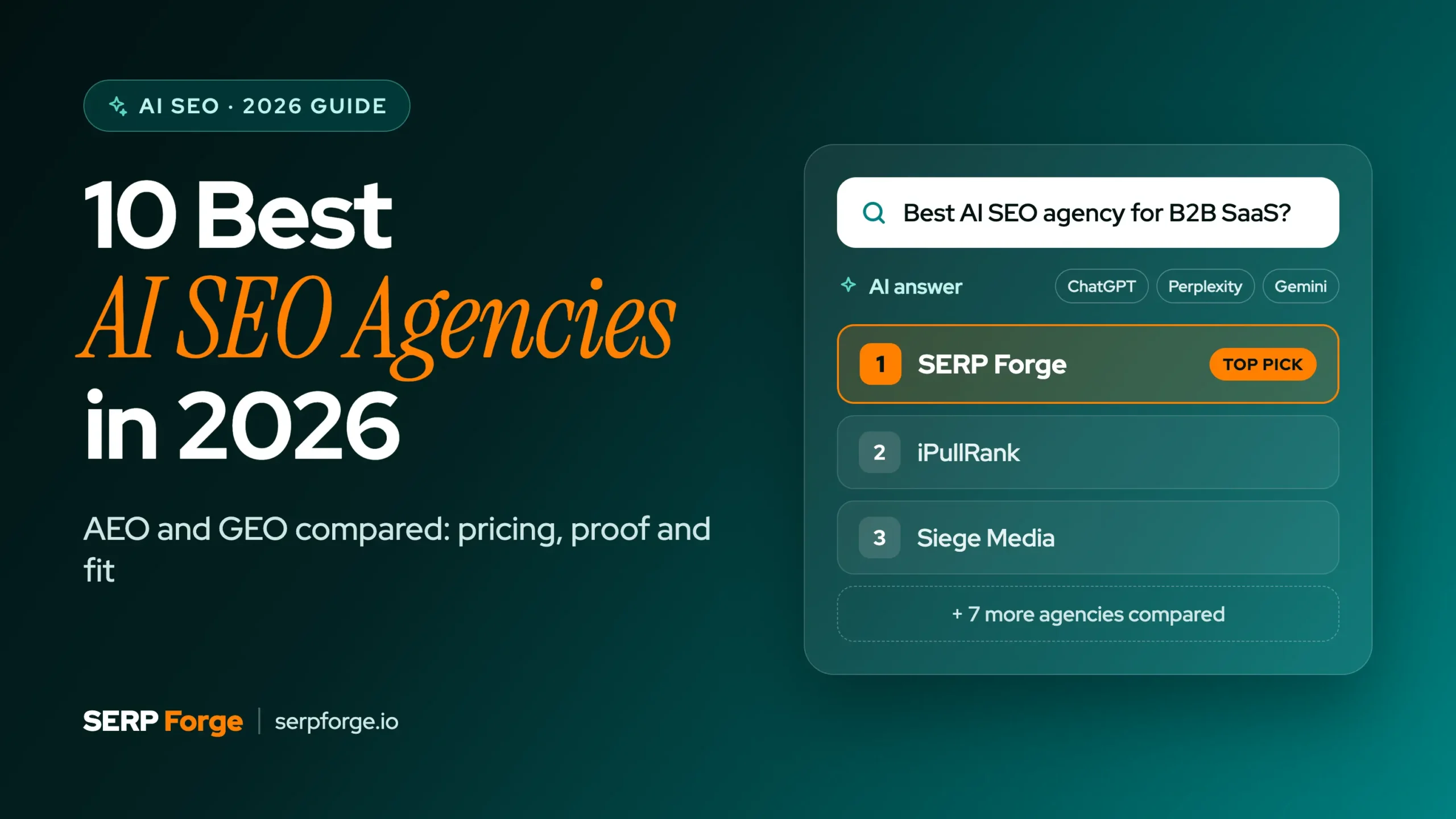
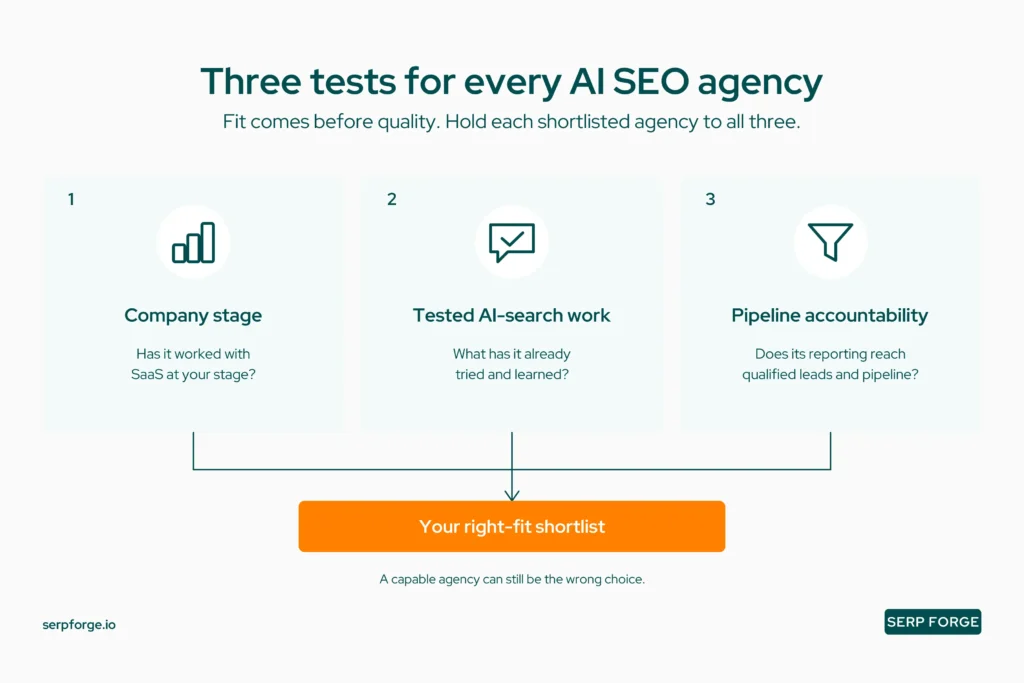
For enterprise SaaS, the right agency is the one that fits your company stage, can show AI-search work it has already tested, and reports all the way to qualified leads and pipeline. This guide gives you those criteria, the questions to ask, and the red flags to avoid. It does not rank agencies. If you want a ranked list, see our best AI SEO agencies roundup.
Key takeaways
- Choose on fit first: company stage, tested AI-search work and pipeline accountability.
- AI SEO builds on SaaS SEO. It does not replace it.
- No agency can guarantee that ChatGPT or Google will recommend your brand.
- Good reporting goes from visibility to visits, leads, qualified leads and pipeline.
A note on where we stand. SERP Forge is a SaaS marketing agency that combines SaaS SEO, AI SEO, content and paid acquisition, with the aim of turning search and paid visibility into qualified leads and a more predictable pipeline. We use our own model as one example, not as a verdict. Every question in this guide applies to us as well.
Which agencies handle AI search optimization for enterprise SaaS?
Three kinds of agencies do this work. They are not interchangeable, and a ranked list will not tell you which one fits your company.
- Specialist GEO consultancies. Narrow focus on AI answers, often research-led. Good for audits and one-off questions.
- SEO agencies that added AI search. Strong on technical SEO and content, with AI search as an extra service line.
- Full-service SaaS marketing agencies. Run organic, AI search and paid acquisition as one plan, with one team accountable for pipeline.
How do you assess AI SEO agency fit for SaaS growth?
Choosing an AI SEO agency is a fit decision before it is a quality decision. A capable agency can still be the wrong choice if it has never worked at your stage, cannot show tested AI-search work, or reports on activity instead of pipeline. Those three criteria, company stage, demonstrated AI-search capability and pipeline accountability, are the ones to hold every shortlisted agency against.
1. Start with your company stage
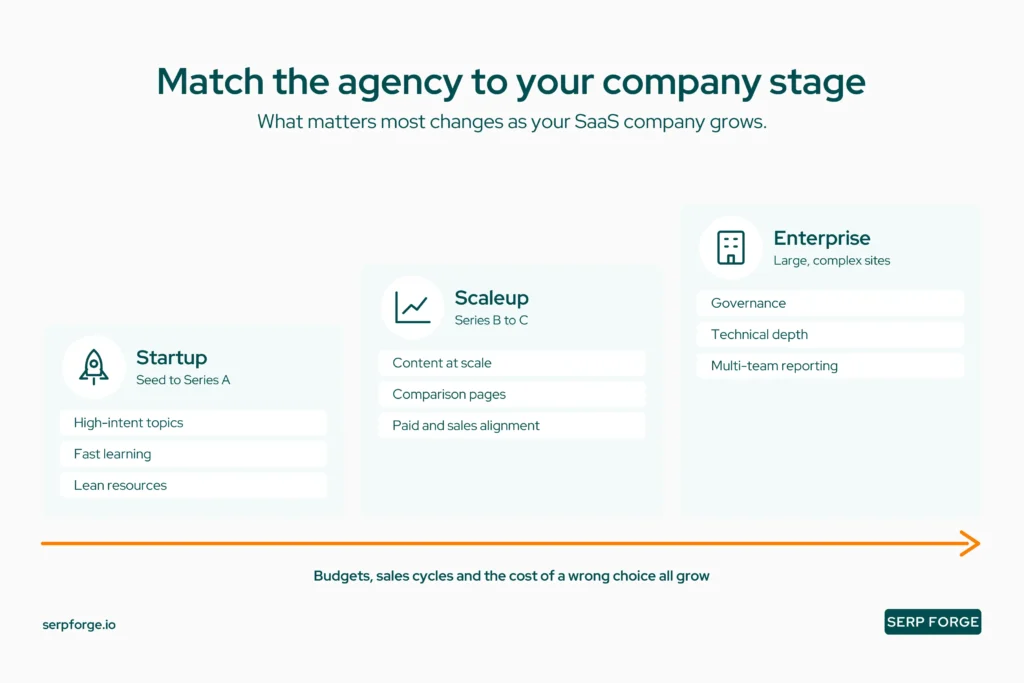
The right agency for a seed-stage startup is rarely the right one for a public SaaS company. Budgets, sales cycles, internal resources and the cost of a wrong decision all change as you grow. Use this table as a starting point.
| Company stage | What usually matters most | What to ask the agency |
|---|---|---|
| Startup (seed to Series A) | A few high-intent topics, fast learning, and a team that works with limited content and engineering resources | Which pages would you build first, and why? How do you work when we have no dedicated SEO hire? |
| Scaleup (Series B to C) | Scalable content production, comparison and product pages, and coordination with paid and sales | How do you prioritize across a large keyword set? How does your reporting reach our sales and revenue teams? |
| Enterprise | Process, governance, technical depth on large sites, and reporting for many stakeholders | How do you work with our engineering, legal and brand teams? How do you handle site-wide changes and approval cycles? |
Treat the table as a conversation starter, not a rule. Some enterprise buyers want a lean specialist team, and some startups need a full-service partner. What matters is that the agency can explain how its way of working matches your situation, and can point to relevant SaaS experience, not just general SEO experience.
2. Look for tested AI-search capability
AI search is new enough that most agencies are still learning what holds up. That makes “tested” the key word. Before asking what an agency can do, ask what it has already tried and what it learned.
Evidence of tested work can include:
- A documented method for choosing the questions and prompts to track, and how often they are re-checked
- Examples of changes made to pages or content, and what was observed afterward, including results that did not go as hoped
- A clear account of what the agency cannot control, such as how a given AI platform chooses its sources
- Named people who do the work, and how they keep up as AI answer experiences change
Be careful with polished case studies that show only a rise in “visibility” and never explain how it was measured. Ask what was changed, what was tracked, and over what period.
It also helps to ask for a live walkthrough instead of a slide deck. Have the agency show how it tracks prompts, how it records which sources AI answers cite, and how it decides what to change next. People who do the work every day can usually show it without much preparation, and the way they talk about mistakes and limits tells you a lot.
3. Ask how reporting connects to pipeline
For a SaaS company, search and AI-search work matters only if it contributes to qualified leads and pipeline. A useful report follows the whole chain: visibility, visits, leads, qualified leads, and finally pipeline. A report that stops at the first or second link tells you very little about business impact.
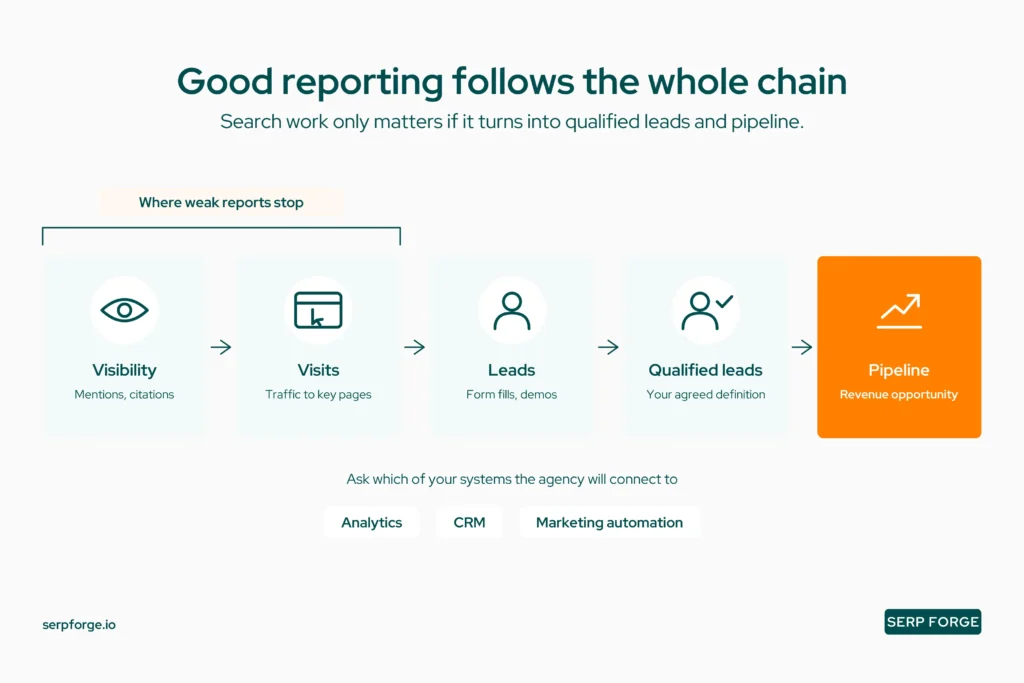
Ask each agency:
- How do you define a qualified lead with us, and who signs off on that definition?
- Which of our systems will you connect to, such as analytics, your CRM and marketing automation?
- How do you handle traffic from AI platforms that is hard to attribute, and which assumptions do you state openly?
- Which metrics will you report, and which outcomes will you refuse to promise?
An agency that is open about attribution limits is usually easier to work with than one that claims perfect tracking. AI-search measurement is imperfect, and a good partner says so.
Where does SERP Forge fit?
SERP Forge is a SaaS marketing agency covering SaaS SEO, AI SEO, content, growth and paid acquisition. It works with SaaS companies from startup through enterprise, mainly in the US, UK, Australia and Canada. The model is to run organic, AI search and paid acquisition as parts of one plan, so that search and paid visibility turn into qualified leads and a more predictable pipeline instead of three separate reports.
That breadth suits some buyers and not others. If you want a single standalone GEO audit, or a specialist research partner for one narrow question, a smaller specialist may be a better match. If you want one team accountable across organic, AI search and paid, a combined model is worth a conversation. Either way, hold us to the same questions listed above.
Combining channels is not automatically better, so ask how it works in practice. Paid campaigns can show which queries and messages bring in qualified buyers, and that can inform which topics organic and AI-search content should cover first. Organic and AI-search work can, in turn, support the pages that paid traffic lands on. Ask any agency offering this model to show where those links happen in its process, and who is responsible for them.
How do you compare agency working models?
Two agencies with the same method can be very different to work with. Compare scope, team and cadence before you compare price. Ask what the fee includes, who does the writing and technical work, how often you will meet, and how decisions get made when the data is unclear. For enterprise teams, also ask how the agency handles approvals, security reviews and handoffs to your engineering and brand teams, since those often set the real pace of the work.
Contract terms matter too. A short scoping or audit phase before a longer commitment lets both sides test the fit at low risk.
Red flags to watch for
- Guarantees of rankings, citations or recommendations in AI platforms
- No SaaS clients or references at your stage
- Reports built on traffic and rankings with no link to leads or pipeline
- A method that cannot be explained in plain language
- Pressure to sign a long contract before any scoping or audit
A simple 5-step shortlisting process
- Write down your stage, target markets, sales motion and what a qualified lead means for you.
- Shortlist three to five agencies with relevant SaaS experience.
- Ask each one for evidence of tested AI-search work and an explanation of how outcomes are measured.
- Ask for a sample report, with client details removed, that shows how reporting reaches pipeline.
- Compare the proposals on method and accountability, not price alone.
Following these steps takes more effort than reading a “best agencies” list. It also gives you something a list cannot: a side-by-side view of how each agency would actually work with your team, and what it would be accountable for.
What does AI search optimization work involve?
The labels vary. Some agencies say AI SEO, some say GEO, and others say AI search optimization or answer engine optimization for much the same activity. Do not choose on terminology. Choose on whether the agency can describe the work it actually does.
For SaaS companies, this work builds on SaaS SEO instead of replacing it. Pages that are easy to find, crawl and understand help in both classic search results and AI answers. The added layer is how your brand is described, compared and cited across the sources AI platforms draw on.
How is AI SEO different from traditional SaaS SEO?
The two overlap, but the emphasis shifts. Traditional SEO aims to rank pages for queries. AI-search work also asks whether your brand is mentioned, how it is described and which sources are cited when an AI system answers a question. That changes what an agency should examine:
| Traditional SaaS SEO | AI SEO / GEO | |
|---|---|---|
| Main goal | Rank pages for search queries | Get the brand mentioned, described correctly and cited in AI answers |
| Focus | Keywords on your own pages | Brand and product descriptions across your site and third-party sources |
| Key queries | Keyword rankings | Comparison and “best for” prompts, where AI answers name several vendors |
| Tracking | A single ranking position | Samples across platforms and prompts, since results vary |
What work should an AI SEO agency do?
A good first question to put to an agency: which types of content do you produce for clients, and why those? An agency should be able to name its content types, explain the reasoning, and say how each one is expected to help.
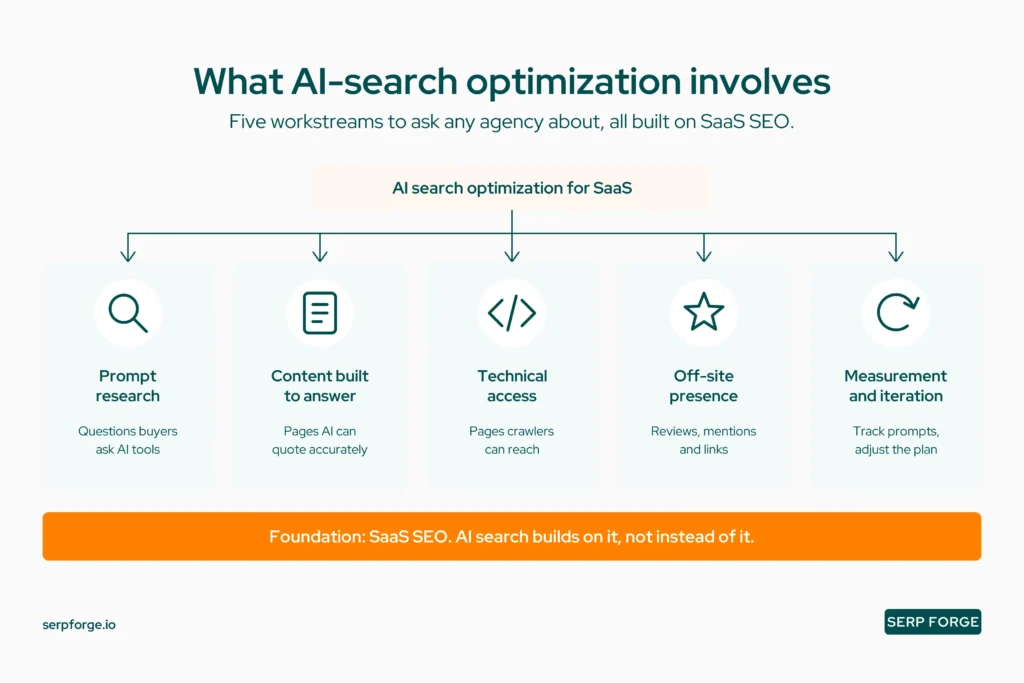
In practice, AI search optimization for a SaaS company usually draws on some mix of the following:
- Question and prompt research. Identifying the questions your buyers ask AI tools at each stage, from problem awareness to vendor comparison, and tracking whether and how your brand appears.
- Content built to answer. Pages that state clearly what the product does, who it is for, how it compares with alternatives and how pricing works, in language that a person or an AI system can quote accurately.
- Technical access. Making sure key pages can be crawled, render properly and are structured so their meaning is clear, including checking what AI crawlers can and cannot reach.
- Off-site presence. Third-party mentions, reviews, directories, community discussions and relevant links, since AI answers often draw on sources beyond your own site. SaaS link building and digital PR often sit here.
- Measurement and iteration. Tracking an agreed set of prompts over time, reviewing which pages and sources are cited, and adjusting the plan based on what the data shows.
At SERP Forge, AI SEO and generative engine optimization sit within the wider SaaS approach to search visibility and lead generation. In practice, the same team looks at technical foundations, content, off-site signals and paid acquisition together, instead of treating AI search as a separate project.
What questions should you ask an AI SEO agency?
When an agency explains its approach to appearing in AI answer experiences, ask it to cover these points:
- How do you decide which questions and topics to target for a SaaS company like ours?
- What would the first phase of work include, and what would you check at the end of it?
- How do you evaluate whether the work is having an effect?
- Which parts depend on third-party platforms that you do not control?
- What would you stop doing if the data did not support it?
- Who on your team does the work, and who will we speak to week to week?
Clear, specific answers matter more than confident ones. An agency that can walk you through its process, including where it is uncertain, has probably done the work before. An agency that answers every question with “it depends” and never gets more specific has probably not.
How should you judge an agency’s workflow and measurement?
Assess the proposed workflow and how it is measured, not the promise of results. No agency can guarantee that an AI platform will recommend your brand or that a page will rank. AI answers can differ between platforms, between users, and even between repeated runs of the same question. That variability is exactly why the design of measurement matters.
Good measurement tends to have these features:
- A fixed, agreed set of prompts and topics, reviewed on a regular schedule
- Tracking across more than one AI platform, since behavior differs between them
- A clear separation between visibility signals, such as mentions and citations, and business signals, such as qualified leads and pipeline
- Honest notes on what cannot be attributed
- A review rhythm in which findings change the plan
Weak measurement is just as easy to spot: a single screenshot of a favorable AI answer, a dashboard that reports only impressions, or a number with no definition behind it. If an agency cannot explain how a figure was produced, treat the figure with caution.
What does a sensible first phase look like?
Without promising an outcome or a timeline, a first phase usually sets the foundations. Expect:
- A baseline of how your brand appears today for an agreed set of prompts
- A technical and content review of your key pages
- A prioritized list of pages and topics
- A measurement setup that connects to your analytics and CRM
If a proposal skips the baseline, you will have nothing to compare later results against. If it skips the link to your CRM, you will struggle to connect the work to pipeline.
Frequently Asked Questions
When should a SaaS company hire an AI SEO agency?
Hire one when your buyers already research your category in AI tools and your brand is missing or described wrongly in those answers, or when your team lacks the time or skills to track prompts, fix content and build off-site presence. If your basic SaaS SEO is weak, fix that first, because AI search builds on it.
What is the difference between a GEO agency and an SEO agency?
A traditional SEO agency mainly works on getting pages to rank for search queries. A GEO agency also looks at whether AI systems mention your brand, how they describe it and which sources they cite. For SaaS companies the two overlap a lot, because pages that are easy to crawl and understand help in both places. Many agencies now offer both.
How do I choose an AI SEO agency for an enterprise SaaS company?
Check every agency on three things. First, has it worked with SaaS companies at your stage? Second, can it show AI-search work it has already tested? Third, does its reporting go all the way to qualified leads and pipeline? Enterprise buyers should also ask how the agency works with engineering, legal and brand teams, and how it handles approvals for changes across the whole site.
Can an AI SEO agency guarantee that ChatGPT or Google will recommend my brand?
No. AI answers change between platforms, between users and even between two runs of the same question. No agency controls how an AI platform picks its sources. If an agency guarantees rankings, citations or recommendations, treat that as a red flag. Ask how it measures progress instead.
How do you measure the results of AI search optimization?
Good measurement starts with a fixed set of agreed prompts that you check on a regular schedule across more than one AI platform. It keeps visibility signals, such as mentions and citations, separate from business signals, such as qualified leads and pipeline. It is also honest about what can’t be attributed, because traffic from AI platforms is often hard to track.
So, which AI SEO agency is right for you?
The agencies that handle AI search optimization for enterprise SaaS differ in size, focus and method, so the useful question is which one fits you. Start with your company stage. Ask for tested AI-search work and a plain account of how it is measured. Check that reporting reaches qualified leads and pipeline, and be wary of anything that sounds like a guarantee. Then compare the working model, including scope, team and review cadence, because that is what you will live with after the contract is signed.
If you want to see how SERP Forge approaches this, you can review our AI SEO service or our SaaS SEO service, then bring the questions from this guide to a conversation. We would rather be compared on evidence than chosen on claims.