


What makes SaaS sales different when revenue depends on renewal, adoption and expansion?
SaaS sales is the process of converting software buyers into recurring-revenue customers through discovery, product proof, consensus building, pricing, onboarding and expansion. A deal only becomes valuable when the customer adopts the product, renews and grows the account over time.
That is why modern SaaS sales teams need more than outreach and demos. They need better qualification, CRM data that supports decisions, buyer enablement, accurate forecasting and a handoff that protects retention.
In 2026, this is harder because buyers research more on their own, buying committees are larger and reps are under pressure to spend less time on administration.
How Is SaaS Sales Different From Traditional Sales?
Traditional software sales often centres on the first purchase, while SaaS sales carries revenue responsibility across adoption, renewal and expansion.
A poor-fit customer may increase bookings this quarter and create churn later. A better SaaS deal brings in a customer that can adopt the product, recover acquisition cost and expand usage.
The table below shows where SaaS sales changes the revenue logic compared with a traditional software sale:
| Area | Traditional Sales | SaaS Sales |
|---|---|---|
| Revenue model | Often one-time purchase | Recurring subscription revenue |
| Sales goal | Close the deal | Close revenue that can retain |
| Buyer proof | Pitch, proposal or demo | Demo, trial, product proof and onboarding path |
| Revenue risk | Lost deal | Poor-fit customer and churn |
| Data needed | Contact and deal data | CRM, product usage, billing and renewal data |
| Growth path | New customers | New customers, renewals and expansion |
This is why SaaS sales metrics need to go beyond lead volume or closed-won revenue. Teams need to track pipeline quality, win rate, sales cycle, customer acquisition cost, retention and expansion.
What Changed in SaaS Sales in 2026?
SaaS sales has become more self-serve, more committee-led and more admin-heavy.
Self-service now handles more of the early sales journey. HubSpot found that 52% of B2B sales pros say buyers use self-service tools more than before, while 64% now offer self-service tools to guide purchase decisions. Pricing pages, trials, onboarding flows and ROI calculators now carry part of the sales conversation before a rep enters the deal.
Buyers now arrive with more research completed. Forrester reports that 73% of purchases involve three or more departments, with an average of 13 people inside the buyer’s organisation and nine external participants involved in the decision. One champion rarely represents the full buying group. Finance, IT, security, legal and operations may all influence the final decision.
Sales productivity is also under pressure. Salesforce reports that sales reps spend 60% of their time on non-selling tasks such as searching for the right deck, entering CRM notes and chasing internal approvals. That creates a revenue problem because seller time gets pulled away from discovery, follow-up and negotiation.
The 2026 SaaS sales shift looks like this:
| Shift | Sales Impact |
|---|---|
| More self-service buying | Pricing, demos and product tours need to educate earlier |
| Larger buying groups | Reps need stakeholder mapping and champion enablement |
| More admin work | CRM and enablement need to reduce seller drag |
| Tighter budgets | Demos and business cases need specific ROI proof |
| AI-assisted sales | Data quality and timing become more important |
The sales team’s role has become sharper. Reps need to enter with context, prove business value and help buyers reach internal agreement faster.
How Does the B2B SaaS Sales Process Work?
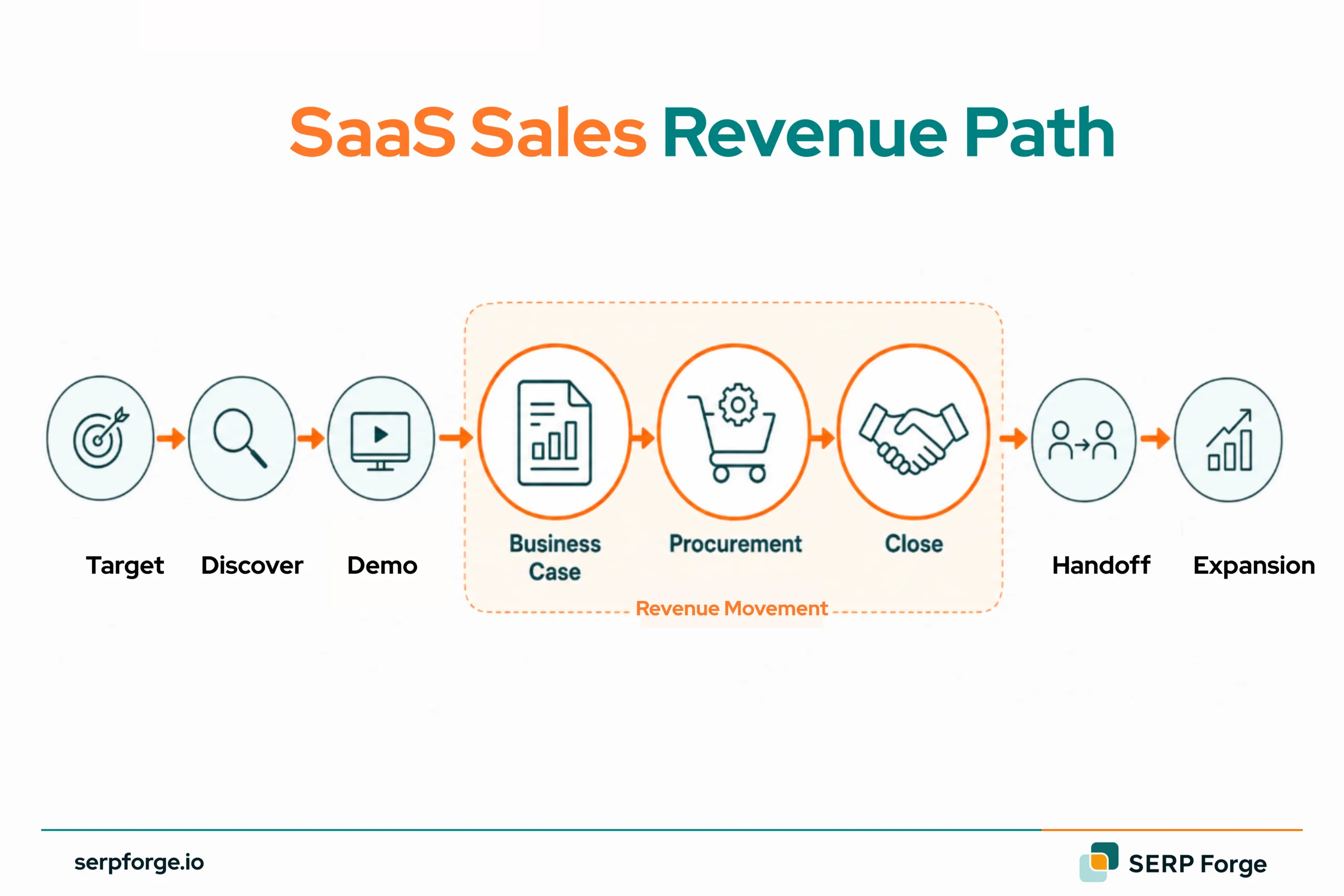
The b2b SaaS sales process turns a qualified account into a customer that can adopt and expand.
It starts before the first call because buyers may already read comparisons, review pricing, watch product videos or test a trial. Sales is still important because complex purchases need discovery, stakeholder alignment and commercial confidence.
A practical B2B SaaS sales process moves each account through defined checkpoints instead of loose activity stages:
| Stage | Sales Job | Output |
|---|---|---|
| Targeting | Identify accounts that fit ICP and ACV goals | Focused account list |
| Prospecting | Use inbound, outbound and intent signals | Meetings or qualified interest |
| Discovery | Understand pain, impact and current workflow | Qualified problem |
| Qualification | Confirm fit, urgency, budget and decision path | Go or no-go decision |
| Demo | Prove the workflow tied to the buyer’s outcome | Product confidence |
| Business case | Connect value to cost, risk or revenue impact | Internal justification |
| Security and procurement | Resolve legal, IT and compliance concerns | Approval path |
| Close | Agree scope, pricing and start date | Signed deal |
| Handoff | Transfer context to customer success | Adoption plan |
| Expansion | Track usage and growth signals | Upsell or renewal path |
A deal moves stages because the buyer completed a real action. A meeting booked, discovery completed, security review started or business case approved is better than a rep’s confidence.
How Does the SaaS Sales Funnel Work?
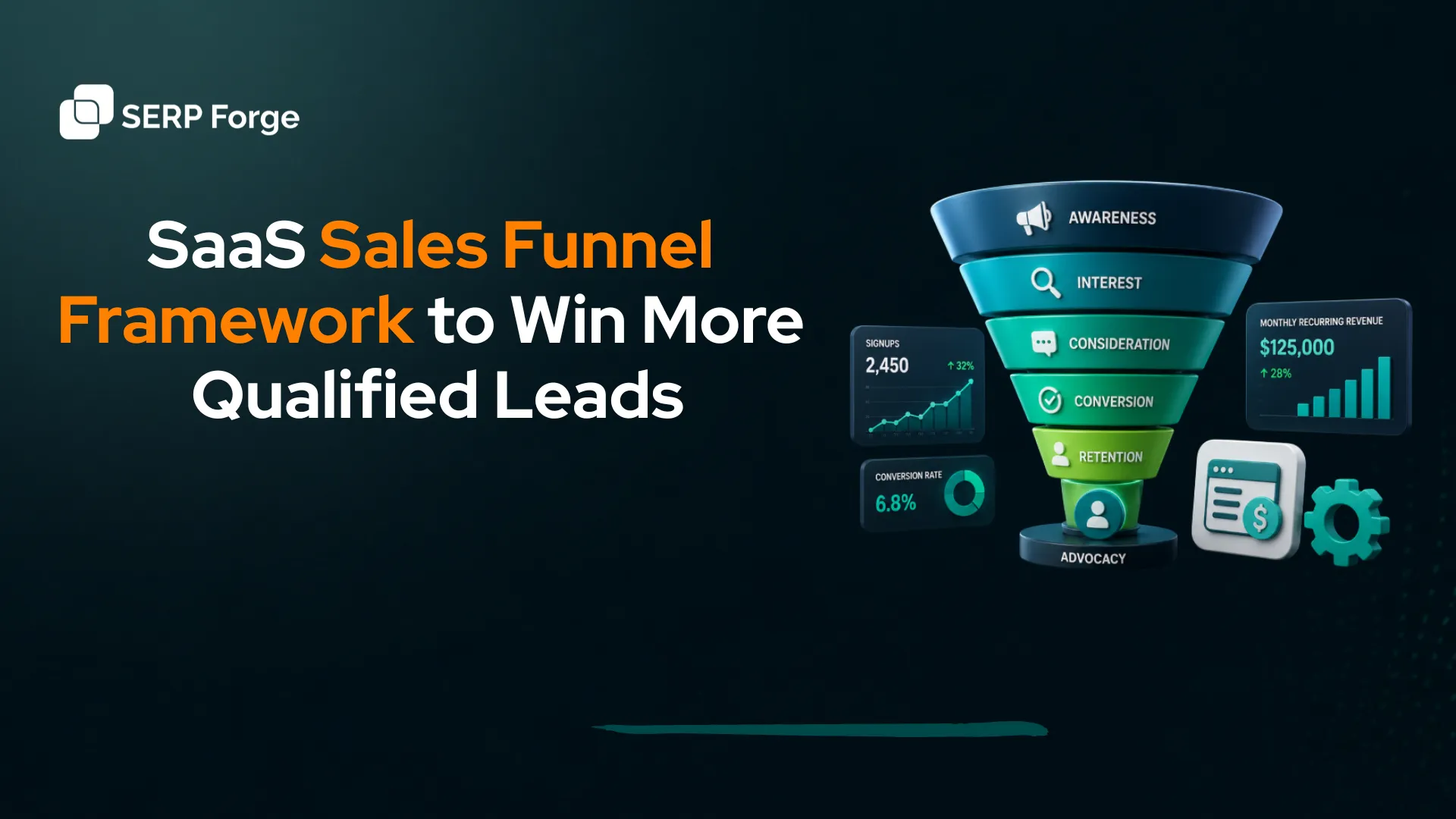
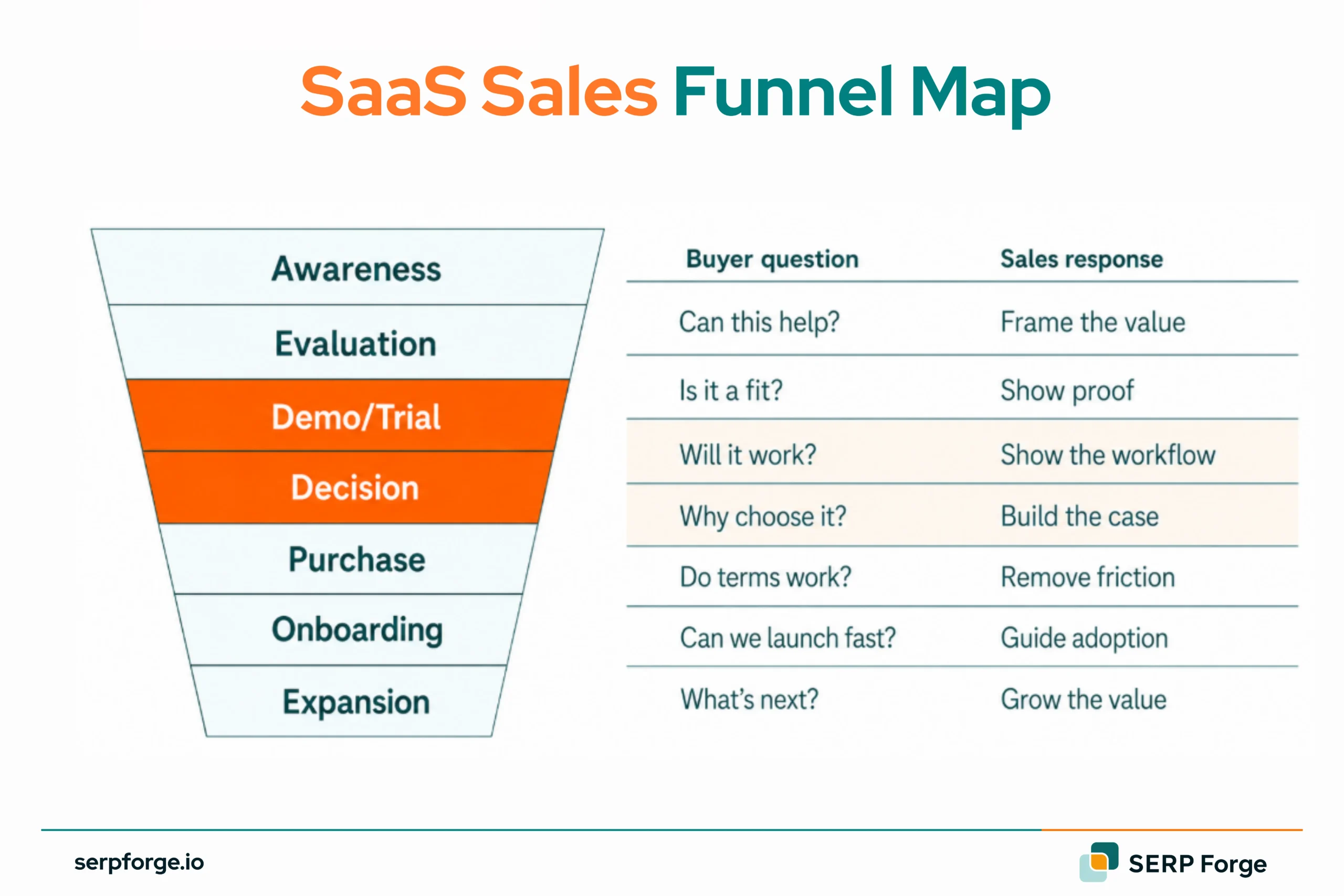
The SaaS sales funnel shows how buyers move from problem awareness to retained revenue.
The sales process explains what reps do. The funnel explains where buyers gain confidence or drop off. That difference is important because many SaaS teams create pipeline that looks healthy until demo, procurement or onboarding exposes weak fit.
Use the funnel to connect each buyer question with the sales response needed at that stage:
| Funnel Stage | Buyer Question | Sales Response |
|---|---|---|
| Awareness | Is this problem worth solving? | Problem-led content and category education |
| Evaluation | Which vendor fits our use case? | Comparisons, proof and product tours |
| Demo or trial | Can this solve our workflow? | Outcome-led demo or guided trial |
| Decision | Can we justify cost and risk? | ROI proof, security answers and business case |
| Purchase | What are we buying? | Pricing, scope and mutual action plan |
| Onboarding | Can users reach value quickly? | Handoff and activation plan |
| Expansion | Can more teams use this? | Usage reviews and expansion path |
A useful funnel tracks buyer progress instead of raw lead volume. If demo requests are high and close rates are weak, qualification or demo quality needs review. If deals close and churn quickly, targeting or sales promises may be creating the leak.
What Changes in Enterprise SaaS Sales?
Enterprise SaaS sales is built around risk reduction.
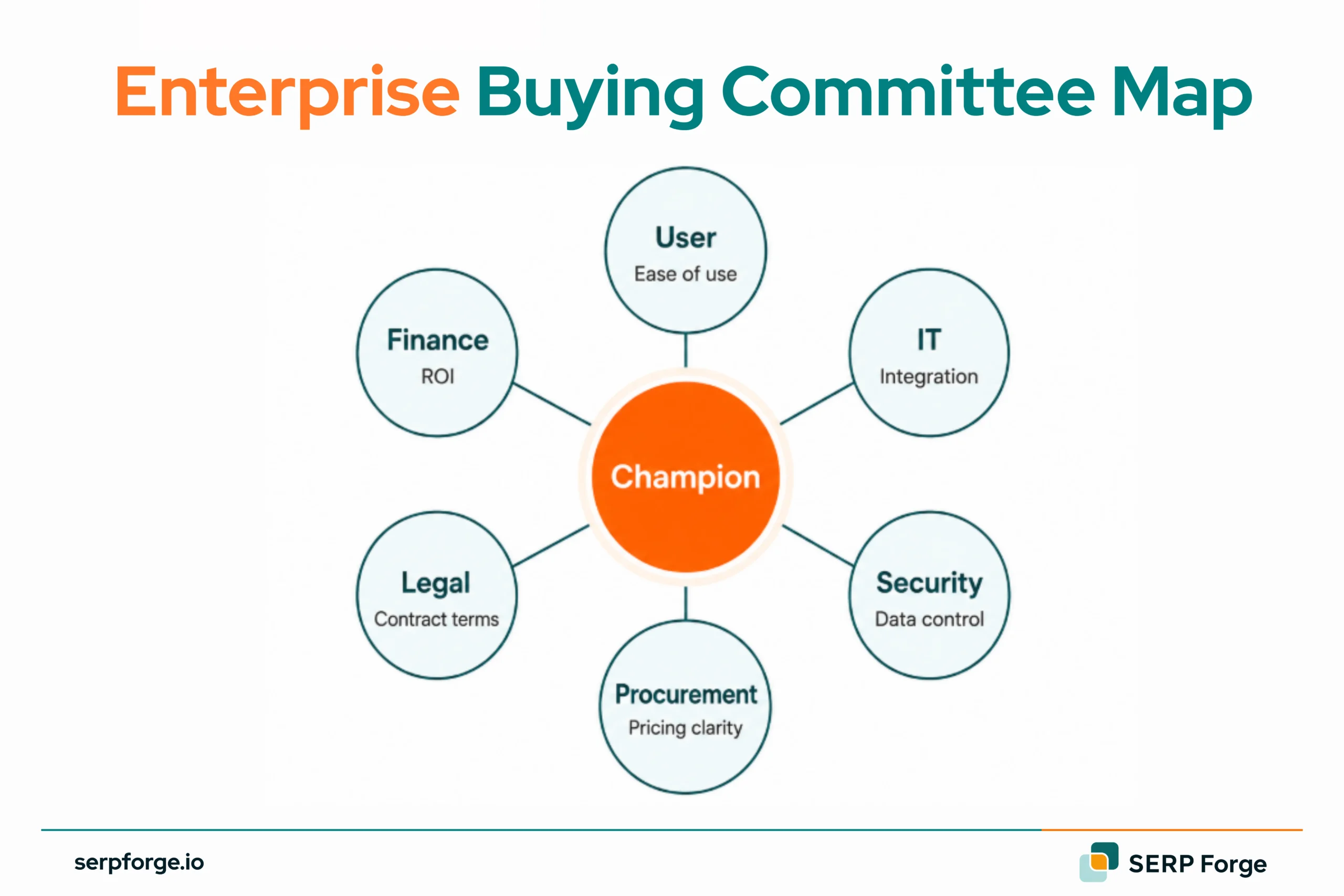
Large deals involve more stakeholders, longer approval paths and higher internal cost if the software fails. The rep’s job is to help the buying group agree on the problem, value, risk controls and rollout path.
Enterprise SaaS deals usually need:
- Executive sponsor
- Economic buyer
- Technical reviewer
- Security and legal approval
- Procurement workflow
- Integration plan
- Business case
- Mutual action plan
- Customer success handoff
The champion needs material they can use internally. A CFO may need payback logic. IT may need integration details. Security may need data controls. Users may need workflow proof.
Enterprise deals improve when these risks surface early. A late security review or missing economic buyer can turn a healthy forecast into a slipped deal.
Which Sales Methodology Fits the SaaS Sales Process?
The best sales methodology for SaaS depends on deal size, buying risk and product complexity.
A low-ACV product with self-serve entry needs different sales behaviour than an enterprise platform with legal review and implementation planning.
The right methodology depends on the deal type, buying risk and level of qualification needed:
| Methodology | Best Fit | Use in SaaS Sales |
| SPICED | Recurring-revenue SaaS | Connects pain, impact, critical event and decision |
| MEDDIC or MEDDPICC | Enterprise SaaS | Qualifies metrics, buyer authority, process and champion |
| Challenger Sale | New or complex categories | Teaches buyers why the current process is costly |
| Consultative Selling | Advisory sales motions | Builds diagnosis before product recommendation |
| Product-led sales | PLG or hybrid SaaS | Uses product behaviour to time sales outreach |
Discovery and qualification bring the methodology into real sales conversations. Reps need to learn the business problem, current workflow, cost of inaction, decision process, economic buyer, timeline and blockers before the demo.
This prevents feature-led selling. The demo becomes better when the rep already knows which workflow, metric or internal risk the buyer needs to improve.
What Are SaaS Demo Best Practices?
A SaaS demo earns attention when it proves the buyer’s priority outcome before showing product depth.
The best demos start with the buyer’s problem. If the prospect needs faster reporting, the demo shows how reporting work changes. Screens that do not support that outcome can wait.
Use these SaaS demo best practices:
| Demo Practice | Why It Works |
|---|---|
| Confirm the pain first | Keeps the demo tied to business value |
| Show one core workflow | Helps the buyer see value faster |
| Use relevant data | Makes the demo feel closer to the buyer’s reality |
| Limit advanced features | Reduces confusion and side objections |
| Prepare role-specific proof | Helps finance, IT and users evaluate different risks |
| Use interactive demos | Supports self-serve buyers before sales |
| End with the next decision | Moves the deal toward approval |
For larger deals, the demo also prepares the champion. Send a short recap with the problem, outcome, proof and next steps. That gives the buyer something useful to share when the rep is absent from the internal discussion.
How CRM and Pipeline Management Work for SaaS Sales?
A crm for SaaS companies needs to manage accounts, contacts, buying groups, pipeline stages, product signals, forecast categories and renewal context.
CRM value comes from the operating design behind it. HubSpot, Salesforce, Close, Zoho or Freshsales can all work for different stages. The CRM has to reflect how SaaS revenue is created.
A SaaS CRM needs to track:
| CRM Field or Area | Why It’s Important |
|---|---|
| Account fit | Helps reps focus on ICP accounts |
| Buying committee | Shows users, champions, finance, IT and procurement |
| Lead source | Connects pipeline quality to channels |
| Product usage | Helps sales time outreach and expansion |
| Stage exit criteria | Improves pipeline accuracy |
| Forecast category | Supports revenue planning |
| Renewal date | Connects sales and customer success |
| Expansion signal | Shows upsell potential |
| Handoff notes | Protects onboarding quality |
A SaaS sales pipeline works best when each stage has exit criteria. A deal enters “business case” when value and internal justification are documented. A deal enters “procurement” when the buyer confirms legal or commercial review.
This improves coaching and forecasting. Managers can see whether deals are stuck because of weak discovery, unclear ROI, missing stakeholders or procurement risk.
How Does SaaS Sales Forecasting Work?
SaaS sales forecasting estimates future revenue using pipeline value, close probability, timing and buyer risk.
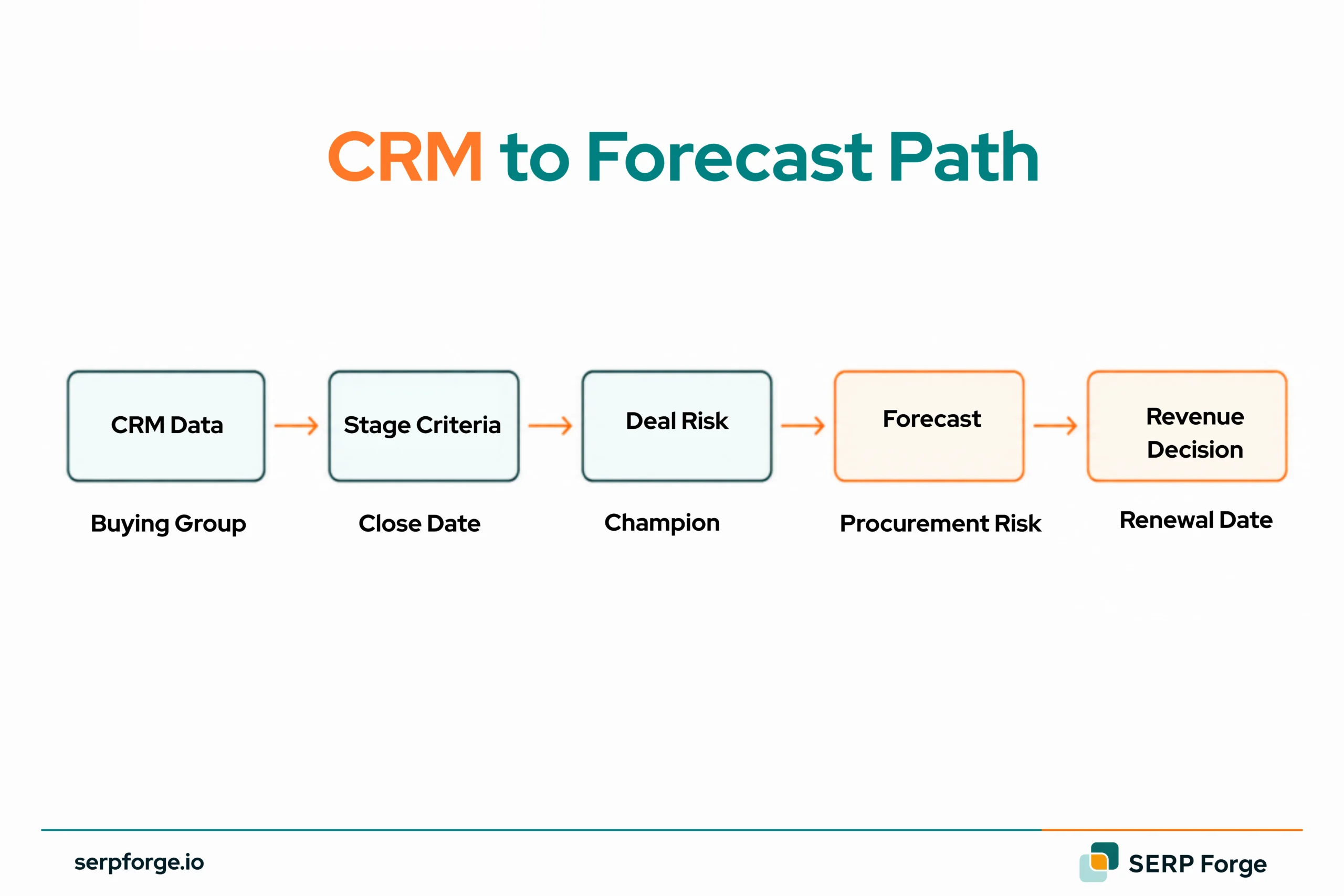
Basic stage probability is not enough. Enterprise SaaS deals can slip because of legal review, finance concerns, security gaps or weak champion support. The CRM may show a late-stage deal, while the buyer may still lack internal agreement.
A practical forecast reviews:
| Forecast Input | What It Shows |
|---|---|
| Pipeline value | Total open opportunity amount |
| Stage quality | Whether the buyer met exit criteria |
| Close date | Whether timing is buyer-confirmed |
| Deal age | Whether momentum is slowing |
| Champion strength | Whether someone can sell internally |
| Procurement risk | Whether legal, finance or security may delay close |
| Expansion forecast | Revenue from existing customers |
| Renewal risk | Revenue that may contract or churn |
Forecasting combines CRM data with rep judgment. CRM data shows patterns. Reps add buyer context. Managers need both to decide whether revenue is real, delayed or at risk.
SaaS Sales Metrics and Win Rate Benchmarks to Track
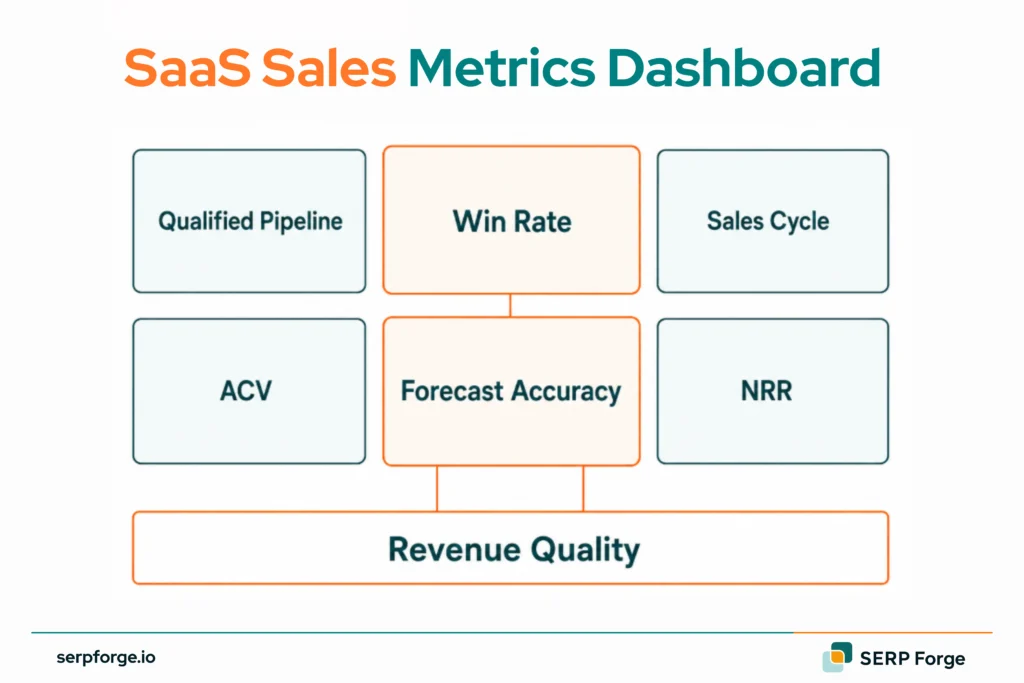
SaaS sales metrics show pipeline quality, conversion efficiency and revenue durability.
A team can hit bookings and still create retention problems. That is why SaaS metrics need to include customer quality.
Use the metrics below to connect pipeline activity with conversion, efficiency and revenue quality:
| Metric Type | Metrics | What It Shows |
|---|---|---|
| Pipeline | Qualified pipeline, pipeline coverage, stage conversion | Whether enough real opportunity exists |
| Conversion | Win rate, demo-to-close, SQL-to-opportunity | Whether buyers are moving forward |
| Speed | Sales cycle length, deal age, response time | Whether deals are progressing |
| Value | ACV, ARR, expansion ARR | Whether sales effort supports revenue goals |
| Efficiency | CAC payback, quota attainment, cost per opportunity | Whether growth is efficient |
| Forecasting | Forecast accuracy, slipped deals, commit coverage | Whether prediction is reliable |
| Revenue quality | NRR, GRR, churn, renewal rate | Whether closed customers retain |
A useful SaaS win rate benchmark depends on source, segment and ACV. A median B2B SaaS closed-won rate around 24% can work as a reference point. Top-quartile teams may exceed 32%, while weaker teams may fall below 16%.
Read win rate with context. Inbound and referral deals often close better than cold outbound. Enterprise deals may close at a lower rate but produce higher ACV and higher expansion potential. A high win rate loses value when deals are small, discounted or likely to churn.
How a SaaS Sales Commission Structure Works
A SaaS sales commission structure works best when it rewards revenue quality.
The plan needs to match the role. AEs, SDRs, account managers and customer success teams influence revenue in different ways.
Commission plans work better when each role is paid around its influence on new revenue, expansion and customer quality:
| Role | Common Pay Logic | Risk to Avoid |
|---|---|---|
| Account Executive | Base plus variable on new ARR or ACV | Rewarding poor-fit bookings |
| SDR | Variable on accepted opportunities or qualified meetings | Paying for meetings that sales rejects |
| Account Manager | Commission on expansion ARR or renewal growth | Confusing renewal maintenance with expansion |
| CSM | Bonus tied to NRR, adoption or expansion influence | Turning customer success into aggressive selling |
| Sales Manager | Team quota, forecast quality and retention impact | Rewarding volume without quality |
Accelerators can reward reps who exceed quota. Clawbacks may apply when customers churn early. For usage-based SaaS, commission may need to include activation or consumption milestones because contract value may grow after initial purchase.
A good commission plan tells reps which revenue the company wants to win.
What Does SaaS Sales Enablement Need to Include?
SaaS sales enablement helps active deals move forward when it answers real buyer questions.
Static libraries create clutter when reps cannot find the right proof during a live deal. Enablement works better when it maps to buyer questions, sales stages and stakeholder concerns.
The most useful enablement assets answer the questions that block real deals at each stage:
| Enablement Asset | Where It Helps |
|---|---|
| Discovery guide | Early qualification |
| Persona messaging | Stakeholder conversations |
| Demo script | Product proof |
| ROI calculator | Business case |
| Security answers | IT and security review |
| Competitor battlecard | Vendor comparison |
| Case study by segment | Proof for similar buyers |
| Mutual action plan | Enterprise deal control |
| Champion deck | Internal selling |
| Objection handling notes | Late-stage deal risk |
Forrester’s buying-group data makes enablement more important because champions need internal material for other departments. One contact needs material that helps finance, IT, legal and security review the decision from their own angle.
Good enablement reduces buyer uncertainty and rep effort at the same time.
What SaaS Sales Mistakes Hurt Revenue Quality?
SaaS sales mistakes often appear later as churn, slipped forecasts or weak expansion.
The biggest pattern is selling before fit is confirmed. Poor-fit accounts can close after discounting, but they often need more support and renew at lower rates.
Watch for these mistakes:
- Selling outside the ICP
- Skipping discovery
- Running feature-led demos
- Ignoring security until late
- Moving deals without exit criteria
- Forecasting from rep optimism
- Weak champion enablement
- Commission plans that reward bad-fit bookings
- CRM fields that create admin without insight
- Weak customer success handoff
Fixing these issues improves more than close rate. It improves pipeline quality, forecast accuracy, retention and expansion.
Build SaaS Sales Around Revenue Quality
A useful SaaS sales motion helps the right buyers reach a decision with less friction.
A buyer may book a demo, review pricing and still pause when the business case feels weak or the internal path is unclear. Sales teams need to help serious buyers understand the value, compare the risk and explain the decision to finance, IT, procurement or leadership.
If your SaaS deals are stalling after demos, slipping in procurement or losing momentum before close, it may be time to review the sales process, CRM setup, demo path and enablement assets behind them.
Are Qualified SaaS Buyers Dropping After the Demo?
SERP Forge, a B2B SaaS marketing agency, reviews your sales funnel, demo path, CRM setup and enablement gaps to find where qualified buyers stall or drop.
Frequently Asked Questions
How do SaaS companies find sales leads?
SaaS companies find sales leads through product signups, inbound content, outbound prospecting, referrals, review sites, webinars, paid campaigns and intent data.
What is the difference between SaaS sales and SaaS marketing?
SaaS marketing creates demand before the sales conversation starts. SaaS sales works with qualified buyers to prove fit, handle objections and guide the deal through pricing, security and procurement.
What is ACV in SaaS sales?
ACV means Annual Contract Value. It shows the yearly value of a customer contract. SaaS teams use ACV to decide whether a deal needs self-serve, inside sales or enterprise sales support.
Why do SaaS deals get stuck?
SaaS deals usually get stuck when the buyer has interest but no internal agreement. Common blockers include unclear ROI, missing economic buyer, security concerns, procurement delays or weak champion support.
What is a SaaS sales playbook?
A SaaS sales playbook tells reps how to sell to the right accounts. It usually includes ICP rules, discovery questions, qualification criteria, demo flows, objection handling, CRM stage rules and handoff steps.
How do you reduce churn in SaaS sales?
Churn reduction starts before the deal closes. Sales teams need to avoid poor-fit accounts, confirm success criteria and pass useful context to customer success.
What is the difference between ARR and MRR in SaaS sales?
ARR means Annual Recurring Revenue. MRR means Monthly Recurring Revenue.
ARR is useful for annual planning and enterprise contracts. MRR is useful for tracking monthly subscription movement, especially in self-serve SaaS models.